










In this guide: Why the Naming Confusion Matters · What Is an Immersion Blender · What Is a Hand Blender · What Is a Stick Blender · Immersion Blender vs Hand Blender vs Stick Blender UK: Technical Comparison · Which Name Do UK Buyers Actually Search · Choosing the Right Blender Line for Your UK Business · Choosing the Manufacturer for Your UK Range · Frequently Asked Questions
If you sell kitchen appliances in the UK, you have seen the same product listed under three names: immersion blender, hand blender and stick blender. Understanding how immersion blender vs hand blender vs stick blender uk naming works is not trivia; it decides which keywords rank, which products you stock, and which suppliers you choose. A UK shopper typing immersion blender vs hand blender vs stick blender uk into a search engine is looking for one answer, and the business that answers it clearly wins the listing. This guide compares the three names from a wholesale buyer’s perspective, explains what UK buyers actually search for, and shows you how to build a range and choose a factory around the naming reality of the British market.
For buyers comparing supply options, the hand blender range from YLD HOME lists every model by type and wattage, with MOQ, lead time and certification stated per page.
Why the Naming Confusion Matters for UK Buyers
The three names describe the same product family: a motor unit with a blade at the end of a shaft that blends directly in the pot, bowl or jug. The confusion is not technical, it is commercial. UK retailers, marketplaces and catalogues mix all three names, so a buyer searching one name sees listings written under another, and a seller who only uses one name silently misses the other two search audiences.
For a wholesale buyer the stakes are concrete. If you write product titles, Amazon listings or catalogue copy using only “hand blender”, you are invisible to buyers who search “immersion blender” or “stick blender”, and those audiences are substantial. If you negotiate with a supplier without knowing that an “immersion blender” and a “stick blender” are the same tool, you can pay a premium for the same motor and shaft in a different box. The naming question also matters for your own product planning: the same factory line can be sold to a hotel supplier as an immersion blender, to a retailer as a hand blender, and to a discount chain as a stick blender, at different prices, with no engineering change at all. For the full analysis, our immersion blender vs hand vs stick blender comparison walks through every naming angle in detail.
What Is an Immersion Blender?
Immersion blender is the technical and professional name, and as the Wikipedia article on immersion blenders explains, the same tool is also called a hand blender or stick blender depending on the market. It is the term used in commercial catalogues, catering equipment distributors, and the specifications written by chefs and kitchen planners. The name describes the action: you immerse the shaft directly into the food, rather than pouring food into a jug blender.
Commercial immersion blenders start around 800W and run up to 1600W or more, with variable speed dials, turbo buttons and stainless steel shafts rated for continuous duty. These machines are built for soups, sauces and purees at volume in restaurants, hotels, care homes and food production kitchens, and they are priced and specified very differently from household units. If a UK buyer asks for an “immersion blender”, they usually want a commercial-grade tool, a robust motor with a metal gearbox, a long stainless shaft, and a manufacturer that stands behind warranty claims from professional kitchens.
For a distributor, the immersion blender segment is a margin story. The household version of this product family is a commodity, but the commercial version sells at multiples of the price with far fewer competitors. Factories that produce both tiers, with separate certification and warranty policies for each, are the ones that make the commercial segment profitable. When you see the word “immersion” in a UK tender or a catering catalogue, treat it as the professional tier of the market.
What Is a Hand Blender?
Hand blender is the everyday name in most English-speaking retail, and it is the term UK consumers use most often in conversation and search. The “hand” describes how you operate the tool: one-handed, over the pot, with the motor and controls in your grip.
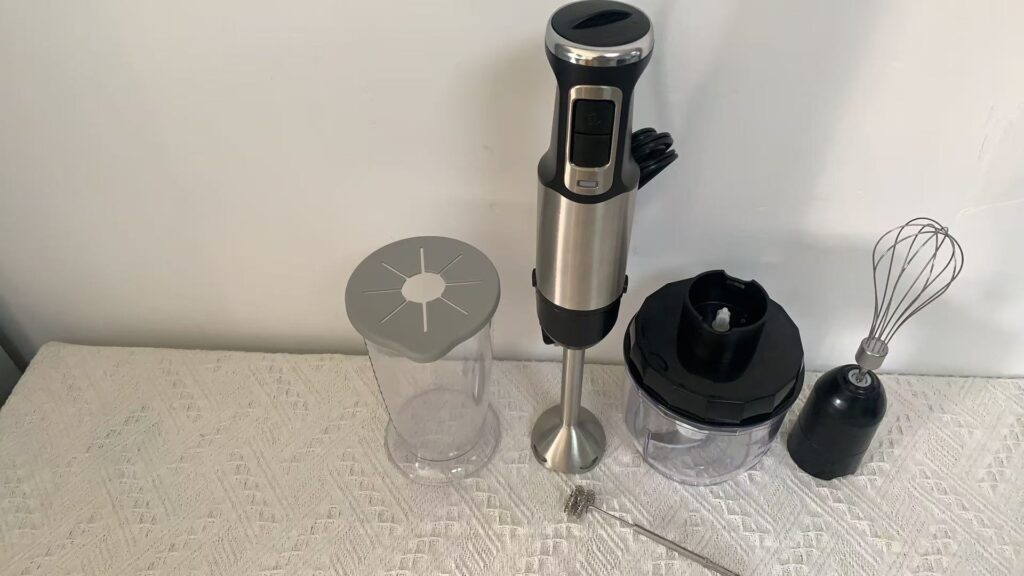
Household hand blenders typically run from 200W to 500W, with two to eight speeds, and they ship with accessories such as a whisk, a chopper bowl and sometimes a milk frother. Retail prices in the UK start in the budget tier and rise through mid-range sets to premium cordless models. When a UK customer says “hand blender”, they mean the same tool a chef calls an immersion blender, but their expectations are different: light enough for everyday soup-making, easy to clean, and quiet enough for a family kitchen.
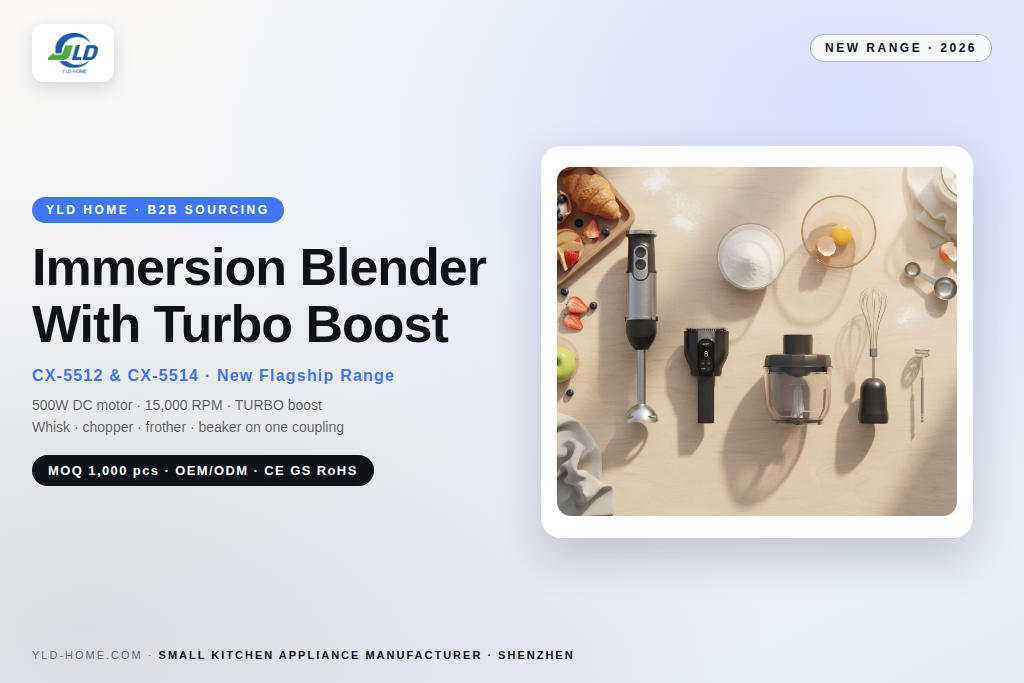
For wholesale buyers, the hand blender name is your volume play; the hand blender collection shows the household range that carries that volume. It is the search term that drives the largest retail demand, so your marketplace listings, packaging and manuals should carry it even when the commercial specification sheet says “immersion blender”. The practical rule in UK retail is simple: use “hand blender” where consumers shop, use “immersion blender” where professionals buy, and make sure the same product’s listing contains both names so you capture both audiences. The 2-in-1 hand blender is a strong example of the format UK households expect: the blending shaft paired with a whisk in one retail-ready box.
What Is a Stick Blender?
Stick blender is the name common in UK and Australian retail, and it refers to the stick-shaped shaft that holds the blade. Some channels also use “wand blender” or “hand blender stick”. The physical product is identical to the other two names; the label is regional and channel-specific.
The stick blender name appears most often in UK grocery catalogues, TV shopping channels and value retailers, where short, memorable product names win shelf space. If a buyer’s brief says “stick blender”, they are usually describing a household model with a simple control, sold on price and ease of use. The name also shows up in marketplace search data, and UK sellers report meaningful monthly search volume for “stick blender” that would be missed by a listing that only says “hand blender”.
From a sourcing perspective, the stick blender is the same SKU, the same motor, the same mould. That is the key insight for UK importers: one product, three names, three price points. A factory that understands this can configure the same unit for a hotel supplier, a grocery chain and a marketplace seller, and each channel sells it under the name that its customers actually use. Naming is not branding fluff; it is a pricing and channel strategy, and wholesale programmes such as our hand blender wholesale range adapt their naming per market for exactly this reason. Within the stick blender segment, cordless models are the fastest-growing format in UK value retail, and they blur the naming line further: listings often read “cordless stick blender” while the same unit appears in catering catalogues as a “portable immersion blender”. For a distributor this means keyword research should track the segment, not just the name, and marketplace titles should combine the format word with the name word, for example “cordless stick blender with charger”, so you appear for both search patterns.
Immersion Blender vs Hand Blender vs Stick Blender UK: Technical Comparison
The table below compares the three names across the dimensions that matter when you build a UK wholesale range.
| Feature | Immersion blender | Hand blender | Stick blender |
|---|---|---|---|
| Product family | Same | Same | Same |
| Typical power | 800-1600W | 200-500W | 200-500W |
| Typical buyer | Catering, hotels, chefs | UK households, retailers | UK value retail, groceries |
| Typical price tier | Premium | Volume | Value |
| Name origin | Action (immerse shaft) | Operation (held in hand) | Shape (stick shaft) |
| Where the name is used | Commercial catalogues, tenders | Consumer search, marketplaces | UK grocery and TV retail |
| Certification needed | UKCA/CE + commercial duty rating | UKCA/CE | UKCA/CE |
| Wholesale implication | Margin segment | Volume segment | Volume segment |
The pattern is clear: immersion blender vs hand blender vs stick blender uk is one product family with three market positions. When UK buyers compare immersion blender vs hand blender vs stick blender uk specifications, the differences they find, power, shaft length, duty rating, are tier differences, not category differences. That is why a comparison like this matters commercially: once you understand the tiers, you can carry the same family across three price points and sell to three buyer groups with one factory relationship. A supplier that offers all three tiers with UKCA certification for each exact model, rather than a single generic certificate, is the one that lets you execute this strategy.
Which Name Do UK Buyers Actually Search?
Search behaviour in the UK is uneven across the three names, and it changes by buyer type, which is why immersion blender vs hand blender vs stick blender uk data has to be read by audience rather than as a single total. Consumer searches for “hand blender” are the highest volume in the country, driven by households, gift shoppers and marketplace browsing. “Stick blender” carries a strong regional audience, particularly in the North of England and Scotland, and in value retail channels where the shorter name is the listing convention. “Immersion blender” has lower volume but far higher commercial intent: the people searching it are chefs, kitchen planners, procurement officers and catering suppliers.
Google Trends and marketplace keyword tools consistently show the same shape: “hand blender” dominates volume, “stick blender” is a solid second, and “immersion blender” is the professional long tail. For a wholesale buyer this means three things. First, your consumer-facing content and listings must lead with “hand blender”. Second, your marketplace titles should include “stick blender” where space allows, because that audience is large enough to matter. Third, your B2B content, catalogue pages and tender responses should use “immersion blender” so you are found by professional buyers, including the growing number who search the full phrase immersion blender vs hand blender vs stick blender uk when they want a definitive comparison before choosing a supplier.
The practical takeaway for UK sellers covering immersion blender vs hand blender vs stick blender uk is coverage, not preference. Rank for all three names with one well-structured product family, and each search audience funnels into the same wholesale enquiry. The comparison guide format works particularly well for this in the UK market, because it answers the question buyers are actually asking and ranks for the long-tail phrase at the same time. Seasonality shapes the search picture too. Volume for “hand blender” climbs from October through December as gift shoppers enter the market, while “immersion blender” searches stay flatter through the year because professional kitchens buy on contract cycles rather than gift seasons. Marketplace data reinforces the pattern: the best-selling hand blender listings in UK Amazon categories are overwhelmingly household models under £40, which tells you where the volume sits and where the price competition lives. If your range does not include a strong sub-£40 household model, you are fighting for a different, smaller share of the search demand.
Choosing the Right Blender Line for Your UK Business
Your product mix for immersion blender vs hand blender vs stick blender uk should mirror the three segments. The volume line is household hand blenders and stick blenders at 200-500W, sold through marketplaces and high-street retail; this is where you win with price, packaging and reliable stock. The margin line is commercial immersion blenders at 800-1600W, sold to catering suppliers and hotels; this is where you win with specifications, certification and after-sales support, and our commercial immersion blender guide covers the specification points that matter. The growth line is cordless models and multifunction sets, which UK retail is actively expanding and which protect you from price wars on corded commodity SKUs. Buyers who also stock the baking category can extend the same factory relationship into hand mixers, which share the motor, certification and packaging infrastructure.
A balanced first order for a UK importer looks like this: two household models, one cordless model, and one commercial model such as the PressPro 1600W hand blender, all sharing the same shaft and blade ecosystem where possible so spare parts are interchangeable across the range. Each model needs its own UKCA certificate, its own UK plug configuration and its own English manual; do not accept a supplier who tries to cover several models with one certificate. YLD Home, a Shenzhen-based small kitchen appliance manufacturer offering OEM/ODM/private label with CE, UKCA and ETL certifications, structures its catalogue exactly this way, so buyers can combine all three tiers in a single mixed container. You can see each tier in action on the YLD Home YouTube channel, which demonstrates blending performance before you request samples.
Order UK-configured samples of every tier before you commit. Test the household units for noise and blending quality, the cordless unit for battery life and charging time, and the commercial unit for continuous-duty performance with hot soup, which is the job that destroys weak motors. Ask YLD Home for the comparison sample set with all three tiers and the UKCA documentation pack, and you will see the naming strategy in physical form: identical family, three market positions. Packaging is part of the line decision. Household volume models sell best in retail-ready cartons with clear wattage and accessory claims, while commercial models need robust shipper packaging, spare-part kits and a warranty card the distributor can issue under its own name. Ask for a packaging mock-up at sample stage, because relabelling a container after arrival costs more than the packaging itself. The same discipline applies to manuals: English instructions with UK plug illustrations, safety warnings and the importer’s details, all printed before shipment, not corrected after customs inspection.
Before you compare immersion blender vs hand blender vs stick blender uk options on paper, watch the multifunction set that anchors the volume tier in action:
YLD Home product video: multi-function immersion blender set
Choosing the Manufacturer for Your UK Range
The manufacturer decision is where naming strategy becomes supply chain reality. You need a factory that understands the UK market deeply: UKCA documentation for every exact model, BS 1363 Type G plugs, 220-240V motors, English manuals and importer labelling. You also need a factory that can serve all three tiers, because switching suppliers per tier multiplies your compliance work and your quality risk.
Verify four things before you sign. First, certificates in the factory’s own name covering every model you plan to import. Second, UK export records: ask for shipping documents or customs data showing genuine UK trade. Third, sample quality: a UK-configured sample that survives your own kitchen test. Fourth, communication: a technical contact who can explain motor specifications and certification details, not just a salesperson reading a price list. YLD Home provides UKCA documents for each model in its range and supports mixed containers across household, cordless and commercial lines, which is the profile that matches what UK importers need. Contact YLD Home for samples and a Get Wholesale Price quotation to benchmark your shortlist.
Beware of the trading company that sells “immersion blenders” from three different factories under one brand. Each factory’s certificate, quality level and after-sales policy is different, and you inherit the difference. One factory, one accountable partner, three tiers: that is the structure that makes the immersion blender vs hand blender vs stick blender uk range profitable in practice, because reorders, spare parts and compliance all flow through one channel. Agree the commercial terms in the same contract as the technical specification. MOQ [fill actual], production lead time [fill actual], sample policy and Incoterms belong in writing, and the quotation should list the certification documents that ship with each batch. A factory that commits to per-batch test reports and certificate-to-serial traceability is worth more than a slightly cheaper quotation from a supplier who treats compliance as a favour. The comparison between the three names is, in the end, a comparison between suppliers: the one that understands the UK market’s naming, voltage and certification reality is the one your reorders will depend on.
Frequently Asked Questions
- Q1: Are immersion blender vs hand blender vs stick blender uk terms for the same product? Yes, they describe the same product family. The difference is market position: commercial tier (immersion), consumer volume tier (hand), and UK value-retail tier (stick). YLD Home markets the same family under all three names across its wholesale range, so buyers can pick the tier that fits their channel.
- Q2: Which name should I use in my UK marketplace listings? Lead with “hand blender”, add “stick blender” where space allows, and use “immersion blender” in B2B content and catalogue pages. This is the exact naming pattern YLD Home’s UK marketplace customers apply to their listings.
- Q3: Do I need separate certification for each name? No, certification follows the model, not the name. Each model needs its own UKCA certificate regardless of which name you market it under, and YLD Home issues a separate certificate for each model number.
- Q4: Can one supplier cover all three tiers? Yes. YLD Home supplies household, cordless and commercial immersion blender lines with UKCA documents, and supports mixed containers.
- Q5: What power range should a UK wholesale range cover? 200-500W for household volume, 800-1600W for the commercial margin segment, plus cordless models for the growth segment. YLD Home’s catalogue covers this full span, from 200W household units to the 1600W PressPro commercial model, so the whole range comes from one factory.
- Q6: How do I test a commercial immersion blender before ordering? Test continuous blending of hot soup, noise level, shaft durability and motor temperature after a 10-minute run. Weak motors fail this test quickly, and YLD Home runs this exact hot-soup continuous test during sample evaluation and shares the results with buyers.
- Q7: Are stick blenders cheaper to source than hand blenders? They are the same SKU, so the cost is the same. The price difference you see in retail is positioning, not manufacturing cost, and YLD Home prices the same SKU consistently regardless of the name it is marketed under.
- Q8: What documentation should I request with samples? The UKCA certificate for the exact model, the Declaration of Conformity, test reports, and a written quotation with MOQ, lead time and Incoterms. YLD Home includes all of these documents with its UK sample pack.
Official references: Immersion blender – Wikipedia
Related models in this range: Hand Blender Manufacturer Direct and Hand Blender Set With Food Chopper.