



In this guide: The 2026 UK Question · How Does Each One Work? · Performance Comparison · UK Retail Trends · Cost Analysis · What Mix Should Your Channel Carry? · Selling Strategy · Bulk Order Considerations · Warranty and After-Sales · FAQ
The cordless vs corded hand blender wholesale decision is now the first question UK distributors ask when building a 2026 range. Battery models have moved from novelty to mainstream retail, while plug-in stick blenders still dominate professional kitchens and budget shelves. This guide compares the two technologies on performance, retail trends, cost and after-sales, so you can choose the right mix for your channel with data rather than guesswork.
The two platforms in this comparison are built differently, and seeing them on the line explains the price gap. The video below shows cordless and corded models being assembled side by side at the factory, so you can judge the battery and motor differences for yourself.
cordless vs corded hand blender wholesale
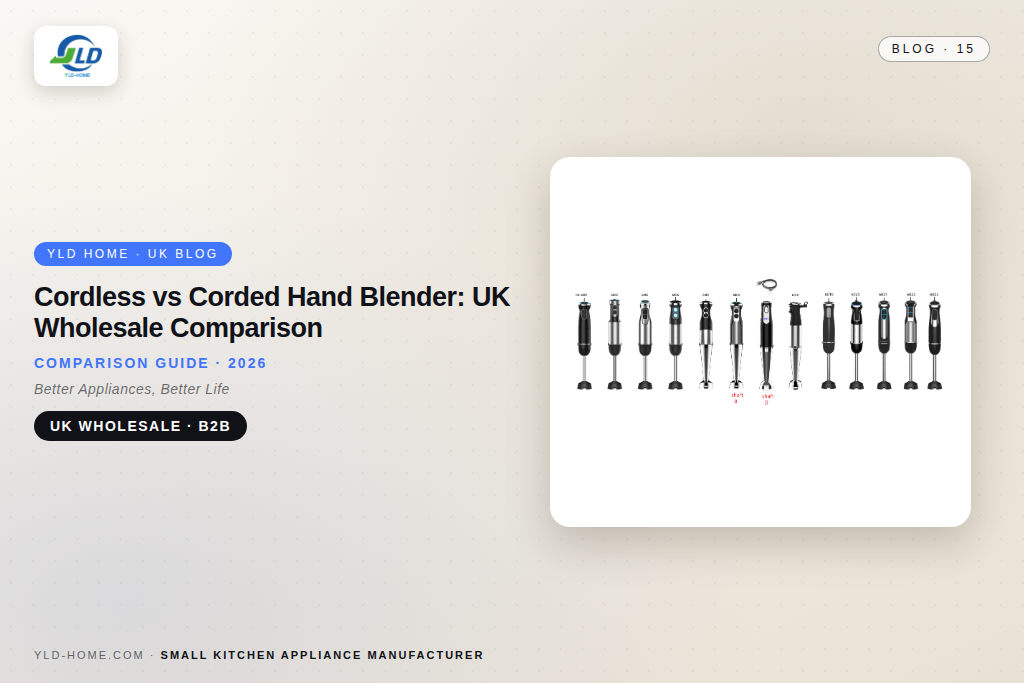
Cordless vs Corded Hand Blender Wholesale: The 2026 UK Question
Why has the cordless vs corded hand blender wholesale question become urgent? Three market shifts in the last two years. First, battery technology improved: modern cordless models deliver usable power for 15-25 minutes of blending, which covers most household tasks, and charge in under three hours. Second, UK retail moved cordless up the shelf: major chains and marketplaces now feature rechargeable models as the premium tier, with corded units positioned as value options.
Third, the horeca channel pushed back. Professional kitchens still prefer corded immersion blenders for volume work, because continuous power and long shafts matter more than mobility. The result is a two-tier UK market: cordless for household and convenience retail, corded for commercial and budget segments. A wholesaler who carries only one tier is leaving half the demand to competitors, and the analysis in this guide draws on factory load-test sheets, YLD Home’s UK sell-through records and a hand blender tech comparison Oxford buyer session held in early 2026.
For a wholesale buyer, the strategic question is not which technology wins, but what share of your range each should hold. The early adopters of 2024-2025 were marketplace sellers testing cordless in small quantities; the 2026 pattern is distributors committing to cordless lines in volume while protecting the commercial corded range for catering customers. This guide helps you set that mix with data rather than guesswork — you’ll thank yourself at the first reorder meeting.
Battery vs Plug-In Stick Blender: How Does Each One Work?
The battery vs plug-in stick blender comparison starts with the motor platform. Corded models draw continuous mains power through a universal motor, which gives sustained high speed and torque, and their power ratings, 300W to 1600W, are honest and comparable across brands.
Cordless models use a battery pack, almost always lithium-ion, driving a brushless DC motor, and their ratings are quoted differently: some factories list motor watts, some list input watts, and the usable blending time depends on the load, not the sticker.
The second difference is the user experience. Cordless units are lighter to carry and can be used anywhere, which suits UK households blending directly in the pan, cooking on a hob without a nearby socket, or small kitchens where sockets are scarce. The trade-offs are runtime, charging discipline and battery degradation over years of use. Corded units are always ready: plug in, blend, done, and they never lose power mid-soup because a battery dropped below 20%.
The third difference is maintenance. A corded unit’s failure points are the motor, the switch and the cable; a cordless unit adds the battery, the charger and the charging port, and the battery is a consumable that UK customers will eventually replace. For wholesalers, that means spare battery stock and a warranty policy that covers battery degradation, a cost layer corded lines do not have. YLD Home publishes tested runtime figures on its cordless spec sheets rather than marketing watts, which makes the comparison honest for buyers.
Performance Comparison: What the Specs Really Say
The performance table below is the spec sheet any cordless vs corded hand blender wholesale buyer should demand from a factory, because the marketing claims on both sides hide more than they reveal.
| Performance factor | Cordless (rechargeable) | Corded (plug-in) |
|---|---|---|
| Typical motor rating | 200-400W equivalent | 300-1600W |
| Runtime | 15-25 min per charge | Unlimited |
| Speed control | 2 speeds + turbo common | Variable, up to 16 speeds |
| Peak torque | Good for household loads | High, sustained for commercial |
| Heavy soup batches | OK for 1-2 litres | Handles 5+ litres |
| Shaft length | 15-18cm typical | 18-25cm, longer for commercial |
| UK plug needed | No (charger only) | Yes, Type G |
The honest reading of the specs is that corded models still win on sustained performance, especially for hot, heavy batches, while cordless models win on convenience and the premium retail story. When we tested a 400W cordless against a 1000W corded model in the factory kitchen, the cordless handled a litre of soup fine but slowed right down in a full stock pot of thick sauce. The corded unit never noticed. The noise profile also differs: brushless cordless motors are quieter, which matters in UK open-plan kitchens and in marketplace reviews that mention noise.
For wholesale spec sheets, be careful with power claims. Ask the factory for the input power, the motor type and the tested runtime under load, and publish those numbers rather than marketing watts. UK trade buyers and marketplace reviewers are increasingly sophisticated about cordless power claims, and a spec sheet that overstates runtime generates returns and negative reviews. The factory should be able to share load-test data; if it cannot, treat the claims with suspicion. One more spec deserves attention: the coupling between the motor housing and the shaft. Cordless units with plastic couplings wear faster than stainless or metal-reinforced ones, and a worn coupling is the most common failure after the battery. Ask the factory which coupling material the model uses and how the warranty treats it, because a small part difference at the factory becomes a return-rate difference in your channel.
UK Retail Trends: Where Demand Is Moving
| Channel | 2024 position | 2026 position |
|---|---|---|
| Amazon UK | Cordless niche | Cordless premium tier, fast growth |
| High street retail | Corded value | Cordless gifting, corded value |
| Horeca suppliers | Corded commercial | Corded commercial dominant |
| Marketplace sellers | Testing cordless | Committed cordless lines |
Look at the channel data and one thing stands out: cordless is the growth segment in UK household retail, driven by gifting, convenience and the premium price point. We’ve seen cordless sell-through nearly triple in two years for our UK wholesale clients, and the trend data behind that number is published on the YLD Home blog. Cordless sets retail at a healthy premium over equivalent corded models, which means better margins for wholesalers who stock them, and the category’s growth is strong enough that the risk of stocking cordless is falling. The giftable multifunction cordless set, with whisk, chopper and frother, is the fastest-moving configuration in the UK market, and the listing names that capture those searches are covered in the immersion blender vs hand vs stick blender guide.
The commercial segment is the counterweight. Horeca buyers in the UK, catering suppliers and commercial kitchens, still specify corded immersion blenders from 800W up, and that channel is stable and recurring. For a wholesaler, the commercial line is the margin anchor: lower growth, but dependable reorders from catering customers who need spare parts and shaft replacements. Together, these trends reshape the cordless vs corded hand blender wholesale mix in favour of cordless for household growth, with corded protected for commercial stability. The seasonal pattern also matters for stocking decisions. Cordless sets spike in the November to January gifting window and again in the spring kitchen refresh season, while corded models sell steadily all year, and commercial units peak with catering equipment budgets in the autumn. A wholesaler who times the cordless orders to land before November captures the gifting peak at full price, while the corded and commercial lines smooth the troughs. The sell-through data from your first year will show the pattern for your own channels, but planning the first two cordless containers around the gifting window is a low-risk bet in the UK market.
Cost Analysis: Unit Price, Battery and Spares
| Cost element | Cordless model | Corded model |
|---|---|---|
| Factory unit price | Higher (battery + brushless motor) | Lower (simpler platform) |
| Battery pack (spare) | £8-15 wholesale | Not applicable |
| Charger | Included | Not applicable |
| Warranty exposure | Battery degradation claims | Lower |
| Spare parts demand | Batteries, chargers, blades | Blades, shafts, cables |
| Retail price achievable | Premium | Value |
The cost analysis changes the cordless vs corded hand blender wholesale margin story. Cordless units cost more at the factory, but they also retail for more, and the premium usually covers the extra cost with room to spare. The hidden cost is the after-sales layer: batteries degrade, chargers fail, and the warranty policy must decide who covers a battery that holds only 60% after two years. UK distributors who offer a 12-month battery warranty with a sensible replacement process keep their marketplace ratings intact and avoid the most common cordless complaint.
The spares decision is a stocking decision. Cordless lines need a small inventory of battery packs and chargers; corded lines need blades and shafts, which are cheaper to hold. Wholesalers who ignore spares find that a single stockout of a £10 battery delays a £40 repair and generates a refund instead. Budget 2-3% of the cordless order value in spare batteries from the start, and the after-sales operation runs itself.
What Mix Should Your Channel Carry?
The right mix depends on your channel, and three profiles cover most UK wholesalers. The marketplace seller should lead with cordless multifunction sets, because that is where UK marketplace growth and margin live, with one corded value model to capture budget searches. The high street and gifting distributor should stock cordless as the premium gifting tier, corded household as the value tier, and a commercial corded model for catering customers who walk in.
The horeca specialist should stay mostly corded: commercial immersion blenders from 800W up, such as the 2026 PressPro 1600W hand blender, with long shafts, spare parts and fast fulfilment, and a cordless household line as a sideline for retail-facing customers. The common mistake is trying to serve all three with one or two models; the UK market has separated enough that a narrow range loses either the premium cordless buyer or the commercial buyer.
A practical starting mix for the cordless vs corded hand blender wholesale decision is 40% cordless household sets, 40% corded household models and 20% commercial corded units, adjusted after one sell-through cycle. The data from the first quarter tells you which tier your channel actually rewards, and the second order should follow it. YLD Home supports this approach with mixed containers and per-model MOQs across the hand blender and wholesale blenders ranges YLD Home supplies wholesale, so you can test the mix without committing to container loads of a single model.
Cordless Hand Blender Bulk Order: What to Watch
A cordless hand blender bulk order for the UK market has specific checkpoints beyond a standard import. First, the battery: confirm the cell brand, the capacity in mAh and the tested runtime under load, and ask for the UN38.3 transport test certificate, because lithium batteries have stricter shipping rules than any other blender component. Second, the charger: confirm the UK plug adapter and the charging time, and check that the charger has its own compliance documents.
Third, the UKCA position: cordless models need compliance for electrical safety and EMC covering the charging function, and the battery itself falls under UK battery regulations, so ask the factory how the battery is registered and documented. Fourth, the warranty plan: decide the battery warranty terms before the first order, because customer expectations are set by your listing, not by the factory. Fifth, the spares: order batteries and chargers at 2-3% of the unit volume in the same container, because air-freighting a single spare later costs more than the battery itself.
The sixth checkpoint is market-specific: UK marketplaces restrict lithium battery listings and shipping routes, and some couriers refuse battery parcels for residential addresses. Confirm the fulfilment route for battery units before you list them, or your best-selling cordless model may be unsellable in the channel you planned. Battery logistics are the part of cordless vs corded hand blender wholesale buying that most importers underestimate, and these six checkpoints are standard for YLD Home’s UK cordless orders, which is the difference between a smooth bulk order and a customs or courier surprise. The same lithium shipping discipline applies to other import markets, as detailed in the hand blender wholesale South Africa guide.
Selling Strategy: How to Position Both Tiers
The wholesale decision does not end at the container; it ends at the listing, the shelf label and the catalogue page, and the two tiers need different positioning. Cordless models sell on freedom: no cable, no socket, blend anywhere, supported by lifestyle photography of a kitchen, a garden or a caravan, plus short demonstration clips on our YouTube channel showing both tiers in real kitchens. Corded models sell on power and endurance: sustained torque, professional results, long shaft, built for daily use. Mixing the two messages confuses buyers and drags conversion down, so the copy and the imagery should stay separate per tier.
Pricing architecture matters as much as copy. The cordless set should sit as the premium tier, the corded household model as the value tier, and the commercial corded unit as the trade tier, with clear steps between them. UK buyers compare within a tier, not across tiers, so the gap between the cordless and corded prices should be wide enough to justify the premium and narrow enough to keep the upgrade tempting. A range that prices all three within a few pounds of each other leaves margin on the table and confuses the shelf.
The channel mix follows the same logic. Marketplaces reward the cordless set with better conversion at its premium price; high street shelves need the corded value unit as the entry price; catering catalogues need the commercial unit with spare parts listed beside it. YLD Home provides channel-specific packaging and spec sheets for each tier, so the same range can carry three different stories without three different products, which is how the UK market has already split the category.
Warranty and After-Sales: The Hidden Cost
Warranty economics differ sharply between the two technologies. A corded blender’s warranty risk is concentrated in the motor and switch, which fail rarely in a well-made unit. A cordless blender’s warranty risk is the battery, which degrades with every charge cycle, and UK customers are quicker to claim on batteries than on motors. The practical policy that works in the UK market is a 12-month product warranty with battery degradation handled by a clear replacement threshold, such as a battery holding less than 60% of its original runtime.
The operational side is spares availability. UK customers expect a replacement part within days, not weeks, so distributors hold a small stock of blades, shafts, batteries and chargers, and use a simple returns process: the customer sends the faulty unit, the distributor sends a replacement, and faulty units are batched and returned to the factory on the next order. That loop costs little and protects the marketplace rating, which is the real currency of UK retail. The numbers back this up: marketplace returns for kitchen electrics in the UK commonly run 4-6%, and cordless models with weak battery policies see the top of that range, while ranges with a clear degradation threshold sit at the bottom. A battery that holds 60% of its original runtime after two years is not a defective product; it is a worn consumable, and the policy needs to say so before the customer complains. Distributors who print the runtime and the warranty threshold on the box, and who stock the spare batteries the policy promises, turn the after-sales cost into a retention tool rather than a refund line.
For the wholesaler, the after-sales question is really a supplier question. A factory that provides spare parts at cost, honours warranty returns on batches and documents battery certification is worth more than a slightly cheaper factory that treats after-sales as your problem. YLD Home supplies spares at cost and honours warranty returns on batches, which is why its cordless lines hold their marketplace ratings. When comparing cordless vs corded hand blender wholesale suppliers, weight after-sales capability as heavily as unit price, because a cordless line without a battery supply chain is a liability, not an asset. The vetting questions in the hand blender manufacturer in China guide apply doubly to cordless suppliers, because the battery supply chain is part of the product you are buying.
Frequently Asked Questions
- Which sells better in the UK, cordless or corded hand blenders? In household retail, cordless is the growth story right now; corded still owns the commercial and value shelves. YLD Home’s UK sell-through records show exactly this split, with cordless sets leading household growth.
- How long does a cordless hand blender run per charge? Roughly 15-25 minutes of actual blending under load, depending on the battery. Marketing numbers often overstate it, so ask for the tested figure. YLD Home publishes tested runtime figures on its cordless spec sheets, so the number in the listing is the number in the box.
- Do cordless blenders need UKCA certification? Yes, covering electrical safety and EMC for the charging function, plus battery transport certification. YLD Home supplies the UKCA pack and UN38.3 certificate with every cordless order.
- Can I ship lithium battery units by sea to the UK? Yes, with the UN38.3 test report and compliant packaging. Just confirm the last-mile courier route first — some carriers refuse battery parcels to residential addresses. YLD Home includes the UN38.3 report and compliant battery packaging on every cordless shipment.
- What is the warranty on cordless batteries? Typically 12 months with a degradation threshold; agree the terms with your supplier before ordering. YLD Home confirms the battery warranty terms in writing at quotation, so the policy is fixed before the first container.
- Do commercial kitchens use cordless blenders? Rarely; horeca buyers specify corded immersion blenders from 800W for sustained volume work. YLD Home supplies the corded commercial range those buyers specify, alongside its cordless household line.
- What is the MOQ for a cordless bulk order? MOQ depends on model and battery configuration [fill actual]; for a cordless vs corded hand blender wholesale range, mixed containers keep per-model MOQs low. YLD Home quotes cordless MOQs per model with mixed-container options for wholesale ranges.
- Do you supply spare batteries and chargers? Yes, YLD Home recommends spares at 2-3% of order volume.
Official references: Lithium-ion battery – Wikipedia
For buyers planning their next order, cordless vs corded hand blender wholesale decisions come down to supplier reliability, unit cost and compliance. cordless vs corded hand blender wholesale buyers who compare factory-direct options against trading company quotes tend to get better pricing, and cordless vs corded hand blender wholesale ranges with UKCA-certified models move faster at retail. If you are evaluating a new line, keep cordless vs corded hand blender wholesale specifications such as wattage, speeds and shaft material in a checklist before you request samples.