







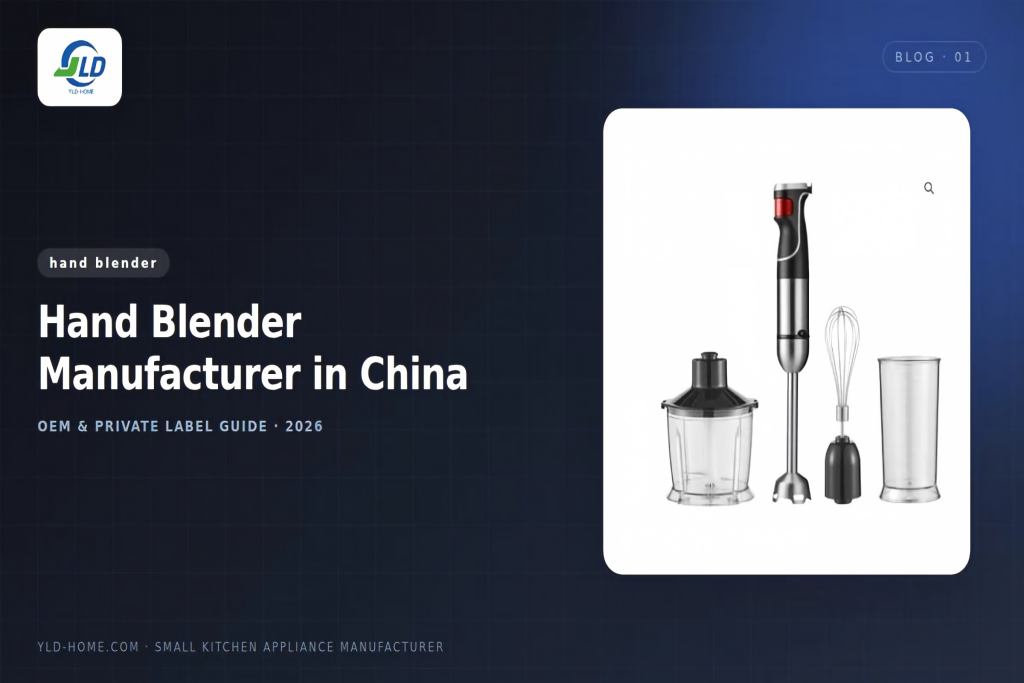

If you are sourcing hand blenders, immersion blenders or stick blenders for wholesale, OEM or private label, this guide explains exactly how to find and work with a hand blender manufacturer in China. It covers what a real factory can offer, how to evaluate suppliers without getting burned, what certifications you actually need, and what the process looks like from first sample to full container load. Whether you are an importer in the USA, a distributor in the UK, a brand owner in Germany, or a wholesale buyer in South Africa, the same principles apply.
For buyers comparing supply options, the hand blender range from YLD HOME lists every model by type and wattage, with MOQ, lead time and certification stated per page.
Why China is Still the Global Leader for Hand Blenders:hand blender manufacturer in China
China remains the world’s largest manufacturing base for small kitchen appliances, and hand blenders are a perfect example of why. The supply chain is concentrated in Guangdong province, where motor production, stainless steel fabrication, mold making, injection molding and final assembly all sit within a few hours of each other. This density creates two concrete advantages for buyers.
The first advantage is speed. When a buyer needs a modified motor winding, a custom color, or a new blade geometry, a hand blender manufacturer in China with in-house R&D can turn around prototypes in weeks, not months. The second advantage is cost. Factory-direct pricing removes layers of trading margins, and because components are produced nearby, tooling changes and reworks are cheaper.
There is also a practical scale advantage. The same factory line can switch between a 150W household model for retail and a 1600W commercial unit for foodservice. That flexibility lets one supplier cover your whole product ladder, which simplifies quality control, documentation and logistics.
What Doeshand blender manufacturer in China Offer?
Most serious factories offer three engagement models. Understanding the difference is the first step to a successful sourcing project.
| Model | What you get | Best for |
| Wholesale | Existing models, factory price, mixed containers | Distributors and importers |
| OEM | Your logo, color and packaging on existing designs | Brands entering a category fast |
| ODM / Private Label | Custom design, tooling and full branding | Brands with a specific product vision |
A reliable manufacturer will be transparent about which model fits your order size. Wholesale orders are the entry point for most buyers: you test demand with standard models before investing in customization. OEM adds your brand to a proven design, which is the fastest route to a branded product. ODM and private label go further, letting you specify speed profiles, accessories, packaging and compliance documentation.
YLD Home, for example, is a Shenzhen-based small kitchen appliance manufacturer offering all three models, with sample testing and prototype design services before mass production.
How to Evaluate hand blender manufacturer in China: 7 Key Criteria
Too many buyers choose suppliers on price alone and pay for it later with quality problems and missed deadlines. Use these seven criteria to compare factories properly.
- 1. Years of manufacturing experience. Ask for company history, export track record and the markets you are interested in. A factory that has shipped to the EU for a decade knows CE documentation inside out; one that only sells domestically will learn on your order.
- 2. Factory scale and production capacity. Verify real capacity matches your target volumes. Ask for monthly output of the specific model you want, not total factory output. A factory quoting a 20,000-unit monthly capacity needs to show you the production line and the equipment.
- 3. International certifications held.** CE, ETL and FCC cover the major Western markets. Request current certificates for the exact model you plan to import, and verify them with the issuing body. Never accept logo images or generic brochures as proof.
- 4. In-house R&D and prototyping. A factory with its own mold and motor team accelerates customization and reduces costs. Ask who owns the tooling and what happens if you want design changes later.
- 5. Quality control pass rate. Ask how QC is structured across IQC (incoming), IPQC (in-process) and FQC (final). Request inspection records and defect rates. A serious factory measures these numbers and shares them.
- 6. Sample availability and lead time. A real manufacturer ships samples quickly. At YLD Home, sample production is typically about 7 days for existing models, and we test every sample before dispatch.
- 7. Verified client references and export record.Request existing customer references and shipment history. Talk to at least one current client in your region about delivery reliability, communication and after-sales support.
OEM vs ODM vs Private Label: Choosing the Right Model
The three terms are often used loosely, so here is the practical distinction. OEM means you take a proven design and put your brand on it: your logo, your color, your packaging. ODM means the factory designs or adapts the product to your specification: different motor power, different speeds, different accessories. Private label is essentially ODM plus your brand on the finished product, ready for your catalog.
Wholesale buyers usually start with existing models to validate demand, then move to OEM once volume justifies tooling investment. A hand blender with 16 variable speeds and titanium steel blades is a strong private-label base because it covers both household and light-commercial use, which widens your target market with a single SKU.
Certifications Required for Hand Blender Imports:hand blender manufacturer in China
Certification requirements depend on destination market, and getting them wrong can stop your shipment at customs. Use this as a starting point and confirm with your customs broker:
| Market | Typical requirements |
| USA | ETL / UL for safety, FCC for EMC |
| EU / UK | CE (LVD + EMC), UKCA for UK |
| South Africa | SABS / SANS compliance |
| Brazil | INMETRO certification |
| Most of Latin America | 110-127V versions, local mark requirements |
Always request the current certificate documents from the manufacturer and verify them with the issuing body. Check that the certificate covers the exact model number you are importing, not a similar one.
Quality Control and Factory Audits:hand blender manufacturer in China
Price negotiates the order; quality control keeps the customer. A serious hand blender factory runs three inspection stages: incoming materials inspection, in-process checks on the production line, and final inspection before packing. Ask for the factory’s QC checklist and defect rate data.
For larger orders, consider a third-party inspection service such as SGS or BV. For first orders, ask for pre-shipment inspection photos or a video of your batch. These habits cost little and prevent expensive surprises.
The Private Label Hand Blender Process: Step by Step hand blender manufacturer in China
Step 1: Product selection. Pick a base model with the power and speeds you need.
Step 2: Sample request. Test performance, noise, materials and finish under realistic conditions.
Step 3: Branding and customization. Specify logo, color, packaging and instruction manual.
Step 4: Compliance verification. Confirm certificates match your destination market.
Step 5: Order confirmation. Agree price, MOQ 500-1000 units
, lead time 7-30 days after confirm orders.
and payment terms in writing.
Step 6: Production and inspection. Agree on inspection milestones and shipping marks.
Step 7: Shipment and after-sales. Keep spare parts available and agree on warranty terms before you pay the balance.
Payment Terms and Shipping:hand blender manufacturer in China
Typical payment terms for first orders are 30% deposit and 70% balance before shipment, or T/T with an irrevocable L/C for larger orders. Payment terms can improve after a track record. Shipping options for hand blenders are sea freight (FCL or LCL), air freight for samples and urgent orders, and express couriers for small parcels. Confirm Incoterms clearly, because FOB, CIF and DDP shift responsibility in very different ways.
Ready to Source Hand Blenders from China?
If you are comparing hand blender manufacturers, send us your target models and volumes. We will reply with factory pricing, sample options and a formal quotation, usually within 24 hours.
Market Trends and Demand Data:hand blender manufacturer in China
The hand blender category is larger than most buyers assume. In the USA and the EU, hand blenders are a standard kitchen staple with steady year-round demand, while commercial immersion blenders are growing with the foodservice sector. In South Africa, demand follows urban retail and the expanding café and restaurant scene. Wholesale buyers who track these trends can time their orders to avoid stock-outs and to catch promotional windows such as holiday seasons.
Two long-term trends matter for sourcing decisions. The first is cordless and rechargeable models, which are moving from novelty to mainstream in Europe. The second is multifunctional sets, where the blender ships with a chopper cup, whisk and milk frother. Both trends push buyers toward manufacturers with strong ODM capability, because differentiation now comes from accessories and features, not just motor power.
Common Sourcing Mistakes
Most sourcing failures are predictable. The most common mistake is choosing on price alone: the cheapest factory usually delivers the cheapest motor, and the warranty claims eat the margin. The second mistake is skipping samples, or testing samples in the office instead of in real cooking conditions. The third is ignoring certification until the shipment is at customs, which causes delays and demurrage charges.
A fourth mistake is poor specification. Buyers who do not write down the voltage, plug type, wattage, speed range, blade material and packaging requirements leave room for the factory to cut corners. A written specification sheet, signed by both parties, prevents most disputes. Finally, many buyers fail to plan for spare parts and after-sales support, which matters because hand blenders are a repeat-purchase category where customers notice service quality.
Cost Breakdown and Negotiation
Understanding the cost structure helps you negotiate. A hand blender’s cost includes the motor, blades, body materials, PCB and controls, packaging, and factory overhead. Motors are the biggest single component, which is why cheap units cut motor quality first. When a price looks too good, ask which component was reduced.
Negotiation tactics that work with serious factories: ask for a price breakdown, not just a total; request better terms at higher volume; combine models in one container; and offer longer payment history as leverage. Avoid pushing prices below sustainable levels, because the factory will compensate with lower quality that you will pay for later in warranty claims.
Documentation Checklist
Before you place an order, collect these documents: product specification sheet, commercial invoice and packing list, certificate of origin, safety certificates for your market, and the factory’s QC report for your batch. Keep the certificate files organized by destination and model, because customs and retailers will ask for them repeatedly. Check certificate validity dates before every reorder, because expired certificates stop shipments.
Working with Your Supplier: Communication and Process
A smooth sourcing relationship is built on clear communication. Agree on a single point of contact at the factory, use written confirmations for every change, and keep a shared specification document that both sides update. Chinese suppliers work on fast cycles, so confirm deadlines in writing rather than assuming them.
Useful habits: send a meeting agenda before calls, confirm price and lead time in the chat record after every negotiation, and request photos or videos at each production milestone. A factory that shares progress openly is usually a factory that delivers. If communication feels evasive during quoting, it will not improve during production.
Inspection and Quality Control in Practice
Beyond the QC structure, agree on inspection milestones before production starts. For hand blenders, check motor temperature after a sustained run, verify the blade assembly fits and spins cleanly, inspect the finish for scratches, and test the switch and speed dial repeatedly. For a first order, request a pre-shipment sample from the actual production batch, not from the pilot line.
If you use a third-party inspector, give them a written checklist that mirrors your specification. Keep the inspection report as part of your batch record. This discipline costs little and gives you a defensible position if a dispute arises.
A Typical First Order Timeline
A realistic first order for a private label hand blender looks like this: weeks 1-2, supplier evaluation and quotation; week 3, sample request and testing; weeks 4-5, specification freeze and order confirmation; weeks 6-9, production; week 10, inspection and shipment; weeks 11-14, sea freight to your port; week 15, customs and delivery. Air freight compresses the final leg. Plan marketing and retail launch dates around this timeline, and keep buffer for customs.
Frequently Asked Questions
- How do I know the motor is good quality hand blender manufacturer in China?
- Ask for the motor supplier and duty cycle, and test a sample under load.
- What is the difference between FOB and DDP hand blender manufacturer in China?
- FOB means you arrange freight from the port; DDP means the supplier delivers to your door. Costs and responsibilities differ significantly.
- Can you ship samples by express courier?
- Yes, samples ship by DHL/FedEx/UPS for most destinations.
- How do I communicate with the factory?
- We work in English via email and chat, with a dedicated account manager per client.
- Can I visit the factory?
- Yes, factory visits and video audits are welcome before order confirmation.
- What happens if the batch fails inspection?
- We agree on rework, replacement or refund terms in the contract before production.
- What is the MOQ for hand blenders?
- MOQ depends on model and customization.
- Can I order mixed models in one container?
- Yes, most factories including YLD Home support mixed loads.
- How long do samples take?
- Typically about 7 days for existing models.
- Do you support private label packaging?
- Yes, including custom logo, box and manual design.
- What certifications do your hand blenders hold?
- CE, ETL and FCC are referenced on our site; current certificates are shared at quotation.
- Can you customize motor power and speeds?
- Yes, ODM customization covers power, speeds, blades and accessories.
- What is your typical production lead time?
- Depend order and designs;7-35 days
- Do you offer spare parts for after-sales?
- Yes, we keep spare parts for supported models.
Related Page:https://yld-home.com/products/wholesale-blenders/
hand blender manufacturer in China:Do FOLLOW US in LinkedIn
Related models in this range: 5 In 1 Stainless Steel Hand Blender and Hand Blender Manufacturer Direct.