









Your buyer signs off the artwork, your printer books a slot, and then the factory emails to say the housing
cannot carry your logo where you wanted it. That one message costs a private label programme three to five
weeks of launch window and a reprint bill big enough to swallow the margin on the first container. Almost every one of
these failures starts months earlier, in a conversation with a hand blender supplier Germany private label
partner that never got asked the right questions.

Germany is the most demanding own-brand market in Europe and also the most rewarding. If your label is going to sit
on a shelf next to established names in an Elektromarkt, an Edeka or a Kaufland, the product has to survive a German
quality review, a German compliance folder and a German shopper’s idea of build quality. Get it right and the label
becomes an asset you keep for a decade. Get it wrong and you are re-labelling cartons in a warehouse during Advent.
This guide is written for own-brand owners, brand managers and buying offices who need a manufacturing partner rather
than an order-taker. It sets out what a hand blender supplier Germany private label partner must prove, the compliance
folder that clears a German shipment, the pricing bands that make custom tooling worth paying for, and the landed-cost
maths that decides whether your label makes money. YLD Home manufactures a ten-piece hand blender set in a 25,000 m²
facility with five production lines, 600,000 units of monthly output and a 1,000-piece minimum order, and the numbers
below show what that means for your programme.
Your Real Problem: A Label You Cannot Change Late
Private label fails for administrative reasons, not engineering ones. Four of them cause most of the pain:
- Artwork locked too early. Once tooling and print plates are cut, a colour change becomes a new
project rather than a revision. - A logo position the housing cannot take. Pad printing, laser etching and in-mould decoration
each need a different surface and a different lead time. - A compliance folder in the wrong name. Papers issued to a trading company instead of to your
brand create questions the moment a market surveillance authority opens them. - Cartons that ignore the retailer’s label specification. Re-labelling happens in your warehouse,
at your cost, in your peak week.
Every one of these is avoidable for the price of a few questions asked before the deposit rather than after
it. The rest of this guide is those questions, and what they are worth to your programme.
What a Hand Blender Supplier Germany Private Label Partner Must Prove
A supplier who gives you a written production completion date is worth more than one who quotes five per cent lower.
The reason is arithmetic: your tooling amortisation, your launch date and your first promotional price all depend on
certainty, not on the last decimal place of a unit price. Ask for a date, not a lead time in days. A date can be
checked against your calendar and re-checked in three weeks; a range of days cannot.
Then ask who owns the certificates. Papers in the manufacturer’s own name survive a change of brand, packaging or
season; papers issued to a brand that swaps supplier next year do not. A hand blender supplier Germany private label
partner should be able to name the certificate holder in one line of an email.
Result for your programme: with slot visibility and clean certificate ownership documented,
your launch buyer can hold three to four weeks of safety stock instead of six to eight, and that freed working capital
is usually the single largest margin improvement available to an own-brand business. YLD Home reserves capacity blocks
for private label partners who share a rolling forecast precisely so the launch week is protected.
The German Shelf: What Your Product Has to Survive
German retail buyers test three things that buyers in looser markets often skip. First, materials: the shaft, the
chopper blade and the bowl must be food-contact safe and documented as such, because a German test institute will ask
for the declaration. Second, thermal and electrical safety at 220–240V, because the whole range runs on the same
mains. Third, repairability and spares, because the warranty promise in Germany is taken seriously by shoppers.
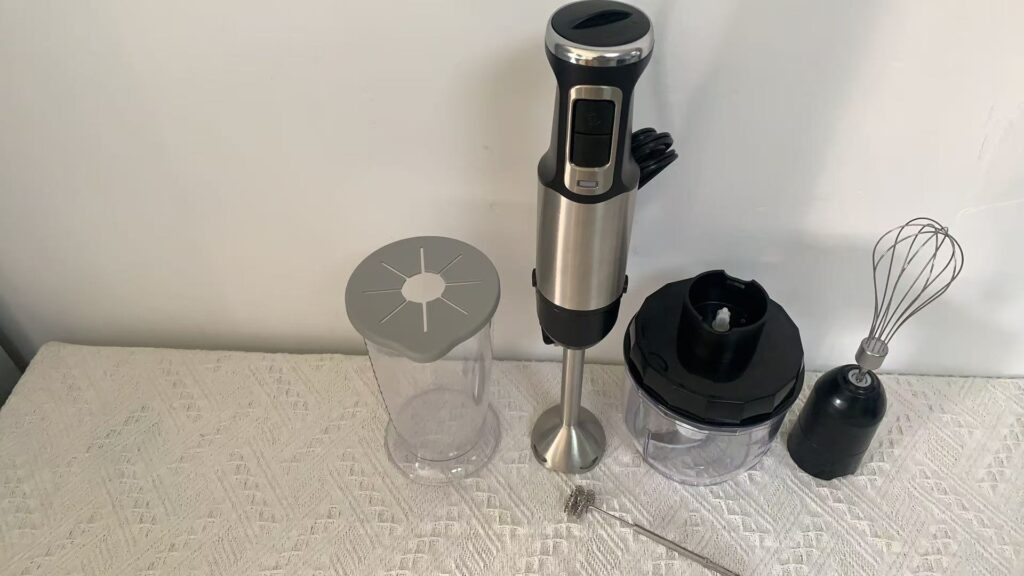
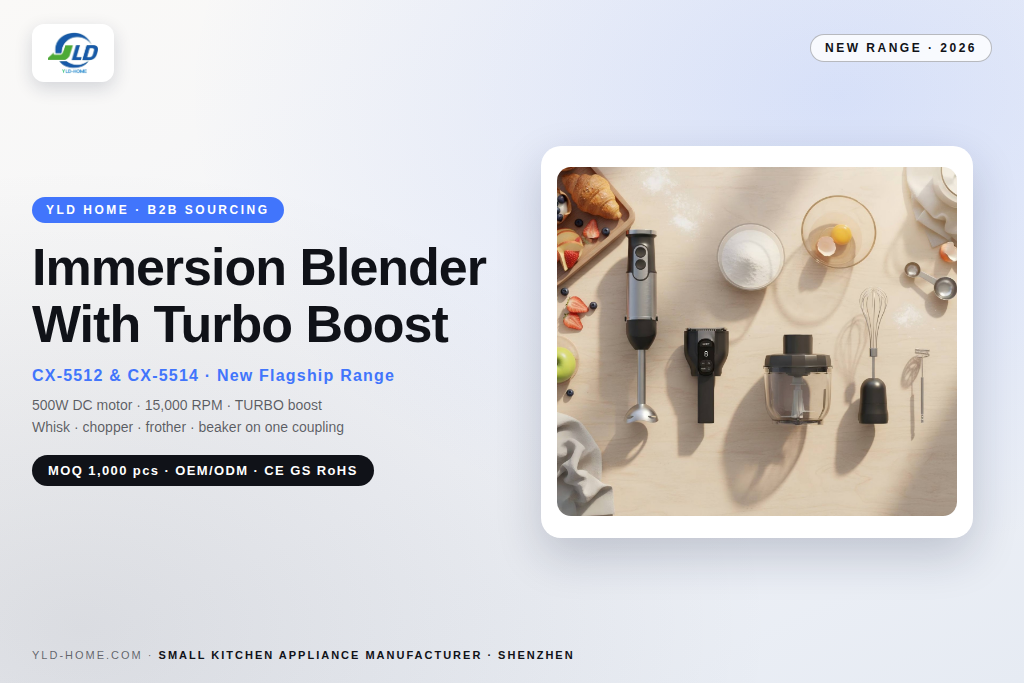
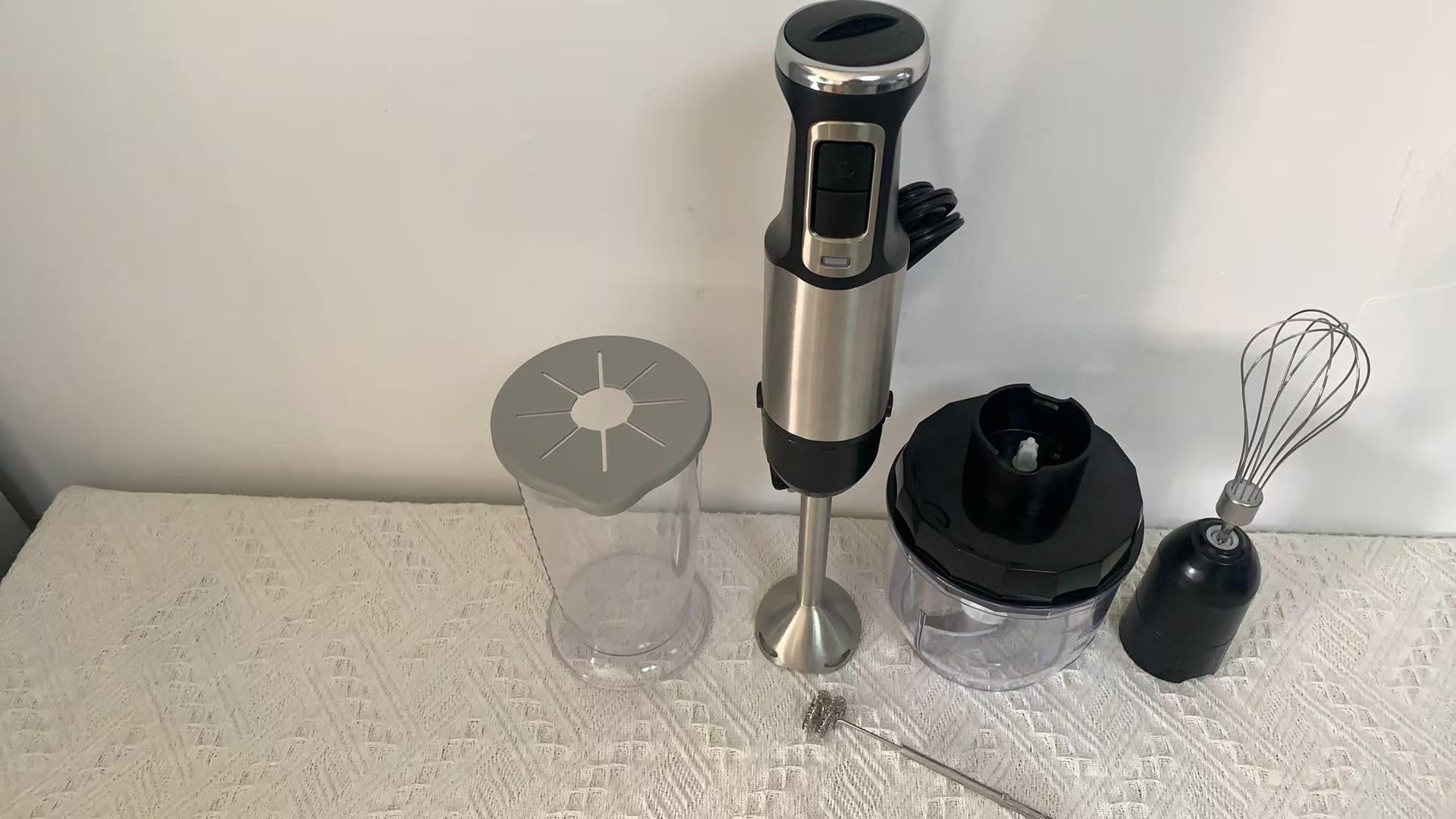
The ten-piece set answers all three in one carton. One main handle with three speeds, pulse and a TURBO boost, a
detachable stainless steel blending shaft, a balloon whisk, a milk frother, two beaters, two dough hooks, a 600 ml
chopper bowl and a measuring cup. One article number covering blending, whisking, frothing, mixing and
chopping means one planogram line, one set of listing images and one promotional price point instead of four.
The full accessory build is described on the
hand blender set page.
Result for your programme: consolidating four buying decisions into one SKU typically removes two
slow-moving lines from your end-of-season discount list, and that reduction is worth more than the nominal margin on
your fastest seller.
Pricing Bands: What Custom Tooling Buys You
Private label pricing is about what becomes economically possible at each volume, not only about the number at the
end of the row. The table below shows how your programme changes as volume rises.
| Annual volume band | What your label gains | Recommended shipping pattern |
|---|---|---|
| 1,000 – 2,999 pcs | Own brand label on stock housing, standard colourway, stock colour box — lowest-risk launch | Single part-container |
| 3,000 – 9,999 pcs | Your logo on the housing, your colour box artwork, custom manual — brand control | Two to three shipments a year |
| 10,000 – 29,999 pcs | Custom housing colour, dedicated carton print, reserved capacity block — launch certainty | Quarterly replenishment |
| 30,000 pcs and above | Dedicated line allocation, rolling forecast, faster artwork cycles, private mould options | Monthly or six-weekly |
Commit to an annual band but take delivery in quarterly shipments. That combination normally negotiates better than
committing to a single container, because the factory can buy components and print packaging against an annual figure
while you keep your own warehouse lean. Recommendation: get your brand onto the housing at the 3,000-piece
band, where the artwork amortises across enough units to be almost free per set.
Getting Your Brand onto the Housing
The housing is where own-brand programmes are won or lost. Pad printing suits a flat, slightly curved panel and gives
a soft, low-cost look. Laser etching gives a permanent mark on coated metal. In-mould decoration gives the sharpest
result and the longest tooling lead time. Each has a minimum run, a surface requirement and a colour tolerance, and the
right answer depends on where the panel sits once the handle is gripped.
Send the factory a physical sample of your intended surface, not only a PDF. Colour on a screen and colour on a
brushed housing are different conversations, and the proofing cycle is where a launch date is usually lost. YLD Home
proofs housing artwork, colour box artwork and carton markings together before production starts, so the three documents
cannot drift apart during the run.
Result for your programme: one combined proofing cycle instead of three separate ones removes
roughly two to three weeks from a first private label launch, which is often the difference between catching your
planned promotional slot and missing it.
Compliance: The Folder That Clears a German Shipment
A missing declaration does not stop production, it stops your stock. A shipment held for a document arrives as cost,
not as inventory. Build the folder before you build the cartons:
- CE declaration of conformity, and GS where your retail channel requires it.
- CB test reports covering the relevant IEC 60335-2-14 requirements for kitchen machines.
- Evidence against the
Low
Voltage Directive and the Electromagnetic Compatibility Directive, plus REACH and RoHS statements. - German-language instructions, safety warnings and packaging text, and a declaration of conformity naming your
brand as the responsible economic operator inside the EU.
Result for your programme: a complete indexed folder means your container clears into stock rather
than sitting on a dock, and your legal team approves the label without a second review cycle. YLD Home issues that pack
as one indexed document set, which is exactly what a market surveillance authority asks to see.
One more German detail that catches own-brand owners out: packaging take-back registration. Germany runs a mandatory
scheme for sales packaging, and your brand name on the carton makes you the obligated party. Confirm early who registers
the packaging and under which brand, because a late registration stops a listing even when the product itself is
perfect. A hand blender supplier Germany private label partner should treat the compliance folder as part of the
product rather than as postage, and publish it early enough that your legal team reads it before the artwork is final.
Cartons That Protect the Margin
Container-damaged returns are the quietest margin killer in own-brand retail. A dented carton photographed by a
shopper and returned for a refund is paid for twice: once by you, once by the retailer charging it back. Four packaging
decisions protect you:
- Board grade and burst strength high enough for four to six high pallet stacking, so the middle
of the pallet does not compress in a central warehouse. - Carton markings matched to the retailer’s label specification, including barcode placement, so
nothing is re-labelled in your peak week. - Reinforced inner protection for the chopper bowl and the blending shaft, the two components that
break first in transit. - One multilingual manual and label pack for Germany, Austria and Switzerland, so a single carton
serves the whole German-speaking region without repacking.
Ask the factory for the board specification in writing rather than a photograph of a finished carton. A photograph
cannot tell you the flute grade, the burst strength or the stacking limit.
Result for your programme: a drop-tested carton configuration removes the leading cause of transit
damage in this category, and it shows up in your return rate long before it shows up in your supplier’s price.
YLD Home supplies artwork matched to your retailer’s own files and treats the carton as part of the product, not as
packing material.
Landing-Cost Maths Before You Commit
Two suppliers can quote an identical unit price and still produce a double-digit difference in your landed cost per
set, purely because one carton fills a pallet footprint and a container bay efficiently and the other does not. Always
ask for master carton dimensions, units per carton, pallet configuration, pallet height and pallets per 40HQ, then check
them against your own racking as well as against the container.
Confirm the master carton specification with your hand blender supplier Germany private label partner before you
approve the colour box, because the two are printed on the same sheet and a mismatch between them is expensive to
correct once the run has started.
Build the comparison the other way round too. Take your target retail price, subtract the retailer’s margin, subtract
duty, freight, insurance and your own handling, and see what FOB price the programme can support. Working backwards
from the shelf is how seasoned own-brand buyers avoid a product that sells well and makes nothing. The
Incoterms 2020 rules are the common
language for that boundary; agree FOB or CIF in writing before the first quotation is compared. The master carton data
behind every YLD Home quotation is published from yld-home.com, so your forwarder never has to guess at a loading
figure.
Result for your programme: better carton geometry is a permanent, one-time margin gain you keep on
every future shipment without renegotiating a single unit price, and it is the fastest way to see which candidate is a
real hand blender supplier Germany private label partner and which is merely reselling someone else’s loading plan.
Spares, Warranty and the Long Tail of a Private Label
Your after-sales promise outlives the container. If a shopper needs a replacement whisk eighteen months after
purchase, that promise should not depend on you cannibalising saleable stock. YLD Home supplies spare blending shafts,
whisks, beaters, dough hooks and chopper bowls made to the original specification, so your warranty commitment stays a
service line rather than an inventory write-off.
Result for your programme: spare-part availability lets you price a two-year warranty with
confidence, and it protects the retail relationship that took you two years to build. It also lets you quote a
replacement-part price list to your retail partners, which most own-brand labels cannot do. Choose a hand blender
supplier Germany private label partner that keeps a spares programme running for ten years, not one that treats spare
parts as a favour.
Five Red Flags in a German Private Label Conversation
- A supplier who quotes a lead time in days rather than a date and a slot.
- No master carton specification available before the order is placed.
- Certificates naming a different company with no explanation.
- Only a sales contact and no named quality owner when an inspection problem appears.
- A price well below every other quote with no specification difference to explain it.
None of these ends a conversation by itself, but each predicts a specific failure, and each is visible weeks before
the failure arrives.
How to Run the First Production Run
Treat the first run as a rehearsal with a real audience. Approve a gold sample and sign it off in writing, then have
that sample sealed at the factory and compared against production. Name one person on your side as the technical
decision-maker and one on theirs, so questions do not circulate. Agree the inspection standard in the purchase order
rather than in a later email thread.
Recommendation: ask for a four-gate inspection record — incoming material, in-process,
final and out-going — sampled at AQL 1.5 for major defects and AQL 4.0 for minor defects, and welcome a
third-party inspection before loading. YLD Home works to exactly that standard and treats a customer-arranged
inspection as normal practice rather than an insult. A hand blender supplier Germany private label partner should be
able to show you a sealed gold sample from a previous programme and describe what was measured against it.
Frequently Asked Questions
What is the minimum order for a German private label programme with YLD Home?
The minimum order quantity is 1,000 pieces per run, so you can open a listing with a part container, prove
sell-through, then scale into quarterly replenishment. YLD Home locks the specification between runs so your second
order matches your first.
How do I check whether a hand blender supplier Germany private label partner is a real manufacturer?
Ask for a production completion date, the master carton specification and the name of the certificate holder. YLD Home
answers all three from its own 25,000 m² facility, where the set has been manufactured on five lines since 2012.
Can YLD Home put my logo on the housing and the colour box?
Yes. From the 3,000-piece band upward, YLD Home prints your logo on the housing and produces a branded colour box,
sleeve and carton markings, all proofed together before production starts. YLD Home acts as a hand blender supplier
Germany private label partner on both the housing and the packaging, so the two documents cannot drift apart.
Which documents arrive with a shipment to Germany?
YLD Home supplies the CE declaration of conformity, CB test reports, RoHS and REACH statements, German-language
instructions and label text, and the four-gate inspection record for the run.
How long does a first private label run take?
A first run with new housing artwork and new packaging normally completes inside 25–35 days once artwork is
approved, and YLD Home confirms the completion date in writing so you plan a booking rather than guess at one.
Can YLD Home reserve capacity for my launch week?
Yes. YLD Home reserves capacity blocks for private label partners who share a rolling six-month forecast, because the
factory plans its 600,000-unit monthly output weeks in advance rather than booking it day by day.
Do you supply spare parts after the warranty period?
YLD Home supplies spare shafts, whisks, beaters, dough hooks and chopper bowls to the original specification, so a
replacement part never depends on breaking up saleable stock.
How many sets fit into a 40HQ container?
Container yield depends on the final carton configuration. YLD Home confirms units per carton, pallet configuration
and pallets per 40HQ with your quotation so your forwarder can verify the maths independently.
Your Next Three Moves
Pick whichever of these matches where you are in the buying cycle, and do it this week:
- Request the specification sheet and MOQ tier table so you can compare hand blender supplier
Germany private label candidates on identical paperwork. - Book a sample (5–7 days by courier) and test the accessory set and the housing surface
against your intended artwork. - Ask for the container loading plan (20GP / 40HQ) so your forwarder can confirm landed cost before
you cut tooling or pay a deposit.
Review the wholesale hand blender range to see how
the set sits alongside the rest of the line, read the
quality control process so you know what a shipment will be tested
against, and check the factory tour and
customer visit records for programmes with a similar profile.
Buyers with a wider food-preparation range can also review the
food processor line to consolidate shipping.
Any commercial question not covered here is answered on the
frequently asked questions page, and a specific requirement can be put to the
yld-home.com export desk through request a quote. You will get a firm offer, a
production slot and an artwork plan built around your launch date.