









In this guide:
- Why the hand blender food processor combo sells in the US
- What a hand blender with food processor includes
- Sizing, motor power, and bowl capacity for US kitchens
- Food safety: FDA contact rules and sanitary design
- Wholesale pricing and margin structure
- Private label and OEM options
- MOQ, lead times, and shipping for wholesale
- How to qualify a hand blender processor supplier in the USA
*alt:hand blender food processor *
A hand blender food processor is the answer to a question we hear constantly from US buyers: do we stock two appliances or one? Retailers and distributors tell us the combo outsells separate units because it takes up less shelf space and one price tag does the selling. Restaurants and catering companies like it because one motor block replaces three machines on a crowded prep counter. YLD Home has shipped this configuration into the US market for years, and this guide covers what goes into a wholesale hand blender food processor program: the components, the compliance paperwork, the pricing structure, and the supplier checks that keep your first container profitable.
For buyers comparing supply options, the food processor range from YLD HOME lists every model by type and wattage, with MOQ, lead time and certification stated per page.
Why the Hand Blender Food Processor Combo Sells in the US
The US market rewards appliances that do more than one job, and the hand blender food processor is the strongest example in our category. A bare stick blender blends soups and smoothies. Add a processor bowl and it also slices, shreds, chops, and mixes dough. That single upgrade changes which department buys it: home goods, small appliances, kitchen tools, and even housewares buyers who normally skip blenders entirely. We track this in our wholesale data, and the processor-equipped models consistently outsell bare units in the same power class.
Part of the appeal is storage. American kitchens, especially apartments in New York and Chicago, do not have counter space for a full-size food processor that gets used twice a month. A compact hand blender food processor stores in a drawer or a cabinet and still handles a holiday-size batch of coleslaw or a batch of pie dough. For retailers, the combo means one SKU instead of two, which simplifies planograms and reduces dead inventory risk.
The foodservice angle is bigger than most importers expect. Food trucks, caterers, and small restaurants in Miami, Houston, and Los Angeles buy combos because the prep footprint is tiny and cleanup is fast. Our 4-in-1 hand blender with a whisk and a chopper covers nearly every prep station task. When we show US buyers the sell-through numbers on processor combos versus bare units, the conversation usually shifts from price to program size within minutes.
What a Hand Blender with Food Processor Includes
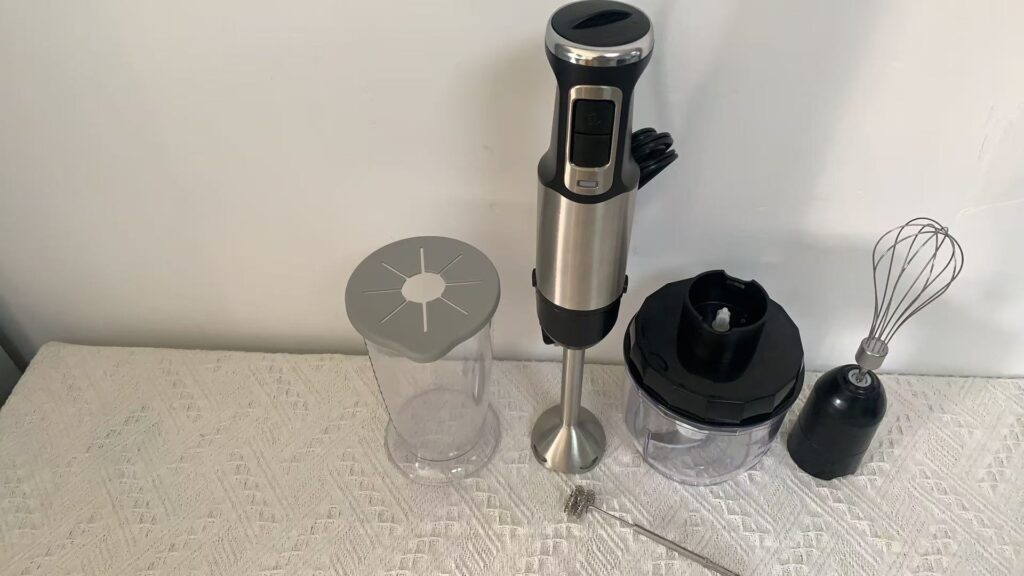
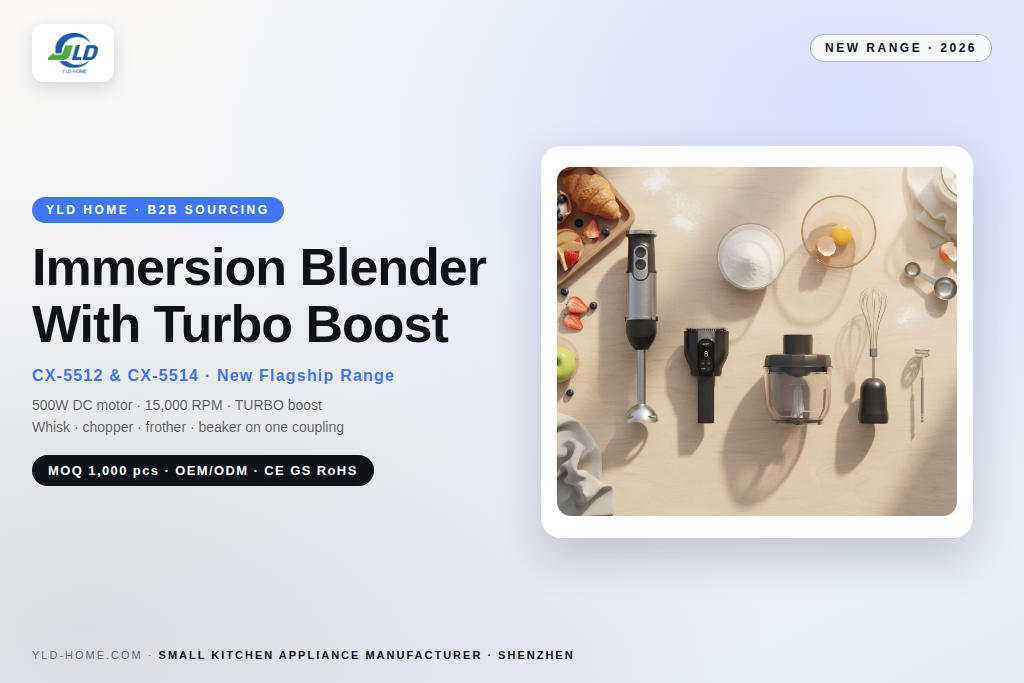
A hand blender with food processor USA wholesale order typically includes the motor block, the immersion shaft, a processor bowl with lid and feed tube, and a set of discs. Every hand blender food processor we ship includes the same core components, and the standard configuration looks like this:
| Component | Spec buyers check | Why it matters |
| Motor block | 500-1600 W, variable speed | Power headroom for dense chopping loads |
| Immersion shaft | 240 mm length, stainless blade | Reaches stock pot bottoms in foodservice |
| Processor bowl | 1.5-2 L capacity, BPA-free | Batch size that matches US recipes |
| Slicing disc | Adjustable thickness | Potato, cucumber, onion prep |
| Shredding disc | Medium grate | Cheese, cabbage, carrot work |
| Whisk attachment | Wire count, locked collar | Cream, eggs, dressings |
| Mini chopper bowl | 500 ml, sealed lid | Small prep during service |
| Beaker | 600-800 ml, graduations | Portion blending and travel use |
The processor bowl is the component that separates serious combos from gimmicks. We mold the bowl from BPA-free material, fit the lid with a dual seal, and design the feed tube so a standard potato fits without pre-cutting. The discs lock into the bowl base with a splined hub, so they do not strip under load. A distributor in Los Angeles told us the disc hub is the first part his customers check after a season of use, and we made it a replaceable part in our spare program.
The motor side has to be honest about its ratings. A 600 W motor handles light chopping fine; a 1000 W or higher motor handles dense loads like nuts, frozen fruit, and pie dough without stalling. We recommend buyers match the motor class to the intended channel. Home retail can run on the lighter end; foodservice and club stores should spec the heavier class.
Sizing, Motor Power, and Bowl Capacity That Match US Kitchens
US recipes are written in cups and pounds, and the bowl capacity has to handle a full recipe, not a scaled-down version. A 1.5 liter bowl handles a standard batch of salsa or a pound of coleslaw mix. A 2 liter bowl covers pie dough and bigger holiday prep. We test every new bowl size against common US recipes before we release it, because a bowl that cannot fit a full recipe generates returns and bad reviews. For a hand blender food processor, sizing starts with the bowl and works backward to the motor.
Motor power maps to prep density. For pureeing hot soup, 500-600 W is enough. For chopping onions and herbs, 600-800 W does the job cleanly. For nuts, frozen fruit, and dough, you want 1000 W or more. Our 6010 powerful stick blender and the 6006L powerful stick blender are the models US buyers usually match with processor bowls when they want headroom for dense loads. Both run on 120V with UL-listed builds, so they drop straight into a US retail program.
Speed control matters as much as raw watts. A variable speed dial lets the operator start slow for hot liquids, then ramp up, which prevents splatter and blade cavitation. We set the slow start on the motor side and keep the dial under the thumb. When we demo combos to US buyers, we ask them to try a hot soup puree and a frozen smoothie back to back. Those two tests expose more about the machine than any spec sheet.
The Prep Jobs a Hand Blender Food Processor Handles in Foodservice
In a working kitchen, the hand blender food processor replaces three stations. The immersion shaft purees soups and sauces in the pot, no transfer needed. The processor bowl handles mise en place: onions, peppers, cheese, and cabbage for the day’s service. The whisk whips cream and emulsions for the pastry side. A caterer in Chicago told us the combo cut his prep time for a 200-cover event by about forty minutes, mostly because cleanup took one sink cycle instead of three.
Batch size is the foodservice constraint. Full-size processors handle 5-10 liters, but most small operators do not need that volume and do not want the storage footprint. The 1.5-2 liter bowl hits the sweet spot for food trucks, cafes, and catering kitchens. For larger runs, the operator processes in two batches, which takes less time than hauling out a full-size machine. For operators who want the processor bowl to double as a countertop unit, our HB006-3 detachable food processor separates the bowl from the motor entirely.
The design details that matter in foodservice are the ones you cannot see in a photo. The blade should sit low in the bowl so small batches still make contact. The lid seal has to hold under pressure when processing hot ingredients. The bowl base should lock firmly enough that the bowl does not walk across the counter. We test all three in our own kitchen lab before a model goes into the catalog, and we publish the test criteria so buyers can verify them on samples.
Food Safety: FDA Contact Rules and Sanitary Design
Every part of a hand blender food processor that touches food falls under FDA food contact rules, and the food safety standards for commercial equipment go further. The bowl, lid, discs, and beaker need migration testing, and any plastic part should be BPA-free with the test report to back it. The blade and discs are stainless steel, which passes easily, but the seals and gaskets deserve scrutiny. A cheap seal can leach or degrade after repeated dishwasher cycles.
Sanitary design is about geometry as much as material. Grooves trap food, and trapped food breeds bacteria. We design the bowl interior with radiused corners, keep the lid seal removable for cleaning, and make the discs dishwasher-safe. The motor block never touches food, but the shaft collar does, so the collar is sealed and the shaft rinses clean under running water. These details show up in health inspections, and operators notice.
For US wholesale, the paperwork is the same as the engineering. FDA food contact test reports, Prop 65 compliance for California, and material declarations for each plastic grade. YLD Home attaches these documents to every quotation for a hand blender food processor program, and we advise buyers to keep them with the product file. A customs broker or a retailer’s compliance team will ask for them eventually, and having them ready shortens the approval cycle by weeks.
Wholesale Pricing and Margin Structure for the US Market
Pricing a hand blender food processor for the US market is a three-layer exercise: your landed cost, your margin, and the retail price your channel can support. The combo typically prices 30-40% above a bare stick blender at the same power level, which gives you room to sell it as an upgrade at retail. Most US distributors we work with target a 40-50% gross margin on the combo SKU, with volume rebates for full-container programs.
The cost structure favors the combo on the factory side. The motor, shaft, and packaging are shared with the bare model, so adding the processor bowl and discs adds only the incremental tooling and parts cost. That is why the retail price gap is smaller than the capability gap, and why the combo converts so well at the shelf. Private label buyers capture the same economics: the tooling for a custom bowl color is modest, and the motor stays standard.
*图 alt:hand blender food processor 碗与刀盘*
We quote hand blender food processor wholesale USA pricing per set with volume breaks, and we separate the cost of the discs and the whisk so buyers can trim the bundle for a lower entry price. [fill actual: set price at first volume break] is the starting conversation for most importers, but the real number that matters is your landed cost after freight and duty, which we walk through line by line before you commit. The duty classification for stick blenders and their attachments is standard, and our export documents list the HTS code so your broker can pre-clear the shipment.
Private Label and OEM Options for a Hand Blender Processor Supplier
Most of our US private label programs start the same way: a buyer brings us a shelf price and a target margin, and we reverse-engineer the bundle. The motor block, the shaft, and the processor bowl are the core. The buyer chooses the color, the logo placement, and the box design. For a private label hand blender food processor, the flexibility of that process is what separates a partner from a vendor. YLD Home keeps the standard molds running across the hand blender range so lead times stay short, and we handle custom branding at the tooling stage.
Logo placement follows the same rules we apply to attachments. The motor housing carries the main brand mark. The bowl gets a laser-engraved or pad-printed logo, never a molded one that traps food. Packaging is where private label buyers differentiate: retail-ready boxes, bilingual English-Spanish inserts, hang tabs, and club-store cartons. We have built programs for distributors in Miami, Los Angeles, and Houston that started with a single custom color and grew into full seasonal lines.
The OEM question that matters most is mold ownership. If you fund a new bowl mold or a custom disc, the mold should be yours, held under a written agreement at the factory. We put mold ownership and exclusivity terms in writing for every custom program, because a supplier change should never strand your SKUs. Ask any prospective hand blender processor supplier in the USA market the same question, and get the answer in the contract, not in a promise.
MOQ, Lead Times, and Shipping for Hand Blender Food Processor Wholesale USA
The MOQ for a standard hand blender food processor program is [fill actual: quantity], which covers a mixed set of models and colors in one production run. Private label programs with custom branding start at [fill actual: quantity] per SKU, and we can spread that across models to keep your first order flexible. Lead time for standard builds is [fill actual: weeks]; custom colors or logos add [fill actual: weeks] for tooling and first-article approval.
Shipping economics favor consolidation. The processor bowl and discs are light, so a 40-foot container carries a large number of combos, and mixing combos with bare blenders fills the container efficiently. Most US importers ship sea freight, 30-40 days from Shenzhen to Los Angeles, New York, or Houston. For retail reorders, air freight keeps shelves stocked while the next container sails. We quote both options and let the buyer pick the blend that matches their sell-through.
Documentation is part of the lead time, not an afterthought. Every order ships with the commercial invoice, packing list, certificate of origin, and the compliance file. For a hand blender food processor wholesale USA order, we include the UL/ETL and FCC certificates, FDA food contact reports, and Prop 65 documentation in the same package, so your customs broker and your retailer’s compliance team have everything before the truck arrives.
Compliance Checklist: UL, ETL, FCC, and Food Contact
Before your hand blender food processor hits a US shelf, four compliance items need to be locked down. First, UL or ETL listing on the 120V motor. Second, FCC compliance for the electronics. Third, FDA food contact testing for every food-touching part. Fourth, Prop 65 assessment for California. Missing any one of them can hold a container at customs or trigger a retail chargeback, and both outcomes are expensive.
YLD Home builds the 120V versions of our combos pre-certified, so the certification queue is not part of your lead time. We send the certificate numbers with the samples, and we recommend buyers verify them on the UL and FCC online databases before placing the production order. For private label programs, the certificates carry the model number, and we coordinate with your brand name where the listing allows it. Some retailers require the listing in the buyer’s name, which we support with the factory documentation.
The food contact side deserves a deeper check than the certificate. Ask for the actual test report, with the lab name, the test date, and the tested material grades. A certificate without a report is a marketing document. Also confirm the dishwasher durability claims, because the FDA covers chemistry, not mechanical survival, and a bowl that warps after 100 cycles is a returns problem even if it is food safe.
How to Qualify a Hand Blender Processor Supplier in the USA
Qualifying a hand blender processor supplier in the USA market comes down to five checks we recommend every importer run. One, order the full combo as a sample and test it against your channel’s worst case: a dense frozen smoothie, hot soup, and a full batch of dough. Two, disassemble everything and inspect the seals, the disc hubs, and the blade edges. Three, run the bowls through 100 dishwasher cycles and look for warping and color change. Four, ask for the compliance file and verify the certificates online. Five, talk to the factory’s other US customers, or at least ask for reference accounts in the same channel. Run the same five checks on any hand blender food processor program before you commit volume.
Ask the supplier how they handle the failure modes you found in testing. A good factory has a fix, not an excuse. We track our own warranty data on processor combos and design out the top issues between seasons: lid seal upgrades, disc hub reinforcement, and blade geometry changes are the usual suspects. When a distributor in Houston tested our combo against two competing imports, the tie-breaker was not price. It was that we shipped a revised seal within a week of his first complaint.
*图 alt:hand blender food processor 批发套装*
Finally, structure the first order to learn, not to gamble. A trial container with two or three models, one custom color, and a mixed attachment mix teaches you the packing, the paperwork, and the sell-through without betting the year on a single SKU. When you are ready to spec your program, YLD Home can put together a wholesale quote with samples, compliance documents, and a landed-cost breakdown for your target ports.
Frequently Asked Questions
Q1: What is included in a wholesale hand blender food processor set?
A standard set includes the motor block, immersion shaft, processor bowl with lid and feed tube, slicing and shredding discs, whisk attachment, mini chopper, and beaker. You can trim the bundle for a lower entry price or expand it for a premium retail tier.
Q2: What is the MOQ for a hand blender with food processor USA order?
Standard programs start at [fill actual: quantity] units, mixable across models and colors. Private label programs start at [fill actual: quantity] per SKU, with custom branding lead time added on top of the standard build time.
Q3: Are the processor bowls and discs FDA food contact certified?
Yes. Every food-touching part ships with FDA food contact test reports, and all plastic parts are BPA-free and tested for Prop 65. We send the lab reports with the sample package, not just a certificate.
Q4: What motor power should I spec for foodservice customers?
For light prep and home retail, 600-800 W is enough. For dense loads like nuts, frozen fruit, and dough, spec 1000 W or higher. The 6010 and 6006L models are the ones US foodservice buyers typically choose.
Q5: How long does a private label program take from PO to delivery?
Standard builds ship in [fill actual: weeks]. Custom colors or molded logos add [fill actual: weeks] for tooling and first-article approval. Sea freight adds 30-40 days to the US; air freight is available for urgent reorders.
Q6: Can I sell the combo under my own brand?
Yes. Most of our US wholesale business is private label. You choose the color, logo placement, and packaging, and the motor tooling stays standard to control cost. Mold ownership and exclusivity terms are put in writing.
Q7: Do you provide the compliance documents for customs and retail?
Yes. UL/ETL and FCC certificates, FDA food contact reports, Prop 65 documentation, and the HTS code come with every order. Retailers and customs brokers get the full file before the shipment arrives.
Official references
Related models in this range: Food Blender For Soup Wholesale Supplier and Food Processor Blender Wholesale Supplier.
Related pages from YLD Home: inspect our quality control process and inspection reports, walk the Shenzhen factory floor, or read about buyers who visited us in person.