









Twelve people around a folding table, a bag of ice sweating on the counter, and a host who has already walked back to the kitchen twice for a spoon. Nobody designs a living room around game night, but for four or five hours it becomes a small production line — drinks, snacks, salt, coffee, a bowl of peanuts somebody wants crushed. The wall behind that table almost never has an outlet within reach, and when it does, the cable is the thing guests trip over on the way to the bathroom.
That is the practical case for cordless appliances for game night, and it is why the category has stopped being a novelty and started appearing on buying sheets with real quantities beside it. Retail buyers, brand owners and club or tournament suppliers are no longer asking whether a battery-powered grinder is clever. They worked that out the first time they used one. They are asking whether it lasts a long session, how it gets charged, whether it ships legally, and whether the carton makes sense on a shelf next to a card game. Those are the questions this page answers, in the order they reach our inbox.
The brief behind the brief
Almost nobody sends an email that says “I want cordless appliances for game night.” They send something narrower, and the narrow version tells you what the real product is.
A gift-box buyer for a department store chain is building a seasonal set and needs every SKU to survive one carton, months on a pallet, and still work on the morning it is opened. A brand owner with an existing line of playing cards or dice wants an accessory that carries their logo without embarrassing the parent brand when a customer unboxes it. A club or tournament supplier is ordering for venues where tables go up and down four times a day, where staff who did not read the manual and guests who press whatever looks like a button both use the same unit.
Those three briefs pull the same catalogue in different directions. The gift box cares about packaging and shrink. The brand owner cares about surface finish, logo placement and colour consistency on a reorder. The venue supplier cares about the button that has to work after two hundred presses a week and the lid that has to close one-handed. YLD Home has spent fourteen years learning to tell those three apart before quoting, because the honest answer to “how long does it run” depends on who is holding it.
Question one: how long does one charge actually last?
Every buyer asks this first, and it is the question where a straight number is least useful. A host grinding pepper for eight people presses the button for maybe two seconds per person per course. A venue using the same grinder through a lunch service and then an evening session presses it far more often. Same battery, same motor, very different evenings.
So we talk about duty cycle instead of a headline hour figure. What matters is how many seconds of motor time the appliance gets in an hour, how heavy the load is, and whether the unit sits in a hot car between events. A supplier who quotes a single runtime for cordless appliances for game night without asking those three questions is quoting a lab condition, not your channel.
Here is how the range lines up on paper. The capacity column is the checkable part; the session column is what it means in a room full of people.
Battery capacity against session profile
| Model | Battery | Capacity | Job at the table | Session profile |
|---|---|---|---|---|
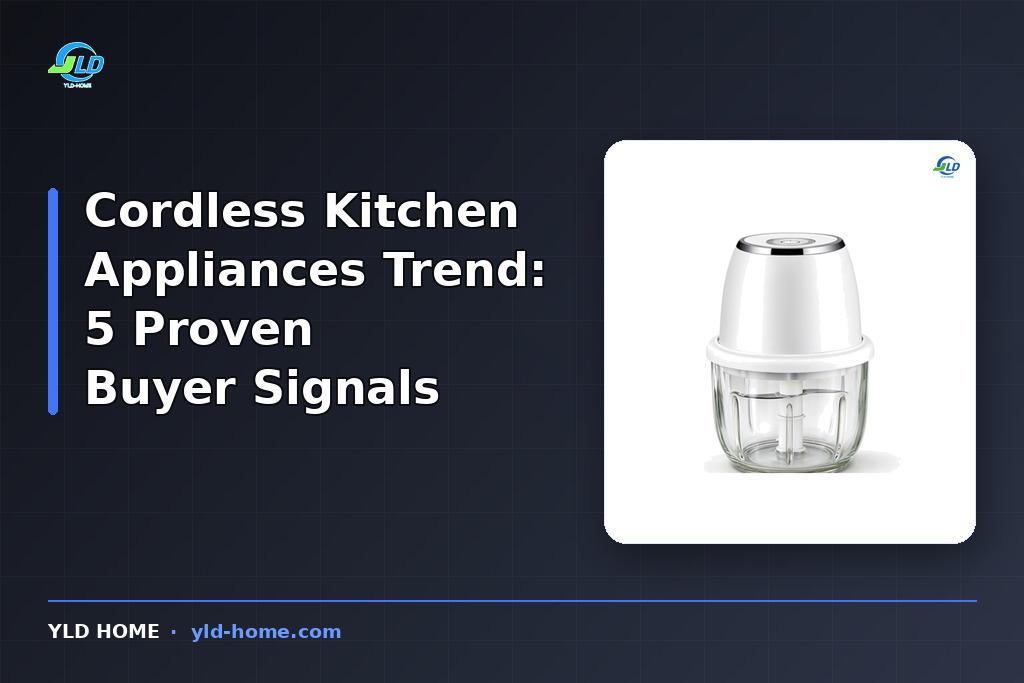
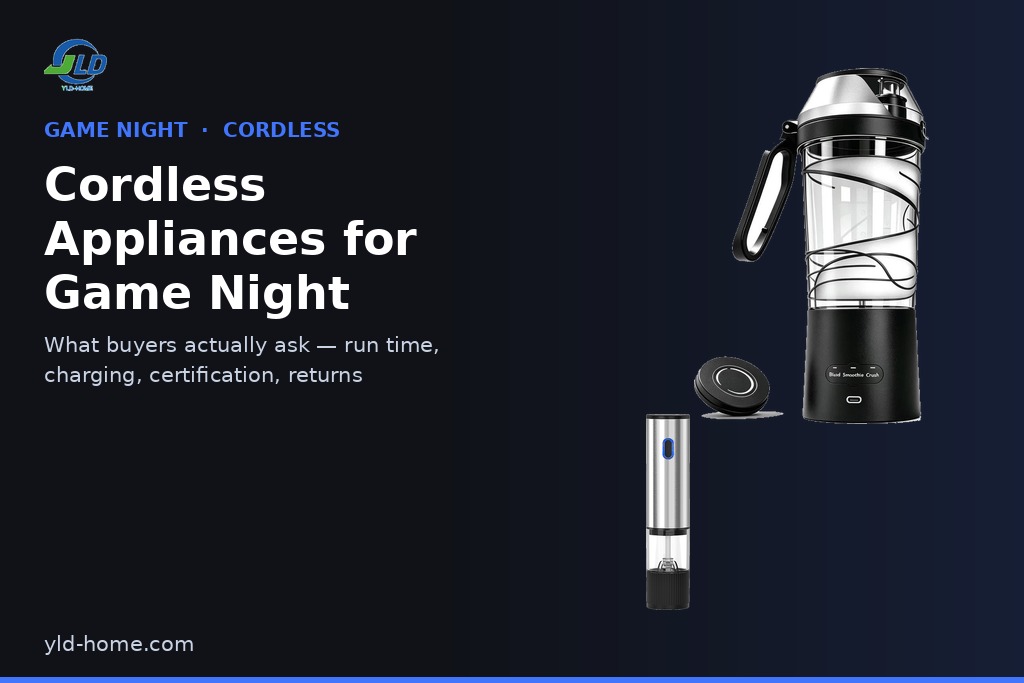
| 701 salt and pepper grinder | 500 mAh | 80 ml | Seasoning through a long dinner-and-cards stretch | Built for intermittent pressing; a normal evening is limited by the chamber, not the cell |
| 702 coffee grinder | 800 mAh | 210 ml | Fresh grounds for the last pot of the night | Suits a host who brews twice; hopper size matters more than battery for most buyers |
| 1219 portable glass blender cup | 1,200 mAh | 350 ml, six-blade 420J2 stainless | Dips, sauces, blended drinks for a group | The heaviest draw in the range; the model buyers spec for party formats |
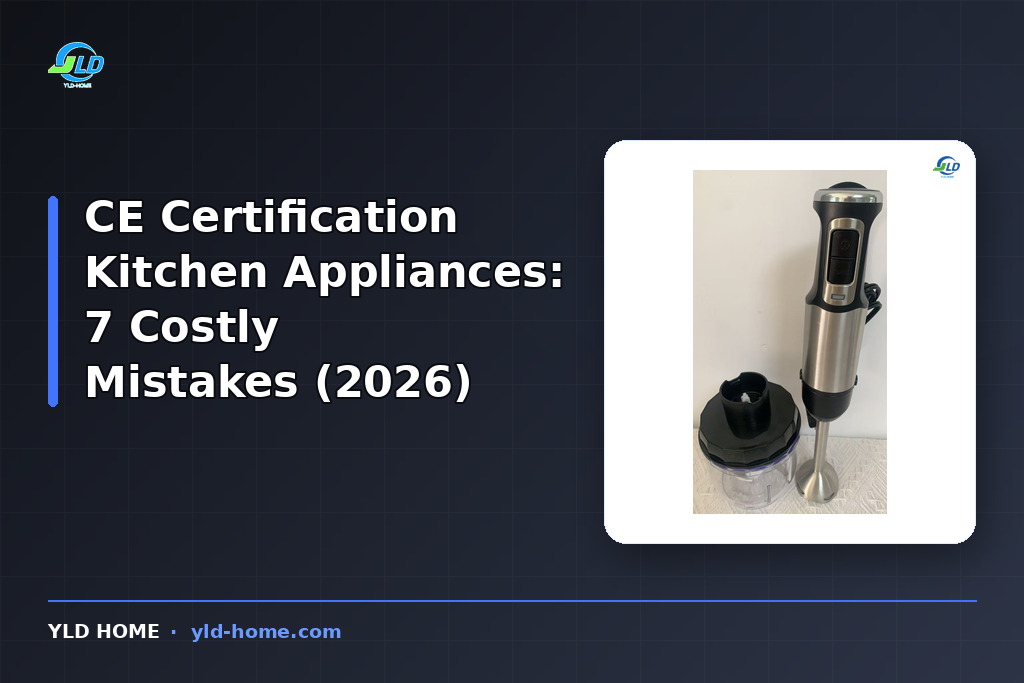
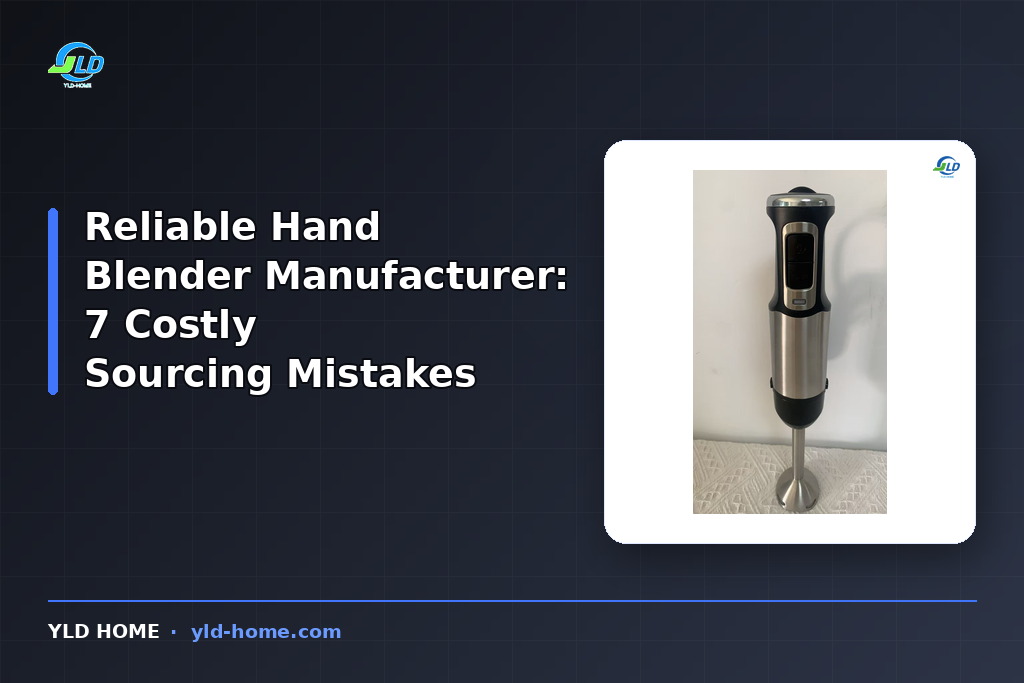
| 323 hand blender | Stick format, 4 speeds, storage sleeve included | — | Soup, cream, quick purée at the sideboard | Not a table centrepiece, but the piece that makes a set feel like a kitchen kit |
Capacity is not a performance claim. A 1,200 mAh pack in a six-blade blender cup does different work from 1,200 mAh in a grinder, because blade geometry, jar volume and load all move the number. We publish cell capacity and jar volume because a buyer can check those against a competitor; we do not publish a fantasy runtime. In practice the refill is often the real limit — an 80 ml pepper chamber runs out before a managed battery does — which is why experienced buyers ask about lid travel and fill-line visibility rather than milliamp hours.
If your channel genuinely runs eight-hour sessions, say so at sampling. The right answer may be two units rotated through a dock rather than one unit with a bigger cell, and that is a packaging decision.
Question two: where does it get charged, and whose job is that?
Buyers who have run a cordless programme before ask this ahead of capacity, because they have lived through the version where the charging cable went missing. It is the least glamorous part of buying cordless appliances for game night and the part that generates the most support tickets.
Three things to settle early: whether the unit charges by cable or sits on a dock; whether the port is reachable without turning the appliance upside down on a tablecloth; and whether the cable shares a bag with the appliance or rattles loose in a gift box. For gift and club sets the loose cable is the complaint generator, because the customer opens the box on the night they need it, finds a cable that slid under the insert, and concludes a part is missing.
For venue buyers there is a second question: who owns charging during the shift. A dock that lives behind the bar and holds two units is a different product from a cable that lives in a drawer and gets lost. If you are ordering cordless appliances for game night for a venue rather than a home, tell us the charging location — it changes the accessory list and sometimes the recommended model.
Question three: what happens when it ships?
Lithium cells are regulated dangerous goods, and this is where otherwise well-run projects stall. Artwork is approved, the sample is signed off, and then somebody in logistics asks for transport documents nobody ordered.
Every cordless unit YLD Home ships travels with a UN38.3 test summary and an MSDS in the carton documentation set. That is the baseline. If your forwarder is consolidating by air, they will want the report for the specific cell and pack configuration, not a generic certificate for a different product family, so the model list on your purchase order has to match the model list on the test summary. The UNECE dangerous goods framework is the reference your forwarder works from; reading the lithium provisions before you book beats reading them at the port.
Two consequences. Keep the pack configuration stable across reorders, because a change in cell count or an added charging board can put you back into testing. And plan the sample shipment and the production shipment as one paperwork exercise — buyers who test with one document set and ship with another are the ones who lose a week.
Question four: which certificate do I actually need?
Certification translates a buyer’s market list into a production order, and it is the step where more cordless appliances for game night programmes stall than at any other point. The answer is per-market, not per-family.
| Market | Marks we work to | Electrical basis | Notes for the buying sheet |
|---|---|---|---|
| United States | ETL, FCC | 120 V | The 120 V build is a separate configuration from the European one; do not plan one SKU for both |
| Canada | ETL | 120 V | Usually ordered as part of a North American programme rather than alone |
| European Union | CE, GS, CB | 230 V | GS is what retail buyers in Germany and Austria ask for by name; CB reports help where local approval is also needed |
| United Kingdom | UKCA | 230 V | Separate from CE, and increasingly requested alongside it rather than instead of it |
Two things buyers get wrong. The first is assuming a CE-marked unit can be re-labelled for the US — the voltage, plug and safety basis differ, so the honest answer is a second build. The second is treating the certificate as a document rather than a chain: the mark on the housing has to match the report, which has to match the model number on the invoice, which has to match the packing list. Our certifications page lists what YLD Home holds per product; the standards published by the IEC are the technical reference if your compliance team wants to check scope.
If you sell into several markets from one purchase order, put the market split on the PO. Cheaper than finding out at the port that a pallet of 230 V units was headed for a 120 V channel.
Question five: what actually comes back?
This one separates a first order from a fourth, and it is rarely in the first email. It should be.
Returns on cordless appliances for game night cluster in predictable places, and almost none of them are about the motor. A lid that needs two hands and a firm press comes back from anyone holding a glass in the other hand. A grind that drifts when the chamber is nearly empty gets reviewed as “stopped working.” A button that needs a long press is called broken by a guest who tapped it. A unit that whines at a pitch audible over conversation is returned for noise, even though the bench figure is normal. A charging cable that arrived loose is reported as a missing part.
None of those are engineering failures in the strict sense. They are expectation failures, cheap to design out at sampling and expensive to fix after a container lands. That is why the quality control process spends time on lid force, button travel and packaging retention rather than only motor bench tests, and why we ask buyers to put a sample in front of three people who are not engineers before signing it off.
Corded or cordless: the procurement comparison
Not every programme should be cordless. If the appliance lives on a counter with a socket behind it, corded is lighter, simpler and carries no transport paperwork. The comparison that matters is not technology, it is where the product sits in the customer’s evening.
| Factor | Corded | Cordless | What it changes in the order |
|---|---|---|---|
| Placement | Within reach of an outlet, cable across the surface | Anywhere on the table, sideboard or bar | Cordless is the only version that works mid-room |
| Guest experience | Cable is a trip hazard and a talking point | Nothing to move before serving | Fewer complaints in venue channels, where tables are reset daily |
| Returns pattern | Cable damage, plug and reach complaints | Lid force, button feel, missing cable | Different spares kit and a different insert design |
| Certification | One build per market voltage | Same market logic plus battery documents | UN38.3 and MSDS join the document set |
| Shipping | Standard cartons | Regulated lithium goods | Book freight earlier and freeze the pack configuration |
| After-sales | Cord or switch | Cell, charging board or port | Ask about spare batteries at quoting, not after the first complaint |
| Packing | Simple carton | Needs retention for cable, dock and manual | Gift sets need a die-cut insert, not a poly bag |
The short version for a buying sheet: cordless appliances for game night win wherever the table is the venue, and corded still wins wherever the counter is. YLD Home builds both, and most programmes carry both, with the corded SKU as the value entry and the cordless unit as the upgrade.
What a game-night set actually contains
The bundle is where most of the margin and most of the complaints live on cordless appliances for game night. A working set for six to twelve people usually starts with the 701 grinder, because seasoning is what guests reach for and what looks worst in a plastic shaker. The 702 coffee grinder joins when the evening ends with coffee rather than a last round. The 1219 portable glass blender cup is the party-format addition — the model that turns a snack table into something producing a dip without a trip to the kitchen. The 323 hand blender, four speeds with a storage sleeve, is what makes the set read as a kitchen kit rather than a gadget.
What buyers add on top usually decides whether the set sells: a die-cut insert that holds the charging cable, a card showing three serving ideas, and a carton that takes a retail label without the artwork falling apart. Our game night appliance bundles page shows how those sets are configured, and the cordless kitchen appliances range lists what can be mixed into one programme.
One caution: every SKU you add multiplies certification and documentation work, because each model on the PO needs its own paperwork trail. A four-SKU set is a fine product and a heavier administrative object than a single-SKU order, and it needs a longer first run than a reorder.
Sampling, MOQ and the timeline buyers plan around
The figures buyers ask for on cordless appliances for game night, plainly: MOQ is 1,000 pcs, or 300 sets for mixed bundles. Sampling runs 5–7 days. Production runs 25–35 days. Terms are FOB Shenzhen.
Three notes on those numbers.
Sampling at 5–7 days assumes a stock configuration with your logo applied. A new housing colour, a custom insert or a changed button layout adds tooling and print time, and it is better to hear that on day one than day nine. Mixed bundles at 300 sets are planned as a set, so the model mix inside has to be fixed before the slot is booked — swapping a grinder for a blender cup after the insert is cut means cutting it again.
And the 25–35 day window starts when artwork, sample sign-off and deposit are in place, not when the enquiry lands. Buyers working backwards from a retail delivery date usually need the sample approved about ten weeks out. If you are working to a seasonal window, put the date in the first email and we will tell you honestly whether it holds.
Quote requests move fastest with the market and voltage, the model list or the job the set must do, the quantity and pack format, whether the set is branded, and the date you need it. Our quote page takes that in one form, and a spreadsheet works too. For the shape of a comparable programme, the case studies cover sets built the same way, and the wholesale portable kitchen appliances page covers the volume side.
FAQ
Do cordless appliances for game night need special sockets or adapters abroad?
No adapters, but they do need the right build. US units are 120 V, European and UK units are 230 V, and those are separate configurations rather than one unit plus a plug converter. Tell us the destination market and YLD Home will match the build and the documentation to it.
How many units do we have to order for a private-label set?
1,000 pcs for a single model, or 300 sets where the order is a mixed bundle. Bundles are planned as a set, so the mix needs fixing before the slot is booked. Reorders are simpler because insert, artwork and documentation are already approved.
Can you print our logo on the appliance, not just the box?
Yes, and placement is worth deciding at sampling rather than after. Logo position affects how the housing is masked during finishing and how the unit reads on a table under low light. Send vector files and tell us the minimum legible size — small marks on a curved housing look fine in a PDF and vanish in production.
What if the battery fails inside the warranty period?
The unit is replaced or repaired under the agreed warranty terms and the failure logged, because cell and charging-board failures cluster. What we ask from buyers is batch information and a description of the use pattern, which is what turns a single complaint into a fixable trend. Spare batteries and charging boards can ship with the original order.
Are spare batteries available separately?
Yes. For venue and hospitality programmes, order a small spares quantity with the first shipment rather than after the first complaint, because a unit out of service for a week costs more than the spare. Spares follow the same lithium transport rules as complete units.
Can we mix models in one container?
Yes. Mixed containers are normal for gift and club programmes, and the 300-set threshold exists to make small mixed runs possible. What we cannot do is change the mix after packaging is cut, so the model list has to be final before the insert goes to print.
What documents come with a lithium shipment?
A UN38.3 test summary and an MSDS, in the carton documentation set, matching the model list on the purchase order. Your forwarder may also ask for the packing list, battery net weight per carton, and the classification under the UNECE framework. If you ship by air, confirm acceptance requirements with the airline before the goods are ready rather than the day they are collected.
The short version
Buyers who get cordless appliances for game night right tend to do four things. They put the sample in front of real guests before signing it off. They decide where the unit charges before they decide what colour it is. They treat lithium paperwork as part of the product rather than part of shipping. And they keep the pack configuration stable across reorders so the documentation trail stays valid.
Buyers who struggle usually skipped one of those, and the symptom surfaces months later as a return reason reading “stopped working” when the real issue was a lid that needed two hands. That is a sampling problem, and it is much cheaper to solve at a table than at a port.
If you are building a set for a retail chain, a club or your own brand, send the market, the model list and the date you need it. YLD Home will tell you what is realistic.