









In this guide:
- What “commercial blender for sale” means to US wholesale buyers
- The segments that buy commercial machines
- How to read a spec sheet
- Certification and compliance requirements
- Wholesale pricing by class
- MOQ, lead times, and shipping to US ports
- Private label and OEM options
- A Chicago foodservice supplier case study
- Red flags when buying online
- How to pick a vendor
When a US buyer searches for a commercial blender for sale, they are usually not shopping for themselves. They are an importer, a distributor, or a private label brand looking for inventory to resell. We’re YLD Home, a Shenzhen factory that has supplied commercial-grade hand blenders and stick blenders to American wholesalers for over a decade, and we get this exact search every day. The phrase commercial blender for sale covers a lot of ground: countertop jar machines for bars, immersion units for kitchens, and everything in between. This guide walks through what US wholesale buyers should look for when they see such a listing, how to price it, how to certify it, and how to get it from our factory to their warehouse without surprises. It is written from the factory side, with the numbers and details we share with US clients every week.
What “Commercial Blender for Sale” Means to a US Wholesale Buyer
Let’s start with the phrase itself. A commercial blender for sale is a machine sold in volume for business use: restaurants, bars, caterers, commissaries, and food processing. It is not a consumer unit, and it is not priced like one. When we see a $39 retail listing, that is marketing, not commercial grade.
Commercial equipment earns the label through duty cycle and construction. A commercial unit should run for extended periods without thermal shutdown. It should be built from food-grade materials that survive sanitizing chemicals. It should have replaceable parts. And it should come with documentation a US buyer can use: UL or ETL, FCC, and FDA material certs.
For wholesale buyers, the phrase carries another meaning: margin. At wholesale prices it is a product you can mark up and resell. Big brand machines cost $300 to $800 retail, which leaves distributors little room. Factory-direct units from Shenzhen, at a fraction of that cost, are what keep distributors and private label brands in business.
One more thing the phrase implies: service. A machine without a spare parts plan is a one-season product. Restaurants cannot wait three weeks for a blade. The vendors who win the US market are the ones who can put a replacement part in a US warehouse within days.
So when you evaluate a commercial blender for sale, evaluate it like inventory, not like a kitchen appliance. What is the landed cost? What is the margin? What is the warranty cost? Who owns the certification file? Those four questions decide whether the product makes money for you.
The Segments That Buy Commercial Blenders
Different segments, different specs, different buying rhythms. Know which ones you serve.
Bars and restaurants. They need countertop jar blenders for drinks and sauces, and immersion units for soups and purees. Orders come from kitchen suppliers and broadline distributors. Volume is steady, and reorders are predictable.
Caterers and food trucks. They buy portable, powerful immersion units. They care about runtime, durability, and ease of cleaning on site. Orders are seasonal, peaking before summer event season. Food trucks alone account for a meaningful slice of immersion blender demand, and that slice grows every year as the segment expands past its coastal origins.
Meal prep and ghost kitchens. This segment blends in bulk. They want continuous-duty machines and easy-to-clean parts. They buy fewer units per order but reorder often.
Institutional foodservice. Schools, hospitals, and corporate cafeterias buy through distributors with strict certification requirements. NSF is often mandatory here. The sales cycle is longer, but the accounts are sticky.
Retail-adjacent buyers. Some distributors sell commercial machines to small businesses through online marketplaces. They care about packaging, warranty terms, and returns.
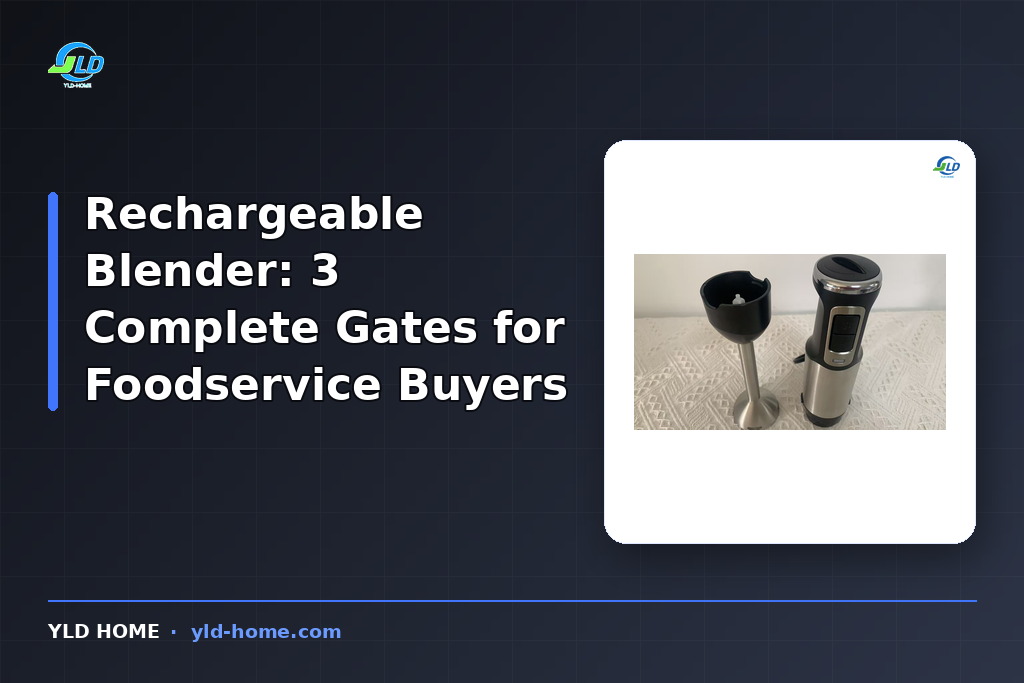
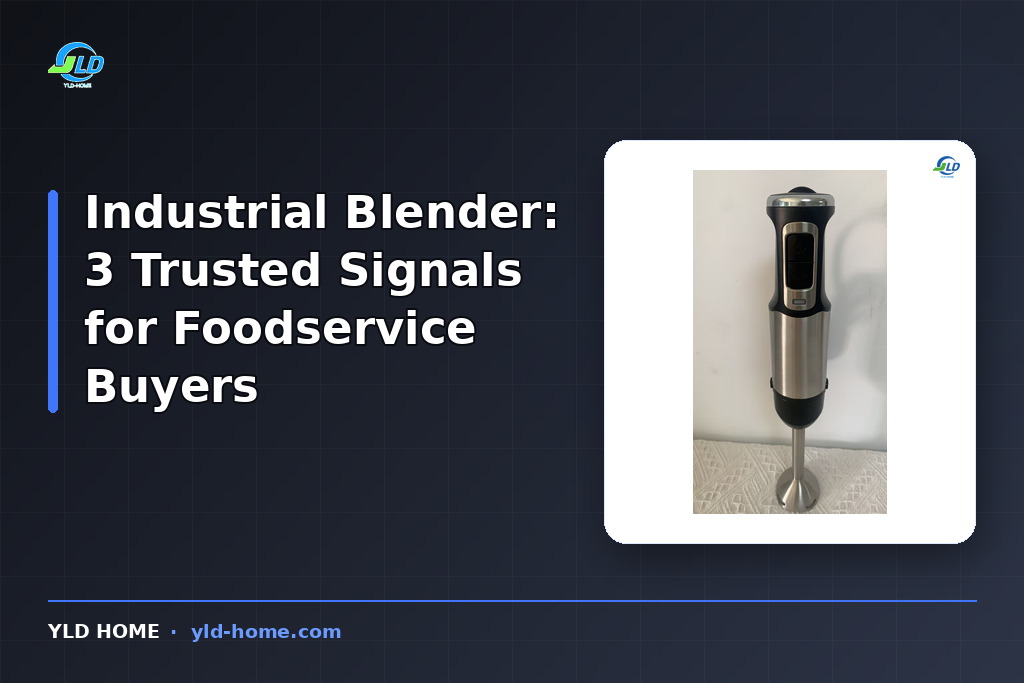
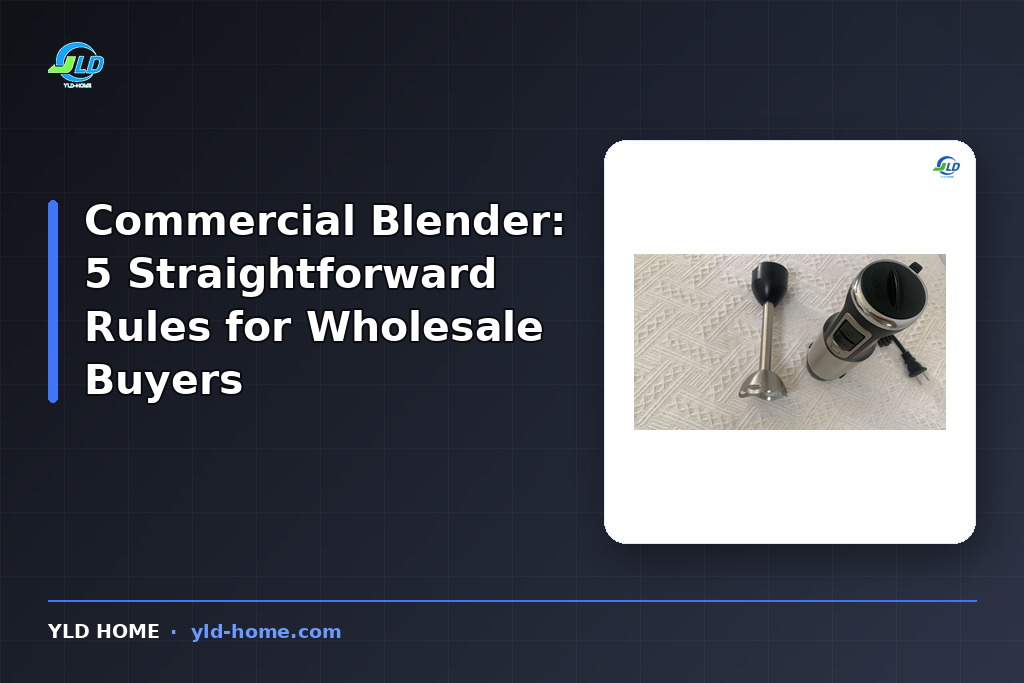
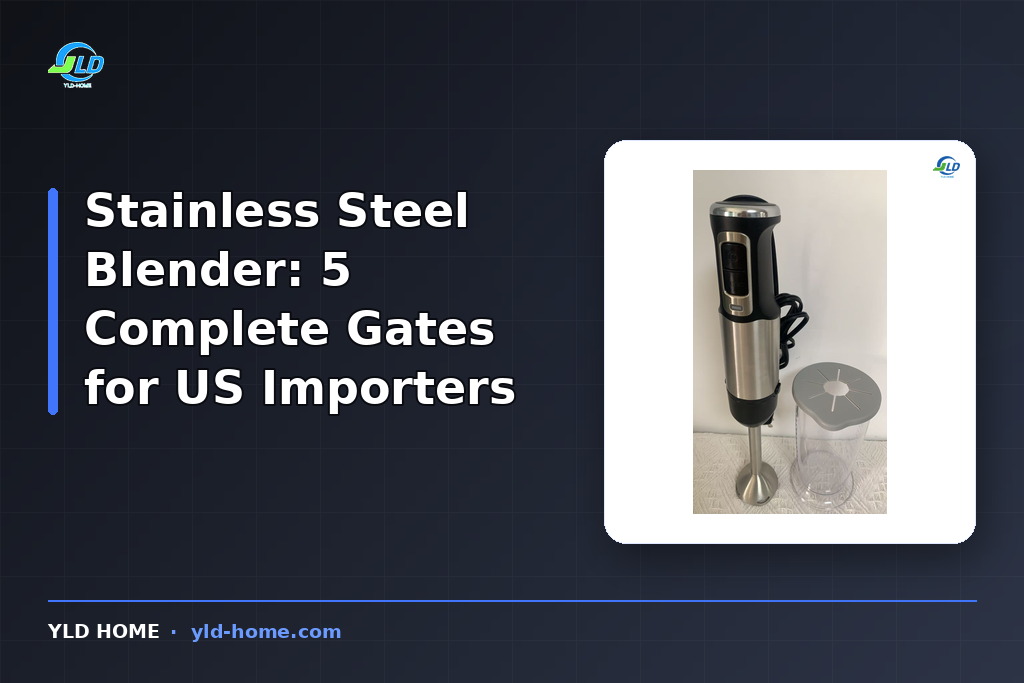
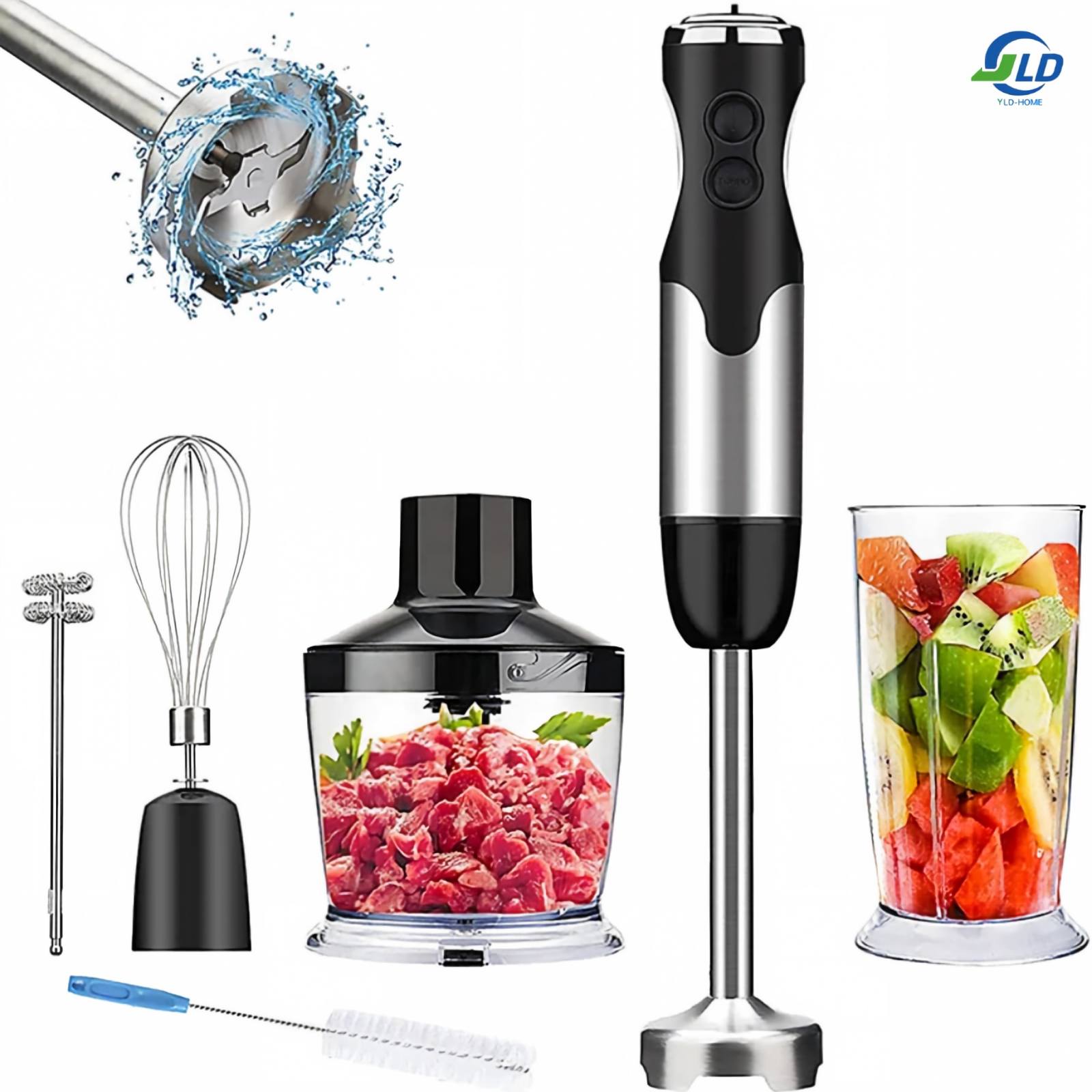
Each segment wants a slightly different machine. Bars want jar blenders. Kitchens want immersion units. Our 6010 powerful stick blender covers the kitchen side, and our 4-in-1 hand blender covers multi-station prep. Distributors who carry both can serve every segment above with just two SKUs.
How to Read a Commercial Blender Spec Sheet
A spec sheet is a sales document, so read it like one. Here is what matters and what is noise.
Motor power. Look for continuous output, not peak marketing wattage. A listing claiming 2000W peak may deliver half that continuously. Ask for the sustained rating.
Shaft and blade material. 304 or 316 stainless steel for food contact. Avoid coated shafts. Check the blade thickness, because thin blades dull and chip in commercial use.
Speed control. Variable speed with a dial beats two-speed switches for texture work. Pulse function is a bonus for bars.
Duty cycle. This is the spec that separates commercial from consumer. Look for 20 minutes continuous or better on immersion units. A machine that needs a 10-minute rest after every batch is not commercial.
Noise. Nobody publishes noise levels, but operators care. Ask for a video of the machine running at full speed before you commit.
Here is a comparison of the classes we produce:
| Spec | Entry commercial | Mid-range | Heavy-duty |
|---|---|---|---|
| Motor | 600-800W | 1,000-1,200W | 1,600W+ |
| Shaft material | 304 stainless steel | 304 stainless steel | 316 stainless steel |
| Speed control | 2 speeds | Variable speed | Variable + pulse |
| Continuous runtime | 10-15 min | 20 min | Continuous |
| FOB price range | $8 – $12 | $13 – $18 | $20 – $30 |
Our 6006L powerful stick blender sits in the mid-range sweet spot, and it is the model we quote most often for US kitchen suppliers.
Certification and Compliance for Commercial Blenders
The rules are the same as for any appliance sold in the US, but commercial buyers enforce them harder. Here is the checklist.
UL / ETL. Electrical safety for 120V operation. Required by most retailers, inspectors, and commercial insurance policies. The UL file matters: if you private label, transferring the file to your company gives you control of the certification.
FCC. Electromagnetic interference testing for the motor and controls. Required for import and sale in the US.
FDA food contact. The shaft, blades, and any food-contact parts need FDA-compliant materials. Request material certificates from the factory.
NSF. The commercial mark. Not legally required everywhere, but chains, schools, and many municipalities require NSF-listed equipment. It adds cost and time, so certify the models you sell in volume.
Prop 65. California’s Proposition 65 requires warnings for products containing listed chemicals. Confirm your supplier’s materials avoid the list, or you will deal with notice letters in California.
Also worth knowing: certification is per model, not per factory. A factory with UL files on three models does not have UL on the fourth. Ask specifically about the model you are buying, and get the certificate number in writing.
A practical point: ask the factory which models already hold certification. Existing UL and NSF files save you months. At YLD Home, our main commercial models hold UL, FCC, and FDA documentation, and we have NSF experience on select models. The paperwork folder is the first thing we show a US buyer.
Wholesale Pricing: What a Commercial Blender for Sale Should Cost
Price is where wholesale buyers make or lose money. Here are the FOB Shenzhen ranges by class, for orders of 500 to 2,000 units. Use them as planning numbers; ask us for a quote at your volume.
| Class | FOB price | Landed cost (West Coast) | Typical wholesale | Typical retail |
|---|---|---|---|---|
| Entry stick blender | $8 – $12 | +15-25% | $20 – $30 | $40 – $60 |
| Mid-range stick blender | $13 – $18 | +15-25% | $30 – $45 | $60 – $90 |
| Heavy-duty immersion | $20 – $30 | +15-25% | $45 – $65 | $90 – $130 |
| Countertop jar blender | $25 – $60 | +15-25% | $60 – $120 | $120 – $250 |
| Premium countertop | $80 – $160 | +15-25% | $180 – $320 | $350 – $650 |
The margin structure is why factory-direct sourcing keeps growing. A distributor who buys a heavy-duty immersion unit at $25 FOB and sells at $55 wholesale doubles the money even after freight and duty.
These ranges hold when the order is 500 to 2,000 units of a standard model. Custom colors, private label packaging, and ODM changes move the numbers up, and larger volumes move them down. The table is a starting point for your margin model, not a quote.
Three cost items buyers forget: packaging built for commercial durability, spare parts kits, and certification maintenance. Budget for all three, and your margin projection will survive contact with reality.
MOQ, Lead Times, and Getting the Goods to US Ports
The logistics side, in plain numbers.
MOQs run 1,000 units per model for standard configurations and 1,000 for private label. Lead time is 30 to 40 days from deposit for standard models, plus 7 to 10 days for custom branding. ODM projects with new tooling run 90 to 120 days. Plan holiday and summer peaks accordingly.
Shipping is where logistics quality shows. Most of our US clients ship by ocean freight from Shenzhen to Los Angeles, Long Beach, New York, or Houston. Transit is 12 to 16 days to the West Coast, 20 to 28 days to the East Coast. Customs clearance adds 2 to 5 days when the paperwork is right, and weeks when it is not.
The paperwork is the hidden variable. A shipment clears customs fastest when the factory provides commercial invoices, packing lists, UL certificates, FCC reports, and FDA material certs in one clean folder. We prepare that folder for every shipment, and our US buyers tell us their customs brokers finish entries in half the time.
A detail many buyers miss: book the freight early. Peak season, usually August through October, tightens container space and raises rates. Our export team flags this to US clients before they place the order, so nobody is surprised at the dock.
Payment is usually 30 percent deposit and 70 percent against the bill of lading, or L/C for larger programs. Sample orders ship by air, usually within a week. Keep 8 to 10 weeks of inventory and reorder on a rolling schedule, and you will never tell a customer “out of stock” during a busy season.
Private Label and OEM: Putting Your Name on the Machine
The fastest way to grow margin in the US commercial channel is to own the brand.
OEM is the entry point: you buy an existing model as-is, with your logo applied. Fast, low risk, low MOQ. The catch is that the same machine is available to every other distributor, so the price race starts early.
Private label is the standard upgrade. Your brand on the unit, your packaging, your manual, your colors. The machine is still an existing model, but the presentation is yours, and retail accounts start to associate the category with your name.
ODM is the full program. We modify the design to your spec: motor class, blade configuration, cable length, control layout, even custom colors. ODM creates a unit that nobody else in your territory can offer, which protects your margin for years.
The certification angle matters here too. When you own the brand, you want the UL file in your name, or at least a written guarantee of continued support from the factory. We handle file transfers for private label programs and walk buyers through the process during sample evaluation.
A private label program with YLD Home includes the UL file transfer option, spare parts support, and a US-friendly warranty process. Distributors tell us the branded unit outsells the identical unbranded machine two to one, which is the whole point.
The decision is about where you are in your growth curve. First container: OEM or light private label. Second and third: commit to a branded SKU. By the time you are ordering containers quarterly, ODM should be on the table.
Case Study: A Chicago Foodservice Supplier
A foodservice supplier in Chicago called us with a problem. His customers kept asking for a machine that could handle soup production, and the only options on his line card were two national brands priced at three times what he wanted to charge.
We sent samples of our HB006-3 detachable food processor and our heavy-duty immersion line. He ran them in a catering kitchen for three weeks: 15-liter soup batches, 20 liters of marinara, a full prep shift every day. The machines held up, and the detachable design made cleaning faster than anything his staff had used.
He ordered 1,500 units under his own label: immersion blenders, food processor attachments, and a spare parts kit. The container shipped to Chicago via the East Coast in about five weeks. His first sales cycle moved 900 units, mostly to independent restaurants and small caterers who had never been able to afford a machine like this before.
His margin on the branded line was 48 percent, compared with 22 percent on the national brands he had carried. He has since added our 4-in-1 hand blender to the program and is testing a countertop jar blender for his bar accounts.
The pattern repeats across the US: buyers do not need cheaper machines, they need cheaper access to good machines. Factory-direct private label is how that happens.
Red Flags When You See a Commercial Blender for Sale Online
The online marketplace is full of listings. Most are fine. Some will cost you money. Here is what sets off our alarms.
“Commercial” at consumer prices. A genuine commercial unit costs what it costs. If the price looks too good, the duty cycle is probably consumer-grade, and the warranty cost will eat the savings.
No certification documents. Any US-bound commercial appliance needs UL or ETL, FCC, and FDA material compliance. A listing that cannot produce documents is a listing to skip.
Peak wattage marketing. “2000W peak” with no continuous rating is a red flag. Ask for the sustained output and the duty cycle in writing.
No spare parts program. Commercial buyers replace parts, not machines. If the seller cannot supply blades, shafts, and seals, the product dies with its first field failure.
Vague factory identity. If you cannot find the factory, its address, and its export history, you are buying from a middleman who adds cost and hides risk.
No sample policy. Any supplier that will not send production samples for a small fee is telling you what they think of their own product.
No after-sales contact. If the listing cannot put you in touch with a person who answers technical questions, move on. Commercial kitchens break things, and when they do, they call you. You need a vendor who answers.
We are transparent about all of these on our side. Our samples come from the same production line as your container, and we publish the documentation you need to make a decision.
How to Pick a Vendor for the US Market
Last section, and it is the one that saves you the most money.
Start with documentation. UL or ETL certificates, FCC reports, FDA material certs, and for battery models, UN38.3. A vendor that produces these on the first call has done this before.
Test samples like your customers will. Run a full prep shift. Blend thick and thin. Clean the unit repeatedly. Ask for the field return rate and the failure analysis. We track the field return rate on commercial models and share it with every buyer on request.
Check the factory, not just the sales office. Visit, or do a live video tour of the assembly line, QC stations, and test benches. We host US buyers in Shenzhen regularly, and the visit settles more questions than a month of email.
Verify the after-sales system. Who answers warranty questions in US time zones? Can the vendor ship spare parts to a US warehouse? Commercial customers will call you at 8 a.m. with a broken machine and a full service to run. Your vendor needs to be reachable.
Start small. A first container of 500 to 1,500 units tells you everything about a vendor: quality consistency, paperwork accuracy, and honesty when something goes wrong. If the first container is clean, scale with confidence.
And when you are ready, the full YLD Home range covers the commercial spectrum: the 6010 powerful stick blender and 6006L powerful stick blender for kitchen work, the HB006-3 detachable food processor for prep, the 4-in-1 hand blender for multi-station flexibility, and the rest of the hand blender range for every other application. One factory, one compliance folder, one invoice.
Frequently Asked Questions
Q1. What is the best commercial blender for sale for a US distributor?
For most distributors, a mid-range immersion blender in the $13 to $18 FOB range is the best first SKU: real commercial duty cycle, strong margin, and broad demand from restaurants and caterers. Add a countertop jar blender as your second SKU for bar accounts.
Q2. Do these machines need UL or ETL certification?
Yes. Any 120V appliance sold into US commercial channels needs UL or ETL listing. Verify the factory holds the file and whether it transfers for private label, because the file is an asset you should own.
Q3. What separates a commercial unit from a consumer blender?
Duty cycle, materials, and serviceability. A commercial unit is built for extended continuous use, food-grade stainless steel construction, and replaceable parts. Consumer blenders are built for occasional use and are not designed for a dish pit.
Q4. What MOQ do I need for private label?
Standard private label runs 1,000 units, and custom ODM programs are quoted per project. We also offer sample programs so you can validate quality before the container order.
Q5. How long does shipping take from Shenzhen to the US?
12 to 16 days at sea to the West Coast, 20 to 28 days to the East Coast, plus 2 to 5 days for customs when the paperwork is complete. Total lead time from deposit is typically 6 to 9 weeks.
Q6. Can YLD Home manufacture a commercial blender for sale under my brand?
Yes. We offer OEM, private label, and ODM programs on our commercial line. You choose branding, packaging, and optional spec changes; we handle production, certification files, and export.
Q7. What is the typical warranty?
Standard factory warranty terms are written into the quotation, with coverage on the motor and on parts, plus a spare parts program for US warehouses. Field return data and failure analysis are shared with qualified buyers.