









In this guide:
- Why US buyers keep importing immersion blenders in 2026
- The compliance checklist: UL, ETL, FCC, FDA, and 120V
- Customs, duties, and tariff basics straight from CBP
- How to vet an immersion blender manufacturer in China
- MOQ, pricing, and lead times that make sense
- Private label: from your logo to the retail shelf
- Shipping, US ports, and Incoterms
- Red flags when a supplier looks too good
Search “immersion blender wholesale” and you will get thousands of supplier pages, most of them from China. Sorting the real factories from the trading companies is the hard part. We are YLD Home, a Shenzhen manufacturer that has shipped immersion blenders to US importers, distributors, and private-label brands for over a decade. You can watch how we build them on our YouTube channel, from motor winding to final test. This guide covers the full path: product specs, compliance, customs, factory vetting, pricing, lead times, and the exact questions to ask before you commit to a container.
Why US buyers keep importing immersion blenders
The category keeps growing in the United States for a simple reason: people actually use the thing. Home cooks blend soup right in the pot. Restaurants puree sauce without transferring hot liquid to a countertop blender. Bakeries, meal-kit companies, and even laboratories use the same tool. When we looked at our own order books at YLD Home, the pattern was clear. Orders for immersion blender models spike every September and stay strong through January, then the foodservice buyers come back in March and April ahead of summer menu changes.
Very few US factories still make small kitchen appliances at scale. That is the second reason imports dominate. The tooling, the motor winding, the injection molding, and the assembly lines mostly live in Guangdong now. So an American distributor who wants a reliable the product has two realistic choices: import from a proven factory, or pay a big markup to buy someone else’s imported stock. The math almost always favors importing directly.
There is also the private-label angle. Every year we see new US brands launch with their own color, their own logo, and their own packaging on the same proven motor platform. That used to be a big-company game. Now a distributor in Houston or a small brand in Chicago can run a container of immersion blenders with their name on the box. The barriers to entry are lower than most buyers think, which is exactly why this guide exists.
What you are actually importing: types and specs
Not every model is the same machine, and the differences show up fast in the field. Before you talk to any manufacturer, decide which configuration you actually need.
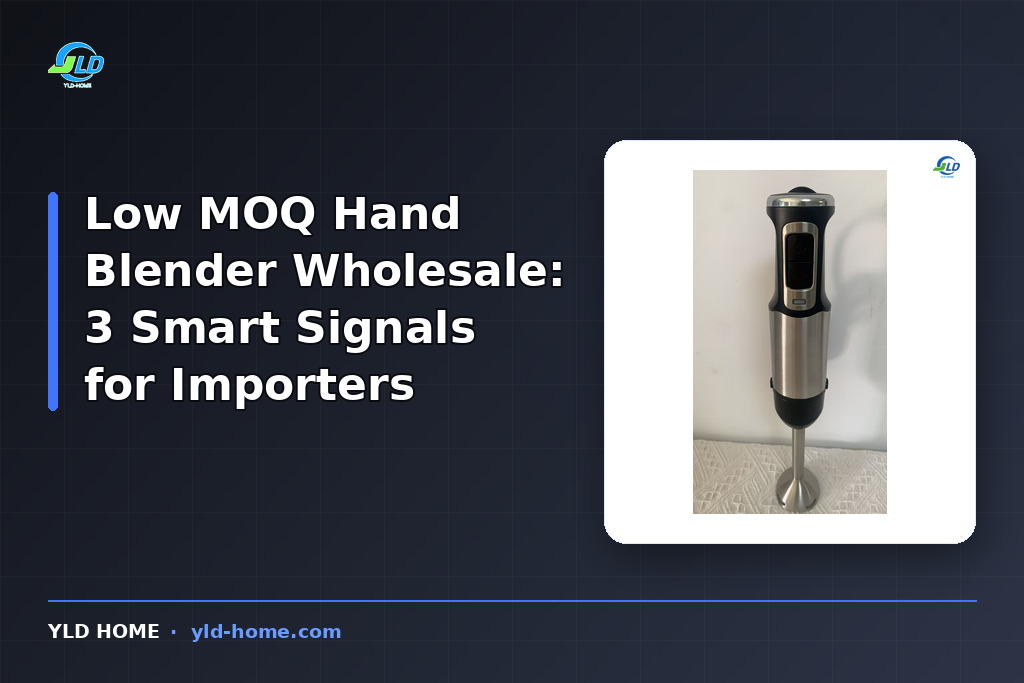
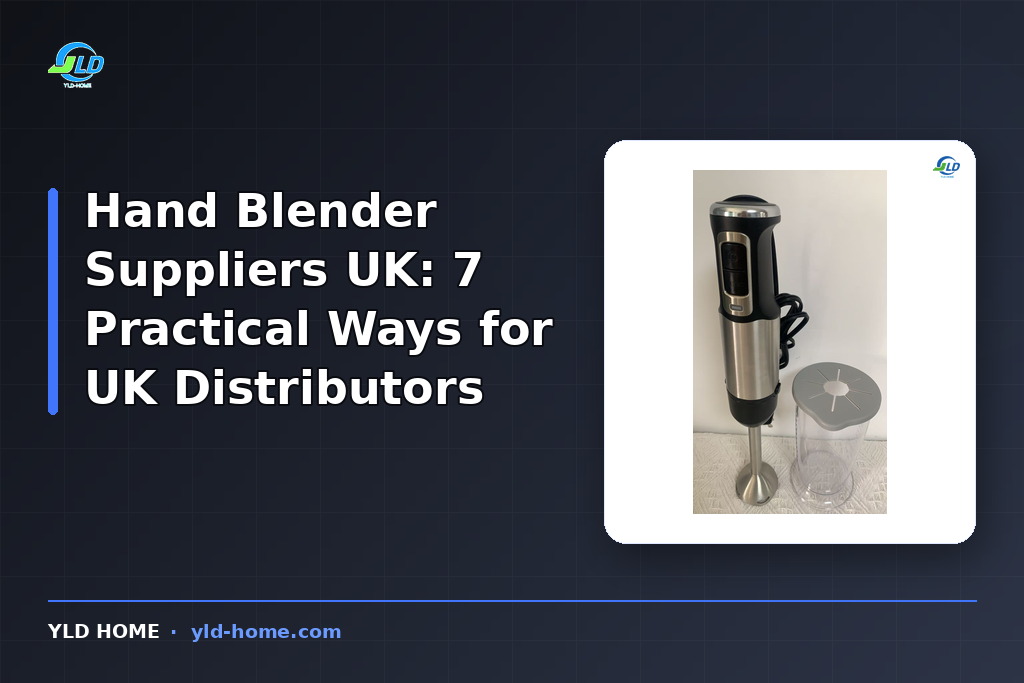
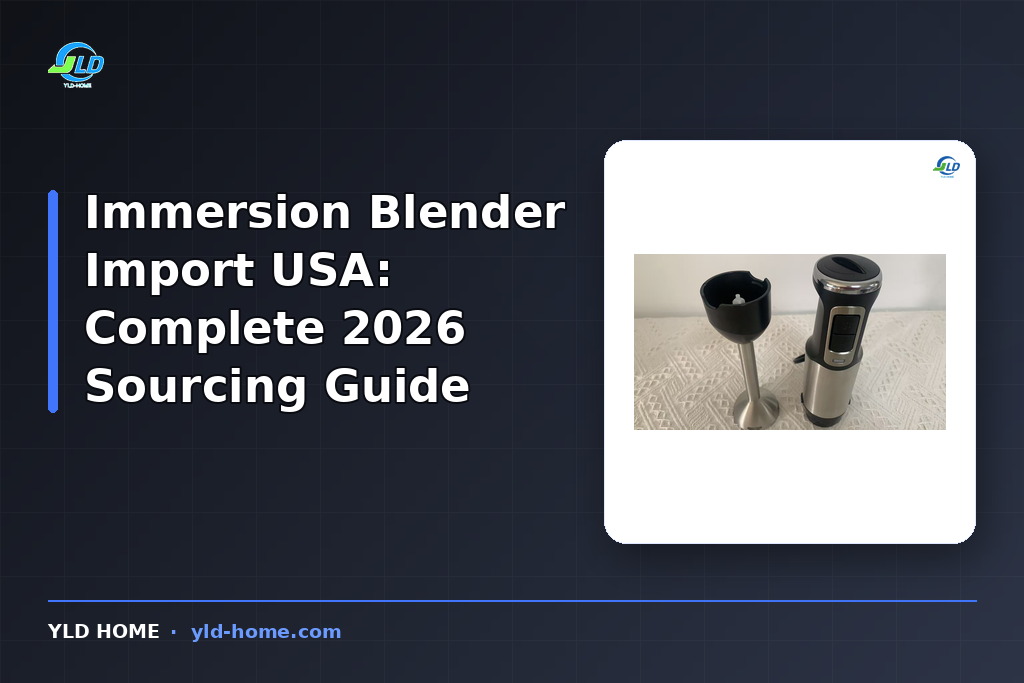
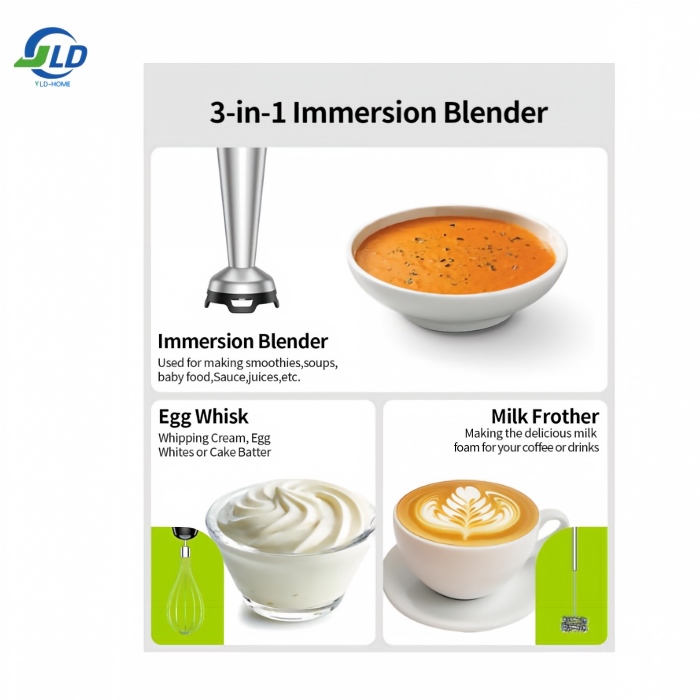
A basic stick-style model runs 300 to 600 watts, has a fixed shaft, and handles soups, sauces, and smoothies at home. A heavy-duty commercial unit runs 1,000 to 1,600 watts, uses a detachable stainless shaft, and is built to run for hours in a restaurant kitchen. In between, you have multi-function models that add a whisk, a chopper bowl, or a full food processor attachment. These 2-in-1, 3-in-1, and 4-in-1 machines are what most US retail buyers order first, because one SKU covers three selling stories.
The specs buyers actually argue about are wattage, shaft material, speed control, and noise. Wattage matters because American consumers read it as power. Shaft material matters because stainless steel sells. Speed control matters in foodservice, where a chef wants to go from a fast puree to a gentle fold without stopping the motor. Noise matters because retail returns spike when a blender sounds like a lawnmower.
Here is the spec sheet we work from when a US client asks us to quote an the product program:
| Specification | Home model | Commercial model |
|---|---|---|
| Motor power | 300–600 W | 1,000–1,600 W |
| Shaft | Fixed, stainless steel | Detachable, stainless steel |
| Speeds | 2–5 fixed speeds | Variable speed trigger |
| Voltage | 120 V / 60 Hz (UL listed) | 120 V / 60 Hz (UL listed) |
| Attachments | Whisk, chopper, or none | Whisk, chopper, food processor |
| Typical use | Home kitchen, gift sets | Restaurants, catering, foodservice |
| MOQ | 1,000 units per model | 1,000 units per model |
Keep this table handy. When a supplier quotes you a price, ask which column they are quoting. We have seen buyers compare a 300 W home unit against a 1,600 W commercial unit and wonder why one costs four times as much.
The compliance checklist: UL, ETL, FCC, FDA, and 120V
This is the section where most first-time importers get burned. A unit sold in the United States has to run on 120 volts and 60 hertz. That sounds obvious, but we still get emails from buyers holding samples that were built for the Chinese market at 220 V. It happens because factories quote fast and some trading companies do not check. Always confirm the voltage and plug type in writing.
Electrical safety certification is the next gate. American retailers will not touch a small appliance without a UL or ETL listing, and Amazon requires it for kitchen electricals. UL and ETL are both Nationally Recognized Testing Laboratories, so either one works for most buyers. The certification covers the motor, the wiring, the plug, and the enclosure. FCC compliance matters too, because every motorized appliance emits electrical noise, and the FCC has limits on it.
FDA food-contact rules apply to anything that touches food, including the blending shaft, the blade, and the jar if there is one. Your supplier needs FDA-compliant materials for the stainless shaft and any plastic that touches food. Do not take their word for it. Ask for the material certificates and the test reports, and keep copies with your import files.
Here is the honest part: certification is not free, and it is not instant. If you bring a brand-new design to market, UL testing and listing can take months and costs run into the thousands of dollars per model. That is why most US brands start with an existing certified model and private-label it. The factory already holds the certificates, and you get a compliant product without paying for the test cycle yourself. When we quote a private-label program at YLD Home, we send the UL report, the FCC report, and the FDA material declarations together with the quotation, because that is what a serious US buyer needs to show their retailer buyer.
Customs, duties, and tariffs: the CBP basics
Customs is where imported immersion blenders either sail through or sit in a warehouse accruing fees. The rules come from US Customs and Border Protection, and the agency publishes a plain-language guide to basic import and export procedures that every first-time importer should read before booking freight. Small kitchen appliances fall under a specific HTS code, and the duty rate depends on the classification, the country of origin, and any trade actions in effect that year.
Here is what we tell every client: get the HTS classification right before you ship, not after. A misclassified shipment gets held, inspected, or reassessed, and those delays eat your margin. Your supplier’s commercial invoice, packing list, and bill of lading must match each other line by line. We have seen a container held for two weeks because the invoice said “blender set” while the packing list said “hand blender,” and the officer wanted an explanation.
Two more things to plan for. First, duties are paid by the importer of record, which is usually your US entity, not the Chinese factory. Second, if you use a customs broker, give them the full product documentation up front. A good broker in Los Angeles or New York can clear an appliance shipment in a day when the paperwork is clean. The CBP guide we linked above covers the broker relationship, the entry process, and the records you are required to keep.
How to vet an immersion blender manufacturer in China
Every buyer asks us the same question: how do I know the factory is real? Start with the distinction between a manufacturer and a trading company. A manufacturer owns the mold, the motor supply chain, and the assembly line. A trading company owns a laptop and a catalog of other people’s photos. Both can sell you an the product. Only one can fix a quality problem in your next production run.
Ask for a video call inside the factory, not in the office. Ask to see the assembly line, the motor winding section, and the QC bench — you can preview that walkthrough in our factory floor video. A real manufacturer will happily show you all three. Ask which certifications they hold, and ask them to send the certificate PDFs with the factory name and address on them. Then check the addresses. A certificate issued to “Shenzhen ABC Technology Co., Ltd.” that comes from a supplier calling itself “ABC Group HK” is a warning sign.
Visit if you can. Buyers from New York, Los Angeles, and Miami fly to Shenzhen or Guangzhou for factory visits all the time, and the trip pays for itself on the first order. If you cannot travel, hire a third-party inspection company to do a pre-shipment audit. The inspection report should cover the line, the materials, the packaging, and the certifications. We host buyer visits at YLD Home several times a month, and we send the same documentation to remote buyers, because a serious buyer deserves the same answers either way.
When you shortlist a manufacturer for OEM work, ask these five questions: How many models do you produce per month? Which certifications do you hold and for which models? What is your defect rate on the last twelve shipments? Can you show me a sample with my logo? What happens when a unit fails in the US after six months? The answers tell you more than any brochure.
MOQ, pricing, and lead times that make sense
Money questions come third in our conversations, after compliance and factory vetting, because price means nothing on an uncertified product from an unverified factory. Still, you need real numbers to build your P&L. MOQs for immersion blender programs at a Chinese factory typically start around 1,000 units per model for a standard model and 1,000 units for a private-label program with custom color and packaging. Multi-function sets with extra attachments usually carry a higher MOQ because they need more parts.
Lead times follow a rhythm. A standard model with existing tooling runs about 3 to 4 weeks from order confirmation to ready-for-shipment. A custom private-label program with new colors and packaging runs 4 to 6 weeks because the color master batch and the packaging plates need their own production slots. Peak season changes everything. Orders placed in August and September for the holiday push compete for line capacity, so book early or expect slippage.
Pricing tiers look roughly like this for a mid-range model:
| Order size | Typical unit price (FOB) | What is included |
|---|---|---|
| 500 units | Quoted per model | Standard model, neutral packaging |
| 1,000 units | Quoted per model | Your logo, standard packaging |
| 2,000+ units | Quoted per model | Custom color, custom packaging |
| 5,000+ units | Quoted per model | Full OEM/ODM, new tooling options |
Do not fixate on the lowest number. A unit price that is 15 percent lower from an unknown supplier disappears fast when you pay for air freight because production slipped, or when a bad batch comes back as returns. When we quote, we include the production schedule and the QC plan in the same document, because total landed cost is what matters, not the FOB line.
Private label: from your logo to the retail shelf
Private label is how most US brands enter the small-appliance space, and immersion blenders are one of the easiest categories to start with. The factory holds the UL listing. The motor platform is proven. You bring the brand, the color story, the packaging, and the distribution. That split of responsibilities works, as long as the contract is clear.
The minimum private-label program at YLD Home includes your logo on the unit, your brand on the box, an instruction manual in English with your company details, and barcodes printed to your spec. From there you can go further: custom color, custom handle texture, custom accessory kit, even a bespoke model built around your spec. That is OEM territory, and it needs tooling investment and longer timelines, so most brands start with the logo-and-packaging tier first.
One thing to plan early is the retail packaging itself. US retailers have display requirements, and Amazon has its own packaging rules. Get your box dimensions, drop-test results, and carton markings approved before mass production, not after. A distributor in Houston once told us his private-label blender line sat in his warehouse for three weeks because the cartons lacked the barcode placement his grocery chain required. Small details like that decide whether your product reaches the shelf on schedule.
Shipping, US ports, and Incoterms
Sea freight is the default for immersion blender programs because the products are heavy and the margins are thin. Most Shenzhen shipments go out of Yantian or Shekou and land at Los Angeles, Long Beach, New York, or Savannah. Transit time to the West Coast runs about 18 to 22 days, and to the East Coast about 25 to 30 days through the Panama Canal. Air freight is possible for urgent reorders, but a container of blenders is heavy, so air only makes sense for small test quantities.
Incoterms decide who owns the risk at each step. FOB Shenzhen is the most common starting point: the factory delivers the goods onto the vessel, and from that moment the freight, insurance, and customs are yours. CIF and DDP shift more responsibility to the supplier, and DDP in particular needs a supplier that truly understands US customs. If a quote says DDP, ask who the importer of record is. If the answer is vague, walk away.
Plan for the port side too. Peak season congestion at Los Angeles and Long Beach is a recurring story, and demurrage charges stack up fast. Your customs broker should know your container’s arrival date the day it departs, not the day it docks. And always carry cargo insurance. We have seen two containers lost or damaged in our years of shipping, and in both cases the insurance was the difference between a recovered loss and a write-off.
Red flags when a supplier looks too good
A price 40 percent below the market is not a deal. It is a flag. An immersion blender at that price is either missing the UL-listed motor, using thinner shaft steel, or quoting you a home model while showing photos of a commercial one. We have had buyers come to us after that exact experience, holding samples that failed within a month, and the “factory” they paid had stopped answering messages.
Watch for these patterns: a supplier that only communicates through a sales platform and refuses a video call; a certificate PDF with a different company name; an MOQ that changes after you send a deposit; a lead time that extends every week; and a sample that arrives with no certifications attached. Any one of these is survivable. Two or more together is a strong signal to keep looking.
The other quiet flag is overpromising on customization. If you ask for a custom color and the supplier says yes to everything with no discussion of tooling or timelines, they are probably planning to slap your logo on whatever they have in stock. A real factory will tell you what a change costs and how long it takes. That conversation is a trust test, and honest answers are a good sign.
Your first order: a simple action plan
Start small and move fast. Order samples from three shortlisted immersion blender manufacturers, including at least one that holds UL and FCC reports for the model you want. Test the samples yourself: run hot soup, run a thick sauce, run the unit for ten minutes straight, and listen to the noise. Check the shaft for flex and the speed trigger for feel. Your buyers in the US will judge the product the same way.
Then place a small first order, 1,000 units or whatever the MOQ allows, and use that shipment to validate the entire chain: production, QC, packaging, freight, customs clearance, and delivery to your warehouse. Measure the actual lead time against the promised one. Measure the defect rate against the factory’s claim. That first container is your training run, and the data it produces is worth more than the margin you could have made on a bigger order.
When you are ready to scale, ask your supplier for the next tier of pricing and lock in a production calendar. This is where a real partner earns their keep. At YLD Home, most of our US customers start with one model and grow into a family of products: a 2-in-1 hand blender for entry price points, a 3-in-1 hand blender for the mid tier, a stainless steel hand blender for premium retail, a PressPro 1600W hand blender for foodservice, and a 6010 powerful stick blender for the commercial catalog. One factory, one QC standard, one set of certifications across the line. For deeper background on how those lines run, the YLD Home blog has the production walkthroughs.
The short version: import immersion blenders on purpose, not on price. Verify the factory, lock the certifications, get the paperwork right, and build the relationship before you build the volume. The US market rewards importers who do their homework, and punishes the ones who skip it.
Frequently Asked Questions
Q1: What is the best immersion blender wholesale price I can get in 2026?
Wholesale pricing for an immersion blender depends on the model tier and the order size. A basic home unit sits in the cheapest tier at container volumes, while a commercial 1,600 W model with variable speed runs several times that. The price you should target depends on your retail channel, your margin goals, and whether you need UL-listed motors. Get three quotes with certifications attached, and compare landed cost, not just the FOB line.
Q2: Do I really need UL or ETL certification to sell immersion blenders in the US?
If you sell through retail or online marketplaces, yes. Big-box retailers require a UL or ETL listing for small kitchen appliances, and Amazon enforces it for electrical products. Foodservice buyers in most states ask for it too. UL and ETL are both accepted by US retailers, so pick whichever your supplier already holds.
Q3: How long does shipping from China to the US actually take?
West Coast ports like Los Angeles and Long Beach usually take about 18 to 22 days from Shenzhen. East Coast ports add another week or so through the Panama Canal. Add production time on top of transit, and a full order typically lands 8 to 12 weeks after you confirm it, depending on the season.
Q4: Can I put my own brand on an immersion blender made in China?
Yes. Private label is the standard route: your logo on the unit, your brand on the box, English manuals, and barcodes to your spec. Custom colors and packaging are available at higher MOQs. Most US brands start with an existing certified model and add their branding, which keeps costs and timelines manageable.
Q5: What is the minimum order quantity for a private-label program?
MOQs vary by factory and model. Standard models with existing tooling usually start around 1,000 units per model, while custom-color private-label programs start higher. Multi-function sets with extra attachments carry higher MOQs because they need more parts. Ask for the MOQ in writing before you invest in samples or packaging design.
Q6: What happens if a batch of immersion blenders arrives defective?
That depends on your contract. Serious factories warrant the goods against manufacturing defects and will replace or credit defective units, usually after a defect report with photos. The warranty terms, the replacement process, and the timeline should be written into your purchase order. That is why pre-shipment inspection matters: defects found at the factory cost you nothing compared with defects found in your warehouse.
Q7: Do I need a customs broker for my first container?
You do not strictly need one, but we recommend it. A licensed broker handles the entry, the classification, and the duty payment, and they catch paperwork problems before they become delays. The CBP basic import and export guide is a good place to start understanding the process, and a broker makes the practical side much easier.
Q8: Should I use a trading company instead of a factory?
A trading company can be a fine middleman for small quantities, but you pay a markup and you lose control of quality and schedules. If you plan to build a real immersion blender program with repeat orders, work directly with a manufacturer that holds the certifications and owns the production line.