










In this guide: Why Home Retail Is Different · How to Choose a Hand Blender UK · Power and Speed · Shaft, Blade and Build · Attachments That Sell · Corded vs Cordless · Branding and Packaging · Ecommerce Channels · Wholesale for Ecommerce Sellers · Regional Insight: Lincoln · FAQ
If you are planning a home retail range for 2026, knowing how to choose a hand blender uk range that actually sells starts with the shopper, not the spec sheet. UK home retail runs on supermarkets, homeware chains, department stores and online marketplaces, and each of them buys differently. We’ve supplied these channels for years, and the same mistakes keep coming up: over-specifying power, under-investing in packaging, ignoring the whisk. This guide covers what we check before a single unit goes on the shelf.
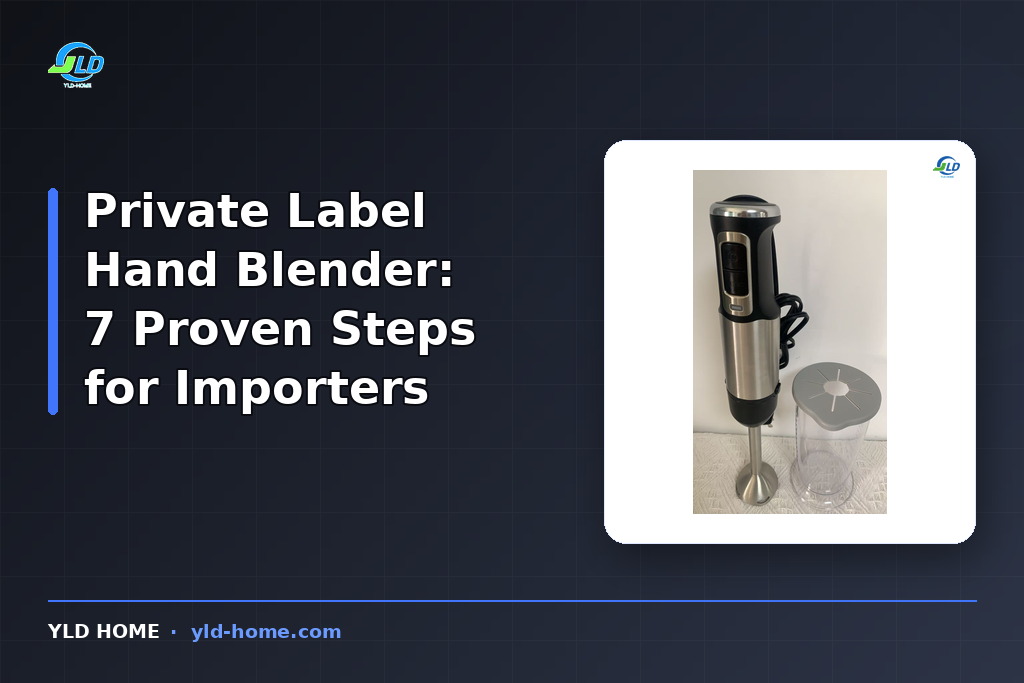
For buyers comparing supply options, the hand mixer range from YLD HOME lists every model by type and wattage, with MOQ, lead time and certification stated per page.
Why Home Retail Is a Different Game
Put a hand blender in front of a home shopper and you’ll usually get a decision in under two minutes. Home retail is the volume engine of the UK small appliance market: supermarkets such as Tesco and Sainsbury’s treat hand blenders as everyday kitchen staples, homeware chains such as Dunelm, Lakeland and Argos sell them as giftable, repeat-purchase lines, and department stores such as John Lewis rely on brand trust. Prices sit between £15 and £60, and the decision is often impulse.
Three behaviours define this shopper. Start with gifts: hand blenders spike at Christmas, Mother’s Day and wedding season, so packaging and shelf position matter as much as the motor. Then there’s returns: home buyers return more than trade buyers when expectations are not met, which makes honest specs and clear manuals essential. Finally, brand: a recognised brand or a well-designed private label outsells unbranded equivalents at the same specification.
For a retailer or distributor, home retail means planning ranges around seasons, keeping best sellers in stock through Q4, and choosing models that are easy to explain on the box. Commercial catering buyers forgive plain packaging; home buyers do not. That is why the selection process for retail stock differs fundamentally from horeca supply, and why most UK importers run the two ranges separately. The difference shows in data: a home retail unit sells for less but turns over several times faster than catering equipment, and households buy upgrades and spares on shorter cycles. Range decisions that look small, such as adding a pastel colour option or a compact storage box, move sell-through more than a 100W power increase. That is the reality a 2026 range plan has to price in.
How to Choose a Hand Blender UK: Start with the Home Buyer
Before you pick a motor, pick a buyer. The fastest way to learn how to choose a hand blender uk is to segment the shoppers you are serving, because a single one-size-fits-all model leaves margin on the table. A student, a family and a health-conscious professional want different things.
| Buyer profile | Typical tasks | Best power band | Key selling point |
|---|---|---|---|
| First-time buyer | Soups, basic sauces | 300-400W | Low price, simple controls |
| Family household | Soups, smoothies, baby food | 400-500W | Detachable shaft, easy cleaning |
| Health and smoothie user | Daily smoothies, protein shakes | 500-600W | Beaker and turbo, strong blades |
| Empty nesters | Soups, small portions | 300-400W | Light weight, quiet motor |
| Gift buyer | Any | 400-600W | Attractive set, premium packaging |
Once you map the profile, the specification follows. Every profile in the table is served by a corded model with a stainless shaft; the differences are power, accessories and presentation. Stocking two or three profiles instead of one doubles your shelf coverage without doubling your SKU count.
Retailers who skip this step end up with a single 200W model that disappoints smoothie users, or an 800W model that scares first-time buyers off with the price. The middle of the market, 400-500W with a whisk and chopper, is where UK home retail volume sits, and it should anchor every range. When buyers search how to choose a hand blender uk, they are really asking which of these profiles they belong to.
Power and Speed: What UK Shoppers Actually Need
Wattage is printed on every box, so shoppers treat it as the truth. The good news is that home use does not need commercial power; the band between 300W and 600W covers the overwhelming majority of UK households. That is the first lesson in how to choose a hand blender uk sensibly.
| Power band | Best for | Retail price range | Typical speeds |
|---|---|---|---|
| 200-350W | Light soups, soft sauces | £15-£25 | 2 speeds |
| 400-500W | Everyday soups, smoothies, baby food | £20-£35 | 2-5 speeds plus turbo |
| 600-800W | Heavy blending, frozen fruit, thick soup | £35-£60 | Variable plus turbo |
Speed control matters more than raw wattage for home users. Two or three fixed speeds satisfy most buyers, whilst variable speed attracts the premium segment that wants control over texture. Turbo or pulse is now a near-universal expectation, and its absence is a common complaint in UK reviews. For most households, a 400-500W stainless shaft model is also the best immersion blender for home uk retail in terms of value for money.
UK voltage is 220-240V at 50Hz, and every model sold through retail must carry a UK Type G plug. Models configured for other markets fail retail listing checks, so confirm the configuration at the factory rather than relying on adapters. YLD Home configures all UK retail models with Type G plugs and UKCA documentation as standard, which removes the most common sourcing error. For retailers who also serve catering accounts, the YLD PressPro 1600W hand blender shows what the commercial tier looks like.
Shaft, Blade and Build: What to Check Before You Order
The shaft and blade are invisible in the box and unforgettable on first use. A stainless steel shaft is the baseline expectation in the UK; plastic shafts dent and discolour with hot soup and come back as returns at higher rates. Look for a shaft at least 190mm long so the blender reaches the bottom of a standard saucepan without the motor head dipping into the food.
Blade design determines blending quality. Four-blade stainless configurations with serrated edges handle frozen fruit and fibrous vegetables far better than simple two-blade cutters, and the extra cost is small. Anti-splash features, such as a bell-shaped guard around the blade, reduce mess and show up well in review scores.
Build quality signals itself through weight and balance. A well-balanced unit with a comfortable grip feels premium in the hand, and UK shoppers increasingly read reviews before buying, so the tactile experience drives ratings. Detachable shafts are now a strong selling point: buyers want to rinse the shaft under the tap without washing the motor.
When we tested production samples for our UK clients, we checked three things you should too. First, blade-to-shaft seating: a wobbling blade or a shaft that flexes under pressure is a defect buyers will find within a week. Second, the stainless grade certificate: the difference between 304 and 201 grade steel shows up as rust spots within months of dishwasher use. Third, noise: a loud motor is a top complaint in UK home reviews, so test in a quiet room. A quiet, well-balanced unit at a mid-range price earns the four and five star reviews that carry retail sales.
Attachments That Lift the Average Basket
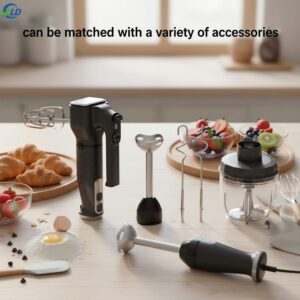
This is where margin hides. A bare blender sells at the commodity price; a blender with a whisk, chopper and milk frother sells as a kit at a significantly higher price point, and the shopper perceives genuine value in the set.
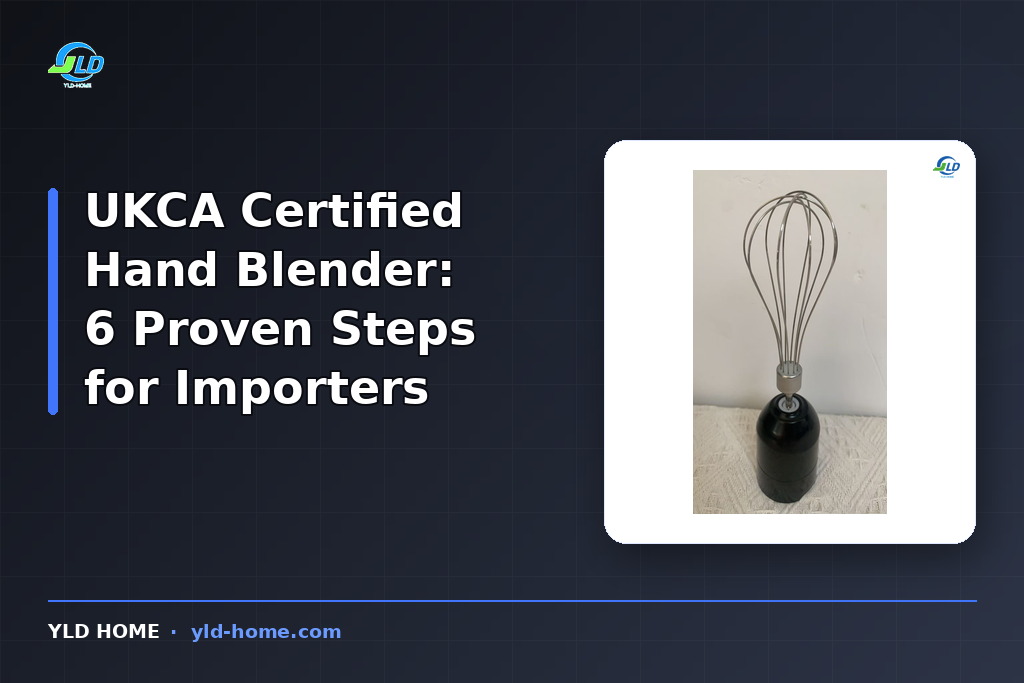
The whisk is the most demanded attachment in the UK, used for cream, eggs and batter. The chopper cup, typically 500-800ml, extends the blender into a mini food processor and is the second most valued accessory. The milk frother has grown quickly with home coffee culture and is now a differentiator on marketplaces. A measuring beaker, 600-1000ml, doubles as the blending vessel and is expected in most sets.
Three rules for accessory strategy. Sell at least one kit SKU per range, because kits lift average order value by 40-60% compared with single units. Make accessories interchangeable across your models where possible, which simplifies spare parts and increases accessory repurchases. And keep the accessory count honest: buyers and reviewers count the pieces, and a five-piece set that is really a blender with two small cups generates negative reviews. The 2-in-1 hand blender shows how a whisk-and-blender combination keeps the kit honest while still lifting the basket.
When you source wholesale, ask for the kit configuration that matches your channel: supermarkets favour compact sets, marketplaces favour larger visible kits, and independent shops favour giftable presentation boxes. The same factory line can usually produce all three. Storage matters more than most buyers expect: a set that includes a wall bracket or a compact storage case solves the classic UK kitchen problem of nowhere to put the accessories. If your channel is supermarkets, ask for a set where the beaker nests inside the chopper cup so the box stays small.
Corded or Cordless: Which Should You Stock?
Ask ten UK retailers and you’ll get ten different answers. Corded models remain the backbone of UK home retail: cheaper, lighter, more powerful for the price, and never out of charge mid-recipe. For supermarkets and value retailers, the corded 400W model with a whisk is the proven volume line.
Cordless models are the growth segment. UK buyers increasingly want to blend directly in the pan or jug without hunting for a socket, and cordless units with a charging dock or USB-C charging have moved from novelty to mainstream. Expect battery capacity around 2000-2600mAh, giving 20-35 minutes of run time, which covers soup batches and daily smoothies.
Cordless trade-offs are real: a higher retail price, a heavier motor head, and battery degradation over two to three years. Retailers should plan warranty terms around the battery, typically 12 months, and stock the matching charging cable as a spare part. YLD Home’s cordless line ships with USB-C charging and a 12-month battery warranty, which makes the warranty conversation with retailers straightforward.
The balanced 2026 range carries both. Use corded for the value band and the premium band, and cordless for the convenience segment between them. Check that both configurations carry UKCA documentation, because cordless models with charging functions still fall under electrical compliance in the UK. Price the two lines honestly: the cordless premium is typically £10-£15 at retail, and the marketing should sell convenience, not power. A single USB-C charging cable across your cordless models reduces SKUs and makes the spare-parts conversation simpler for retailers.
Branding and Packaging for UK Shelves
The box is your salesperson on the shelf. Home retail buyers make their first decision from the packaging, so retail-ready boxes are non-negotiable: a clear product photo, visible wattage and speed information, the UKCA mark, a UK plug image, and a short benefit line in UK English.
Private label is the fastest route to margin in home retail. An unbranded blender competes on price; a private label blender competes on brand. UK retailers and distributors who private label typically lift retail price by 20-40% over the same unbranded unit. The factory handles logo printing, box design, manual translation and UKCA paperwork, and the buyer owns the shelf presence. YLD Home produces retail-ready packaging, UK English manuals and EAN-13 barcodes for private label buyers, which is why its UK retail ranges launch without repackaging.
The manual matters more than most importers think. It must be in UK English, cover safety warnings, explain assembly and cleaning, and include a warranty card with the distributor’s contact details. UK consumers read appliance manuals more than buyers in most markets, and errors in translation or voltage information generate returns and negative reviews.
Finally, sort the logistics of packaging early: display cartons for independent shops, shipper-friendly outer boxes for marketplaces, and EAN-13 barcodes registered for UK retail. Confirm these details at the sample stage, because changing packaging after production is expensive. Retail buyers also check box weight and dimensions against their shelf planograms, so request the exact carton measurements at quotation stage. The full hand blender range YLD Home ships to UK buyers is configured this way from the first sample.
Ecommerce Channels: Marketplace and DTC
Most of our UK clients now sell more online than in store. Amazon UK is the dominant marketplace, followed by eBay, and both reward complete listings: strong titles, clear images, UK-specific bullets and compliance documents uploaded in advance. The title should follow the format Brand + Hand Blender + power + key feature + accessory set, and hand blender should appear alongside stick blender because UK shoppers use both names; our guide to the naming differences between immersion, hand and stick blenders explains why this matters for search coverage.
Titles and bullets should answer the questions behind the how to choose a hand blender uk search: what power do I need, is it corded or cordless, what is included, how do I clean it, and what warranty applies. UK spelling matters: colour, whisk, soup, catering. Include the UK plug and voltage in the first bullet, because that is the most common hesitation point.
Direct-to-consumer stores on Shopify give retailers control over margin and data. A DTC page with comparison tables, honest specifications and a video demonstration converts well for mid-price models. Many UK sellers run marketplace and DTC in parallel, using marketplaces for volume and DTC for private label lines.
Watch the YLD Home multi-function immersion blender set in action to judge how a complete kit performs before you commit to stock:
YLD Home product video: multi-function immersion blender set
More demonstration clips sit on the YLD Home channel on YouTube, which is useful material for your own DTC pages and marketplace listings.
Whatever the channel, the images decide the click: the blender in use, the full accessory set, a clean studio shot of the branded unit. FBA sellers need barcodes on the outer carton and a carton weight under the platform threshold, whilst DTC sellers need packaging that survives a single parcel journey. Sellers who sort these details before ordering avoid the classic delay of relabelling stock at the fulfilment centre.
Hand Blender Wholesale for UK Ecommerce Sellers
Ecommerce sellers buy differently from shops, and we’ve adjusted our production around that. Hand blender wholesale for UK ecommerce sellers means low initial MOQs, mixed containers, UK configuration, compliance documents, and packaging that survives courier handling. A seller testing three models needs a factory that will produce a mixed load, not a factory that insists on one SKU per container.
| Sourcing checklist | Why it matters |
|---|---|
| UKCA documents for the exact model | Marketplace approval and customs |
| UK Type G plug, 220-240V | Listing compliance and fewer returns |
| Retail packaging with barcodes | Amazon FBA and eBay requirements |
| Sample testing before bulk order | Review scores drive conversion |
| Mixed model MOQ | Test demand across segments |
| Spare parts availability | Warranty and marketplace claims |
Sellers who know how to choose a hand blender uk at factory level ask for three things: a UK-configured sample, the certificate for the exact model number, and a written MOQ and lead time. The sourcing discipline is the same one we lay out in our hand blender wholesale market guide, and for UK sellers the checklist above is the practical version. Our guide to choosing a hand blender manufacturer in China covers the factory audit side in detail.
YLD Home supports exactly this pattern: UK-configured samples, mixed first containers, private label packaging, and spare parts dispatched for after-sales. Sellers who source this way launch in weeks rather than months, and they reorder based on sell-through data instead of guesswork. The wholesale blenders range lists the UK-configured models ecommerce sellers most often test first. Contact YLD Home for samples and the current MOQ schedule.
The economics work because ecommerce removes the retail middle layer. Buy wholesale, sell at retail, fund customer acquisition from the spread. The risk is inventory: buy too deep and cash sits in a warehouse; buy too shallow and listings lose rank during restock. Mixed small orders solve both problems during the testing phase.
Regional Insight: Home Blender Retail Lincoln
National ranges hide local quirks. Regional markets such as Lincoln show how home blender retail Lincoln behaves differently from London or Manchester. Lincoln is a cathedral city and county town with a strong independent retail scene: farm shops, gift shops and small cookware specialists, alongside national chains and online competition.
Independent retailers in Lincoln buy differently from national chains: smaller order quantities, faster restock, giftable presentation, personal supplier relationships. A distributor serving this market succeeds by carrying mixed ranges, offering mixed-case ordering and next-day delivery, and supplying point-of-sale materials that independent shops actually use.
Local demand signals are useful for any national seller. Lincoln’s population skews towards families and retirees, which maps to the 400-500W family model and lighter 300W models respectively. Farm shops and delis in the county also buy small quantities of commercial-grade units for their own kitchens, a B2B pocket that sits inside a retail town. Regional buyers search how to choose a hand blender uk every week, and the retailers who answer with a local range win the sale.
Practical steps for a supplier: offer a Lincoln-market starter case with mixed models and spares, provide shelf talkers with the distributor’s contact number, and run one local promotion per season, such as a soup-season bundle in October. Regional accounts respond to attention, and attention is cheaper than discounting. The same playbook that works in Lincoln scales to dozens of UK market towns. One more thing we noticed in towns like Lincoln: the buyers who order in January are often the same buyers who reorder in September, so capture their contact details at the first sale and build a simple reorder reminder. It sounds obvious, but most suppliers never do it, and the distributor who does owns the shelf.
Frequently Asked Questions
- How do I know how to choose a hand blender uk for marketplaces? Keep it simple: complete listings, UK spelling, plug and compliance info in the first bullet. YLD Home supplies UK-configured samples of the exact models you will list.
- What power do UK home buyers need? Honestly, 400-500W covers most households; go 600W and above for smoothie-heavy users. YLD Home’s 400-500W kits sit at the sweet spot of UK retail demand.
- Corded or cordless for home retail? Corded for value and premium, cordless for the convenience segment. Most ranges carry both, and YLD Home’s cordless line ships with USB-C charging as standard.
- Do retail models need UKCA? Yes. Electrical goods placed on the GB market need conformity documentation, no exceptions. YLD Home provides UKCA documents with every UK retail model.
- What attachments sell best in the UK? The whisk, chopper cup and milk frother kit outsells bare units every time, which is why YLD Home’s kits bundle all three.
- Can you private label with UK packaging? Yes, YLD Home handles logo, box, manual and barcode configuration.
- What is the MOQ for a mixed first order? [fill actual]; YLD Home supports mixed first containers so you can test several models in one shipment.
- Do you supply spare parts for retail after-sales? Yes, motors, shafts, blades and accessories, with YLD Home keeping spares available for UK dispatch.
Official references: Retail – Wikipedia
For buyers planning their next order, how to choose a hand blender uk decisions come down to supplier reliability, unit cost and compliance. how to choose a hand blender uk buyers who compare factory-direct options against trading company quotes tend to get better pricing, and how to choose a hand blender uk ranges with UKCA-certified models move faster at retail. If you are evaluating a new line, keep how to choose a hand blender uk specifications such as wattage, speeds and shaft material in a checklist before you request samples.
Related models in this range: Hand Mixer With Storage Case and Hand Mixer With Dough Hook, 7 Speed Hand Mixer.