







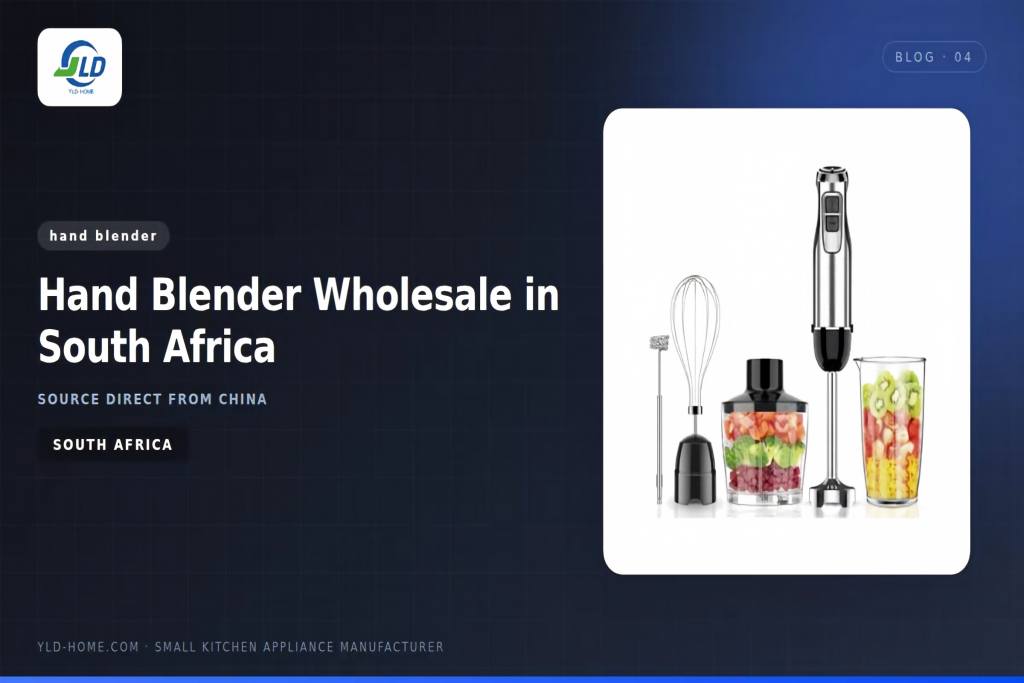

South Africa’s small appliance market is growing steadily, and kitchen appliances lead the demand. For importers in Johannesburg, Cape Town and Durban, sourcing hand blender wholesale in South Africa from China is a proven business model. This guide explains the market opportunity, the compliance requirements, the logistics, and the exact steps to build a reliable supply chain.
For buyers comparing supply options, the hand blender range from YLD HOME lists every model by type and wattage, with MOQ, lead time and certification stated per page.
Overview for hand blender wholesale in South Africa
South African buyers balance price and reliability. Imported hand blenders compete with local brands on price and with premium European brands on value. The segments to watch are household hand blenders (150-500W) for retail, and commercial immersion blenders (800-1600W) for restaurants, catering and hotels in the main metros. Wholesale buyers who carry both segments cover the widest demand.
The market has a strong informal trade channel as well as formal retail. Spaza shops and small distributors buy in smaller quantities but order frequently. Understanding your channel mix matters because it determines pack sizes, price points and documentation needs. Formal retail needs full compliance documents; informal channels care more about price and availability.
Why Import Hand Blenders from China?
China offers the widest range of hand blender models at factory prices, with OEM and private label support that local distributors can use to build their own brands. Shipping to South Africa is well established, with sea freight to Durban and Cape Town and air freight for samples and urgent orders. Because hand blenders are compact and relatively light, even LCL (less than container load) shipments remain profitable at moderate volumes.
Compliance & Certification for South Africa
Electrical appliances imported into South Africa must meet SABS / SANS requirements, and plugs must match South African Type M/N sockets. Confirm with your supplier that the model can be produced with the correct voltage (220-240V) and plug, and that the required documentation is available.
The practical steps are: request the certificate for the exact model, check the validity period, and confirm whether the certificate covers the South African market. Work with a customs broker who knows the SABS process, because the documentation requirements change and mistakes are expensive. Also confirm the labelling requirements, including the manufacturer’s details and wattage markings on the product itself.
How to Find a Reliable Supplier
- 1. Ask for a sample before any bulk order and test it under local conditions.
- 2. Verify certifications for the exact model, not the factory’s generic brochure.
- 3. Request the packaging and instruction manual in English.
- 4. Confirm spare parts availability, because blenders fail and parts support decides whether your customers stay.
- 5. Start with a mixed container of household and commercial models to test the market.
- 6. Ask for reference clients in Africa or similar markets, and talk to at least one of them.
Shipping & Lead Time
| Method | Typical time | Best for |
| Sea freight (FCL/LCL) | 4-6 weeks | Bulk orders |
| Sea + air | 2-3 weeks | Mid-size orders |
| Air freight | 5-10 days | Samples and restocks |
Lead times are confirmed at quotation; sample production at YLD Home is typically about 7 days. Plan your first order around the longer sea freight time and keep a safety stock for your best-selling models.
Pricing and Payment for South African Importers
Work with the manufacturer on a clear price breakdown: product price, packaging, shipping marks, and Incoterms. First orders typically use 30% deposit and 70% balance before shipment. Exchange rate risk matters for rand-denominated budgets, so agree on the currency and pricing validity period in writing. Many Chinese manufacturers quote in USD; confirm whether that includes insurance and freight.
Building Your Own Brand
Private label is the fastest way to differentiate from competitors. You take a proven model, add your brand, your packaging and your manual, and you control the retail price. This works well for South African distributors who want to own the shelf space rather than resell another brand. Start with one or two SKUs, validate demand, then expand the line.
Building a Retail Price Strategy
Set retail prices from the landed cost, not from the competitor. Calculate product cost, freight, duties, storage, marketing and margin, then set a price that funds the business. Use tiered pricing: distributor price, retail price and promotional price. Keep the margin structure documented, because discount requests come with every order.
For private label, your price strategy defines the brand: value positioning or premium. Either works if the cost structure supports it. Test price elasticity with one SKU before applying it to the range.
Quality Control at Receiving
Inspect goods at receiving, before they enter your warehouse. Check cartons for damage, spot-check units for finish, and run a few functional tests against the sample. Photograph any damage and notify the supplier immediately with evidence. A receiving inspection takes minutes and prevents months of after-sales pain.
First-Order Checklist
Your first order sets the pattern for every order after it. Checklist: written specification, confirmed samples, certificates for the exact model, agreed price and MOQ, confirmed lead time and Incoterms, inspection plan, receiving inspection plan, and a spare parts decision. Tick each item before paying the deposit. A disciplined first order prevents most of the problems that kill later ones.
Channel Strategy for South African Buyers
South Africa has three distribution channels worth planning for: formal retail, wholesale distribution, and the informal trade. Formal retail chains want full documentation, consistent supply and longer payment terms. Wholesale distributors care about margin and shelf turnover. The informal trade, including spaza shops, buys smaller quantities but orders frequently and responds to price.
A balanced strategy starts with one channel, validates the model mix, then expands. Many successful importers start with wholesale distribution, build a brand, then approach retail chains with proof of sell-through. The key is to keep the supply chain simple at the start: fewer models, deeper stock, faster reorders.
Negotiation and Payment Terms
When negotiating with a Chinese factory, focus on the total landed cost, not just the unit price. Ask for a breakdown of product price, packaging, shipping and certification costs. Payment terms for first orders are typically 30% deposit and 70% balance before shipment; better terms follow a payment track record.
For South African importers, currency planning matters. If your budget is in rand and the quote is in USD, agree on the validity period of the price and how exchange rate movement is handled. Some suppliers offer partial payment structures for repeat clients; ask early rather than assuming.
Documentation Checklist for South Africa
Keep a folder for each shipment with: commercial invoice, packing list, bill of lading, certificate of origin, SABS/SANS certificate for the model, and the factory QC report. Your customs broker will also need the import declaration and, for electrical appliances, the relevant SABS documentation. Check that the certificate covers the exact model number and that it is still valid.
Seasonality and Reorder Planning
Kitchen appliance demand in South Africa peaks around holiday and back-to-school seasons, with steady base demand year-round. Track your sell-through monthly and plan reorders around sea freight lead times of 4-6 weeks. Keeping safety stock on best-selling models prevents lost sales during port congestion, which is a recurring risk in South African logistics.
Importing vs Buying Local Brands
South African importers often weigh factory-direct imports against buying from local distributors or brands. The trade-off is control versus convenience. Imports give you lower unit costs, private label options and inventory control, but they require compliance work, freight planning and cash tied up in containers. Local purchasing is faster but thinner-margin and offers no branding control.
For a first venture, a small mixed import order is a low-risk way to test the model. For an established distributor, direct import with a private label line is how margins grow. The decision should be based on your capital, your channel and your willingness to manage the supply chain.
Container Planning and MOQ Strategy
Plan your first container around your channel, not around the factory’s maximum. A 20-foot container of hand blenders holds several thousand units depending on model and packaging; a mixed container spreads risk across models. Agree the MOQ per model with the factory and use the container space to test two or three price points.
Keep your SKU count low at the start: five models done well beat fifteen models done poorly. Track sell-through monthly and let the data decide which models earn the next container.
After-Sales and Warranty in South Africa
After-sales support decides whether your customers reorder. Agree the warranty period with the factory and hold spare parts in country for fast replacements. For electrical appliances, keep the SABS documentation accessible, because retailers and customs may ask at any time. A small parts stock of blades, shafts and switches protects your reputation at low cost.
Glossary
FCL: full container load. LCL: less than container load. SABS: South African Bureau of Standards. SANS: South African National Standards. Incoterms: international trade terms defining buyer and seller responsibilities. Demurrage: port storage fees charged when containers overstay. MOQ: minimum order quantity.
Marketing Your Hand Blender Line
Marketing starts with clear positioning. Position household models for value and convenience, and commercial models for professional kitchens. Use application photography: soup in a pot, sauce in a pan, smoothie in a glass. In South Africa, retail packaging and English manuals are table stakes; the differentiator is price and availability.
For B2B buyers, build the story around the factory relationship: direct sourcing, private label options and reliable supply. Provide marketing collateral, images and spec sheets to your channel partners. Buyers who understand the product story sell it faster.
Environmental and Safety Standards
Safety compliance is non-negotiable for electrical appliances. Confirm the safety certifications for your market, the plug type and the voltage. Environmentally, check that packaging is recyclable and materials are compliant. For South African buyers, the SABS documentation must be current and match the model.
Work with suppliers who document compliance openly. A factory that shares certificates and material data is easier to sell with, because your retail and B2B customers will ask.
FAQ
- How do I set a retail price? Build from landed cost plus margin; document the structure.
- Should I inspect at receiving? Yes, check cartons and spot-test units before accepting the batch.
- What if goods arrive damaged? Document with photos and notify the supplier immediately.
- What is the most important first-order step? A written specification and confirmed samples before the deposit.
- When do I confirm Incoterms? Before the deposit, so cost and responsibility are clear.
- What is the difference between SABS and SANS? SANS is the standard; SABS is the certification body that verifies compliance. Your broker can confirm the exact requirement.
- Can you help with South African plug types? Yes, Type M/N plugs are configured at order.
- Do you offer credit terms? Terms are agreed after a payment track record; first orders are typically deposit-based.
- How many units fit in a container? It depends on model and packaging; we calculate a loading plan per order.
- Do I need a local agent for customs? A customs broker is recommended for electrical appliance imports.
- What spare parts should I keep? Blades, shafts, switches and beaters for your best-selling models.
- What marketing materials do you provide? Product images, spec sheets and packaging designs for channel partners.
- Are your products compliant for the South African market? SABS/SANS documentation is confirmed at quotation for your models.
- Do you support retail packaging design? Yes, packaging design support is part of OEM and private label service.
- What is the MOQ for hand blenders to South Africa? 1 pieces.
- Do you supply 220-240V models with South African plugs? Yes, voltage and plug are configured at order.
- What certifications do I need to import hand blenders? SABS/SANS compliance for electrical safety; confirm details with your customs broker.
- Can you do private label for my South African brand? Yes, including logo, packaging and manual.
- How long does sea freight take to Durban? Typically 4-6 weeks depending on port and shipping line.
- Do you support small first orders? Yes, we can start with a small mixed order to test the market.
Related models in this range: 1000 Watt Hand Blender and 1000W Hand Blender Wholesale.