






Every autumn the same message reaches our inbox from importers and private-label buyers: “The factory says 100 W, the marketplace listing says 60 W, the carton says 120 W. Which figure goes on my packaging?” It is a fair question, because electric blanket wattage decides three things at once — how fast the product heats, what a household pays to run it, and whether your listing survives a customer’s plug-in power meter.
This guide answers it with arithmetic rather than adjectives: the wattage ranges normal for each format and size, the formula that converts wattage into kilowatt-hours, worked examples for an eight-hour night, a straight comparison against a 1,500 W space heater and an air conditioner, and the inspection protocol we use at YLD Home before a container leaves the factory.
Quick answer: typical electric blanket wattage at a glance
Most mains-powered electric blankets sold in Europe, North America and Australia draw between 60 W and 150 W, and the figure scales with heated area rather than with the number of heat settings. A single underblanket commonly sits at 60–70 W, a double or queen underblanket at 100–120 W, and a king at 120–150 W. Overblankets and throws run 100–150 W because their element layout must warm the air above the bed rather than the mattress below.
Two caveats belong in the same breath. That range describes the rated wattage on the label — the draw at the highest setting and at nominal voltage (220–240 V in the EU and UK, 120 V in the US). And the average draw across a night is usually lower, because the controller cycles the element once the target temperature is reached; the duty-cycle section below quantifies that gap.
| Blanket format | Size | Typical rated wattage | Energy for 8 h at rated draw |
|---|---|---|---|
| Underblanket (fitted) | Single | 60–70 W | 0.48–0.56 kWh |
| Underblanket (fitted) | Double / Queen | 100–120 W | 0.80–0.96 kWh |
| Underblanket (fitted) | King | 120–150 W | 0.96–1.20 kWh |
| Overblanket / throw | Single | 100–120 W | 0.80–0.96 kWh |
| Overblanket / throw | Double | 130–150 W | 1.04–1.20 kWh |
| Low-voltage travel throw | 12 V or 24 V | 30–50 W | 0.24–0.40 kWh |
| USB heated wrap | 5 V power bank | 5–15 W | 0.04–0.12 kWh |
Those last two rows matter for gift and travel ranges, and they are the rows most often mislabelled. A 5 V USB wrap cannot deliver 60 W through a standard power bank for a whole night; if a supplier quotes that combination, ask for current in amperes and do the arithmetic.
What electric blanket wattage means on a spec sheet
Wattage is the product of supply voltage and current, fixed by the resistance and length of the heating element inside the blanket. Change the size and you change element length, so the wattage moves with it. That is why a 200 × 150 cm double and a 160 × 140 cm double from the same line can differ by 20 W without anyone redesigning anything.
The practical consequence: specify electric blanket wattage per SKU, not per product family. A spec sheet listing “60–150 W” across six sizes tells a buyer nothing and will fail most marketplace audits. Ask for size, element type, rated voltage, rated wattage with tolerance, current at nominal voltage and the test standard used. Tolerance is normally ±5% or ±10% and must be stated, so that a 100 W blanket reading 108 W on your meter sits inside contract rather than outside it.
Wattage also drives cost. More watts means a thicker element, a heavier controller, a larger carton and a different plug rating, so factory cost is not flat across a size range. Negotiate wattage and size together; a blanket 15 cm narrower and 20 W lower is genuinely cheaper to build and still passes an honest “double size” description.
The only formula you need: kWh = W × hours ÷ 1000
Electricity is billed in kilowatt-hours, so every running-cost conversation starts with one division:
kWh = W × hours ÷ 1000
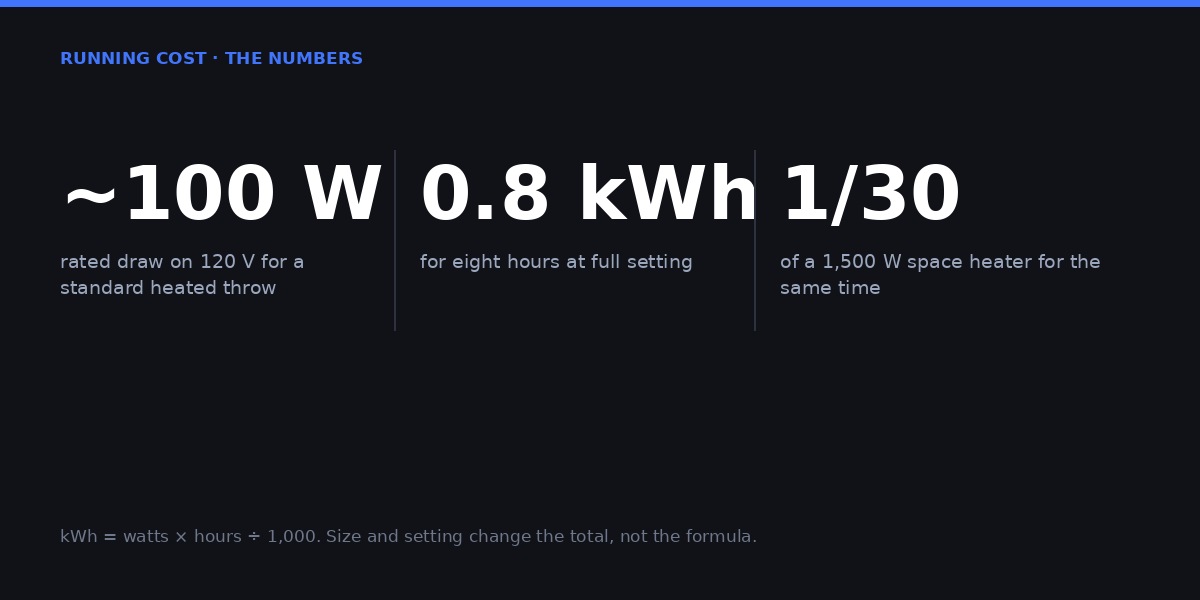
A 100 W blanket over eight hours therefore uses 100 × 8 ÷ 1000 = 0.8 kWh. At an illustrative tariff of USD 0.20 per kWh that night costs about USD 0.16; at EUR 0.25 per kWh, about EUR 0.20. Substitute your market’s tariff and the arithmetic still holds, which is why the formula beats any single cost figure quoted in a blog post.
Two refinements keep the estimate honest. Multiply by the duty cycle for average rather than rated consumption: a 100 W blanket on for 55% of an eight-hour night uses 100 × 8 × 0.55 ÷ 1000 = 0.44 kWh. And check the tariff structure in your market — a night-time off-peak rate can halve cost per kWh without changing the wattage at all.
For scale, the same formula shows why blankets sit at the bottom of the heating load table: a 1,500 W fan heater uses 1.5 kWh in a single hour, close to two whole nights of a 100 W blanket.
One night, eight hours: three worked examples
Buyers ask for the eight-hour figure because that is how blankets are used: switched on half an hour before bed, left running until morning, often turned down after the first hour. Three representative cases, at rated wattage and at a 55% duty cycle:
- Single underblanket, 60 W. 60 × 8 ÷ 1000 = 0.48 kWh per night, about 175 kWh a year at nightly use. At 55% duty: 0.26 kWh. Cost at USD 0.20/kWh: USD 0.10 rated, USD 0.05 average.
- Double underblanket, 100 W. 0.80 kWh per night, roughly 292 kWh a year. At 55% duty: 0.44 kWh. Cost: USD 0.16 rated, USD 0.09 average.
- King underblanket, 150 W. 1.20 kWh per night, about 438 kWh a year. At 55% duty: 0.66 kWh. Cost: USD 0.24 rated, USD 0.13 average.
Few households run a blanket at maximum for eight hours, and most controllers include an auto shut-off between one and nine hours. That feature is not only a safety measure; it is why real annual figures land nearer the duty-cycle column than the rated column.
| Case | Rated W | kWh / 8 h at rated | kWh / 8 h at 55% | Cost at USD 0.20/kWh |
|---|---|---|---|---|
| Single underblanket | 60 | 0.48 | 0.26 | USD 0.10 / USD 0.05 |
| Double underblanket | 100 | 0.80 | 0.44 | USD 0.16 / USD 0.09 |
| King underblanket | 150 | 1.20 | 0.66 | USD 0.24 / USD 0.13 |
| 1,500 W fan heater | 1,500 | 12.00 | 6.60 | USD 2.40 / USD 1.32 |
| 3,500 W central AC (heating) | 3,500 | 28.00 | 15.40 | USD 5.60 / USD 3.08 |
Electric blanket wattage vs a 1,500 W heater and an air conditioner
A 1,500 W heater at full output consumes 1.5 kWh in one hour. Matching that single hour would take a 100 W blanket fifteen hours. Across eight hours the heater uses 12 kWh at rated draw against 0.8 kWh — a ratio of roughly fifteen to one, and still above seven to one if you assume the heater cycles at 50%.
Air conditioners used for heating sit in a similar bracket: a central system drawing around 3,500 W while the compressor runs consumes roughly 28 kWh across eight hours of continuous operation. Heat pumps move heat rather than generate it, so delivered heat per kWh is better than a resistive element, but the electrical draw is still measured in kilowatts. The US Department of Energy’s guidance on residential central air conditioners and heat pumps is a good reference when explaining rated draw, seasonal efficiency and delivered heat to a retail buyer.
The defensible claim for your listing is therefore narrow: a blanket warms the sleeper directly, so it delivers comfort at 60–150 W instead of 1,500–3,500 W, and the saving depends on how much room heating it replaces. Not “cheaper than heating your home”. Buyers who respect that distinction write better copy and get fewer one-star returns saying the blanket “didn’t heat the room”.
Why size changes electric blanket wattage
Element length is the main driver. A single underblanket uses roughly 12–16 m of element wire; a king can use 25 m or more. Manufacturers scale wattage with area so that heat output per square metre stays inside the comfort and safety envelope set by the applicable standard.
Our quoting rule of thumb is 45–60 W per square metre of heated area for underblankets, and slightly higher for overblankets where the element sits further from the body. A 160 × 140 cm double is 2.24 m², landing at 100–134 W; a 200 × 160 cm king is 3.2 m², landing at 144–192 W and usually capped lower in practice to keep surface temperature compliant.
Surface temperature, not wattage, is what safety standards regulate. That is why a large blanket sometimes carries the same wattage as a smaller one: the designer lowered watts per square metre so the hottest point stays within the permitted rise above ambient. Compare both figures across suppliers. Higher wattage on a bigger blanket is not automatically better, and lower wattage on a smaller one is not automatically weaker.
How the control type changes real consumption
The controller decides how often the element is energised, so two blankets with identical wattage can consume very different amounts. This is where most real-world variation in running cost comes from — and where the cheapest products lose their advantage.
| Control type | Behaviour | Effect on consumption |
|---|---|---|
| Single on/off switch | Element runs continuously while on | Close to rated draw throughout; highest surface-temperature risk |
| Three-position switch | Fixed voltage reduction on lower settings | Roughly 40–70% of rated draw on low |
| Adjustable thermostat dial | Cycles element to hold a set temperature | Typically 30–60% of rated draw in steady state |
| Digital controller with timer | Thermostat plus 1–9 h auto shut-off | Adds small standby draw, cuts total run time |
| Dual-zone controller | Two independent thermostats, one per side | Lower average draw per person on a double |
| Smart / app controller | Scheduling and energy feedback | Fewer hours run; standby draw must be declared |
A digital controller with a display typically draws under 1 W in standby, though this should be measured, not assumed. Half a watt continuous is about 4.4 kWh a year — more than five nights of actual blanket use. If you publish an annual running-cost estimate, declare whether standby is included.
Dual-zone control deserves a specific mention, because it changes the story in a way buyers can sell. A 120 W double with two zones is not 120 W per person; it is 120 W split across two heated areas, each with its own thermostat. One partner can run low while the other switches off, and average draw falls accordingly. That is verifiable — unlike vague “energy-saving technology” claims.
Duty cycle: rated wattage versus average draw
Every thermostat-controlled blanket has two numbers that matter. Rated wattage is the draw while the element is energised. Average draw is what a meter records over an hour, and it depends on room temperature, bedding insulation, the selected setting and controller tuning.
In a cold bedroom on the highest setting a blanket may run near rated draw for the first 30–45 minutes, then cycle at a lower duty ratio as the bed warms. Once the space under the duvet is at temperature, duty cycles of 30–55% are typical for mid settings. A customer measuring 0.4 kWh overnight on a 100 W blanket is not seeing a faulty product; they are seeing the thermostat work.
For importers, specify both numbers in the test report: rated wattage at nominal voltage, and energy consumed over a defined eight-hour profile at a stated ambient temperature. Without the second, every running-cost discussion becomes an argument about assumptions. With it, you can put a defensible figure on the packaging and in the listing bullet.
Low-voltage, 12 V and USB blankets
Low-voltage blankets are a growing sub-category for automotive, camping and gift channels, and their electric blanket wattage logic differs. A 12 V throw for a car socket typically draws 30–50 W, which is 2.5–4 A at 12 V — within a standard accessory circuit. A 24 V truck-cabin blanket usually sits in the same band, since higher voltage means lower current for the same heat output.
USB blankets are where claims most often outrun physics. A 5 V supply at 2 A delivers 10 W; at 3 A, 15 W. Those are honest, usable numbers for a heated wrap or seat pad. A “60 W USB blanket” would need 12 A at 5 V, which no standard power bank supplies continuously. When a supplier quotes a USB product, ask for volts, amperes and tested heat-up time to 40 °C, then check that the three figures agree.
Low-voltage products also carry a different compliance file. Battery versions need UN 38.3 transport testing and a material safety data sheet before they can fly, and buyers sourcing these ranges should request those documents at quotation stage rather than at shipment.
What this means for importers, distributors and private-label brands
Electric blanket wattage is a merchandising decision as much as an engineering one, and the right number depends on the channel.
Volume retail. A 60 W single and a 100 W double cover most demand. Lower wattage keeps the BOM small, the carton light and the running-cost claim easy to defend; the trade-off is slower heat-up, so set a target — 20 minutes to a comfortable surface temperature is a reasonable brief — and test it.
Mid-market and department stores. A 100 W double and a 120–150 W king with a digital thermostat and 1–9 hour timer. This is where dual-zone control and a washable, detachable controller earn their cost, because they answer the two questions retail buyers ask most: can it be washed, and can it be left on?
Premium and gifting. Overblankets and throws at 100–150 W with soft-touch fabric, plus low-voltage travel and USB wraps at 10–50 W. Premium buyers respond to measured numbers — heat-up time, surface temperature, standby draw — more than adjectives, and a spec table with real figures is itself a trust signal.
Across all three, price the specification rather than the adjective. A blanket with 20 W less rated draw is not 20% cheaper to run in every use case, because duty cycle dominates real consumption, but it is a lower-stress design with a smaller controller and a lighter carton.
If you are mapping size, wattage and control combinations against your market’s voltage and plug standard, our electric blanket wholesale programme sets out the formats we produce, and the new products page shows the current heating range alongside our kitchen appliances.
Compliance: proving your wattage claims
Wattage claims sit inside a compliance framework that differs by market. In the EU and UK an electric blanket is assessed as a household heating appliance against the EN 60335-2-17 family, with the Low Voltage Directive and EMC Directive forming the legal basis for CE marking. North American retail typically expects a UL or ETL listing against the applicable heating-appliance standard, and Australia requires the relevant electrical safety certificate before sale.
The EU energy label is a separate question, and buyers often get it wrong. Most electric blankets are not classified as local space heaters, so the space-heater labelling regime does not automatically apply. The European Commission’s EU energy label and ecodesign rules are the right starting point for checking scope with your notified body instead of assuming a label is required. If a supplier says a blanket “has an A-rated energy label”, ask which regulation the rating was issued under.
For North American buyers, UL’s appliances programme explains how heating appliances are evaluated, and it helps when a retail compliance team asks why the controller, cord set and element form one certification rather than three.
The output is a document pack, not a sticker: test reports stating rated wattage at nominal voltage, surface-temperature results, overheat and short-circuit protection evidence, cord and plug approval for the destination market, and a declaration of conformity. Our certifications page lists the documentation we hold for the heating range, and the quality control process describes the inspection points where those numbers are re-verified.
One trap is worth flagging: element resistance drifts with manufacturing tolerance, so wattage measured on a prototype is not automatically the wattage of production. A factory that only tests prototypes is telling you what the design can do, not what the container contains. Require a wattage check on a sample from every production batch, at nominal voltage, recorded against the SKU.
How to verify electric blanket wattage before you place an order
This is the protocol we run, and any buyer can run it with a meter, a thermometer and an hour.
1. Confirm the electrical basis. Rated voltage, frequency, wattage with tolerance, and current at nominal voltage. Reject a spec sheet that omits tolerance.
2. Measure at nominal voltage. Meter between socket and controller; record watts at maximum, at each intermediate setting and at minimum.
3. Measure standby. Controller plugged in, blanket off. Anything above 1 W should be declared.
4. Run an eight-hour profile. Room at 18–20 °C, maximum for the first hour then the setting your market will use. Record total kWh — this is the number for your running-cost copy.
5. Check surface temperature. Probe the hottest accessible point under a folded section and compare with the declared rise above ambient.
6. Verify safety functions. Auto shut-off at the declared period, overheat cut-out, and controller detachability if sold as washable.
7. Repeat on a production sample. Not a golden sample — a unit pulled from the line after the first bulk run, tested blind.
Step seven separates a reliable supplier from a persuasive one. Wattage is easy to hit on a hand-built prototype; holding it across ten thousand units is a manufacturing discipline. If a supplier resists that test, the conversation about price is premature.
The bottom line
Electric blanket wattage for mains-powered household products sits in a narrow, well-understood band: 60–70 W for a single underblanket, 100–120 W for a double, 120–150 W for a king, and 100–150 W for overblankets and throws. Over eight hours that is 0.48–1.20 kWh at rated draw, and materially less once the thermostat cycles. Against a 1,500 W heater the ratio is about fifteen to one at nameplate, and the reason is physics rather than marketing: a blanket heats a person, a heater heats a room.
For buyers, the commercial translation is simple. Publish the formula, the assumption, the tolerance — and let the numbers sell. A range with honest wattage figures, a measured eight-hour energy profile and a complete compliance pack will outperform a cheaper range with a bigger claim on the box, because the second generates returns and the first generates repeat orders.
Send us a SKU list with your market’s voltage and tariff and we will return the energy table plus a quotation with the wattage range locked per size. YLD Home has manufactured small household appliances since 2012, and the heating range follows the same documentation discipline as our kitchen line: measured numbers, declared tolerances, and a test report behind every claim.
FAQ
How many watts does a typical electric blanket use?
A single underblanket typically uses 60–70 W, a double 100–120 W, a king 120–150 W, and an overblanket or throw 100–150 W. Low-voltage travel blankets sit at 30–50 W and USB wraps at 5–15 W. These are rated figures at the highest setting; average draw across a night is usually lower because the thermostat cycles the element.
How much electricity does an electric blanket use in eight hours?
Using kWh = W × hours ÷ 1000, a 100 W blanket uses 0.8 kWh in eight hours at rated draw, a 60 W blanket 0.48 kWh and a 150 W blanket 1.2 kWh. At an illustrative USD 0.20 per kWh that is USD 0.10–0.24 per night. At a 55% duty cycle the range falls to roughly 0.26–0.66 kWh.
Is a 100 W electric blanket warm enough for a double bed?
For a 160 × 140 cm double, 100 W works out at about 45 W per square metre, inside the normal comfort band for an underblanket, provided the controller has a thermostat rather than a simple on/off switch. In an unheated room, or where fast heat-up matters, specify 120 W and test the heat-up time.
Does electric blanket wattage change with the heat setting?
The rated wattage is fixed by the element; the setting changes how much of the time the element is energised. A three-position switch reduces voltage on lower settings and typically draws 40–70% of rated power on low, while a thermostat holds temperature by cycling and averages 30–60% of rated draw in steady state.
Can I use a 220–240 V electric blanket in a 120 V market?
No. A blanket rated for 220–240 V delivers roughly a quarter of its rated wattage at 120 V and will not reach its design surface temperature, while a 120 V product used on 230 V is a fire risk. Specify voltage per destination market; for one SKU across markets, source a dual-voltage design with the correct plug and controller for each.
What wattage should I specify for a private-label electric blanket?
Start from size and channel: 60 W single and 100 W double for volume retail; 100 W double and 120–150 W king with digital thermostat and timer for mid-market; 100–150 W overblankets and 10–50 W low-voltage products for premium and gifting. Then require a test report showing rated wattage at nominal voltage plus an eight-hour energy profile, so the packaging claim is measured rather than assumed.
Related reading for buyers
- Dual Control Electric Blanket: 5 Real Checks Before Ordering
- Electric Blanket Cord Replacement: 4 Safe Steps for Distributors
- Electric blanket wholesale range — dual control, certification, service parts
- Certifications and compliance: what each market requires
- Request pricing, carton data and the certificate list
About YLD Home
YLD Home has supplied small appliances to distributors and private-label brands since 2012 and now builds heated bedding for the same buyer profile. YLD Home issues the certificate list, carton data and wear-parts quotation with the price — so a distributor can check the file before committing to a seasonal slot.