









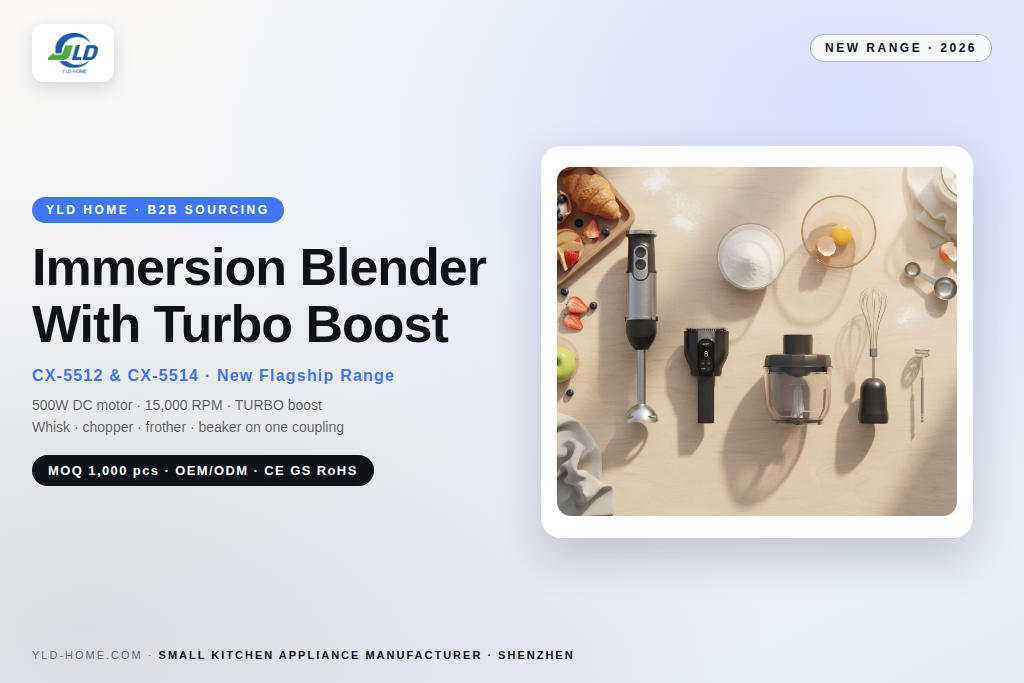
Summary: The YLD Home CX-5512 and CX-5514 are a new two-model hand blender platform built for European appliance chains, marketplace sellers, own-brand programmes and professional kitchenware channels. Both models run a 500W DC motor that reaches 15,000 RPM. The CX-5512 is the leaner unit: a digital speed display with 0-8 settings, two-button control (on/off plus speed), blue LED feedback, a universal coupling, and one 304 stainless-steel blending shaft in the box. The CX-5514 is the flagship immersion blender with turbo boost: the same motor, plus a TURBO key, a Click & Go tool-free coupling and a full accessory kit. Minimum order quantity is 1,000 pcs per model, both carry CE, GS and RoHS, and everything ships FOB Shenzhen with a 12-month warranty.
CX-5512 and CX-5514: A New Immersion Blender with Turbo Boost Platform
Two SKUs, one platform. That is the whole idea behind this launch, and it is the part that matters most to a buyer weighing up a new supplier.
The CX-5512 and the CX-5514 are built on one platform, so they share their motor, electronics, housing mouldings, shaft geometry and voltage options. From a buyer’s desk that means one set of spare parts, one certification file, one engineering contact and one training video that covers both units. Dealers who have juggled three unrelated suppliers for three slightly different blenders will understand what that saves. It also keeps the reorder conversation simple: the same spare part keeps working whichever of the two models is selling faster that quarter.
Where they part company is at the top of the range. The CX-5512 keeps things deliberately plain: an eight-step speed display, two buttons and a status light, with a single tool in the box. For soups, smoothies, sauces, purees and baby food, that is enough, and the price point reflects the shorter bill of materials.
The CX-5514 takes the same chassis and turns it into a complete immersion blender with turbo boost. A dedicated TURBO key gives the motor a short, controlled burst for denser mixtures: nut butters, thick batters, small batches of crushed ice, wet dough. The coupling is different too. Instead of the universal fitting used on the CX-5512, the flagship uses a Click & Go system so tools click on and off without force and without tools. In a professional kitchen, where hands are often wet and time is short, that detail gets noticed.
Both units wear the same clothes. A brushed stainless-steel body meets a matte black diamond-pattern handle and a chrome ring where shaft meets motor body. It is a finish that photographs well on a retail shelf and holds up under a close-up shot on a product listing, which, if you sell through marketplaces, is a large part of the battle. YLD Home has been finishing housings in this style for years, and the wear tests behind it are the reason the chrome ring stays put after a thousand dishwasher cycles. The choice of a DC motor rather than a cheaper AC unit is deliberate as well: DC gives smoother low-speed control, which is what a shopper feels in the first three seconds of a shop-floor demonstration.
CX-5512 vs CX-5514: Picking the Right Model for Your Market
Buyers usually arrive at this question from the shelf backwards, not from the specification sheet forwards. The two models share the same motor platform, so the decision is not about which one blends better. It is about which one earns its space in your assortment, and that depends on who you sell to and what they are trying to solve.
Start with the customer, not the unit. A shopper replacing a worn-out stick blender is price-anchored and wants something familiar and simple. A shopper upgrading a kitchen, or buying a gift, is looking for a reason to spend more and will read the box for one. The entry model answers the first shopper, and the step-up model answers the second. Carrying only the premium unit leaves the entry price point open to a competitor, and carrying only the entry unit caps your basket value. That is the commercial case for listing both.
| What the buyer is trying to solve | Model that fits | Why it works commercially |
|---|---|---|
| Opening a marketplace listing at a sharp entry price | CX-5512 | Lowest landed cost per unit, so the listing survives a price war without giving up margin on the step-up |
| Winning a premium shelf or a gift channel | CX-5514 | A fuller box justifies a higher ticket and is easier to demonstrate in store |
| Supplying cafes, delis or office kitchens | CX-5514 | One counter tool covers blending and foaming, so the operator buys once instead of twice |
| Testing a new market with the smallest commitment | CX-5512 | Less cash tied up in the first order while you learn the real reorder rhythm |
| Building a price ladder on one category page | Both | Entry and step-up come from one tooling set, so artwork and spare parts are shared |
| Serving a market where shoppers search by function rather than brand | CX-5514 | The model that answers a search for an immersion blender with turbo boost, which is how many buyers describe the category |
If you are unsure, sample both before committing to a container. A distributor who puts the two units side by side on a counter normally reaches a decision in one meeting, and the sample cost is credited against the production order. What you are judging is not the motor. It is how the box reads, how the handle feels in a wet hand, and which of the two your own buyers reach for first once both are on the shelf, the two speed model or the turbo model.
Inside the Box: The Accessory Ecosystem
Accessories are where the revenue is, and also where the returns come from. Buyers care about both, so it is worth separating the two.
On the revenue side, a box with more tools lifts the average basket value without changing the motor, the certification file or the tooling. It also gives an online seller more to work with: a larger kit supports more listing images, a longer bullet list and a stronger reason to click. The step-up model is supplied with the tools that turn it into a small kitchen system, and the entry model accepts the same tools through the same coupling, so a buyer who starts lean is not locked out of the range later.
On the risk side, three things cause most aftermarket complaints. Attachments go missing, seals and whisk cages wear out, and shoppers who cannot find a replacement part return the entire unit. Every tool in this range is stocked as a spare, so a distributor can sell a replacement whisk assembly or chopper bowl long after launch instead of absorbing a return. That single policy is often the difference between a one-off order and a repeat customer.
For promotions, the fuller box does the selling on its own. A shopper comparing two boxes on a shelf almost always takes the one with more in it when the price gap is modest. You can see how the complete tool set sits together on the page for the hand blender with whisk and food processor.
Why an Immersion Blender with Turbo Boost Sells in DACH and Nordic Retail
Germany, France, Italy, Spain, the Netherlands and the Nordics do not buy kitchen appliances for the same reasons, and a single launch cannot treat them as one market. Still, there is a pattern worth understanding if you are planning an assortment.
German and Austrian buyers read the spec sheet. The digital speed display, the eight settings and the 15,000 RPM figure do real work in a listing there, because shoppers compare numbers before they compare badges. GS certification is not optional in that conversation; it is the entry ticket. Nordic buyers, by contrast, tend to care about how a tool handles in the hand, how loud it is and how quickly it can be rinsed clean, which is exactly where the Click & Go coupling on the CX-5514 earns its keep. The tool-free fitting means a rinse under the tap takes seconds, and that single fact closes sales in markets where convenience outranks raw power.
Southern European markets respond more to the accessory count and to how the unit looks on a counter. An immersion blender with turbo boost photographed with a full spread of attachments reads as the premium option in a shelf of look-alike boxes, and photography is where a good distributor beats a cheap one. France and the Netherlands sit somewhere in between, with a strong appetite for branded kitchen tools and a willingness to pay for a name, which is why private-label conversations start fastest there.
The practical consequence is that the same two models can carry different positions in different countries. In one market the CX-5514 is the hero and the CX-5512 is the budget line. In another the CX-5512 is the volume seller and the flagship is the gift-season upgrade. That flexibility is the reason we did not force a single configuration across the range, and it is the reason the platform takes custom colours without a new mould.
Building a Dealer Assortment Around an Immersion Blender with Turbo Boost
If you already carry hand mixers, the new CX pair slots in beside them without cannibalising the shelf. A hand mixer is the tool for batters and cream; an immersion blender with turbo boost is the tool for soups and sauces. Shoppers rarely buy one and skip the other, and once both are in the range the average basket goes up. Our hand mixer range lists the models that sit alongside the CX-5512 and CX-5514 most naturally.
There are three ways to structure the assortment, and most distributors pick one and stick with it. The first is a two-tier approach: the CX-5512 for the entry shopper and the CX-5514 for everyone who wants the tools. The second is a family build, where you stock the blenders, the mixers and the spare parts as one proposition and market the whole set together across a seasonal catalogue. The third is a private-label play, where you take the platform and put your own name on it, which we cover further down.
Whichever route you take, order the spares at the same time as the finished goods. It is the single most common oversight we see from first-time buyers: a full container of blenders, and no whisk assemblies behind them. The wholesale hand blender range overview shows how the models and their accessories are grouped for trade ordering, so you can build a complete purchase order in one pass rather than chasing parts later.
One more piece of advice from the trade side. Anchor your price ladder before you open negotiations. If the CX-5512 sits at the bottom and the CX-5514 at the top, decide your retail gaps early, because those gaps decide how much promotional room you have at Christmas and in the back-to-school window. Distribution is a game of margins between tiers, and a clean two-model ladder is easier to defend than a range of five look-alike SKUs.
Certifications, Voltage Options and Market Readiness
Both models are supplied with CE, GS and RoHS as standard. For markets that need more, we handle the documentation on request, and it is worth being clear about what that covers so there is no surprise at customs.
On the food side, every part that comes into contact with food is built to meet the European framework for food contact materials, and the paperwork to support that is part of our standard file. You can read the European Commission’s own guidance on the food contact materials regulation if you want the source. On the electrical side, the units sit within the scope of the EU Low Voltage Directive, and the same safety engineering feeds our GS approval. Buyers who want the exact wording can go straight to the Low Voltage Directive page.
On voltage, the platform ships in 220-240V and 110-120V, both at 50/60Hz, so a single range can serve European and selected export markets without a redesign. That matters when you are listing the same immersion blender with turbo boost in six countries from one warehouse. That said, confirm your destination mix before you fix an order, because the plug and the cord set differ by region and those parts are locked in early. A container that leaves Shenzhen with the wrong plug is a container that sits in a warehouse.
If you want to inspect the line before you commit, YLD Home runs open factory visits by arrangement. The factory tour page explains what a visit involves and how to book one around your travel schedule. Seeing the assembly line is, for most first-time buyers, the moment the decision gets easier.
OEM, ODM and Private Label for Your Own Brand
The CX platform is available as a finished product under the YLD Home name, or as the base for your own. OEM and ODM work here covers colour, logo, panel sticker, nameplate and packaging. In practice a distributor usually starts with a nameplate and a colour change, then moves to full panel customisation once the first order has sold through.
What we do not do is pretend that OEM and ODM are the same thing. They are not, and the difference decides your lead time and your tooling cost. If you are new to the distinction, our comparison of OEM versus ODM versus private label sets it out plainly: OEM means you bring the design and we build it, ODM means you adapt ours, and private label sits in between. Most first orders from a mid-sized distributor land in the private-label column, because it is the fastest route to a branded box with no tooling spend.
Tooling is quoted per project, and the 15,000m² workshop and five production lines give us room to run a custom colourway without pushing standard production out. Colour and logo changes typically add little to the timeline; new moulds are a different conversation and need their own schedule. Whichever you choose, the finish stays the same: brushed steel, matte black handle, chrome ring, and a look that holds together whether the nameplate says your brand or ours.
MOQ, Lead Times and Spare Parts Support
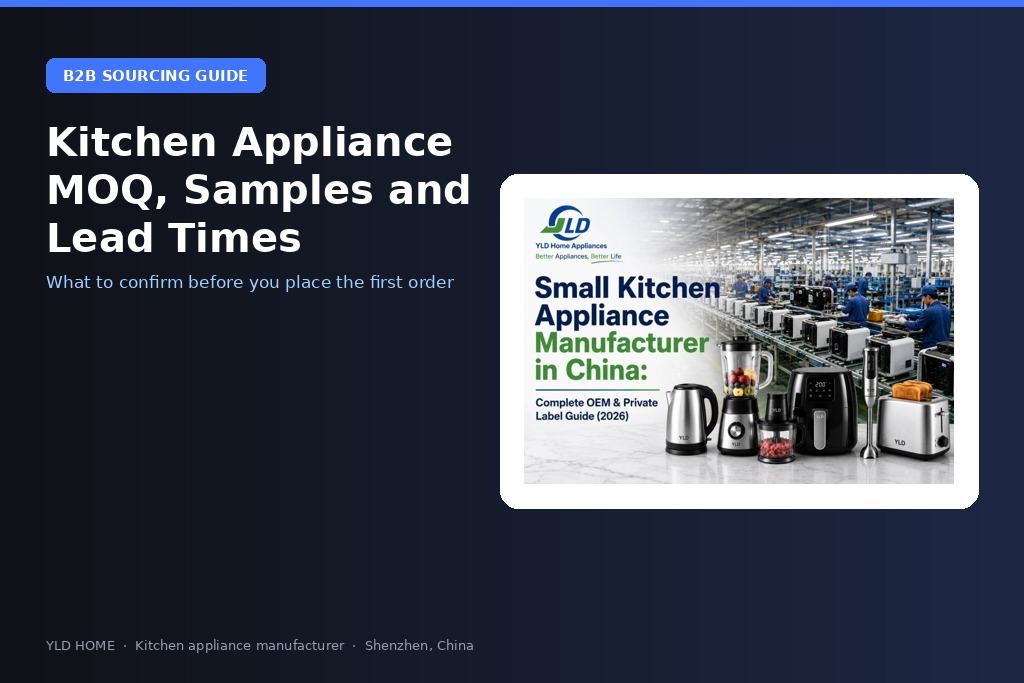
The commercial terms are straightforward. YLD Home sets minimum order at 1,000 pcs per model, you can mix colours within that, and production runs 25 to 35 days from deposit and artwork confirmation. Shipments are FOB Shenzhen. Warranty is 12 months, and the spare parts line covers the blending shaft, the whisk assembly, and the chopper bowl and lid.
If you are importing from China for the first time, the lead time is the number most buyers underestimate, so plan your first order backwards from the shelf date rather than forwards from the deposit. Our guide to importing kitchen appliances from China walks through the points that trip up new importers, from incoterms to inspection timing. For the wider question of how to vet a supplier rather than just a product, the hand blender supplier checklist for B2B buyers is a useful companion to this piece, because it lists the questions a good distributor asks before signing anything.
On spares, the policy is simple: anything we ship as a tool, we ship as a part. That is why the accessory list above names each component separately instead of treating the kit as one sealed set. An immersion blender with turbo boost that can be repaired for the price of a whisk is a unit a retailer is happy to push, because a low return rate protects the margin on the whole order. Keep a small spare-parts buffer in your warehouse and the aftermarket takes care of itself.
Frequently Asked Questions
Do the CX-5512 and CX-5514 really share the same motor?
Yes. Both run on the same motor platform and reach the same top speed. YLD did this on purpose so that spares, service and certification carry across the range, and so that a distributor only has to learn one platform.
What exactly is in the box with the CX-5514?
The CX-5514 ships with the stainless-steel blending shaft, a whisk cage, a food processor and chopper with its own bowl and lid, a mixing and frothing attachment, and a beaker. YLD supplies each of those items as a spare part as well.
Why would a buyer choose the immersion blender with turbo boost over the standard model?
The TURBO key and the tool-free coupling are the two reasons. YLD fits the flagship with a full accessory kit, so the CX-5514 covers whisking, chopping and frothing without a second appliance on the counter.
What is the minimum order quantity, and can I mix colours?
MOQ is 1,000 pcs per model. You can mix colours within that figure, and YLD quotes custom colours per project once the design is confirmed.
Can you put our own brand on the blender?
Yes. YLD offers OEM, ODM and private-label work covering colour, logo, panel sticker, nameplate and packaging. Most first orders start with a nameplate and a colour change.
What certifications do the CX-5512 and CX-5514 carry?
CE, GS and RoHS as standard. For other markets YLD can prepare additional documentation on request, and food-contact and electrical-safety files are part of the standard pack.
How long does production take after I confirm?
Production runs 25 to 35 days from deposit and artwork confirmation. Shipments are FOB Shenzhen, and YLD recommends planning the shelf date backwards from that window.
Are spare parts available after launch?
Yes. YLD stocks the blending shaft, the whisk assembly, and the chopper bowl and lid. Ordering spares with the finished goods is the simplest way to keep the aftermarket healthy.
The CX-5512 and CX-5514 are ready for distributor conversations now, and the fastest way to move is to tell us your market, your voltage and your volume. If you want the entry model, the flagship immersion blender with turbo boost, or both, the commercial terms are the same: 1,000 pcs per model, 25 to 35 days, FOB Shenzhen, CE, GS and RoHS, with OEM and private-label options on top.
Send us your target price and your shelf date, and the YLD Home team will come back with a quotation and a sample plan. Start with a quote request, or browse the full hand blender range to see where these two models fit in your line-up.
Related pages from YLD Home: inspect our quality control process and inspection reports, walk the Shenzhen factory floor, or read about buyers who visited us in person.