









# Aftermarket Success: Reducing Returns on Small Kitchen Appliances
Every returned blender, hand mixer or kettle tells the same short story. The customer wanted something, the product did not deliver it, and now the unit is travelling backwards through your supply chain while your margin travels with it. Importers often treat returns as a cost of doing business, but the strongest programmes treat them as data. The brands that find a way to reduce returns kitchen appliances actually keep, year after year, are the ones that built the discipline into the product and the paperwork long before the first complaint arrived.
This guide is written for importers, distributors and brand owners who source small kitchen appliances at wholesale volume. It explains where returns come from, how to trace them back to a batch, how packaging and manuals prevent them, and how the aftermarket, handled well, turns a cost centre into a second sales channel.
The True Cost of a Return
A return is never just the product price. Add the outbound shipping, the return shipping, the inspection time, the repackaging, the lost sale and the review that follows. For a small appliance, a single preventable return can wipe out the margin on several units, and a run of them can erase a season.
When you build a returns model, include:
Once you see the full figure for a family of products, efforts to reduce returns kitchen appliances carry become easy to justify against almost any quality investment.
Why Small Appliances Come Back
Returns cluster around a handful of causes, and nearly all of them are predictable.
Track which of these dominates your own returns. Most importers find that transit damage and expectation mismatch account for the majority, and both are fixable before a container ever ships.
Data: The Foundation of Any Returns Programme
You cannot reduce returns kitchen appliances buyers send back unless you know exactly which units come back and why. Build a simple returns log that captures the model, the batch or production window, the channel, the reason code and the remedy issued. Within a quarter, patterns appear that no single complaint reveals.
Look for these signals:
Serial numbers or date codes make this traceable. Ask your supplier to keep production records that can be matched to a shipment, so a failing batch can be identified and corrected rather than repeated.
Designing Out Returns at the Factory
The cheapest way to reduce returns kitchen appliances importers face is to prevent the causes inside the factory. Ask your supplier what they do before packing and demand specifics: incoming inspection, in-process checks and a final functional test.
YLD Home runs IQC on incoming parts, IPQC on the line and OQC before packing, with a 12-month warranty on finished models. That structure catches the faults that would otherwise reach your customer. Ask any candidate supplier how many units they test and what happens to a rejected batch, because a factory that tests everything and a factory that tests nothing will quote the same price.
Packaging That Survives the Journey
Packaging is the first line of defence against returns. A box that survives a courier network protects both the product and the review.
Test it before you scale:
| Packaging Element | Test | Pass Criteria |
| Retail box | Visual inspection after transit | No crushed corners or torn print |
| Inner insert | Drop from distribution height | Product stays fixed, no movement |
| Master carton | Stacking load test | Board holds without bowing |
| Full carton | Drop test on edge and corner | Contents undamaged |
Run a drop test on the master carton and the individual box, then open them and inspect the appliance inside. If the housing survives, you have removed one of the biggest causes of returns. If it does not, change the insert before you ship. Packaging engineering is far cheaper than reverse logistics.
Manuals, Expectations and Onboarding
A large share of returns are sold by the product page and unsold by the unboxing. A customer who cannot find the dough hook or cannot switch the speeds assumes the unit is defective. Clear, illustrated manuals reduce this category quickly.
Steps that work:
When you reduce returns kitchen appliances through better onboarding, you also lift review scores, because a customer who uses the product correctly is a customer more likely to praise it.
Motor Quality and the Warranty Window
Many returns happen in the first ninety days, but the ones that hurt most arrive between month three and month twelve, when a cheap motor fails. The winding material decides much of this. Copper windings run cooler and last longer than aluminium substitutes, and the difference shows up precisely inside the warranty period.
Specify the motor in writing. Ask for the winding material, the rated power and the duty cycle, and test a sample under real load. A supplier who is candid about the motor is usually candid about everything else.
Spare Parts and the Aftermarket Opportunity
Returns and repairs are two sides of the same coin. A customer with a worn blade or a broken beater does not always want a new appliance; sometimes they want a part. An importer who stocks spare parts can resolve issues cheaply and earn revenue at the same time.
Build an aftermarket parts list with your supplier covering motors, blades, shafts, seals, beaters, dough hooks and switches. Price them so repair is attractive compared with replacement. YLD Home keeps spare parts on site and holds a 12-month warranty, which lets importers resolve most problems with a part rather than a refund.
Accessories, too, become a channel. Additional chopper cups, whisks and beaters sell to existing owners and reduce the temptation to return a whole unit.
Warranty Terms and Remedy Planning
Agree the warranty before the order, not after the first claim. Define the period by market, because consumer law differs sharply between the EU, North America and Africa. Set out what counts as a defect, how claims are submitted, who pays the return freight, and whether the remedy is repair, replacement or credit.
A manufacturer confident in quality will accept a defect cap in the contract, because it does not expect to breach it. One that refuses to discuss remedies is signalling that it expects claims. Document every term and keep records so you can trace a failing batch back to its production window.
Reverse Logistics Without the Pain
Handling returns efficiently keeps their cost down. Set a simple process: a customer request form, a reason code, a return authorisation, an inspection step and a defined remedy. Refurbish what can be refurbished and resell it through the right channel rather than scrapping it.
A clear process also feeds your data. Every inspected return confirms or rules out a cause, and that evidence is what lets you argue a defect case with your supplier or a packaging case with your logistics provider.
Choosing a Supplier Who Cares About Returns
Returns are largely decided before the product leaves the factory, so choose a supplier who treats quality as their problem, not yours. Test candidates on:
A supplier who answers these questions in detail will help you reduce returns kitchen appliances programmes depend on. One who deflects will cost you more in the aftermarket than they ever saved you on price. For a full evaluation framework, see our B2B buyer checklist for choosing a hand blender supplier.
MOQ, Samples and Lead Time
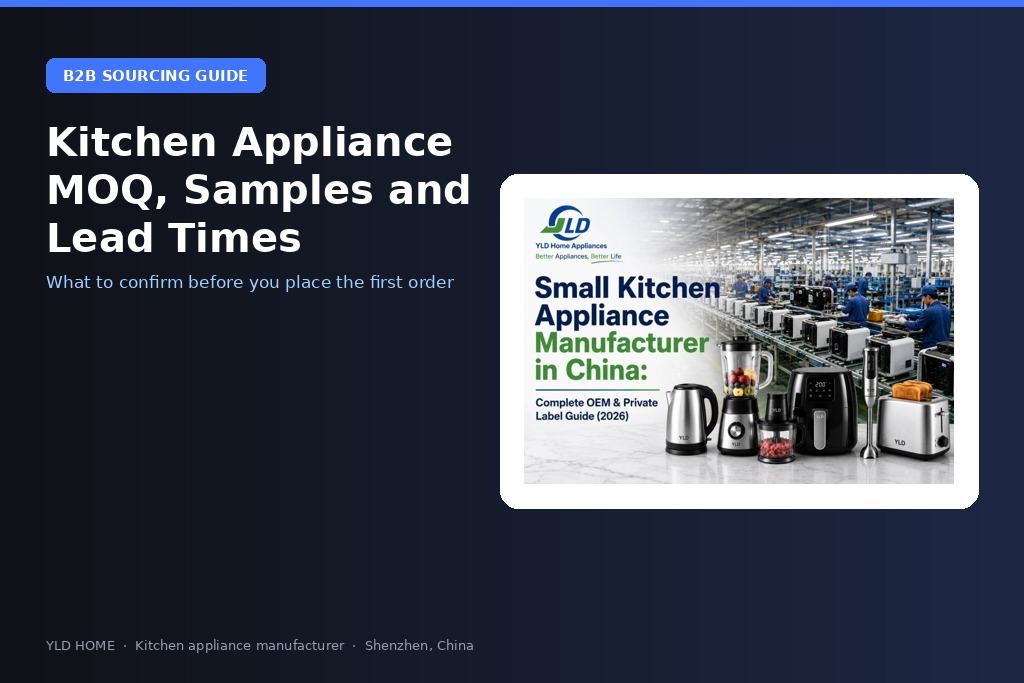
Test before you commit, because a sample that runs hot under load will warn you long before a container arrives. YLD Home works from 100 units per model, with a 500-unit minimum on hand blender platforms that carry heavier tooling. Samples ship in 5 to 7 days and the fee is credited against the first production order. Volume production runs 25 to 35 days from deposit and approved artwork, on FOB Shenzhen terms with a 30% deposit and the balance before shipment. Our guide to MOQ, samples and lead times explains how to plan around both.
A Practical Returns Reduction Plan
Bring the pieces together in this order:
Anyone who wants to reduce returns kitchen appliances programmes wrestle with should follow this loop, because it is continuous rather than one-off.
Mistakes That Keep Return Rates High
Each of these keeps returns high and margins thin, and each is fixable with a small amount of discipline.
Measuring Your Return Rate Properly
A single return rate hides more than it reveals. Split it by channel, by model and by reason code, then set a target for each. A rate that looks healthy overall can conceal one model carrying all the damage, and one marketplace driving most of it.
Track the net return rate after refurbishment and resale, not just gross returns. When you want to reduce returns kitchen appliances programmes depend on, that single number tells you whether the whole system is improving.
Root Cause Analysis of a Failing Batch
When a batch fails, treat it as a case rather than a complaint. Pull the production records, identify the component and the window, and ask the factory what changed. A supplier who can explain the cause and the fix is worth keeping; one who only offers a discount is telling you the problem will return.
A short written root-cause report after every significant batch failure builds a knowledge base that prevents repeats. It also gives you evidence if you need to discuss credits with your supplier.
Building a Quality Agreement
Put the quality expectations in writing before production. The agreement should cover the motor specification, packaging standards, test checkpoints, defect caps and warranty terms. With the standards fixed, both sides know what “good” means, and the argument happens before the money rather than after it.
YLD Home documents the specification and warranty terms in the purchase contract and runs IQC, IPQC and OQC checkpoints, so the quality agreement rests on a process instead of a promise.
Customer Education and Use Cases
Many returns begin with a customer who used the product for something it was not built to do. Clear guidance on what the appliance can and cannot handle prevents that. Show the intended uses, the duty cycle and the attachments in the manual and on the listing, so expectations land closer to reality, which is how you reduce returns kitchen appliances buyers send back for the wrong reasons.
The Economics of Refurbishment
Not every return is a loss. A unit with damaged packaging or a worn accessory can be refurbished and sold through a secondary channel, or stripped for spare parts. Set a simple rule: refurbish if the cost stays below a set fraction of the unit price, otherwise harvest the parts.
Refurbishment is where a returns programme earns its keep. It also feeds your data, because every refurbished unit reveals exactly what failed.
Training Your Support Team
Your support team decides whether a return happens. Give them the fault-finding guide, the spare-parts list and the authority to solve a problem quickly. A customer who receives a replacement blade in three days does not return the machine, which is exactly how you reduce returns kitchen appliances businesses carry each season.
Setting Return Targets by Channel
Online marketplaces return more than trade distributors, because consumers change their minds. Set different targets for each channel so you compare like with like. When you reduce returns kitchen appliances sold through marketplaces, the benefit shows up fastest, because the baseline is higher.
Working With Third-Party Logistics
Your logistics partner handles the physical return, so choose one that reports back. Ask for reason codes, transit-damage rates and inspection photos. That data tells you whether the fault sits in your packaging or in their handling, which decides who pays for it.
Authoritative sources
Frequently Asked Questions
Related pages from YLD Home: inspect our quality control process and inspection reports, walk the Shenzhen factory floor, or read about buyers who visited us in person.
What is the fastest way to reduce returns on small kitchen appliances?
Start with packaging, because transit damage is the largest single cause and the cheapest to fix. YLD Home tests cartons and inserts against a drop standard and can adjust packaging to your parcel network, which removes a large share of returns before the product even ships.
How do I trace a faulty batch back to my supplier?
Ask for production records and date codes so every shipment can be matched to a batch and a window. YLD Home keeps production records and runs IQC, IPQC and OQC checkpoints, so a fault can be identified and corrected rather than repeated on the next order.
Does motor quality affect return rates?
It does, particularly between month three and month twelve. Copper windings run cooler and last longer than aluminium substitutes, so YLD Home specifies the winding material, rated power and duty cycle up front, letting buyers verify the motor before ordering.
Can spare parts help me reduce returns kitchen appliances buyers send back?
Yes. Offering a replacement blade, beater or shaft often satisfies a customer who would otherwise return the whole unit. YLD Home keeps spare parts on site and holds a 12-month warranty, so importers can resolve most issues with a part rather than a refund.
What warranty should I expect from a factory?
YLD Home holds a 12-month warranty on finished models, and the terms are written into the purchase contract before production. A confident supplier will also accept a defect cap, so both sides know how claims are handled.
What is the minimum order quantity?
YLD Home starts at 100 units per model, with a 500-unit minimum on hand blender platforms that carry heavier tooling. Samples ship in 5 to 7 days and the fee is credited against your first production order.
Can the factory customise packaging and manuals?
Yes. YLD Home runs OEM, ODM and private-label programmes covering your logo, colour, rating label, gift box and multilingual manual, so your packaging and instructions match the market and the listing that sold the product.
Next Steps for a Lower-Return Programme
Reducing returns is not a single fix; it is a habit. Log the data, rank the causes, fix packaging first, tighten the manuals, specify the motor, stock spare parts and write the warranty before you order. Do this for one season and your return rate will fall; do it for three and the aftermarket becomes a source of profit rather than a drain.
YLD Home has manufactured small kitchen appliances in Shenzhen for more than a decade, with hand blenders, stick blenders and hand mixers at the core of its range. If you want to reduce returns kitchen appliances programmes across your business face each season, request a sample and a full document pack, then measure how carefully the supplier answers before you place the order.
Browse the hand blender range and the hand mixer range, take the factory tour, read the wholesale FAQs, or request a quotation with your target specification and volume.