









In this guide:
- When do you actually need an industrial blender?
- Duty cycle, motor power, and heat: the industrial difference
- Industrial blender wholesale: factory direct vs US distribution
- NSF certification and why it matters on food lines
- Materials that survive a production floor
- OEM and private label industrial blenders
- Spare parts and the 10-year cost of ownership
- Compliance paperwork for industrial buyers
- Starting a pilot order with an industrial blender manufacturer
* alt:industrial blender *
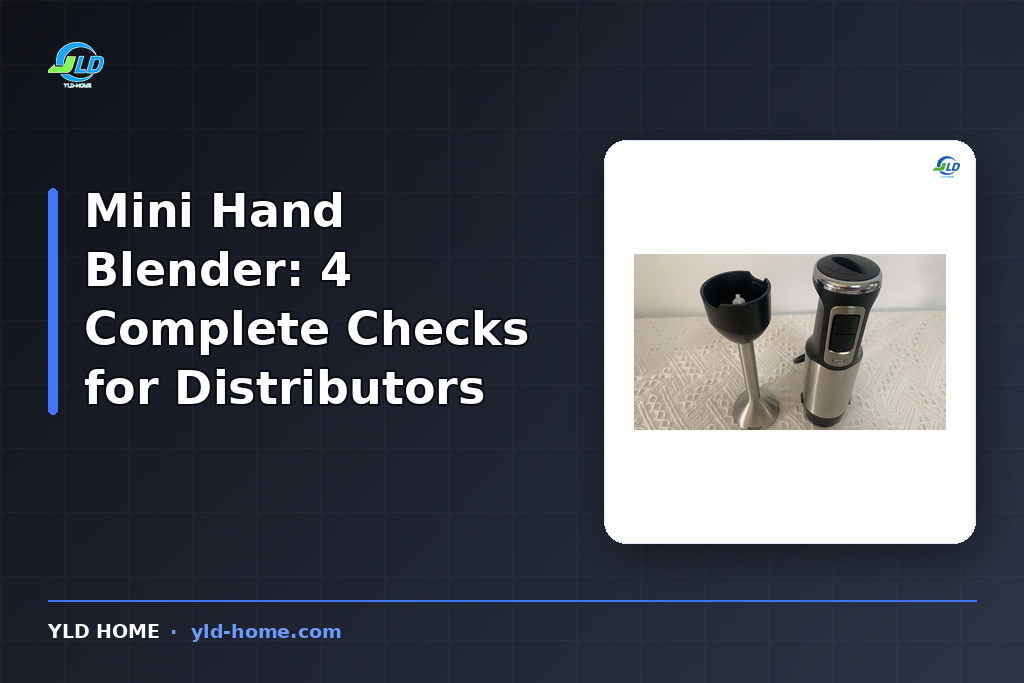
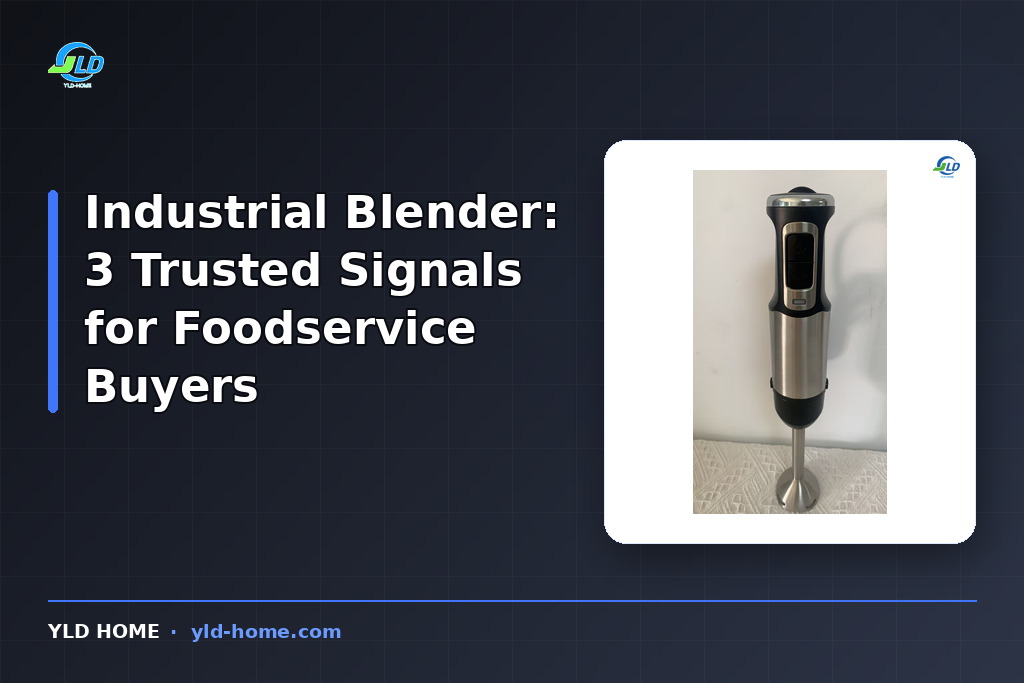
An industrial blender is not a bigger version of a kitchen blender. It’s a different machine, built for a different shift: eight hours of production, thick batches, continuous duty, and no patience for downtime. We’re YLD Home, a Shenzhen manufacturer that builds heavy-duty hand blenders and stick blenders for US food processors, commissary kitchens, and industrial foodservice operations. This guide covers what to look for when you source an industrial blender for the US market, from motor specs to NSF paperwork to the questions that separate serious factories from box movers. For a look at the operation behind those machines, see why YLD Home is a reliable partner.
When Do You Actually Need an Industrial Blender?
The word “industrial” gets thrown around loosely, so let’s set the bar. You need an industrial blender when the machine runs for hours, handles thick or heavy product, and sits inside a production process where a breakdown stops money. That describes food plants in Texas, commissary kitchens in Chicago that feed schools and hospitals, sauce manufacturers, and central kitchens for restaurant groups.
The classic sign is batch size and viscosity. If your operator is blending 20-liter pots of thick chili or 15 liters of batter, a light commercial unit stalls and overheats. An industrial blender keeps torque at the blade regardless of what’s in the pot. The second sign is runtime. One batch every few minutes all morning is a different duty class than one drink every few minutes.
The third sign is integration. In a production line, the blender is a step in a process, not a tool. It gets used on a schedule, cleaned on a schedule, and serviced on a schedule. That changes what you buy: spare parts kits, service documentation, and a factory that answers support calls matter more than the sticker price.
If none of that sounds like your operation, an industrial blender is overkill. A commercial-class unit at half the price does the job. But if you’re running a production floor, buying below industrial grade is the expensive mistake. We’ve seen it play out with a sauce plant in Houston that went through three “commercial” units in one year before switching to our heavy line.
Think about who buys these machines and you’ll see the market clearly. Equipment dealers in Dallas and Houston stock industrial blenders for the food plants around them. Distributors in Chicago and New York serve commissary kitchens and central production facilities. Online sellers target the same buyers with faster delivery and thinner margins. The common thread is that the end customer knows exactly what they need: a machine with a duty rating, a service plan, and a factory behind it that will answer the phone. That’s the bar we hold ourselves to, and it’s the bar you should set when you compare quotes. Cheap is only cheap until the first production shift it can’t finish.
Duty Cycle, Motor Power, and Heat: The Industrial Difference
The specs that matter on an industrial blender are duty cycle, torque, and thermal management. Wattage alone is a marketing number. What counts is sustained output without overheating.
| Duty class | Motor power | Continuous run time | Typical environment |
| Home | 300–600W | Seconds | Household kitchens |
| Commercial | 800–1200W | A few minutes | Restaurants, bars |
| Industrial | 1400–1600W+ | Hours with scheduled rests | Food plants, commissaries, central kitchens |
The industrial-class motors built at YLD Home run [fill actual: 30 minutes continuous] under load, which is roughly ten times what a home unit delivers. The housing is aluminum or stainless, machined for heat transfer, and the winding wire is sized for sustained current. When we test an industrial blender, we run it at full load until the thermal breaker trips, log the curve, and design the duty rating from real data, not a datasheet.
Torque is the spec cooks actually feel. A 1600W motor with a good gearbox turns a thick batch steadily. A motor that only makes power at high RPM stalls the moment the blade bites into something heavy. Our heavy models use machined stainless shafts and hardened blades, so the power reaches the product instead of flexing the coupling.
Heat is the quiet failure mode. Industrial duty generates heat that a short-run motor never sees. That’s why the motor mount, the bearing seats, and the shaft seal all get metal housings and proper clearances. We also vent the housing for airflow, because a sealed plastic shell turns into an oven. These are the details that keep an industrial blender running through a full production week.
Industrial Blender Wholesale: Factory Direct vs US Distribution
When you buy an industrial blender for a US operation, you have two routes, and they serve different needs. Factory direct from China gives you the best FOB pricing, full customization, and a direct line to the engineering team. The trade-offs: longer lead times, freight and duty costs, and managing warranty support across the Pacific.
US distribution gives you local inventory, fast replacement, and support in your time zone. The price is higher per unit, and the selection is usually limited to what the distributor stocks. For a production floor that can’t wait eight weeks for a spare, that availability is worth real money.
Most serious buyers run a hybrid. The production volume comes factory direct on a scheduled cadence, and the US distributor holds safety stock for emergencies. We support that structure directly. Our export team coordinates with our customers’ US partners on lead times, and we keep spare parts kits in the pipeline so the distributor’s shelf stays stocked.
The market word people search for is an industrial blender supplier in Texas, and there are good ones, especially around Dallas and Houston where the food processing industry is dense. They understand duty cycles, NSF requirements, and the reality of a plant floor. If you’re buying for a Texas operation, a local supplier who knows food plants is worth the markup on the first order alone.
NSF Certification and Why It Matters on Food Lines
For any industrial blender that touches food in the US, NSF certification is the standard that health departments, inspectors, and institutional buyers recognize. NSF is an independent organization that tests and certifies food equipment for sanitation, materials, and construction. Their standards cover things like cleanability, food-contact materials, and corrosion resistance, and their mark on a machine tells an inspector the equipment was built to a known bar.
Why does it matter on a production line? Because institutional customers, school districts, hospitals, and chain restaurants often require NSF-certified equipment in their contracts. A food plant serving those customers can’t use equipment that fails their vendor requirements. The NSF mark also shortens inspections. An inspector who sees NSF-certified equipment spends less time questioning it.
The certification process is real work. It involves design review, material testing, and plant audits, and it has to be maintained. If you want to know the specifics of the standards and the certification process, the NSF website is the authoritative source, and it’s worth reading before you commit to a supplier.
When a factory tells you a product is “NSF compliant” but shows no certificate, that’s a red flag. Ask for the certificate number and verify it on the NSF site. YLD Home certifies its industrial lines with NSF where the channel requires it, and we walk customers through the process, including the lead time it adds to a new model introduction.
Materials That Survive a Production Floor
A production floor is a corrosive environment: steam, sanitizers, acids from product, and constant washing. The materials in an industrial blender have to survive all of it. Grade 304 stainless steel is the baseline for shafts, bells, and blades. It handles food acids and sanitizers, and it meets food-contact expectations. Some plants run 316 where chlorides are aggressive, and we offer that on request.
The seals are where cheap builds fail. The shaft seal sits between the motor and the blending bell, and it takes the worst of everything: heat, product, and cleaning chemicals. We use food-grade silicone and PTFE in the seal stack, and we test for leaks under pressure. A leaking seal on an industrial blender isn’t a nuisance, it’s a contamination risk that shuts down a line.
The blade assembly matters more than people think. An industrial blade has to cut through fibrous and frozen product without dulling fast, and it has to be balanced so the unit doesn’t shake. We harden and balance every blade, and we publish the blade life data so plants can plan replacements instead of reacting to failures.
Housings on industrial units are aluminum or stainless, never plastic. Plastic cracks in a plant environment, and it doesn’t shed heat. The switch and the cord entry get sealed boots, because washdowns hit everything. When a plant manager opens one of our units after a year of service, the inside should look like the inside of a tool, not a science experiment. For plants that want the same build quality in a lighter tool, the stainless steel hand blender shares the same 304 shaft material and sealed switch boots. That’s the standard we hold, and it’s the standard you should hold your supplier to.
* alt:industrial blender *
OEM and Private Label Industrial Blenders
Industrial buyers often need something specific: a different voltage, a longer shaft, a special blade profile, or simply their own brand on the machine. That’s the OEM and private label side of our business, and it works differently from catalog buying.
OEM work starts with your spec. You tell us the duty cycle, the batch sizes, the product viscosity, and the compliance requirements, and YLD Home’s engineers spec the motor, gearbox, shaft, and blade to match. We build samples, run them through your actual product, and iterate until the batch comes out right. Tooling and sample rounds run [fill actual: 4–6 weeks] for a modified standard model, longer for a ground-up design. Our Innovation for ODM and new designs video shows how a custom project moves from your spec to working samples.
Private label is lighter. Pick a base model, choose color and branding, and we handle production and documentation under your brand. The 3-in-1 hand blender and the HB006-3 detachable food processor are popular private label bases because they cover multiple prep tasks in one station. Plants like the detachable design because it separates the motor from the washdown.
Whatever the route, the compliance file follows the machine. OEM units get the same UL, FCC, and FDA documentation as our catalog models, and NSF certification can be added where your channel requires it. One caution: if your brand is going on the machine, make sure the product liability picture is clean. Your name on the box means your name on the warranty, and the factory’s certificate history is part of that assessment.
Spare Parts, Service, and the 10-Year Cost of Ownership
An industrial blender is a capital decision, so think in years, not months. The real cost of a machine is purchase price plus spares plus downtime over its working life. A cheap unit that fails twice a year costs more than a solid unit that runs for a decade.
Plan the spare parts kit at purchase time. For an industrial blender, the kit is shafts, blades, seals, switches, and a spare motor if the plant runs continuous shifts. We ship parts kits with larger orders and keep the consumables in stock for the life of the model. A plant that changes seals on schedule and swaps blades before they dull runs for years without a major failure.
Downtime is the expense nobody budgets. If a blender is down for a shift, the line is down, and that costs more than the machine did. That’s why we publish duty data, seal life, and blade life, and why YLD Home answers support emails within 24 hours. The customers who treat us as part of their maintenance plan get the best results.
Warranty terms are part of the cost math. Our industrial lines carry [fill actual: 12–24 months] warranty on the motor and gearbox, with consumables excluded as is standard. Read the warranty before you sign, not after a failure. And keep the serial number records, because the warranty follows the machine, not the invoice.
Here’s a practical example from a plant we supply in Texas. They run two heavy units across a double shift, about sixteen hours of blending a day. Their maintenance plan is simple: replace the seal kit every six months, balance-check the blades quarterly, and keep one spare motor on the shelf. In three years they’ve had zero unplanned downtime. The plant manager told us the spare motor paid for itself the first time a bearing failed on a Friday night, because the swap took forty minutes instead of a week. That’s the difference between buying equipment and buying a production capability. Ask your supplier for the maintenance schedule they recommend, and hold them to it.
Compliance Paperwork for Industrial Buyers
An industrial blender crossing into the US brings a paperwork stack, and it’s better to know it up front. Electrical safety: UL or ETL certification to the applicable standard, with the certificate matching your exact model. Electromagnetic interference: FCC compliance for motorized equipment. Food contact: FDA material documentation for every surface that touches product.
The import side adds more. The HTS classification for blenders is [fill actual: 8509.40] with duties around [fill actual: 4–6%], and your customs broker will need the manufacturer’s documentation to support the entry. Country of origin marking is required and has to be legible and permanent. California Proposition 65 evaluation is the recurring one that surprises people, and it’s the importer’s responsibility.
Then there’s the customer-facing paperwork. Institutional buyers want to see NSF certificates, UL marks, and FDA documentation in their vendor files before they approve a product. Food plants will ask for the same set during an audit. Keep a digital compliance folder per model, and make sure the factory updates it when standards change.
The factories worth working with treat compliance as a product feature, not a favor. When we ship an industrial blender order, the folder travels with it: certificates, test reports, material declarations, and a letter of conformance. Your customer’s audit team sees that folder and the conversation moves on to volume. The same file set, model by model, is listed on our appliance certification page.
Starting a Pilot Order with an Industrial Blender Manufacturer
Nobody should bet a production line on a first order. The right way in is a pilot: samples, a spec review, a small batch, then the ramp. Here’s the sequence we recommend.
First, samples. Order three units and run them in your actual process for two weeks. Blend your real product, at your real batch size, on your real shift. If an industrial blender survives your plant’s week, it has passed the only test that matters. Check the PressPro 1600W hand blender and the 6010 powerful stick blender as starting points, because those are the two heavy models most plants test first.
Second, lock the spec on paper. Model, voltage (120V for the US), shaft length, blade profile, accessories, packaging, and the compliance documents you expect. Sign it. This paper settles every argument later.
Third, a trial batch of [fill actual: 50–100 units]. Run it through your quality process, your customer audits, and a full service cycle. Measure the failure rate against the target, and measure the operator feedback. The line cooks will tell you in a week whether the machine is right.
Fourth, plan the ramp. Container-level pricing, spare parts kits, a delivery cadence, and a warranty service plan with your US partner if you use one. By this point, you know the factory’s real behavior, not its brochure. Factories that shipped clean pilot batches, answered questions fast, and fixed small issues without drama are the ones that earn the production contract.
Frequently Asked Questions
Q1: What makes an industrial blender different from a commercial blender?
An industrial blender is built for sustained production duty: higher torque, longer continuous run times, metal housings that manage heat, sealed components for washdown, and compliance with institutional standards like NSF. A commercial blender handles restaurant shifts. An industrial blender handles plant schedules.
Q2: What motor power do I need for continuous production?
For industrial duty, look at the 1400–1600W class with a real duty-cycle rating. Our industrial motors run [fill actual: 30 minutes continuous] under load. Match the motor to your batch viscosity, not to a marketing number on the box.
Q3: Are your industrial blenders NSF certified?
Our industrial lines carry NSF certification where the channel requires it, and we can add it to new models. Ask for the certificate number and verify it on the NSF site. The certificate, not the word “compliant,” is what your customer’s audit will accept.
Q4: What MOQ and lead times for industrial blender wholesale orders?
Standard MOQ is [fill actual: 1,000 units] for industrial models, with trial batches of [fill actual: 1,000 units] available. Lead time is [fill actual: 30–45 days] after approval, plus sea freight to the US.
Q5: Can you build an OEM industrial blender to our spec?
Yes. YLD Home’s engineers spec the motor, gearbox, shaft, and blade to your duty cycle, batch size, and product viscosity. Sample rounds run [fill actual: 4–6 weeks] for modified standard models, and the compliance file follows the machine.
Q6: Do you supply spare parts for industrial blender models?
Yes. We keep shafts, blades, seals, switches, and motors in stock for the life of the model, and we ship parts kits with larger orders. Planned maintenance beats emergency purchases on a production floor.
Q7: What voltage options do you offer?
Our US-bound production is 120V/60Hz as standard, and we build 220–240V versions for other markets. Voltage and plug type are confirmed on the PO so the machine matches the plant’s electrical system.
Q8: How do you test industrial blenders before shipping?
Every unit runs a full-load burn-in before packing, and each batch is sample-tested for torque, seal integrity, and blade balance. We log the thermal curve on every new model and share the data with buyers who ask.