




In this guide: Why It Matters · What Is a Manufacturer · What Is a Trading Company · Price & Quality Compared · Customisation · How to Verify · When Trading Still Makes Sense · Decision Framework · Newcastle Case · FAQ
Every UK importer of small kitchen appliances eventually faces the same fork in the road: buy from a hand blender manufacturer vs trading company, and the choice quietly decides your price, your quality control, your branding options and your risk. Both routes can deliver working machines to a UK warehouse, but they are structurally different businesses with different incentives, and the difference shows up months later in margins, returns and supplier headaches. This guide explains what each type of supplier actually is, compares them on price, quality and customisation, and gives UK buyers a practical verification method and decision framework before they commit a container.
Why the Manufacturer vs Trading Company Question Matters for UK Buyers
The hand blender manufacturer vs trading company question is not academic. UK buyers who pick the wrong route typically discover it after the first big order, when a batch arrives with inconsistent motor quality, or when a promised private-label programme turns out to be impossible, or when the “factory” they thought they were dealing with disappears behind a new trading name. The stakes are higher in 2026 because UK compliance rules make the supplier’s identity legally relevant: the person placing products on the UK market is responsible for UKCA documentation, and that paperwork is much easier to trust when it comes from the business that actually builds the machine.
There is also a scale argument. A one-off order of 50 units can be handled perfectly well by a trading company, because the trading company’s catalogue and logistics add value at small volumes. But hand blenders are a repeat-order category: UK distributors, marketplace sellers and horeca suppliers reorder in cycles, private-label their ranges, and need spare parts for years. Every one of those activities is easier with a manufacturer who controls production, quality and documentation. The decision you make on your first order tends to lock in your supply chain for years, which is why it deserves a proper comparison rather than a hunch.
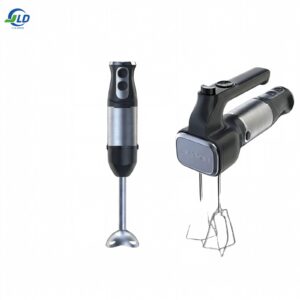
Finally, the market itself is changing. UK buyers now routinely ask for UKCA certificates, UK plugs, mixed-model containers and private-label boxes, and not every supplier can deliver all four. A trading company can broker these services, but a manufacturer performs them natively. The two supplier types represent fundamentally different business models: one sells production capability, the other sells trading services, and matching your import strategy to the model that fits is the single most useful sourcing skill a UK importer can develop in 2026. Start by comparing candidate suppliers against the hand blender models you intend to stock, because the product range tells you immediately which side of the divide you are dealing with.
What Is a Hand Blender Manufacturer?
A hand blender manufacturer is a business that owns production capacity: it designs or licenses products, operates assembly lines, controls the bill of materials, and ships finished goods from its own factory. Most hand blender factories that export to the UK are based in Guangdong, particularly in Shenzhen, Foshan and Zhongshan, where the small appliance cluster has decades of experience building immersion blenders for global brands. A genuine manufacturer will typically show you its own factory building, its production lines, its injection-moulding or metal-stamping equipment, and its quality-control benches.
The defining characteristic of a manufacturer is control. It controls the components that go into each unit, from the motor to the blade steel to the cable, and it controls the quality process at every station on the line. That control translates into three things UK buyers care about: consistent quality batch after batch, the ability to customise (voltage, plug, colour, branding, packaging, accessories), and credible documentation, because the factory holds the test reports and declares conformity against its own production. A manufacturer can also hold spare parts for years, because it still has the tooling.
Manufacturers do have limitations. Most factories focus on a range of models and are not supermarkets: if you want one unit each of forty different models, a factory will usually decline, because its line efficiency depends on concentrating volume. Minimum order quantities are a fact of life, typically 200-500 units per model for a hand blender. And communication can be slower at the factory level than through a trading company, because you are dealing with engineers and production planners rather than sales staff. YLD Home, a small kitchen appliance manufacturer in China that exports hand blenders and hand mixers to the UK, is typical of the category: strong on control and customisation, with MOQs that start around 200-300 units for standard models.
What Is a Trading Company?
A trading company, sometimes called an export company or sourcing agent, does not own a factory. It buys from multiple manufacturers and resells to overseas buyers, adding value through catalogue breadth, sourcing, quality inspection, logistics and documentation handling. Trading companies are common in every Chinese manufacturing city, and many are honest, professional businesses that serve small importers very well. They earn their margin from the spread between what factories charge and what you pay, which is typically 5-15 percent on small appliance categories.
The strength of a trading company is flexibility and range. A good trading company can source a hand blender from one factory, a hand mixer from a second, a milk frother from a third, and consolidate them into one container with mixed SKUs, which suits marketplace sellers testing multiple products. Trading companies also handle the administrative burden: they arrange export documentation, book freight, manage inspections, and communicate in fluent English, which genuinely saves time for a first-time importer. For small orders below a factory’s MOQ, a trading company is often the only route.
The weakness is distance from production. A trading company does not control the factory’s quality, so consistency depends on the inspection regime it runs, which varies widely. Customisation is limited to what the underlying factory will accept, and the trading company’s margin sits on top of the factory price, which is why trading-company quotes are always higher than direct factory quotes for the same model. There is also an identity risk: some trading companies present themselves as factories, and some switch suppliers between orders, so the product you approved in the sample may come from a different line next time. None of this makes trading companies dishonest per se; it just means the buyer is paying for services and carrying the quality risk.
Hand Blender Manufacturer vs Trading Company: Price and Quality Compared
The comparison below is the one UK buyers should pin to the wall. It assumes a standard 500W hand blender, 500-unit order, UK configuration, and identical specification from the same underlying production base.
| Aspect | Manufacturer (factory direct) | Trading company |
|---|---|---|
| Unit price (500W, 500 units) | £13-£18 | £16-£22 |
| Quality control | Own QC line, consistent batches | Depends on inspection regime |
| Customisation | OEM/ODM, plug, colour, box, branding | Limited to factory’s offerings |
| UKCA documentation | Issued by the factory | Brokered from the factory |
| MOQ | 200-500 units per model | From 50 units, mixed SKUs |
| Spare parts | Held for years from own tooling | Depends on factory cooperation |
| Communication | Engineers and production planners | Sales staff, fast responses |
| Risk profile | You manage production directly | You manage the middle layer |
The price gap is real but shrinks with volume and negotiation; at 2,000 units the hand blender manufacturer vs trading company gap can reach 25-30 percent, because the trading company’s margin does not scale down. Quality is where the difference is hardest to measure: a good trading company with a strict inspection regime can deliver quality as consistent as a mediocre factory, and a careless factory can ship worse than a careful trader. The deciding factor is verification, covered below, not the label on the business card.
Customisation: OEM, ODM and Private Label Capability
For UK brands, customisation is usually the deciding argument in the hand blender manufacturer vs trading company debate, because private label is where the margin lives. A manufacturer offers the full ladder: OEM (your logo on an existing model), ODM (their design adapted to your specification), and full private label including custom colours, packaging, manuals and accessories. Because the factory owns the tooling and the design files, changes are implemented in production, not brokered through a third party, and the cost of customisation is transparent.
Practical customisation on hand blenders includes the obvious items: UK Type G plug, 220-240V configuration, your logo on the motor unit, custom box artwork, and a UK-market manual in English with correct terminology. It also includes engineering changes: a longer shaft for commercial models, a different blade geometry for purée work, a custom accessory set, or a specific colourway for a chain. Manufacturers quote these changes quickly because they know their own production; trading companies must go back to the factory, which adds days or weeks to every change request.
There is a quality trap in private label that UK buyers should know about. When you private-label through a trading company, the underlying factory may change between orders, which means your second batch can differ in motor sound, blade finish and weight from your first, while still carrying your logo. When you private-label factory-direct, the production line is the same and the process is repeatable. YLD Home, for example, runs a dedicated private-label programme for UK brands, from its 1600W commercial PressPro hand blender down to entry household models, with design files, packaging and UKCA documentation all handled in-house, backed by the certificate library on its appliance certification page, which is the kind of end-to-end control that trading companies struggle to replicate.
How to Verify Whether Your Supplier Is a Real Factory
Verification is the skill that separates professional UK importers from everyone else, and it matters more than the hand blender manufacturer vs trading company label on a website; our factory verification guide for Chinese hand blender manufacturers walks through every document and check in order. Start with the business licence and the registered address. A genuine factory’s licence will list manufacturing as its business scope, and its address will appear in satellite imagery as an industrial facility with loading docks and production buildings, not an office tower or a residential block. Cross-check the licence name against the bank account you are asked to pay; paying a “factory” into a personal or unrelated account is a classic warning sign.
Second, demand a live video walkthrough. A real factory can show you the line running, the QC benches and the warehouse on a video call, and most will do it happily because it converts buyers faster. Ask to see the specific model you are ordering being assembled.
The footage below is exactly the kind of live line tour you should demand before paying a deposit: assembly stations, QC benches and the warehouse at YLD Home’s factory in Shenzhen. Any genuine manufacturer should be able to produce something similar within a day of being asked, and you can browse more factory footage on the YLD Home YouTube channel.
alt:hand blender manufacturer vs trading company
Third, request export records: customs declarations, shipping marks and bills of lading showing previous exports, ideally to the UK or Europe. Fourth, ask for certificates in the factory’s own name, including UKCA or CE declarations and test reports from laboratories such as TUV, SGS or Intertek; a trading company will usually have documents in the factory’s name, which is fine, but the factory should be able to produce them itself.
Fifth, order a sample and compare it with what a second sample, ordered through a different channel, would look like. Sixth, if the order is large, commission a third-party audit from SGS, Bureau Veritas or Intertek, which will confirm headcount, production capacity and whether the factory is what it claims. Finally, use payment terms that protect you: a small deposit with balance against inspection report is standard, and a supplier who insists on 100 percent upfront before any evidence is a supplier to walk away from. Verification is a half-day of work that can save a full container of grief.
When a Trading Company Still Makes Sense for UK Importers
For all the advantages of factory-direct buying, there are situations where a trading company is the rational choice, and honest sourcing advice should say so. The first is very small volumes. If you need 50 to 100 units to test a new channel, no manufacturer will take the order, and a trading company can consolidate your hand blenders with other products into a single small shipment. The second is catalogue testing: marketplace sellers who want to list five different appliance categories before committing to any of them are better served by one trading partner than by five factory relationships.
The third is speed and language. Trading companies respond fast, speak fluent English, and handle documentation, freight and inspection as a service, which genuinely reduces workload for a small team. The fourth is mixed SKU consolidation: one container holding hand blenders, hand mixers and frothers from three factories is a trading company’s specialty, and factories will rarely agree to that spread at good pricing. The fifth is risk distribution: a trading company with a strict inspection regime can be the right choice when you cannot visit China and do not want to manage production remotely.
The rule of thumb is to match the route to the stage of your business. Use a trading company while you are testing products and channels, then migrate volume to factory-direct once you know which models sell and you are ready to order in the hundreds. Many UK importers run both relationships in parallel: a trading company for the long tail of test SKUs, and a manufacturer for the core range. The mistake is choosing one route and never reviewing it, because the best hand blender manufacturer vs trading company mix changes as your order volumes grow.
A Decision Framework for Your Hand Blender Import
Use this framework to settle the hand blender manufacturer vs trading company question for your specific situation. Score each statement honestly; the column with more ticks is your starting point, and the guidance below each row explains the trade.
| Scenario | Go factory-direct if… | Use a trading company if… |
|---|---|---|
| Order volume | 300+ units per model, repeat orders | Under 150 units, one-off tests |
| Branding | Private label or OEM planned | Unbranded or generic listing |
| Range | One category, deep SKUs | Many categories, shallow SKUs |
| Compliance | You want documents from the factory | You want a broker to manage everything |
| Spares | Commercial/horeca customers need parts | Retail sell-through only |
| Risk appetite | You can manage production directly | You want a middle layer to handle issues |
The framework points most established UK buyers to factory-direct for the core range. A distributor importing hand blenders for resale to UK retailers will typically order 500-2,000 units per model, private-label a portion, and need UKCA documents and spare parts, all of which favour the manufacturer column; when that distributor serves horeca customers, our guide to choosing a commercial immersion blender covers the power and shaft-length decisions that matter most for foodservice, and the current wholesale blender range shows the volume price bands for each model. A startup marketplace seller listing ten appliance types with 50 units each is firmly in the trading company column. Where buyers get into trouble is straddling the middle: ordering 200 units through a trading company at factory-minus margin expectations, which disappoints both sides.
Case Example: Sourcing a Hand Blender Factory Direct from Newcastle
A Newcastle-based kitchen appliance importer, call them North East Kitchen Co., came to us after eighteen months of buying through a trading company. They were private-labelling a 500W hand blender for the UK marketplace channel, selling roughly 800 units a quarter, and their pain points were familiar: the trading company had switched underlying factories between two orders, the second batch’s motor noise was noticeably louder, and a promised colourway change took six weeks to quote. They asked us to help them source a hand blender factory direct from Newcastle, and the transition took one quarter.
The first step was verification: we sent them a live video walkthrough of the YLD Home production line in Shenzhen, showed the QC benches and the specific 500W model being assembled, and shared export records to the UK and Europe. North East Kitchen Co. ordered samples in their target colourway with their logo, tested them against the previous batch, and confirmed the documentation: UKCA declaration, test report from an accredited laboratory, and UK plug configuration, all in the factory’s name. The first production order was 1,200 units across two colourways, with the balance payable against the pre-shipment inspection report.
The results were exactly what the decision framework predicts. Unit price dropped roughly 22 percent against the trading company price, the colourway change was implemented in the first production run without drama, and the second reorder matched the first within tolerance, because the same line, same tooling and same QC process produced both. Spare shafts and blades were stocked in Newcastle for after-sales. The importer still uses a trading company for its test SKUs, but the core range is now factory-direct. The lesson for UK buyers is that the hand blender manufacturer vs trading company choice is not a one-time decision; it is a portfolio decision that should be reviewed every time your volume steps up.
Frequently Asked Questions
- What is the difference between a hand blender manufacturer and a trading company? A manufacturer owns production and controls quality and customisation; a trading company buys from factories and resells, adding services but also a margin layer; YLD Home is an example of the manufacturer model.
- Which is cheaper for UK importers? Factory-direct pricing is typically 10-30 percent lower than trading company pricing on the same model, with the gap widening at higher volumes; ask YLD Home for a factory quote to see the difference on your exact model.
- Can a trading company provide UKCA documentation? Yes, trading companies broker documentation from the factory, but the certificate should always be in the factory’s name; YLD Home issues UKCA documents in its own name for every model.
- How can I check that my supplier is a real factory? Verify the business licence, watch a live video walkthrough, request export records, and check certificates in the factory’s name; for large orders, commission a third-party audit; YLD Home offers live line tours and shares export records with UK buyers.
- What is the minimum order quantity for factory-direct hand blenders? Typically 200-500 units per model, with mixed models allowed in one container; YLD Home’s stepped MOQs start around 200-300 units for standard models.
- Is a trading company better for testing new products? Usually yes; trading companies handle small volumes and mixed SKUs that factories will not accept, though YLD Home also supports small test orders on stepped MOQs.
- Does YLD Home support private label for UK brands? Yes, YLD Home provides UKCA documents, custom plugs, branding, packaging and manuals through its in-house private-label programme.
- Can I use both routes at the same time? Many UK importers do: a trading company for test SKUs and a manufacturer for the core range, and YLD Home can serve as the manufacturer side of that split.
Official references: Business model – Wikipedia
For buyers planning their next order, hand blender manufacturer vs trading company decisions come down to supplier reliability, unit cost and compliance. hand blender manufacturer vs trading company buyers who compare factory-direct options against trading company quotes tend to get better pricing, and hand blender manufacturer vs trading company ranges with UKCA-certified models move faster at retail. If you are evaluating a new line, keep hand blender manufacturer vs trading company specifications such as wattage, speeds and shaft material in a checklist before you request samples.