







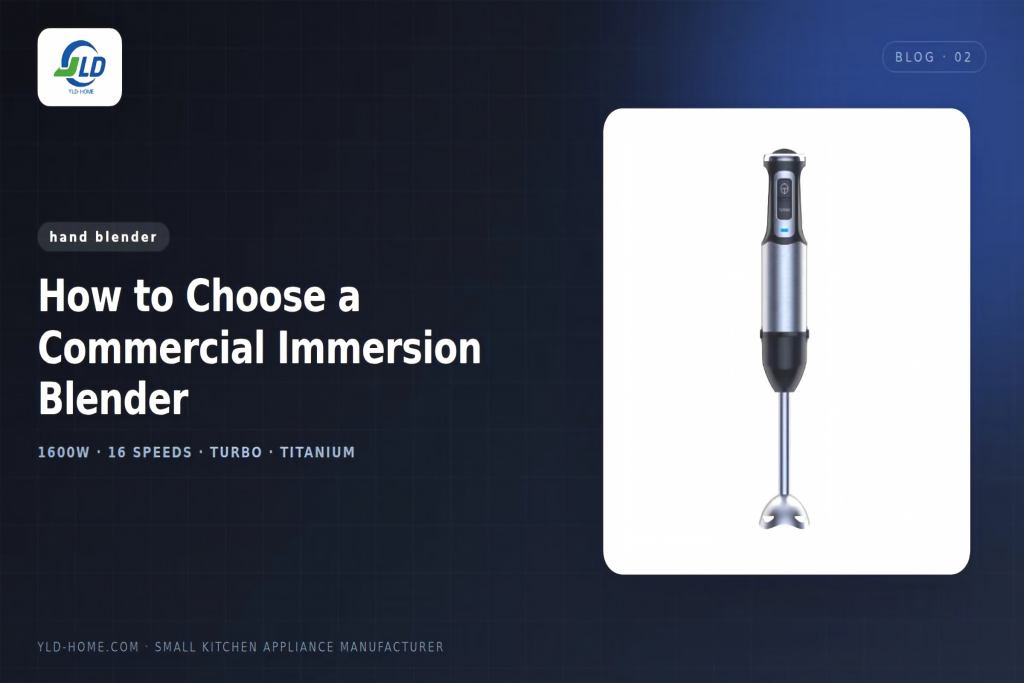

A commercial immersion blender is one of the highest-ROI tools in a professional kitchen. It purees soup directly in the pot, emulsifies sauces, and saves hours compared with batch blending. But choosing the wrong machine means stalled motors on thick soup and endless repair calls. This guide walks kitchen managers, restaurant owners and wholesale buyers through the exact specifications that matter, so you buy the right tool the first time.
For buyers comparing supply options, the hand blender range from YLD HOME lists every model by type and wattage, with MOQ, lead time and certification stated per page.
How to Choose a Commercial Immersion Blender: The 5 Key Specs
Why Commercial Grade Matters
Consumer immersion blenders sit around 200W to 500W. Commercial units start around 800W and go up. The difference is not just power on paper: it is motor design, duty cycle, blade quality and service life. A kitchen that purees soups, sauces and purees daily will destroy a consumer machine in weeks. A commercial machine is engineered for repeated use, longer running times and easier maintenance, which is why foodservice buyers should always choose commercial grade.
Power: What Wattage Do You Really Need for Immersion Blender?
The single most important number is power. At 1600W, a commercial immersion blender handles big-batch soups in the pot without transfer, crushes fibrous vegetables, and keeps working through back-to-back batches. Underpowered machines overheat and stall, and the downtime costs more than the upgrade.
Here is a practical power guide for kitchen operations: light cafés and small restaurants can run on 800-1200W; hotel kitchens, catering companies and central kitchens should buy 1600W units with turbo; food production lines with continuous use should go even higher and buy units with commercial duty cycles. When in doubt, buy more power than you think you need, because the cost difference is small compared with the cost of failure in service.
Speed Control: Variable Speeds vs Single Speed of Immersion Blender
A single-speed machine is fine for basic pureeing. Variable speeds matter for emulsions: mayonnaise, hollandaise, vinaigrette and custard sauces require a slow start to pull oil into the mix, then a higher speed to finish. A 16-speed unit gives the chef precise control from gentle to turbo.
Turbo mode is the practical feature to look for: one button for maximum power when you hit a thick patch. It saves time, protects the motor from stalling, and is the feature chefs actually use every day. When comparing models, check whether speeds are continuous or stepped, and whether the speed dial is easy to use with wet hands.
Blade Material and Geometry
Blades should be stainless steel for food safety and longevity; titanium steel blades add hardness for heavy continuous use. Look at the blade shape too. Multiple blade styles (chopping, pureeing, emulsifying) let one machine cover more tasks, which reduces the number of tools you need in the kitchen.
A detachable blade and shaft make cleaning fast between batches, which is essential in a commercial kitchen where hygiene inspections are routine. Check that the shaft is long enough to reach the bottom of your largest pot, and that the blade guard prevents splashing without trapping food.
Motor Durability and Duty Cycle
Duty cycle means how long the motor can run before it needs to cool down. Consumer machines may run for a minute; commercial machines should handle several minutes of continuous use. Ask the manufacturer for the duty cycle specification, and check the motor brand. Reputable manufacturers use established motor suppliers and can document the motor’s service life.
Ergonomics and Safety
Your kitchen staff will hold this machine for hours. Check handle ergonomics, weight balance and noise level. Safety features matter too: an automatic shut-off on overheating, a secure blade lock, and a stable base when the machine is parked. These details separate a professional tool from a toy.
Recommended Specs for Different Operations
| Operation | Recommended | Why |
| Café / small restaurant | 800-1200W, 8-12 speeds | Daily soups and smoothies |
| Hotel kitchen / catering | 1600W, 16 speeds, turbo | Big batches, varied textures |
| Food production / central kitchen | 1600W+, multiple blades | Continuous duty, dense mixes |
| Bakery / patisserie | 600-1000W | Sauces, custards, small purees |
Wholesale Buying Tips
Buy from the manufacturer, not a reseller, to control cost and customization. Ask for samples before bulk orders, verify voltage (110-120V or 220-240V) for your market, and confirm certification documents (CE / ETL / FCC) at quotation. A commercial immersion blender is a repeat-order product, so reliability of supply matters as much as the unit price. Ask about spare parts availability and warranty terms before you place the first order.
Maintenance and Cleaning
Daily maintenance is simple: detach the shaft, rinse under running water, and wipe the motor body with a damp cloth. Weekly deep cleaning of the blade assembly prevents food build-up. Always follow the manufacturer’s cleaning instructions, because improper cleaning is the most common cause of premature failure.
Common Mistakes When Buying Commercial Immersion Blenders
The most expensive mistake is under-powering: buying a 500W machine for a kitchen that needs 1600W, then replacing it within months. The second is ignoring the duty cycle, which determines whether the motor survives continuous use. The third is choosing a fixed-speed machine for a menu that includes emulsions, then struggling with split sauces.
Another mistake is neglecting voltage and plug configuration until delivery. A 220V machine in a 110V kitchen is a paperweight. Finally, buyers often forget to plan for spare parts. A commercial kitchen cannot wait weeks for a replacement blade or shaft, so parts availability is a purchasing criterion, not an afterthought.
Cost and ROI of Commercial Grade
Commercial immersion blenders cost more upfront, but the ROI calculation favors them in foodservice. Compare the cost of a commercial unit with the labor savings of in-pot pureeing, the quality consistency of controlled speeds, and the avoided downtime of consumer machines failing mid-service. For a kitchen that processes soups and sauces daily, a 1600W unit pays for itself in months.
For wholesale buyers, the economics include service cost. A commercial line with good spare parts support reduces your after-sales burden. When comparing quotes, include the expected service cost over three years, not just the unit price.
Comparing Brands and Models
When comparing models, build a short list with four specifications: wattage, speed count, blade material, and detachable parts. Add duty cycle and noise level if the manufacturer publishes them. Test samples side by side in real kitchen conditions, because specifications on paper do not predict how a machine handles a full pot of chunky vegetable soup.
Purchasing Process Checklist
Make the buying process repeatable. Start with a written requirement: kitchen type, expected batches per day, voltage and plug, and budget. Shortlist three models from different suppliers, request certificates and references, and order samples. Test each sample on the same protocol, score them, and choose the winner. Agree the order terms in writing, including price, MOQ, lead time and warranty.
A documented process protects you from impulse buying and from suppliers who quote inconsistently. It also makes the next purchase faster, because the checklist already exists. Keep the scorecard from each round; it becomes your reference for future orders.
Seasonality and Reorder Planning
Commercial kitchens buy more equipment before peak seasons and during renovations. Track your own usage and plan reorders before demand spikes, because production lead times plus freight add weeks. Keep a spare unit for critical stations so a failure does not stop service. Reorder discipline is what separates a managed kitchen from a reactive one.
Consumer vs Commercial: A Side-by-Side Comparison
To see the difference clearly, compare specifications side by side. A consumer immersion blender typically runs 200-500W, has 2-8 speeds, a plastic or stainless shaft, and a short duty cycle. A commercial model runs 800-1600W, offers 8-16 speeds plus turbo, uses titanium or heavy stainless blades, and is engineered for repeated use with detachable parts for cleaning.
The price difference is real, but so is the service life. For a kitchen that blends daily, the commercial machine saves money over its lifetime through fewer replacements and less downtime. For a home kitchen, the consumer machine is the correct choice. Buying the wrong class is the most common error in this category.
Buying for Different Kitchen Types
A small restaurant with one soup station needs one reliable 800-1200W unit. A hotel kitchen with multiple stations needs several units and a spare. A central production kitchen needs 1600W machines with multiple blade styles and a documented duty cycle. A bakery needs a smaller unit for sauces and custards. Write down your kitchen type and workload before comparing prices, and the right machine becomes obvious.
Supplier Selection and Sample Testing
Choose suppliers by evidence, not by website. Request the certificate documents, ask for client references in your region, and order samples of the shortlisted models. Test each sample with your actual recipes: a thick vegetable soup, a hollandaise, a frozen fruit smoothie. Measure motor heat after three consecutive batches. The sample test separates marketing claims from real performance.
Glossary
Duty cycle: the ratio of running time to cooling time the motor can sustain. Turbo: a momentary maximum-power function. Titanium steel: a hardened blade alloy for heavy use. Detachable base: a removable shaft and blade assembly for cleaning. LVD: Low Voltage Directive, part of CE marking. EMC: Electromagnetic Compatibility, also part of CE.
Kitchen Workflow Integration
A commercial immersion blender works best when the kitchen workflow is designed around it. Place the unit near the range for soups and sauces, keep a spare shaft ready, and assign cleaning responsibility to a specific station. Teams that integrate the tool into their routine use it consistently, which is where the labor savings appear.
For multi-station kitchens, standardize the model across stations so staff can swap units and spares. One familiar machine beats a collection of different brands. Document the standard operating procedure for pureeing, emulsifying and cleaning, and train new staff on it. Consistency in use extends machine life and product quality.
Environmental and Energy Considerations
Energy efficiency matters in commercial kitchens, where appliances run daily. Compare the wattage and the actual power draw of shortlisted models; a 1600W unit used efficiently may consume less than an underpowered unit that runs longer and overheats. Look for machines with efficient motors and sensible standby behavior.
Packaging and materials matter for procurement policies. Favor suppliers that use recyclable packaging and document material compliance. For buyers with sustainability targets, ask about the factory’s environmental certifications and material documentation, because the answers affect your own reporting.
FAQ
- Q:What is a duty cycle?
- The ratio of running time to cooling time the motor can sustain; ask the manufacturer for the number.
- Can a commercial immersion blender handle frozen fruit?
- High-power models with turbo can;
- lower-power models struggle.
- Do you offer trade-in or upgrade programs?
- Discuss volume pricing and service terms with your supplier directly.
- How many suppliers should I compare?
- Three is a practical number for a fair comparison without overload.
- What terms should be in writing?
- Price, MOQ, lead time, warranty, certification and shipping terms.
- How do I plan reorders?
- Track usage, add production and freight lead time, and keep a spare unit.
- How many units should a hotel kitchen order?
- At least one per station plus a spare; volume pricing applies.
- What should I test in a sample?
- Motor heat, blade performance on your recipes, noise, and cleaning ease.
- Do you offer different shaft lengths?
- Yes, shaft length can be specified for deep pots.
- How do I train staff on a new blender?
- Provide a short standard operating procedure and a supervised practice session.
- Does the blender consume much energy?
- Wattage is a peak rating; actual consumption depends on usage patterns.
- Are materials food-safe and documented?
- Yes, food-grade materials and compliance documents are provided.
- What wattage do I need for restaurant soup?
- 1600W with turbo is the safe commercial choice.
- Can one immersion blender make mayonnaise?
- Yes, with variable speed and an emulsifying blade.
- How do I clean a commercial immersion blender?
- A detachable base rinses under running water; blades can be disassembled for deep cleaning.
- What voltage do I need?
- Confirm with your supplier: 110-127V for the USA and most of Latin America, 220-240V for the EU, UK and South Africa.
- How long does a commercial immersion blender last?
- With proper care and duty-cycle discipline, several years of daily service.
- Do you supply spare parts?
- Yes, blades, shafts and motor parts are available for supported models
Who we are and What we provide values for you?
Shenzhen YLD Home Appliances Limited is a professional and number 1 home appliances manufacturer in China. Our slogan is “High-Quality Product at Reasonable Prices.” First, we ensure fair dealing in all our business. We also have a professional team in each department.
Get our brief short video visiting in our factory tour
Do follow us in LinkedIn for more newsletters updates
Related models in this range: 5 In 1 Stainless Steel Hand Blender and Detachable Hand Blender Food Processor.