









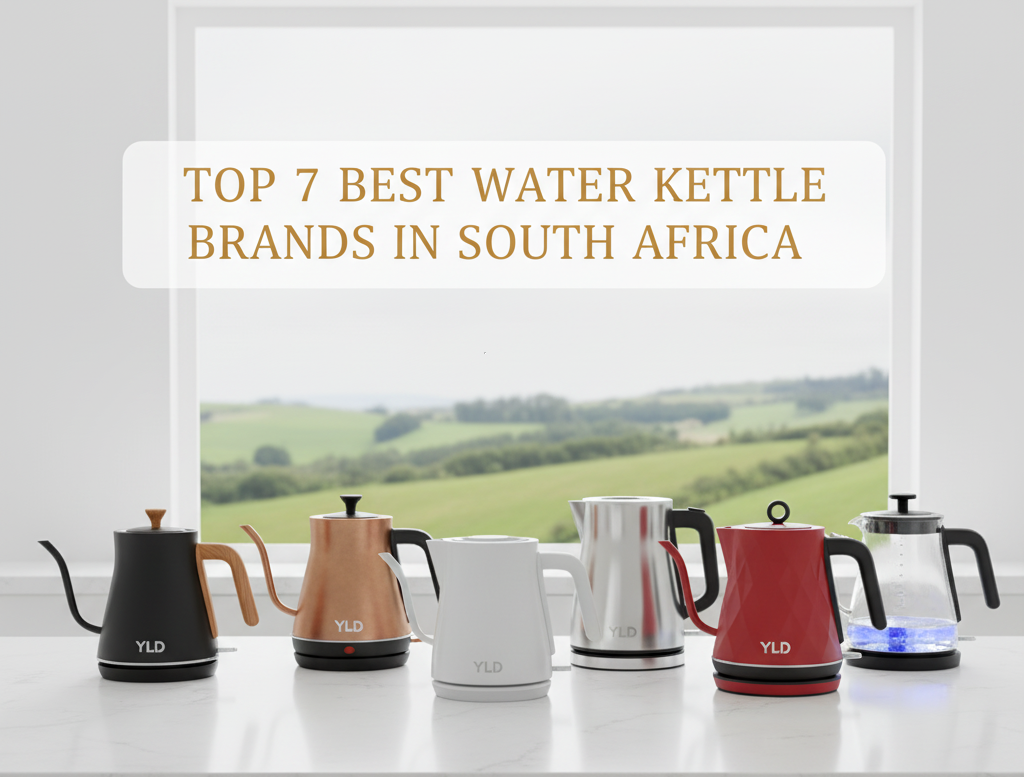
South Africa is an awkward market to sell a kettle into well. The voltage is standard enough, but the grid is not, the water is often hard, the plug is unusual by world standards, and the price ceiling at the entry end is unforgiving. That is why a model that moves by the container in Poland can sit untouched in a Johannesburg warehouse. This guide uses the seven water kettle brands in South Africa buyers most often benchmark against as a starting point, then works back from the real constraints to the specifications, certificates and spares worth checking before a purchase order.
Start with the grid, not the brand
Most buying decisions begin with a brand list and a target price. That order is backwards. Here a kettle is judged on a 220–240 V supply that is interrupted, restored and interrupted again, on water that leaves scale, and on a socket most exporters have never specified for.
These water kettle brands in South Africa are worth studying not because their logos carry weight, but because each defends a position: a price point, a channel, a service promise. Know which one a brand defends and you know what your product must beat. A distributor who opens with “cheaper than Russell Hobbs” has no argument; one who opens with the same boil time, a SANS-compliant plug and five-year switch supply does.
The five constraints that decide whether a kettle survives here
220–240 V and the plug most exporters get wrong
South Africa runs a nominal 230 V, 50 Hz supply, comfortably inside the 220–240 V range most tooling is built for. Voltage is rarely the problem; the plug is. Two 16 A standards apply — the large three-pin Type M plug to SANS 164-1, and the compact Type N plug to SANS 164-2, designated for new products since 2016. Older Type D 5 A plugs survive in older housing but cannot carry a 2 000 W kettle. A unit arriving with a Schuko, a UK Type G or an unterminated cord gets re-plugged locally — the unrecorded operation that voids a Letter of Authority. Specify plug, cord length and anchorage in the PO, and ask for a photo at the moulding station.
Load shedding and what it does to the element
Outages mean a kettle is often switched on the moment power returns. The result: inrush current through a cold element on a recovering supply, contacts that arc more than the laboratory count assumed, and users who fill to the maximum line because they do not know when the next outage starts. Two responses matter — a switch rated a genuine 10 A/250 V with real contact separation, and a boil-dry cut-out that resets reliably. A bimetallic strip that welds closed after repeated dry-boil events turns a warranty claim into a fire claim. Eskom load-shedding schedules still shape daily routines, which is why the switch, not the display, is where the money goes.
Hard water, scale and the coastal split
Much of the municipal supply is hard, and a kettle in Gauteng or the Free State will fur its element within months. Scale is not cosmetic: it insulates the element, lengthens boil time and raises energy draw per litre. Concealed stainless elements handle it better than exposed coils, and a wide lid decides whether a brush or citric acid can get in. Specify a removable filter; a permanent mesh becomes a calcium block. Coastal buyers should add humidity — connectors that pass a dry inland test can corrode in Durban within two seasons, so favour plated contacts.
Boiling point, altitude and the steam sensor
Johannesburg sits around 1 750 m, where water boils near 95 °C; Pretoria and Bloemfontein are similar. Cut-off is usually steam-sensed, so altitude mostly does not break it — but the margin shrinks: a high-set sensor on a partly filled kettle can trip late, a poorly sealed lid early. Cheapest thing to verify, most commonly skipped: boil the same batch at 1 700 m and at sea level, and confirm both the cut-off and the boil-dry trip.
Retail price points and the cost of over-specification
The entry shelf in grocery and hardware is brutally price-led, and the mid shelf is where brand equity does the work. A 1.7 L stainless kettle with digital temperature control will not sell at entry price and will not beat a known brand at mid price. Match features to the shelf, and spend on the parts that fail: switch, connector, element, cord.
| South African condition | What it demands of the design | What to verify on the sample |
|---|---|---|
| 230 V, 50 Hz, Type M / Type N socket | Correct plug moulding, 16 A rated, anchorage to SANS 164 | Plug photo, cord pull test, marking legibility |
| Outages and restore surges | Switch rated 10 A/250 V, robust thermal cut-out | Switch brand and rating, dry-boil reset ×50 |
| Hard municipal water | Concealed stainless element, wide lid, removable filter | Descale access, scale cycle test |
| Highveld altitude (~1 750 m) | Steam sensor with margin, sealing lid | Cut-off test at altitude and at sea level |
The seven water kettle brands in South Africa buyers benchmark against
What follows is not a ranking, and not a recommendation to buy any of them. It is a map of positions already occupied — the only useful thing a brand list can tell a sourcing team.
1. YLD Home (Shenzhen manufacturer, direct supply)
A factory-side option rather than a retail brand: kettles built to order, with specification, plug and packaging set by the buyer. The advantage is control — switch, element, cord, tooling. The disadvantage is that everything a brand would absorb becomes yours: compliance paperwork, spares stock, retail story. Buyers who do well here already have a channel and service capability.
2. Mellerware
Long-established in South African kitchens and hardware retail, with a broad small-appliance catalogue built on price accessibility rather than innovation. Kettles sit in the volume tiers: simple switching, plastic or basic stainless bodies. Its strength is distribution; the gap is build feel, where a well-specified import can differentiate without a price war.
3. Russell Hobbs South Africa
The premium mainstream reference point. Distribution is wide, the design language is deliberate, and the retail buyer expects a product that looks like it belongs on a countertop. Pricing is defended by brand rather than specification, so compete on finish, pour quality and perceived noise — not wattage.
4. Safeway
A budget-led household name with wide reach in grocery and general retail. Products are functional, light and inexpensive, and durability is uneven across the range. Safeway defines the price floor: below it there is very little left for compliance, spares and freight.
5. Bennett Read
Positioned around durability and safety rather than styling, with a following among households that replace appliances reluctantly. Build is heavier and the safety story explicit; the trade-off is weight and a limited palette. Study it if your customer buys once rather than buying ten.
6. Pineware
A South African brand with a long history in small kitchen appliances, strongest in the economical tier and where replacement cost dominates the decision. Its equity is trust at a low price — hard to attack head-on, easier to flank with better materials at a modest premium. Among these water kettle brands in South Africa, it is the clearest case of a name selling on price rather than feature.
7. Platinum Appliances
A practical, value-focused range with a cleaner design language than the pure budget tier. Glass and stainless options appear in the line-up, and grip and pour ergonomics get some attention. It occupies the space between the entry shelf and the branded mid shelf, the most contested square metre in the aisle.
| Brand | Position defended | Indicative shelf band (ZAR) | Where an import can win |
|---|---|---|---|
| YLD Home | Factory-direct, buyer-specified | Quote-based, not shelf | Spec control, tooling, spares |
| Mellerware | Volume, familiar household name | Entry to lower mid | Finish, build feel, switch quality |
| Russell Hobbs SA | Premium mainstream, design-led | Mid to premium | Price-to-spec, faster refresh |
| Safeway | Price floor, wide grocery reach | Entry | Not a price fight — go up a tier |
| Bennett Read | Durability and safety | Mid | Lighter build without losing strength |
| Pineware | Economical, trusted local name | Entry | Materials at a modest premium |
| Platinum Appliances | Value with cleaner design | Entry to mid | Glass quality, pour control, base |
Treat those bands as directional: prices move with promotions, and one model can sit in three bands across grocery, hardware and online within a month. What matters is the gap between tiers, not the number on a ticket.
Certificates, customs and the paper trail
Compliance is where inexperienced exporters lose containers. The rules are not complicated, only specific, and a missing letter of authority stops a shipment more reliably than a quality defect. The plug itself must conform to SANS 164, and the rating label needs correct voltage, wattage, model reference and importer details.
NRCS Letter of Authority
Kettles fall under the compulsory specification regime administered by the National Regulator for Compulsory Specifications. Before sale, the importer needs a Letter of Authority issued against a test report from an accredited laboratory. It is tied to the model, the factory and the construction — change the element supplier or the plug moulding and you may be applying again.
IEC 60335-2-15 and the SANS adoption
The safety standard for liquid-heating appliances is IEC 60335-2-15, adopted here as SANS 60335-2-15. Reports must be current, from an accredited body, and matched to the exact variant shipped — a report on the 1.7 L stainless model does not cover the 2.0 L glass variant sharing a carton.
| Document | Issued by | Why it matters at the border |
|---|---|---|
| Letter of Authority | NRCS | Condition of sale for the model |
| Test report to SANS/IEC 60335-2-15 | Accredited laboratory | Basis of the LOA; must match the variant |
| Plug conformity to SANS 164 | Component supplier or lab | Prevents re-plugging and rejection |
| Rating label and carton marking | Factory | Importer, voltage, wattage, model |
| Spare parts and service declaration | Factory | Supports retail listing and warranty |
Document requirements for this category are set out on our certifications page, with the standards applied per product family.
Spare parts: the quiet deal-breaker
Where appliances are repaired rather than replaced, the parts list decides whether a buyer lists you twice. Three components account for most field failures: the switch assembly, the 360° cordless base connector and the cord set. A fourth, the lid latch, fails on glass models more often than suppliers expect.
Ask for the twelve-month failure rate of each part, what incoming inspection does to catch switch batch variation, then a spares price list and a five-year availability commitment. A supplier who will not commit is telling you something.
| Part | Typical failure mode | What the customer reports | Stocking advice |
|---|---|---|---|
| Switch assembly | Contact arcing, welded contacts after surges | “It won’t switch off” | Highest-volume spare; kit with the rocker |
| Base connector | Corroded or flattened contacts | “Works only if I wiggle it” | Match to model; not interchangeable |
| Cord set and plug | Anchorage failure, plug damage | “The cord is loose” | Ship as a complete SANS 164 assembly |
| Lid latch or hinge | Spring fatigue, cracked pivot | “The lid pops open” | Common on glass; stock with the seal |
| Element or base plate | Scale-induced overheating, open circuit | “It takes forever to boil” | Usually a write-off; argue for a descaler in carton |
A factory audit script you can read out loud
These separate a factory that has shipped to South Africa from one that has shipped to a port and hoped.
- Which plug standard is moulded on the line today, and can I see the cavity marking?
- What is the brand and current rating of the switch and the thermal cut-out?
- Has this exact model been boil-tested at altitude, and do you have the record?
- Which laboratory issued the 60335-2-15 report, and does it name this variant?
- What is the element material and thickness, and is it welded or brazed to the base?
- What is your in-line hi-pot and earth-bond test frequency?
- Can you supply switch, connector and cord as spares for five years, at what price?
- What is your carton drop-test result?
“Standard” or “as per industry” is a non-answer. Our quality control process is documented gate by gate, and the kettle buying guides cover capacity, element and body selection in more depth.
Frequently asked questions
Which water kettle brands in South Africa are actually manufactured locally?
Very few. Most are importers or brand owners specifying from factories in China, Turkey or Eastern Europe. The name tells you who owns the warranty and the distribution, not where the product was built.
Do I need a Letter of Authority to import kettles into South Africa?
Yes. Kettles fall within the compulsory specification regime, and an LOA from the NRCS is required before sale, supported by a current test report to SANS 60335-2-15 naming the exact model and variant.
Is a 2 000 W kettle too much for South African household wiring?
It draws roughly 8.7 A at 230 V, well inside the 16 A rating of a Type M or Type N socket. The risk is the circuit, not the socket: kettles often share a kitchen circuit with other high-draw appliances, so a 3 000 W model is harder to justify than a well-built 1 800–2 200 W unit.
Why do kettles scale up so fast here?
Much of the municipal supply is hard, and scale precipitates on the hottest surface — the element. Concealed stainless elements with a wide lid and removable filter are the practical answer, and a descaler sachet in the carton visibly reduces early complaints.
What is a realistic MOQ for a private-label kettle order?
It depends on tooling. For an existing body with your logo, packaging and plug, MOQs typically start in the low thousands per model; a new mould or custom colour adds tooling and a higher first order. Ask for tooling and unit price to be quoted separately — our quote request form is structured that way.
How do I compare two factory quotes that look identical?
Put switch, cut-out, element material, plug standard, cord length, carton grade and spares commitment on one line each, then price the differences. Two quotes at the same unit price are rarely the same product; the gap sits in the parts that fail in year two. New bodies are listed on our new products page, and buyers building a wider basket often pair a kettle programme with our electric blanket wholesale range for the same season.
Final thoughts
The useful question is not which of the seven water kettle brands in South Africa is best. It is which position on the shelf is still open, and whether your specification can hold it for five years without a spares crisis. Answer the grid, the water, the altitude, the plug and the paperwork before the brand question, and the decision becomes arithmetic rather than taste.
If you are already comparing specifications, send the shelf target and channel and we will return the model, plug, certificate path and spares list in one document — start with a quote.