







MOQ, Samples and Lead Times: What to Ask Before Placing a Kitchen Appliance Order
URL: /kitchen-appliance-moq-samples-lead-times/ | Focus Keyword: kitchen appliance MOQ | Markets: Europe · South Africa · North America · South America | Audience: Importers, Distributors & Wholesalers | CTA: Request MOQ, Sample & Lead-Time Quote
In this guide: Why MOQ Comes First · How MOQ Is Really Calculated · Realistic MOQ by Product Type · Getting Samples Right · Reading a Sample Invoice · The Four Lead-Time Clocks · How MOQ and Lead Time Interact · Negotiating Without Damage · Payment Terms and Incoterms · Regional Buying Patterns · Red Flags · FAQ

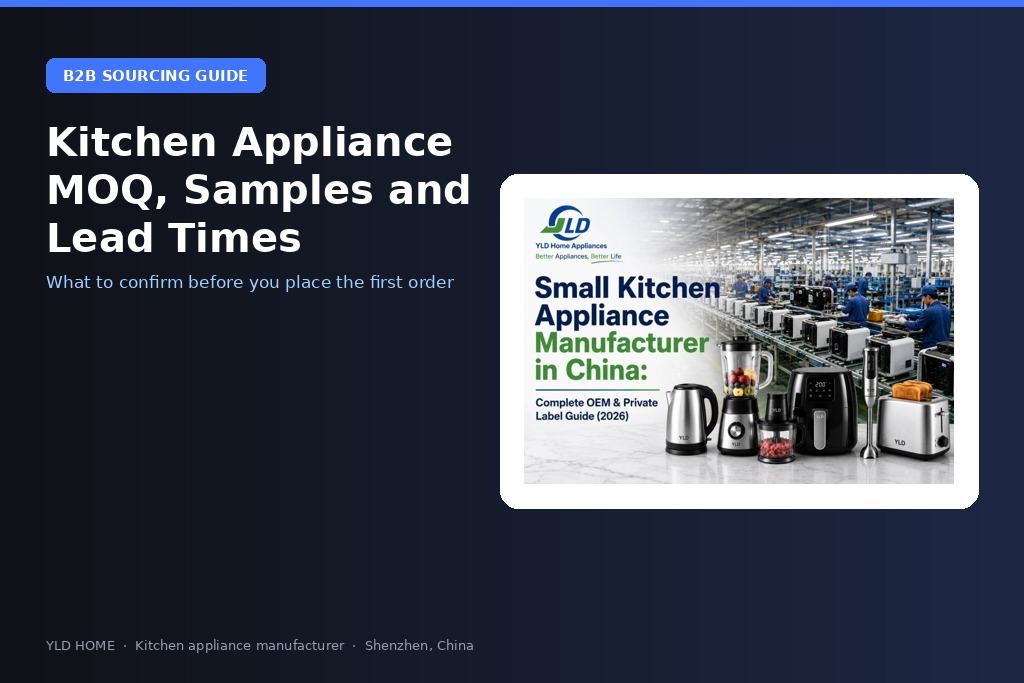
*Image alt: kitchen appliance MOQ and lead time planning at YLD Home factory*
If you import small kitchen electrics, three numbers decide whether a deal works: minimum order quantity, sample cost and production lead time. Get them wrong and you tie up too much cash, or wait eight weeks for stock that lands after your selling season. Ask the right questions about kitchen appliance MOQ before you sign anything, and every later conversation gets easier. This guide is for importers and distributors in Europe, South Africa, North America and South America buying blenders, hand mixers and choppers in volume. It covers what to ask, what answers are reasonable, and where suppliers cut corners.
Why Kitchen Appliance MOQ Is the First Number That Matters
Most buyers start with price. That is a mistake, because price is a function of quantity, and quantity is set by the minimum order quantity. A unit price quoted at 3,000 pieces means nothing if you can only sell 800. Before you compare a single figure, pin down the minimum order quantity for the exact model, in the exact configuration you want, and confirm whether it applies per model or per order.
MOQ also shapes your cash flow for the year. An order that fills a 40HQ container locks up far more cash than a mixed pallet, and that money stays unavailable until the goods sell. Plan MOQ around a realistic sell-through forecast, not around the lowest unit price.
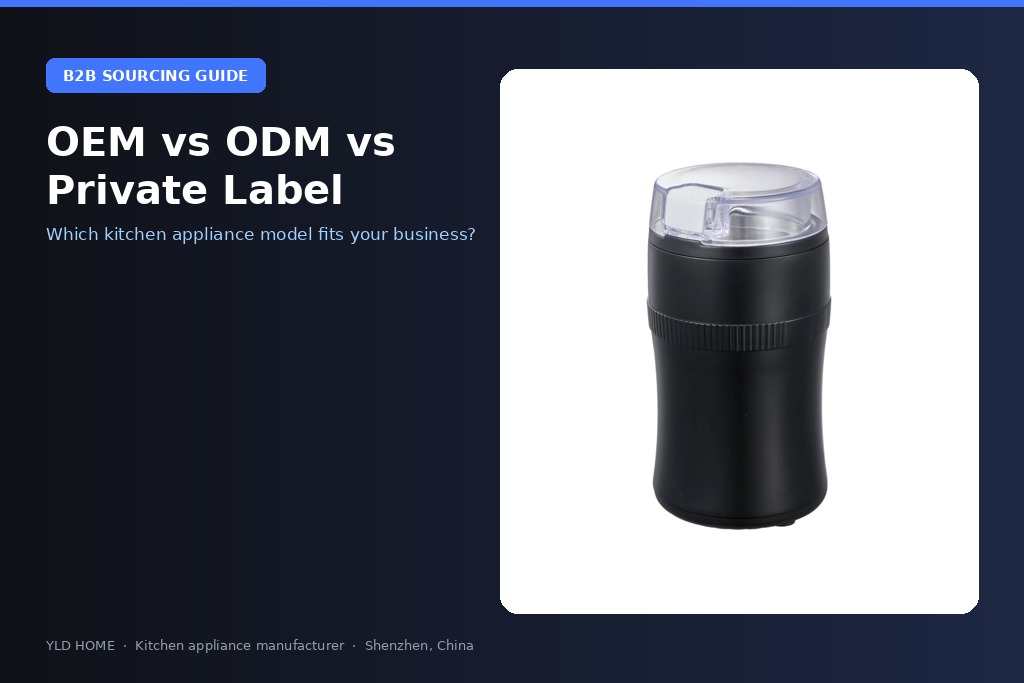
Decide early which supply model you are buying into. Stock models carry the lowest minimum because the factory already runs them. OEM, where you change colour, power, plug or packaging, pushes it up. Private label, built exclusively for your brand, raises it again because of tooling and print runs. If you want to grow from one to the next without changing factories, choose a supplier set up for all three. YLD Home, a Shenzhen-based small kitchen appliance manufacturer, runs exactly this structure, with stepped volumes that let a first-time importer start small and scale.
How Kitchen Appliance MOQ Is Really Calculated
Buyers are often told a number with no explanation, then surprised when it changes. A serious supplier will walk you through the arithmetic. It is built from three cost layers, and understanding them gives you room to negotiate.
The first layer is materials. Plastics, motors, blades and cords are bought in minimum quantities themselves, so a short run creates waste. The second is tooling and setup. Every change to a mould, a colour or a printed carton carries a setup cost, and the minimum spreads that cost across enough units to stay sensible. The third is shipping economics: ocean freight is charged by container, so an order that does not fill one pays a penalty in freight per unit.
| Cost layer | What drives it | How it moves your MOQ |
|---|---|---|
| Materials | Plastics, motors, blades bought in bulk | Higher for custom colours and new motors |
| Tooling & setup | Moulds, carton print runs, line changeover | Higher for OEM and private label |
| Freight | Container fill and Incoterms | Higher when you want a full FCL container |
When a supplier explains the minimum through these lenses, you can attack the right one. If freight is the problem, mix models in one container. If tooling is the problem, accept a standard colour for the first run. If materials are the problem, ask what the factory already stocks. That is far more productive than demanding a lower number.
What a Realistic Kitchen Appliance MOQ Looks Like by Product Type
Every category has its own natural range, and knowing the ranges stops you being quoted nonsense at either end. The figures below are typical for small kitchen electrics from established factories.
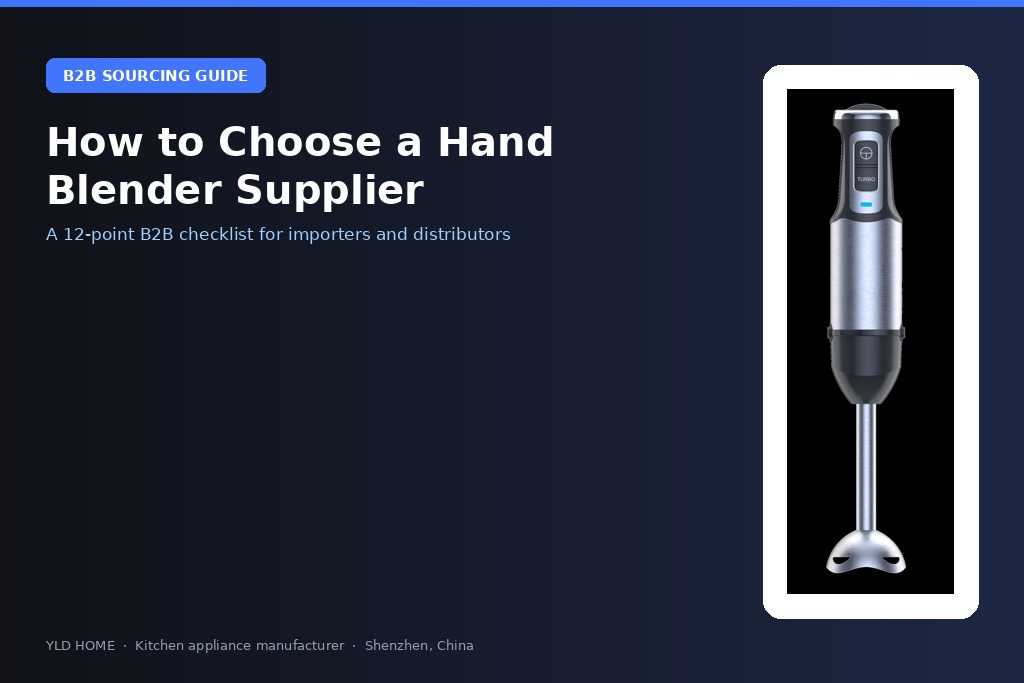
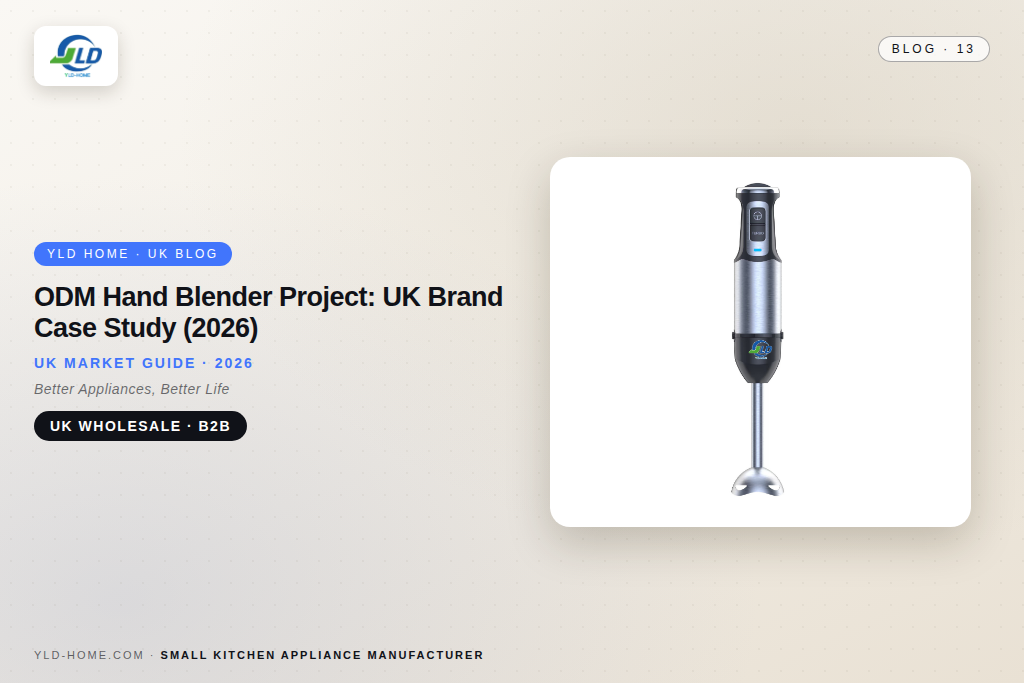
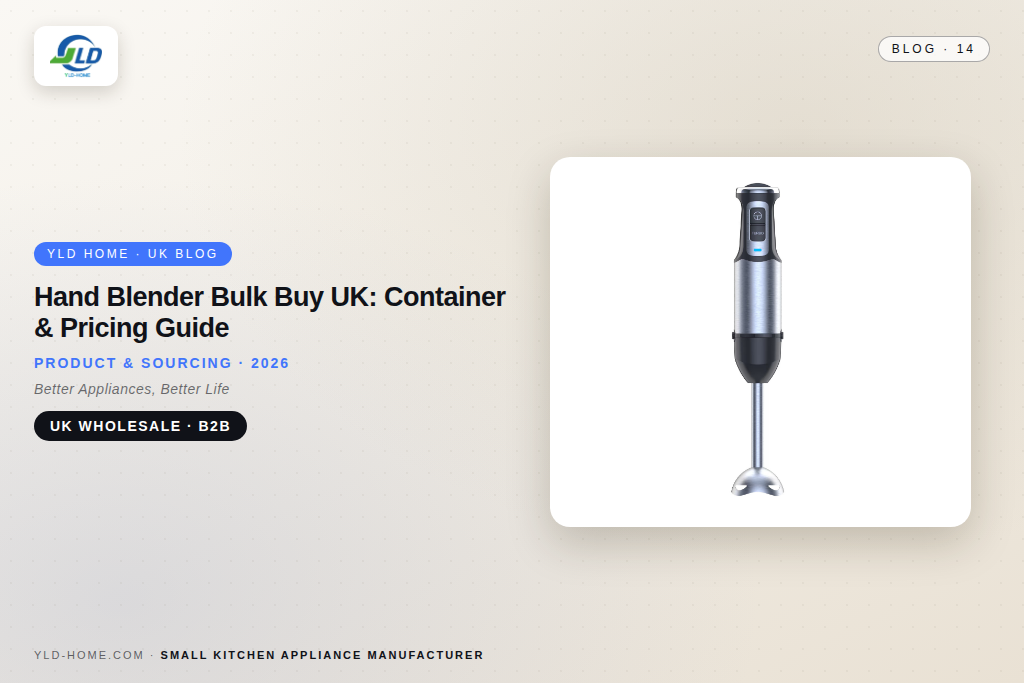
Hand blenders and immersion blenders sit at the accessible end. A stock model might start at 500 to 1,000 pieces, while a customised unit with your own colour and carton often climbs to 2,000 or 3,000. Larger or more complex appliances, such as air fryers and stand mixers, carry higher minimums because the tooling investment and box size are bigger.
Treat the table below as a planning guide, not a quote. If a supplier quotes a kitchen appliance MOQ far below these bands, ask why. Sometimes it is genuine stock clearance, but just as often it signals a trading company with no control over the line.
| Product family | Typical stock MOQ | Typical custom/OEM MOQ |
|---|---|---|
| Hand / immersion blender | 500–1,000 pcs | 2,000–3,000 pcs |
| Hand mixer or chopper | 500–1,000 pcs | 2,000–3,000 pcs |
| Air fryer or stand mixer | 1,000–2,000 pcs | 3,000–5,000 pcs |
Samples: What to Ask and What to Expect to Pay
Samples are where trust is built or lost, so treat the sample stage as seriously as the production order. A good request covers five things: the exact model and configuration, the voltage and plug for your market, the packaging type, the branding treatment, and the intended order volume.
Be clear about what a sample is. It is a unit the factory selects and prepares, not necessarily a random pull from mass production. Ask whether it comes from the production line or a pre-production build. If it is pre-production, ask what might change between the sample and the goods you receive. “Nothing changes” should be a written commitment, not a verbal reassurance.
Sample costs vary widely, and there is no shame in paying. A stock sample might cost the unit price plus express courier, with the fee credited back against your first order. A customised sample with your logo, colour and carton can cost several hundred dollars because of the setup. Get the refund threshold in writing before you pay.
When you request samples, ask for the same three documents you would want at production: a spec sheet, a quality checklist and any safety certificates for the target market.
Reading a Sample Invoice Without Getting Burned
The sample agreement is where small orders quietly go wrong. Read the invoice and covering email for four details before you transfer money: the sample fee and whether it is refundable, the courier cost and Incoterm, the refund trigger (the exact order quantity at which the fee is credited), and the timeline, so you know when to expect the shipment and when your feedback is due.
Watch the difference between a credited fee and a waived fee. “We will credit the sample cost against your first order” is good. “The sample is free, just pay the freight” sounds better but often hides a courier charge that exceeds the unit value.
YLD Home credits sample fees against the first production order once a defined volume is reached and ships samples with a spec sheet and certificates attached, which removes most of the guesswork from this stage.
Lead Times: The Four Clocks That Add Up
New buyers think of lead time as one number. Experienced importers know it is four clocks running in sequence, and any one can blow out your delivery date. Ask your supplier to quote all four separately, because a single figure hides where the risk sits.
The first clock is sample and approval time, the days you spend testing and signing off the unit. The second is production, the factory’s build window, which depends on line capacity and material availability. The third is quality inspection and packing, including any third-party inspection you commission. The fourth is transit, the ocean or air leg to your port plus customs clearance.
| Clock | Typical range | What can stretch it |
|---|---|---|
| Sample & approval | 7–20 days | Slow feedback, redesign rounds |
| Production | 20–40 days | Peak season, material shortages |
| Inspection & packing | 3–10 days | Failed QC, rework, buyer inspection |
| Transit | 18–45 days | Route, port congestion, customs holds |
Add a buffer before you publish a delivery promise to your own customers. Most importers pad the factory figure by two to three weeks, because a late container costs more in lost sales than the buffer costs in planning. Ask for a written schedule with milestone dates, not a single date, so you can spot slippage early.
Why Kitchen Appliance MOQ and Lead Time Move Together
The kitchen appliance MOQ and the lead time are two ends of the same rope. A small order can often slot into a gap on the line, which sounds fast, but small orders also wait behind larger ones when the factory is busy. A large order earns priority and a better unit price, yet it takes longer to build and ties up more cash.
That trade-off is why the smart move is usually to combine: order enough to fill a container, mix several models to reach efficient volume, and schedule production in your supplier’s quieter months. That lowers freight per unit, keeps the minimum workable per model, and shortens effective lead time.
Negotiating Kitchen Appliance MOQ Without Damaging the Relationship
Negotiation is not about forcing the number down. It is about finding the version of the deal that works for both sides, and the minimum is often more flexible than the first quote suggests.
Want a lower minimum? Offer a firm forecast. A written plan for three orders across twelve months is worth more to a factory than one small order, and many will cut the first-run minimum to win the schedule. Want a lower price? Offer higher volume. Want a faster lead time? Offer flexible colours or standard packaging so the line does not stop for changeovers.
Be specific and fair. Demanding a minimum far below the factory’s cost floor wastes everyone’s time, and a supplier who caves instantly is probably cutting something else to compensate. The best outcome is a stepped structure: a low first-order minimum to prove the market, a mid-volume tier with better pricing, and a high-volume tier with the sharpest terms. Ask for that structure in writing alongside the sample terms.
Payment Terms, Incoterms and the Hidden Cost of Small Orders
The commercial terms around your MOQ decide your real landed cost, and they matter as much as the unit price. Payment structure is the first place small buyers feel the squeeze. A typical first order runs on a deposit plus balance before shipment, often 30/70. Larger, proven accounts can negotiate better terms, but a deposit is normal and reasonable.
Incoterms change who pays for what. EXW means you own the goods at the factory gate and arrange everything. FOB puts the goods on the vessel at the named port and is the most common choice for container buyers. CIF adds freight and insurance to your port. DDP delivers to your door with duties handled. Each step adds cost and removes work, and the right choice depends on whether you have your own forwarder and customs broker.
Small orders carry hidden costs beyond freight. Customs brokers charge per entry, so splitting a shipment into three small consignments can cost more than one larger one, and a partly filled container still bills as a container. Plan MOQ with those fixed costs in mind.
Regional Buying Patterns: Europe, Africa and the Americas
Where you sell shapes what you should order. European importers usually want 220-240V, Type C/F or G plugs, CE marking and EU-language packaging, and they often accept higher minimums for rigid compliance documentation. The EU’s Access2Markets portal is a useful starting point for tariff and rules-of-origin questions.
South African importers typically want 220-230V with Type M or N plugs, SABS-relevant documentation and durable packaging for longer inland routes. Order sizes are often moderate but repeatable, and buyers value responsive communication across the time-zone gap.
North American importers need 110-120V, Type A/B plugs and UL or ETL certification, and they usually buy full containers to justify the freight. South American importers often want 127V or 220V depending on the country, NOM or INMETRO-style local certification, and they plan around long customs timelines, so a robust buffer matters more than a fast sample.
| Market | Voltage & plug | Common documentation | Order rhythm |
|---|---|---|---|
| Europe | 220–240V, Type C/F or G | CE marking, EU-language packaging | Higher MOQ for compliance docs |
| South Africa | 220–230V, Type M or N | SABS-relevant documents | Moderate, repeating orders |
| North America | 110–120V, Type A/B | UL or ETL certification | Full containers |
| South America | 127V or 220V | Local certification (e.g. INMETRO) | Long customs buffer required |
A supplier who understands these differences configures samples and production correctly the first time. Getting the voltage or plug wrong is one of the most expensive mistakes in this business, because a non-compliant container can be refused at the port.
Red Flags When a Supplier Quotes a Kitchen Appliance MOQ Too Low
A very low minimum is not automatically good news. It often means the supplier is a trading company reselling without control over the factory, which leaves you exposed on quality, lead time and after-sales support.
A quoted minimum far below the industry band, with no explanation, deserves scrutiny. So does a supplier who cannot name the factory, or who changes the subject when you ask about tooling and line capacity. Vague lead times are another warning: “about a month” is not a schedule. A supplier who will not put MOQ, sample terms, lead time and payment terms in writing is telling you something important.
Watch the sample stage too. A sample that arrives late, in the wrong configuration, or without paperwork predicts a production order that behaves the same way. Be cautious if the supplier pushes hard for a large first order while refusing a small trial.
A minimum that is easy to hit at very low prices usually hides a cheaper motor or thinner plastics, and kitchen appliances carry real electrical-safety obligations, so the cheapest quote is rarely the best value.
Frequently Asked Questions About Kitchen Appliance MOQ and Lead Times
What is a typical kitchen appliance MOQ for a first order?
For stock models, most factories quote 500 to 1,000 pieces per model. Customised or OEM units typically start at 2,000 to 3,000 pieces, and larger appliances go higher. Your first kitchen appliance MOQ can often be negotiated down if you commit to a forecast for later orders.
Are samples free?
Sometimes the unit is free and you pay freight; sometimes you pay a sample fee credited against your first order. Customised samples almost always carry a cost because of setup. Always confirm whether the fee is refundable and at what volume.
How long does production really take?
Production usually runs 20 to 40 days depending on model and season, but the full journey from sample approval to goods at your port is often 8 to 12 weeks. Ask for a milestone schedule, not a single date.
Can I mix several models in one order to reach the minimum?
Often yes, if the minimum is quoted per order rather than per model. Mixing models also helps fill a container, which lowers freight per unit. Confirm the rule in writing before you plan your range.
Do I have to pay for custom packaging?
Standard cartons are included in the unit price. Custom packaging needs a print run, which can lift the kitchen appliance MOQ or add a one-off setup fee. Ask for it itemised.
Is a lower MOQ always better?
No. A minimum far below the normal band can mean a trading company with no factory control. The right MOQ is the one that fills your container efficiently, matches your sell-through forecast and comes with clear written terms.  *Image alt: kitchen appliance MOQ production schedule and QC line at YLD Home*
| Buyer type | Typical first MOQ | Sample terms | Best for |
|---|---|---|---|
| Wholesaler or distributor | 500-1,000 units per model | Unit often free, freight paid | Filling a mixed container |
| Importer (first trial) | 300-500 units | Refundable sample fee | Testing sell-through before a full order |
| Private label or OEM | 2,000-3,000 units | Charged, credited against the order | Launching your own brand |
Getting Your First Kitchen Appliance Order Right
The appliance that sells best is the one that reaches your customers on time, at a cost your margin can carry. That outcome is decided long before the container ships, in the questions you ask about minimum order quantity, sample terms and lead time. Pin down the kitchen appliance MOQ per model, put the sample fee and its refund trigger in writing, and map the four lead-time clocks rather than gambling on each shipment.
If you are sourcing for Europe, South Africa, North America or South America and want a partner who quotes MOQ, sample terms and lead time transparently, YLD Home builds small kitchen appliances to your voltage, plug and packaging requirements. Request a MOQ, sample and lead-time quote and compare it against this guide before you commit. Start with the [hand blender range](https://yld-home.com/hand-blender/) and the [wholesale blenders catalogue](https://yld-home.com/products/wholesale-blenders/) to see the bands, or read our guide to [choosing a commercial immersion blender](https://yld-home.com/how-to-choose-commercial-immersion-blender/) before you shortlist models. Cross-border buyers can also review standard [Incoterms](https://en.wikipedia.org/wiki/Incoterms) to compare shipping terms across quotes. Clear terms up front are what turn a first trial order into a repeat programme.
Further reading: [hand blender range](https://yld-home.com/product-category/hand-blender/) · [hand mixer range](https://yld-home.com/product-category/hand-mixer/) · [factory tour](https://yld-home.com/factory-tour/) · [wholesale kitchen appliance FAQs](https://yld-home.com/faqs/) · [request a quotation](https://yld-home.com/quote/)