










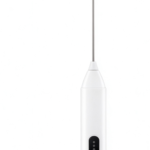
We build hand blenders on a single 500 W motor platform: standalone stick units, two-speed and digital variants, and a 10-in-1 set with nine attachments. As a hand blender supplier we quote OEM housing, colour, logo, packaging, plug and voltage. What follows is the test to run on us — and on every other supplier you shortlist.
Why “hand blender supplier” is the wrong place to stop
The phrase returns three companies that look identical online. Trading offices own no tooling and place your order at a plant you never see. Brand owners outsource the whole appliance. Plants mould their own housing and assemble on their own line. All three call themselves a hand blender supplier; only the third can hold a specification across repeat orders.
A stick blender is a motor, a coupling, a shaft and a blade; bell, whisk, bowl and beaker are accessory work. A supplier buying complete motor units controls none of the parts that decide your returns rate, so ask which of the four they make and for the part numbers.
The platform to ask about first
Ours is 500 W: enough for mid-market price points without a bigger motor bracket or a second compliance file. On it we run a gloss black two-speed unit with SUS 304 shaft, a fingerprint-resistant textured housing, a white ribbed 500 W DC version and a digital variant with 0–8 display at 15,000 rpm. The same platform carries the 10-in-1 set — 500 W plus TURBO, nine attachments — the SKU most importers use to lift basket value; a 1,600 W LCD unit covers the premium end.
Shared motor, coupling and shaft plus one certification family let a distributor list five SKUs, stock one spare-parts set and change price point without new compliance. If every SKU is a fresh design, every SKU is a fresh risk. Specifications are in the current range; the buying logic is in the blender guides.
Five indicators you can verify before you discuss price
None depends on trusting a description; each produces a document or a part number. Score 0–2 per line; under 7 out of 10 is a sourcing risk, not a negotiation problem.
| Indicator | What to request | What a real answer looks like | Red flag |
|---|---|---|---|
| 1. Certificate scope at model level | Certificate, test report and model list page | Your model code on the report; holder matches the contracting entity | Cover page only, or a “series” claim with no model list |
| 2. Motor, coupling and shaft part numbers | Exploded parts list; which core parts are made in-house | Part numbers, motor rating and insulation class, one coupling across SKUs | Vague talk of “high quality motors”; no parts list |
| 3. Sample traceability | Signed and sealed golden sample, plus the lot of your sample | Sample built on the line from production tooling, revision recorded | Sample hand-assembled by engineering; no record of what was approved |
| 4. In-process test records | Hipot, earth-bond and function data per batch, against EN/IEC 60335-2-14 | Batch records with date, station and operator; re-test after any rework | “100% tested” with no records |
| 5. Service-parts availability | Price and lead time for shaft, blade, coupling and seal as a kit | Written prices with validity, minimum per part, parts held after discontinuation | “Available on request”; spares quoted as a favour |
Indicator 4 is the one buyers skip: a unit can pass a visual check and still fail hipot on a pinched motor lead, returning later from your warehouse. Our inspection sequence is on the quality control page.
From sample to mass production: where the weeks go
Buyers assume moulding is the long pole. In practice artwork, packaging and certificates set the date; the pilot run protects the shipment.
| Stage | What happens | Typical cycle |
|---|---|---|
| 1. Spec freeze and DFM review | Wattage, speed control, shaft length, attachments, voltage and plug fixed in writing | 3–5 working days |
| 2. Sample on existing tooling | Stock tooling with your logo and colour; no new mould | 7–10 working days after artwork approval |
| 3. Sample with new mould or housing | Tool build, trial shots, T1 samples, dimensional check | 25–35 days |
| 4. Approval and golden sample | Your evaluation, lab test if required, sealed sample signed by both sides | 3–5 days; add 5–10 for a lab |
| 5. Certification confirmation | Model added to an existing certificate, or a new listing with inspection | 5–10 working days if listed; 4–6 weeks if new |
| 6. Pilot run | 50–100 units on the line, first-article inspection, drop test | 5–7 days |
| 7. Mass production | Assembly, 100% function and safety test, packing | 25–35 days for 1,000–3,000 units |
| 8. Inspection and loading | AQL inspection against the sealed sample, carton marking, loading plan | 3–5 days |
Read it as a risk map: stage 4 stalls on your approval, stage 5 when a listing collides with a launch. Start the certificate conversation at stage 1 and the schedule compresses by weeks.
Service parts: why shaft, blade and coupling are quoted separately
A single unit price hides the parts that generate your after-sales cost. They are separate lines because they are separate purchases with their own tooling and minimums; a distributor reselling them needs to see the margin.
Shaft. SUS 304 tube with a bell; length and bell diameter change with the accessory set, so a 10-in-1 shaft differs from a stick shaft on the same motor. Blade assembly. Stamped or machined four-blade head, titanium-coated on the premium model — the part that decides whether the unit survives frozen fruit. Coupling. The glass-filled sleeve linking motor shaft to blade shaft: first to wear, cheapest to replace, and the usual cause of “motor runs, blade does not turn”. Seal and bearing decide whether a dishwasher-safe claim is honest.
Three questions turn this into a commitment: the parts list with numbers, a kit price per 100 units and per container, and how long parts are held after discontinuation. A hand blender supplier who cannot answer the third has not planned past the current order.
Certification by market: CE, GS, UKCA, ETL
A hand blender is a mains motor appliance that touches food, so two tracks run in parallel. In the EU, CE under the Low Voltage and EMC Directives rests on EN 60335-1 and EN 60335-2-14, with food contact covered by Regulation (EC) No 1935/2004, published in full on EUR-Lex. GS is voluntary, but German and Austrian retail treat it as mandatory: it adds factory inspection and annual surveillance, so a GS file outruns a plain CE declaration.
For Great Britain, UKCA is what UK retailers increasingly expect, on standards mirroring the EN texts; confirm it before tooling is cut. The US and Canada require UL or ETL listing to UL 982 and CSA C22.2 No. 195, and listing means a factory inspection, not just a test report.
Two rules apply to all four. A certificate covers a model, a factory address and a construction: change the motor or housing and the file is re-evaluated. And 500 W at 120 V/60 Hz is not 500 W at 220–240 V. Coverage per model is on the certifications page.
MOQ, mixed containers and what moves the number
On stock tooling most hand blender supplier quotations start at about 1,000 units per model per colour. A new mould, housing colour or custom packaging pushes it to 2,000 and up. Below that, price becomes a subsidy.
Mixed containers are the standard answer for distributors who need range rather than depth: we load several models in one container provided each meets its own minimum, and build the plan from measured carton dimensions. Pack format and floor-loading versus pallets change landed cost more than unit price; ask for the break table at 3,000 and 5,000 units.
Frequently asked questions
How do I tell a hand blender supplier from a trading company?
Ask for the production address, then which processes happen there. A plant that moulds its own housings and assembles its own motors names the shop, the line and the test stations without hesitating; a trader describes capabilities in the third person. Then match the certificate holder to the entity on your contract.
What is the minimum order for a private-label hand blender?
Around 1,000 units per model per colour on existing tooling, 2,000 and above for a new mould, colour or packaging. Accessory sets carry their own minimum because each attachment is a separate tool — ask by component, or you find the constraint after committing.
Can you match the performance of a sample I already sell?
Usually on a 500 W platform, and it depends on what the sample is. Send the unit, rated wattage, shaft length and attachment list; we measure motor, coupling and blade geometry and say whether it is a housing change or a new motor.
How long from enquiry to shipment?
About 8–10 weeks on existing tooling with a certified model, 14–18 weeks with a new mould and a listing. Production is rarely the variable; your approvals and certificate lead time are.
Which certificates do I need for Germany, the UK and the US?
Germany: CE plus GS from a body such as TÜV or Intertek, plus food-contact documents for bell and blade. UK: UKCA, scope checked against designated standards. US and Canada: UL or ETL listing with factory inspection. All three must list your exact model code.
What to send us
Send the wattage, market and voltage, attachment list, packaging format and target quantity per model. We return a model match on the 500 W platform, certificate coverage, MOQ by component and a service-parts price list — the four things this page says to ask a hand blender supplier for. Requests go through the quote form; if you are still choosing between an existing platform and a new design, the guide to hand blender manufacturers in China works through that choice before you commit to tooling.
