









A forty-foot container of 4,000 immersion blenders leaves Shenzhen with a clean set of shipping documents. The CE Declaration of Conformity is in the folder. The test reports are attached. Six weeks later the pallet is sitting in a bonded warehouse in Hamburg, and the buyer’s QA team is asking one question nobody can answer: why does the GS certificate list a different housing material to the units in the cartons?
That is not a shipping problem. It is a documentation problem, and it starts long before the container is loaded. Most buyers treat CE certification kitchen appliances as a single certificate you buy once and file away. It is a living technical file that has to match the goods in the box, part number by part number, for as long as the product is on the market.
This guide covers what the EU actually requires, how GS, CB, UKCA and ETL fit around it, and — the part that costs the most money — which design changes force a retest.
What CE Certification Kitchen Appliances Really Requires
CE marking is not issued. It is declared. The manufacturer or importer signs a Declaration of Conformity (DoC) stating that the product meets the applicable directives, and then holds a technical file that proves it. Nobody in Brussels approves the file before the goods ship.
That single fact explains most of the confusion in this category. The legal basis for CE certification kitchen appliances sits in four separate directives plus two regulations, and each one has its own scope, its own standards and its own evidence requirements:
- **Low Voltage Directive 2014/35/EU (LVD)** — electrical safety for equipment rated 50–1,000 V AC. For a blender this means EN 60335-1 plus the part 2 standard for the product type: EN 60335-2-14 for kitchen machines, EN 60335-2-15 for liquid heating appliances such as kettles, EN 60335-2-9 for toasters and grills. EN 62233 covers electromagnetic fields.
- **Electromagnetic Compatibility Directive 2014/30/EU (EMC)** — emissions and immunity. Typical evidence is EN 55014-1, EN 55014-2, EN 61000-3-2 for harmonics and EN 61000-3-3 for voltage fluctuations. A motor with a cheap suppressor can pass safety and still fail here.
- **RoHS 2011/65/EU** — ten restricted substances, checked by material declaration plus XRF screening and, where needed, wet chemistry. Applies to every homogeneous material, including the solder, the cable jacket and the paint.
- **REACH (EC) 1907/2006** — SVHC screening above 0.1% by weight per article, plus SCIP notification into the ECHA database if the threshold is exceeded. Importers underestimate this one because it has no visible mark.
- **Ecodesign (ErP)** — standby and off-mode power limits, and energy labelling where the product category is covered.
Three more regimes sit outside CE but decide whether a retail listing goes live:
GS is a voluntary German mark issued by a notified body such as TÜV Rheinland, TÜV SÜD, Intertek or SGS. Not legally required, but commercially close to it: German, Austrian and Swiss retailers, and most EU discounters, will not list a kitchen appliance without it. GS is broader than CE — third-party EN 60335 testing, PAH testing to the German AfPS specification, and LFGB food-contact assessment.
CB is an IECEE scheme report. One CB test report to IEC 60335-1 and the relevant part 2 can be converted into national certifications in dozens of countries without retesting the whole product. It is the cheapest route to multi-market coverage.
UKCA is the post-Brexit Great Britain mark. ETL to UL 1082 and UL 982, plus FCC, is the US equivalent path.
The Regime Map: Which Mark for Which Market
The table below maps each regime that touches CE certification kitchen appliances, what it actually covers, and who signs it.
| Regime | Legal basis | What it covers | Who signs / issues | Typical buyer demand |
|---|---|---|---|---|
| CE – LVD | 2014/35/EU | Electrical safety, 50–1,000 V AC | Self-declared DoC | Mandatory for EU sale |
| CE – EMC | 2014/30/EU | Emissions and immunity | Self-declared DoC | Mandatory for EU sale |
| CE – RoHS | 2011/65/EU | 10 restricted substances | Self-declared DoC | Mandatory; retailers audit it |
| CE – REACH | (EC) 1907/2006 | SVHC >0.1% per article, SCIP | Self-declared; importer liable | Increasingly requested |
| CE – ErP | Ecodesign regulations | Standby / off-mode power | Self-declared DoC | Mandatory where in scope |
| WEEE | 2012/19/EU | Producer registration, take-back | Importer registers locally | Checked at customs in DE, FR, IT |
| Food contact | 1935/2004 + 10/2011 | Migration from plastics, metals, seals | Declaration of Compliance | Mandatory if food touches it |
| GS | Geprüfte Sicherheit (DE) | LVD + PAH + LFGB + factory inspection | Notified body certificate | Required by most EU retail |
| CB | IECEE | IEC 60335 series | National certification body | Speeds up multi-country filings |
| UKCA | UK product regulations | Same technical content as CE | Self-declared DoC | Required by some GB retailers |
| ETL / FCC | UL 1082, UL 982 | US electrical safety + EMC | NRTL + self-declared | Mandatory for US sale |
Note the gap in that table. CE covers safety, EMC, substances and energy. It does not cover whether the jug leaches plasticiser into hot soup, or whether the handle paint carries a banned aromatic amine. Those are separate obligations, and they are where most files are thin.
Where CE Certification Kitchen Appliances Stops: Food Contact
Anything that touches food — the blender jug, the whisk, the sieve, the silicone seal under the lid, the non-stick coating on a grill plate — falls under Regulation (EC) No 1935/2004, the EU framework regulation for food contact materials. Plastics must additionally meet Regulation (EU) No 10/2011, which sets overall and specific migration limits and requires a Declaration of Compliance listing the material composition and the migration test conditions.
This is not a paperwork formality. A silicone seal that is fine for cold water can fail overall migration when tested in olive oil at 175 °C for two hours, which is the condition that applies to a soup blender. The test condition has to match the real use, and the use has to match what the instructions claim.
Metals matter too. Stainless steel 304 and 316L are the accepted grades for food-contact parts, and the evidence buyers increasingly ask for is not just the mill certificate but the passivation record — the documentation that the weld zone was pickled and passivated so it does not corrode and release nickel or chromium into food. YLD Home keeps passivation records per batch for 304 and 316L parts precisely because that question now comes up in European audits.
For US-bound programmes the relevant framework is FDA 21 CFR, which is a different test set entirely. A product can be CE compliant and still be rejected by a US retailer because nobody ran the FDA food-contact extraction.
Change Control: Where CE Certification Kitchen Appliances Quietly Breaks
Most CE certification kitchen appliances failures we see are not test failures. The product passed — then somebody changed something.
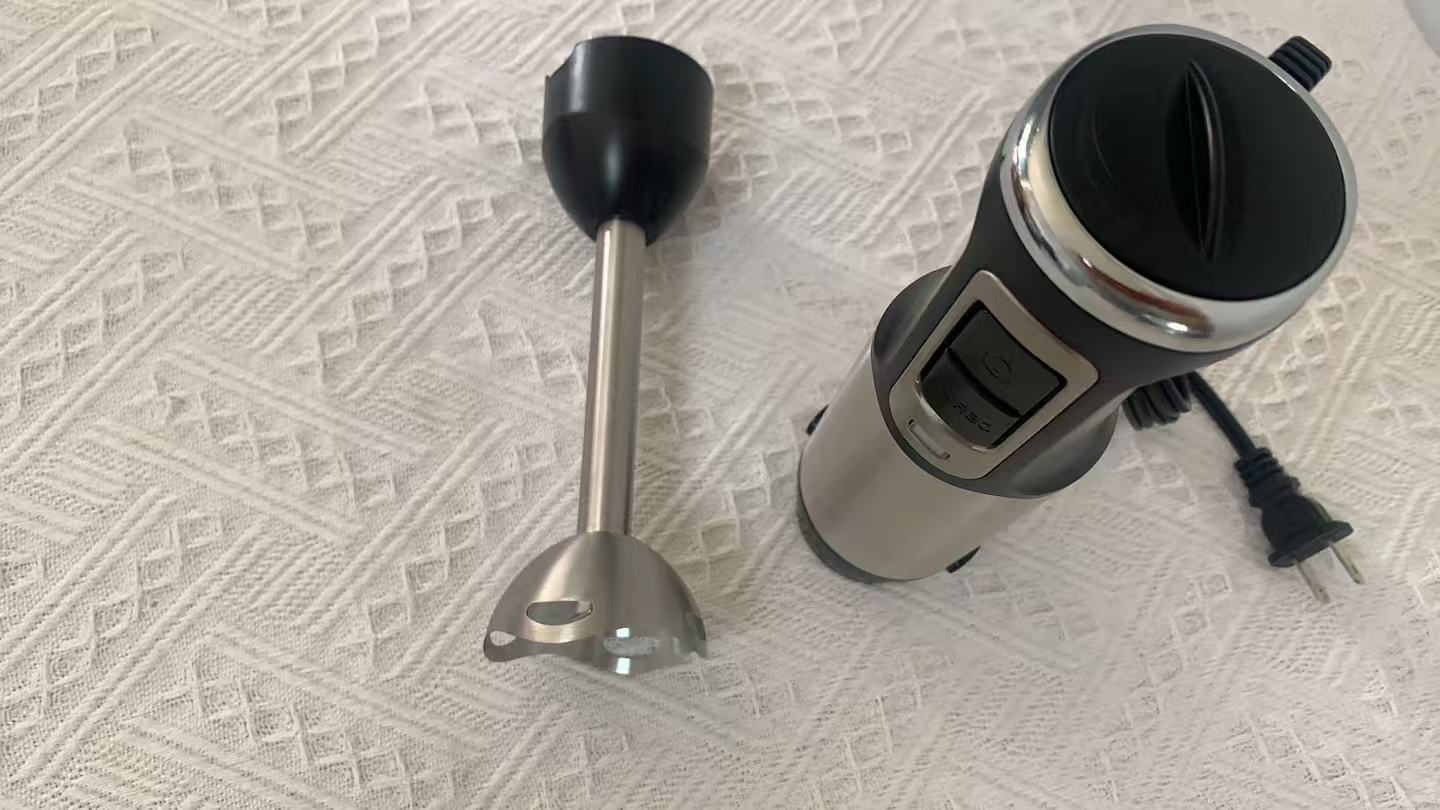
A German buyer we work with placed a repeat order for a 600 W hand blender and asked for the housing to move from off-white to matte black. The factory changed the paint supplier to hit the shade. Nobody reran the PAH screen, nobody updated the material declaration, and nobody told the notified body. The GS certificate on file listed the original coating system and the tested sample’s part numbers.
The container arrived. The retailer’s incoming inspection pulled the certificate, compared the coating supplier declaration against the shipment, and stopped the batch. The cost was not the retest. It was six weeks of storage, a missed promotion window, and a discount negotiated under pressure to move the goods at all.
The rule that would have prevented it: a certificate is only valid for exactly what is written on it. Not for the model family. Not for “the same design in another colour”.
The table below is the change-control matrix we use with buyers at quoting stage, so nobody discovers the requirement after the PO is signed.
| Change | Retest required? | What has to be redone | Cost of getting it wrong |
|---|---|---|---|
| Housing colour only, same resin and same paint system | Generally no | Update DoC and internal variant list; confirm no new pigment | Low if documented, high if the paint system changed |
| New paint, coating or pigment supplier | Да | RoHS, REACH SVHC, PAH; food contact if the surface touches food | Batch rejection, GS certificate void |
| Housing material change (ABS to PP, new flame retardant) | Да | Full LVD + EMC; flammability and material declarations | Container held at port |
| New motor or motor supplier | Да | LVD, EMC (emissions), ErP if power draw changes | Retail delisting, CE challenge |
| New PCB, control board or firmware | Да | EMC emissions and immunity | Interference complaints, market withdrawal |
| New food-contact material or supplier (jug, seal, blade coating) | Да | 1935/2004 + 10/2011 migration; FDA if US-bound | Health-authority notification, recall |
| Cable, cord length or plug type | Usually yes | Safety check plus plug/lead approval; EMC if the filter changes | Customs rejection, plug non-compliance |
| New accessory added to the box | Yes if it touches food or draws power | Migration or LVD/EMC for the accessory | Partial shipment refusal |
| Packaging, carton artwork, manual revision | Нет | Nothing technical; update the language set | None, unless the manual omits a required warning |
| New brand name on an existing design (private label) | No new test | New DoC in your name, your own technical file, your own WEEE registration | You become the manufacturer of record with no file to defend |
That last row is the one that surprises private-label buyers most. Under LVD and EMC, the person who places their name on the product is the manufacturer. Your logo on the housing makes you legally responsible for the technical file, the DoC, the WEEE registration in each member state, and the REACH SCIP notification. The factory’s certificate does not transfer to you. What transfers is a test report and a component declaration package you can build your own file from — and only if the factory will hand over the full set.
Rules That Catch Importers in the First Month
Instructions must be in the language of the country of sale. CE compliance includes the manual. A single English manual shipped into France, Italy, Spain and Germany is a non-conformity in each of those markets, and it is one of the easiest things for a market-surveillance inspector to check.
The plug is part of the product. A Schuko plug, a BS 1363 plug and a moulded Euro plug are different approval items. Sourcing a cheaper lead with an unlisted plug manufacturer invalidates the safety evidence for the lead assembly.
The importer’s name and address must appear on the product or packaging, alongside the manufacturer’s. Missing importer identification is a routine finding in German and Dutch enforcement sweeps.
UKCA and CE Certification Kitchen Appliances After Brexit
Great Britain has its own product regulations, and the UK government has extended recognition of CE marking for most electrical, EMC and RoHS categories, so CE-marked goods are still accepted in England, Scotland and Wales. UKCA remains a valid alternative, and a growing number of UK retailers ask for UKCA documentation anyway because their compliance teams prefer a domestic paper trail.
In practice, for CE certification kitchen appliances shipped to Great Britain, the sensible approach is:
- Keep the EU technical file as the master file.
- Add a UK DoC naming a UK responsible person and citing UK designated standards.
- Confirm BS 1363 plug and fuse rating for the appliance.
- Register for UK WEEE and packaging separately from the EU ones.
Northern Ireland is different again — it follows EU rules, so CE marking applies there, with the UKNI mark where a UK notified body is used.
What YLD Home Actually Hands Over
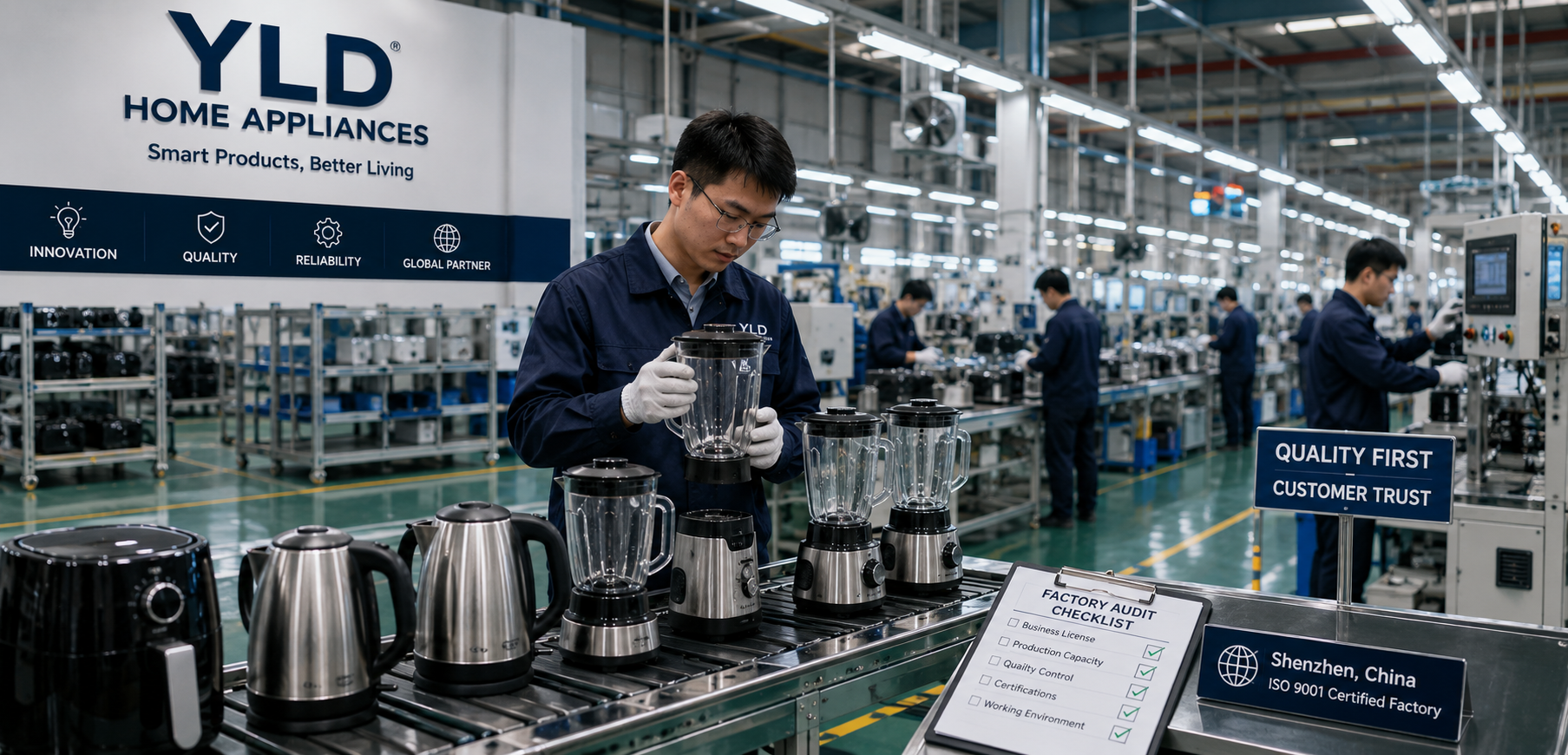
YLD Home has been building small kitchen appliances since 2012, with the factory in Shipai, Dongguan and a showroom in Bao’an, Shenzhen. Roughly 300 people, 25,000 m² of floor space, five production lines, 62 machines and 600,000 units a month. Those numbers matter less than what sits in the compliance folder.
YLD Home treats CE certification kitchen appliances as a change-control system rather than a PDF. Every model carries CE under LVD 2014/35/EU, EMC 2014/30/EU, RoHS 2011/65/EU, REACH and ErP, alongside GS, CB, UKCA and ETL to UL 1082 and UL 982 with FCC for US programmes. Food-contact parts are documented to EU 1935/2004 and EU 10/2011, or FDA 21 CFR for the US, with 304 and 316L stainless supplied against passivation records.
Every first order ships with a document pack, itemised in the section below. The passivation records are the item most factories cannot produce on request, and the one that decides whether a European retailer’s technical file review closes in two weeks or two months.
Production parameters are straightforward: MOQ 1,000 pieces per model and colour, samples in 5–7 days, mass production in 25–35 days, FOB Shenzhen. Custom development runs through the same compliance gate — a new housing tool means new LVD and EMC evidence, quoted into the timeline rather than discovered later.
You can review the mark-by-mark breakdown on the certifications page, the inspection routine on the quality control page, and the line layout on the factory tour. Programmes that start from a blank sheet go through custom kitchen appliance development; catalogue-based buyers usually start from the wholesale hand blender range или portable kitchen appliances range.
The Documents to Request Before You Pay a Deposit
Ask for these in writing and check that part numbers and material descriptions match the quotation:
- **DoC draft** with your legal entity as importer, listing every directive cited.
- **Test reports** with the laboratory’s accreditation number and the tested sample photos.
- **GS certificate** including the tested variant list, and the factory inspection date.
- **Food-contact Declaration of Compliance** with migration test conditions that match real use.
- **SVHC statement** dated within twelve months, plus the SCIP approach.
- **Rating label artwork** showing importer name, address, model, voltage, wattage and WEEE symbol.
- **Manual language set** for each country you will sell into.
- **Change-notification clause** in the supply agreement — the factory must tell you before substituting any material, motor or PCB.
Item eight separates a supplier from a partner. Without it, you learn about the substitution at the port.
ЧАСТО ЗАДАВАЕМЫЕ ВОПРОСЫ
Does CE marking cover the food-contact parts of a kitchen appliance?
No. CE covers electrical safety, EMC, restricted substances and energy. Food-contact compliance sits under Regulation (EC) 1935/2004 and, for plastics, Regulation (EU) 10/2011 — separate tests, separate declaration. YLD Home issues both sets for the same model so buyers are not left filling the gap themselves.
Who signs the Declaration of Conformity for a private-label order?
You do, if your name goes on the product. Placing your brand on the housing makes you the manufacturer of record under LVD and EMC, which means the technical file, the DoC, WEEE registration and the REACH SCIP notification are your obligations. YLD Home supplies the underlying reports and declarations so your file can be assembled and defended.
Is GS mandatory for selling kitchen appliances in the EU?
Legally no, commercially close to yes. GS is voluntary, but most EU grocery, electrical and discounter chains will not list a kitchen appliance without it, and it goes further than CE by adding third-party EN 60335 testing, PAH testing and LFGB assessment. YLD Home maintains GS alongside CE on the core ranges.
Does a colour change really require retesting?
A colour change using the same resin and the same qualified paint system normally does not require a retest — but it does require the DoC and the variant list to be updated. The moment the paint supplier, pigment chemistry or base material changes, the answer flips to yes, because RoHS, REACH and PAH results are tied to the material tested, not to the shade. YLD Home rejects any colour request that quietly changes the coating system.
How much time do CE certification kitchen appliances files add to a project?
On an existing platform, re-testing a changed motor or control board typically takes two to three weeks and sits inside the 25–35 day production window if it is planned at PO stage. On a new housing tool, budget the full LVD, EMC and food-contact cycle before mass production starts. YLD Home quotes certification milestones separately from tooling so the critical path is visible.
What is the difference between CE and UKCA now?
The technical content is essentially the same — the same IEC and EN standards underpin both. Great Britain continues to recognise CE for most electrical categories, while UKCA needs a UK responsible person, UK designated standards cited on the DoC, and separate UK WEEE and packaging registrations. YLD Home prepares the UK variant of the file on request.
Can one CB report cover several export markets?
Often yes. A CB report to IEC 60335-1 plus the relevant part 2 converts into national certificates in many countries without a full retest, which is why buyers running parallel programmes ask for it. YLD Home keeps CB reports current on the main platforms.
What happens if a shipment arrives without a matching technical file?
The importer carries the liability, not the factory. Enforcement ranges from a document request to withdrawal from sale, and retrofitting a file after shipment is expensive because the tested samples no longer exist. YLD Home ships a complete document pack with every first order.
Next Three Moves
If you are launching a new model: send the specification and destination markets before tooling starts. Certification scope is decided at design review, and a short call then is cheaper than a retest after the mould is cut.
If you are switching suppliers mid-programme: compare the tested variant list and material declarations against your current file first. Mismatches are common, and they are fixable before the PO, not after.
If you already have a container on the water: pull the DoC and the certificate variant list now, and check the housing material and coating supplier against the shipment. If they do not match, you still have time to test the retained samples.
Treat CE certification kitchen appliances as a living file rather than a badge, and the border stops being the place where you find out what changed. Start with the certifications overview or send your specification through the quote form and we will map the compliance path before you commit to a tool.