











Most toaster complaints are not electrical. They are the complaint that half the slice came out pale, that the bagel did not fit, or that the lever jammed on a Tuesday morning. Those three failures account for most returns on a two-slot body, and every one of them is decided by a specification a buyer can check before placing an order. This wide slot toaster buying guide sets out what to look for, in the order a purchase decision actually happens: slot geometry first, control panel second, finish third, and the paperwork last – because paperwork is the cheapest thing to fix and the most expensive thing to discover late.
Slot width decides the first week
A standard slot is built for a supermarket slice. It does not take a bagel half, a thick-cut farmhouse loaf, or the bread a bakery sells by weight – which is the bread a large share of shoppers actually buy. When the slice does not fit, the customer forces the lever, the bread wedges, and the unit comes back. Slot width is the single specification that decides whether a toaster stays in a kitchen, and it is the number a buyer should request in writing rather than infer from a product photograph.
Wide slots are not only about bagels. A wider opening lets a slice sit upright instead of leaning, and a slice that leans browns on one edge. That is why auto-centering – a spring bracket that holds the bread in the middle – appears on the better bodies in a range. It is a mechanical part worth asking about, because it is invisible in a catalogue and it is the difference between even browning and a complaint that repeats in every review.
Shade positions are a dial decision, not an element decision
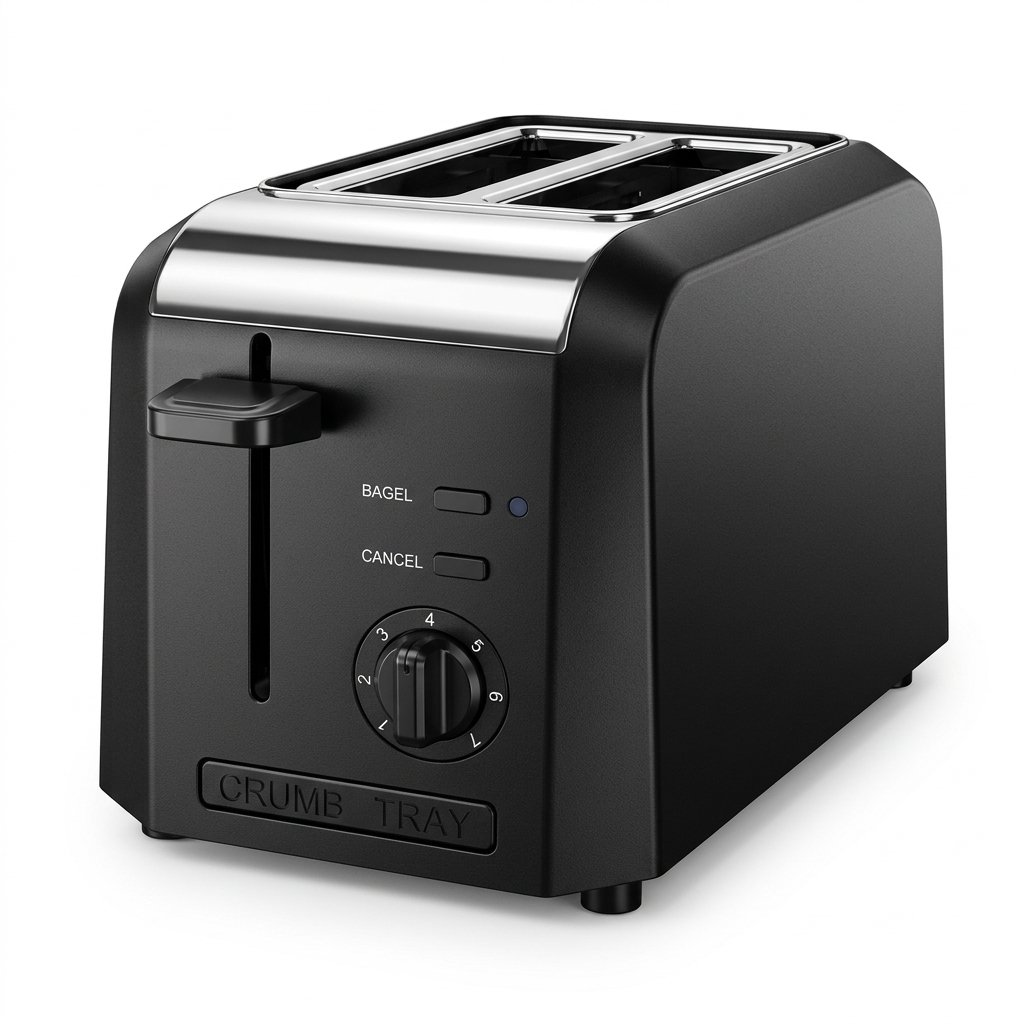
Buyers often assume that more browning settings mean a better element. In most toasters it does not: the element and the timer are shared across a range, and the number of marked positions is a detent ring inside the dial. Three positions read as a budget appliance on a specification sheet. Seven positions read as a mid-tier one. The factory cost difference is small, which makes the dial the cheapest price-point upgrade available on the product – and the reason a distributor should specify positions deliberately rather than accept whatever a quote happens to include.
The practical range for a household is five to seven. Below five, a customer cannot find a setting for wholemeal without guessing. Above seven, the marks become indistinguishable and the extra positions stop selling. Five is the sensible middle: it reads as a considered appliance and it leaves room above and below it in a price ladder.
Two slots, four slots, long slot or dual control
Slot count is not the only decision, and it is not the most important one. What matters is how the openings are arranged, because that determines who the appliance is for.
- Two-slot, wide. The volume SKU. Households of one to three people, entry price point, smallest carton. Most distributors list it first.
- Four-slot, long slot. Two long openings take four slices in one cycle and swallow a full slice of farmhouse bread. One control, one lever. The family and guest-house body.
- Four-slot, two pairs. Four separate slots in two independently controlled pairs, each with its own dial and functions. Two people toast different bread at different shades at the same time. The B&B, office and large-family body.
- Four-slice, four buttons. The step above the volume body: more functions, same two-slot footprint.
The commercial logic is that a distributor covering all four covers four price points from one platform family, with shared slots, levers and elements. That means one spare-parts list, one service story and one manual layout rather than four of each.
The three functions that matter, and the one that depends on the market
Defrost extends the cycle so bread straight from the freezer browns through instead of burning outside and staying cold in the middle. In Northern Europe, where sliced bread is bought frozen, this is a routine use rather than a novelty. Reheat warms a slice without adding colour – the function a hotel buffet or an office kitchen actually uses in the afternoon. Cancel ends the cycle early, which every household uses in the first week.
Bagel is the fourth function and it is not universal. It runs one side of the element, so the cut face browns while the crust stays soft. Some bodies in a range carry it and some do not, and a buyer specifying a SKU should confirm which panel the quotation refers to rather than assume the feature appears on every model. A catalogue photograph is not a specification.
The parts that fail: crumb tray, lever, anti-jam
Crumbs are the most common complaint on a toaster after six months, and the complaint is always the same: the tray cannot be reached. A metal tray that pulls out from the front solves it in one part. The lever is the second wear point, and a bread-lift position – which raises the carriage above the slot so a small slice can be taken out without turning the unit upside down – removes the burn risk that follows.
On a four-slot body, a jammed carriage takes the whole appliance out of service, which is why a double anti-jam release on both carriages is worth specifying rather than treating as a bonus. None of these parts appears on a marketing page, and all of them decide the review score eighteen months after the container arrives.
Finish: what sells the shelf versus what survives the kitchen
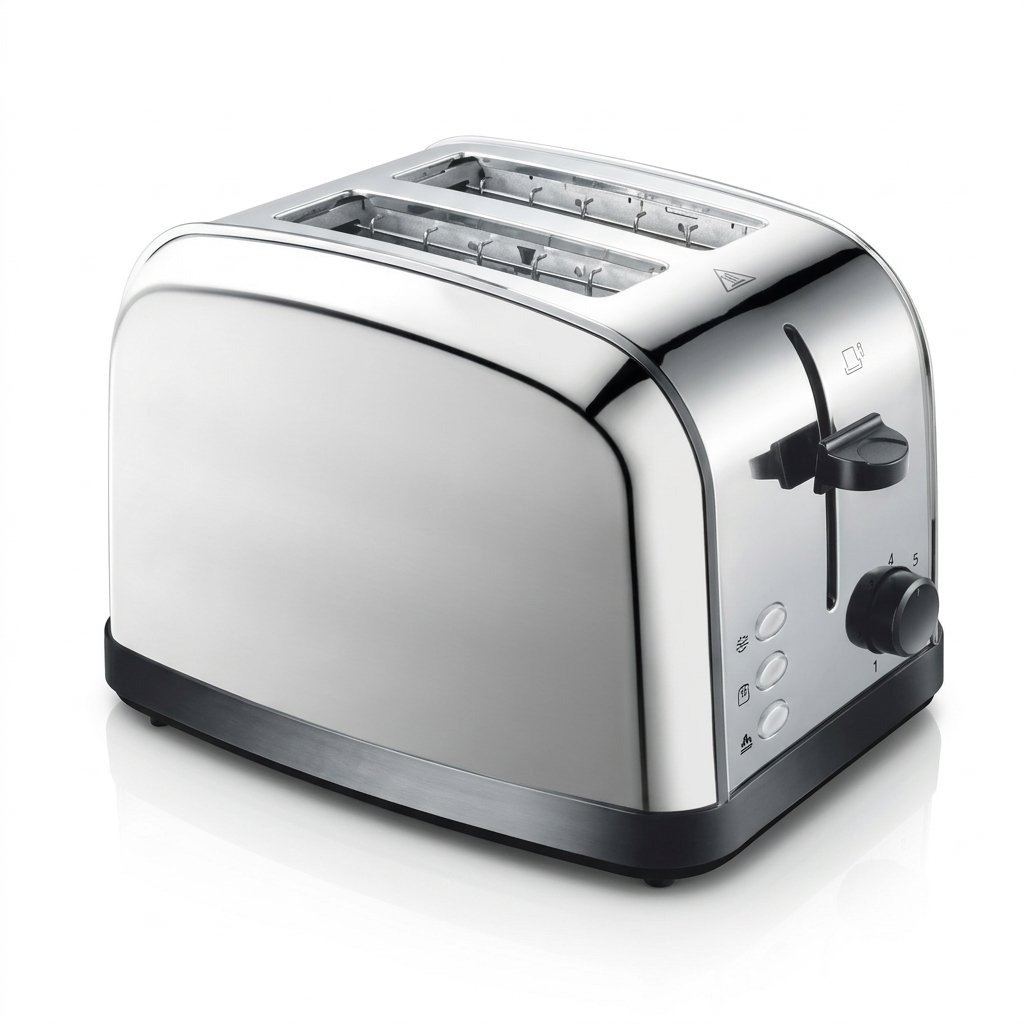
A polished chrome body photographs brighter and moves faster in a catalogue and on a marketplace listing. A brushed body hides fingerprints and light scratches, so it looks presentable after a season of daily handling. They can share the element, the slots and the lever, which means a distributor can list both as two placements from one platform and one certificate set.
The mistake is selling a polished body into a hotel kitchen or a rental fleet, where the unit is handled by people who will not wipe it. Where a buyer expects a demo unit to stay clean through a season, brushed stainless is the correct specification, and a supplier who says so is more useful than one who agrees with everything.
Certification and documents by market
Europe takes a CE declaration with the GS report and the RoHS and REACH statements; GS is what German, Austrian and Swiss buyers ask for first, and it is voluntary in law but effectively mandatory in retail. North America requires an ETL or UL report for the exact model – the requirements are set out by the testing bodies themselves, for example on ul.com for the standard families used on small appliances – and US and Canadian retailers will not list a SKU without one.
The UK takes UKCA, which mirrors CE but is issued separately. Gulf markets run their own scheme, so SASO and G-Mark are quoted on request rather than assumed. Because the plug, the element and the manual change with the market, each voltage build carries its own certificate set, and the report must name the exact model rather than the range.
Two documents are easy to forget and slow to obtain: the food-contact declaration for anything that touches bread, and the carton specification a retailer’s compliance team will ask for before a listing goes live. Both are cheap at the quotation stage and expensive three weeks before a shipping date. Product safety recalls are public, and a buyer comparing suppliers can check the record of any brand on cpsc.gov before committing to a container.
Container loading: the number that decides landed cost
A quotation without a loading figure cannot be compared with one that includes it. Two cartons with different efficiencies produce different landed costs at the same FOB price, and on a small appliance the difference is usually larger than the discount achieved by arguing over the unit price.
Ask for three things in writing: carton dimensions, gross weight, and the 20GP and 40HQ quantities calculated on that carton rather than on an ideal single-SKU plan. Then ask whether mixed loading is possible – a 40HQ holding three colours or two models is often what a first order actually needs, and a supplier who cannot mix is a supplier who will ask you to raise the minimum per model.
Quality control and what AQL actually means
AQL II with critical 0, major 1.5 and minor 4.0 is the inspection standard most European importers write into a purchase order. It does not mean the container is perfect; it means a defined sample size from a defined lot will be inspected against a defined defect list, and the result is a document. A supplier who cannot state their AQL levels in a quotation has not been asked the question often enough by serious buyers.
For a toaster, the defect list that matters includes element continuity, timer accuracy, lever return, panel print alignment against the approved artwork, and cord and plug conformity for the destination market. YLD Home runs production in Dongguan with in-house metal stamping, assembly and end-of-line testing, and inspects to AQL II with critical 0, major 1.5 and minor 4.0 on toaster orders.
From sample to container: the timeline a buyer should plan for
Samples take 5-7 working days once artwork is agreed, and the sample should carry the panel print of your market rather than a generic one – a sample that does not match the order teaches nothing. Production runs 45-55 days after artwork approval and deposit. Carton artwork approval is usually the bottleneck, because it involves a retailer’s compliance team as well as the factory.
YLD Home builds toasters in Dongguan in a 25,000 m2 plant with five production lines and roughly 62 machines, at a capacity of about 600,000 units a month across the appliance range, and has been manufacturing since 2015. That capacity matters less as a number than as an answer to one question: can the factory take a repeat order in the same season without moving your slot.
Packaging: the retail-ready carton
A retail-ready carton is not a bigger box. It is a box that survives a pallet, opens without a knife through the product, prints the compliance marks where the retailer requires them, and states the model and colour in a place a warehouse worker can read. Ask for the dieline before the deposit, not after.
Two details cause most first-order delays: a barcode that does not scan at the retailer’s distribution centre, and a warning label in the wrong language. Both are set by the buyer’s compliance team, and both are cheaper to fix on a proof than on a container.
The seasonal calendar for small appliances
Toasters sell hardest in the fourth quarter, which means a private-label order for that window has to be placed in the second quarter and shipped by the end of the third. Retail reset windows vary by market, but the pattern is consistent: artwork freezes long before the container leaves, and a supplier who quotes 45-55 days of production without mentioning artwork approval has given a number that will not hold.
For the Gulf and Latin America, the buying window is shaped by different holidays and by longer transit times, so a distributor running both Europe and the Gulf from one factory visit usually splits the order into two shipments rather than one.
What a quotation should state before you compare prices
- Unit price by quantity tier, with the tier boundaries stated.
- Carton dimensions and gross weight per unit.
- 20GP and 40HQ loading calculated on that carton.
- The certificate set for the destination market, naming the model.
- Sample lead time and the production window after artwork approval.
- Payment terms and the inspection standard.
- Spare parts availability – crumb trays, levers and knobs – and their price at the time of order.
How to compare two toaster suppliers
Ask for the report number for the exact model. Ask who presses the metal parts, because a supplier who buys housings in cannot change finish or capacity on the next order without a negotiation. Ask for a sample with the panel print of your market. And if the order is large enough to justify the trip, ask for the plant address – an assembly line that runs stamping, assembly and end-of-line testing in one building answers more questions than a document set.
YLD Home presses its own housings and builds the panel assemblies in the same plant, which is why a finish change on a toaster order is a scheduling question rather than a new tooling decision. Buyers comparing the two-slot, four-slot and long-slot bodies can see the specifications side by side on the toaster category page.
Which body fits which channel
O wide slot toaster with a front crumb tray is the retail volume body: two wide slots, seven shades, bagel and cancel. The long-slot four-slice body serves families and guest houses that need four slices in one cycle. The four-slot dual-control body is for B&Bs, office kitchens and large families where two people want different bread at different shades. The polished chrome body is the catalogue and gift placement, and the brushed stainless body with black end panels is the one that survives hotels, rentals and staff kitchens.
A distributor who lists all five covers the shelf, the gift channel, the contract channel and the replacement market from one supplier, one manual layout and one spare-parts list. That is the argument for buying a range rather than a product.
What a wide slot toaster costs to get wrong
The cost of a wrong slot width is not the unit price. It is the return: the courier, the inspection, the credit note and the review that stays on the listing for two years. A buyer who orders a wide slot toaster because the photograph looked generous, and receives a body built to a standard slot, has bought a container of returns rather than a container of appliances. This is why the specification should be agreed on a drawing with a millimetre figure on it, and why a sample should be tested with the bread sold in the destination market rather than with the factory’s own sliced loaf.
There is a second cost that shows up later: the spare parts. A wide slot toaster built on a platform the factory already presses shares its crumb tray, lever and knob with the rest of the range. A body built to a one-off drawing shares nothing, so a replacement tray two years later becomes a small production run at a small production run’s price. Platform sharing is not a marketing point; it is the difference between a serviceable range and a dead SKU.
How to test a wide slot sample in an afternoon
Put four things through the sample before approving it: a supermarket slice, a bakery loaf cut thick, a bagel half, and a frozen slice straight from the freezer. Note whether each one sits upright, whether the shade matches on both faces, and whether the lever returns cleanly when the slice is at its widest. Then lift the bread with the bread-lift position and check that the crumb tray comes out without tipping the unit. An afternoon of this tells a buyer more than a page of specification, and it is the test a wide slot toaster should pass before a purchase order is signed.
YLD Home keeps samples of the wide slot toaster bodies available for exactly this kind of trial, with the panel print of the destination market rather than a generic one, because a sample that does not match the order teaches nothing about the order.
Where a wide slot toaster sits in a price ladder
A range usually runs entry, core and premium. The entry body is a two-slot with a single button and a painted housing: it wins on price and loses the customer who wants a bagel. The core body is the wide slot toaster with a front crumb tray and a functional panel, and it is the SKU that sells the most units per square metre of shelf in most European markets. The premium body adds a finish, a dual control or a fourth slot, and it exists to lift the average basket rather than to be the volume line.
Getting the ladder wrong is common: a distributor lists three wide slot toaster variants and no entry body, then wonders why the opening price point is taken by a competitor. Three rungs, three bodies, one platform – that is the structure that holds a shelf.
Documentation YLD Home supplies with a toaster order
Each order ships with the certificate set for the destination market naming the exact model, the food-contact declaration for the parts that touch bread, the carton specification and dieline, the manual in the required language, and the inspection report at AQL II with critical 0, major 1.5 and minor 4.0. Spare crumb trays, levers and knobs are quoted on the same document so that service stock exists before the first container lands.
YLD Home has manufactured small appliances in Dongguan since 2015, in a plant of 25,000 m2 with five production lines and about 62 machines, running at roughly 600,000 units a month across the range. For a buyer planning a wide slot toaster programme, that capacity answers one practical question: whether a repeat order can take the same production slot in the same season, rather than waiting for the next gap.
Frequently asked questions
What slot width should I specify? Ask the factory for the opening in millimetres and compare it with the bread your market sells. If the answer is a range rather than a number, the quotation is not specific enough to plan a listing on.
Do I need a bagel function? Only where the market buys bagels. It runs one side of the element, so the cut face browns and the crust stays soft – useful in North America and bakery-led European markets, less so where sliced sandwich bread dominates.
Is a four-slot body worth listing? For families, guest houses and office kitchens, yes. On a dual-control body two people can toast different bread at different shades simultaneously. For single-person households it costs more counter space than it returns.
Can I order two finishes in one container? Yes, where the cartons stack cleanly. A finish change carries a minimum per finish, quoted on the order, and it does not reopen the safety file.
What is the usual minimum order? 1,000 pcs per model on this range, with samples in 5-7 working days and production at 45-55 days after artwork approval and deposit.
How do I check the finish will survive retail? Ask for a sample and handle it for a week before ordering. A polished body shows marks, a brushed body hides them, and a painted body shows the chip at the grip point first.
Who do I ask about a private label toaster? O private label programme page sets out how badge, manual and carton are handled from 1,000 pcs, and the same workflow applies to toasters.
Where can I see the factory’s quality process? O quality control page documents the inspection standard and the end-of-line tests; a factory visit is the faster answer and can be arranged with the quotation.