









In this guide:
- Why a stainless steel blender earns its place in US kitchens
- Grade 304 vs 201 vs 316, explained in plain English
- What a stainless steel blender manufacturer in China must control
- How we test stainless steel blenders before they ship
- Welds, finishes, and FDA food contact rules
- MOQ, lead times, and private label programs
- UL, ETL, FCC, and FDA compliance checklist
- Planning your first container order
* alt:stainless steel blender *
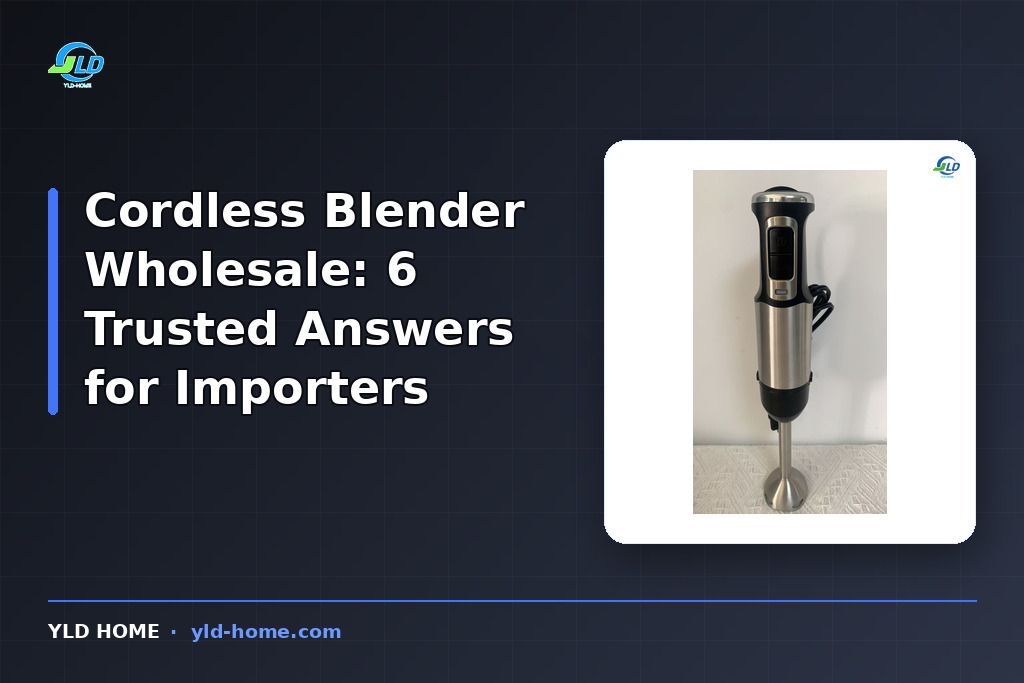
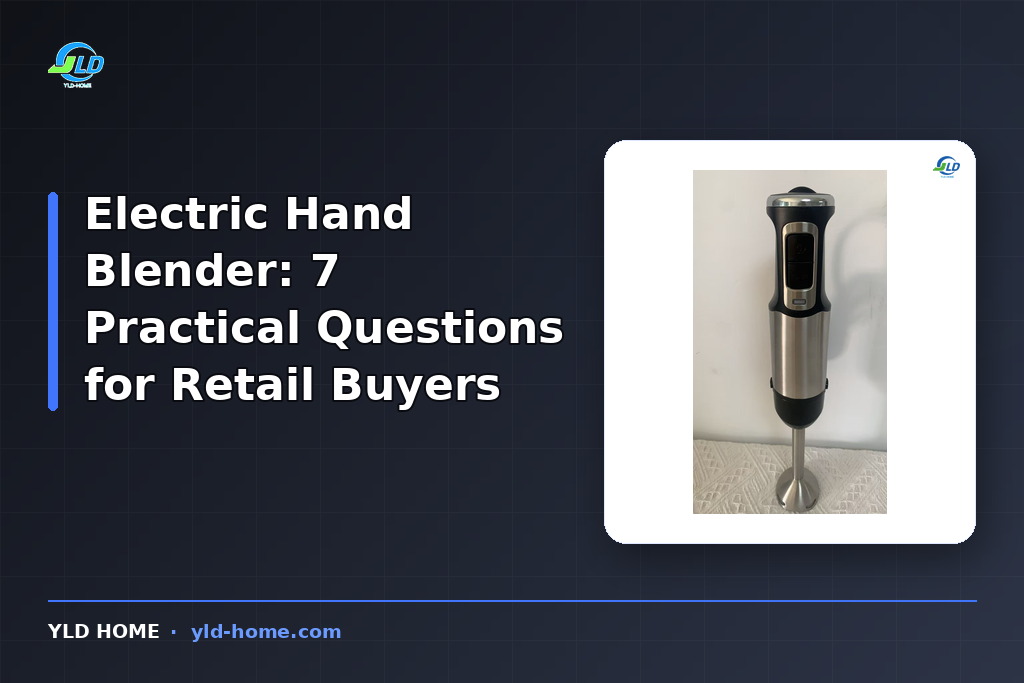
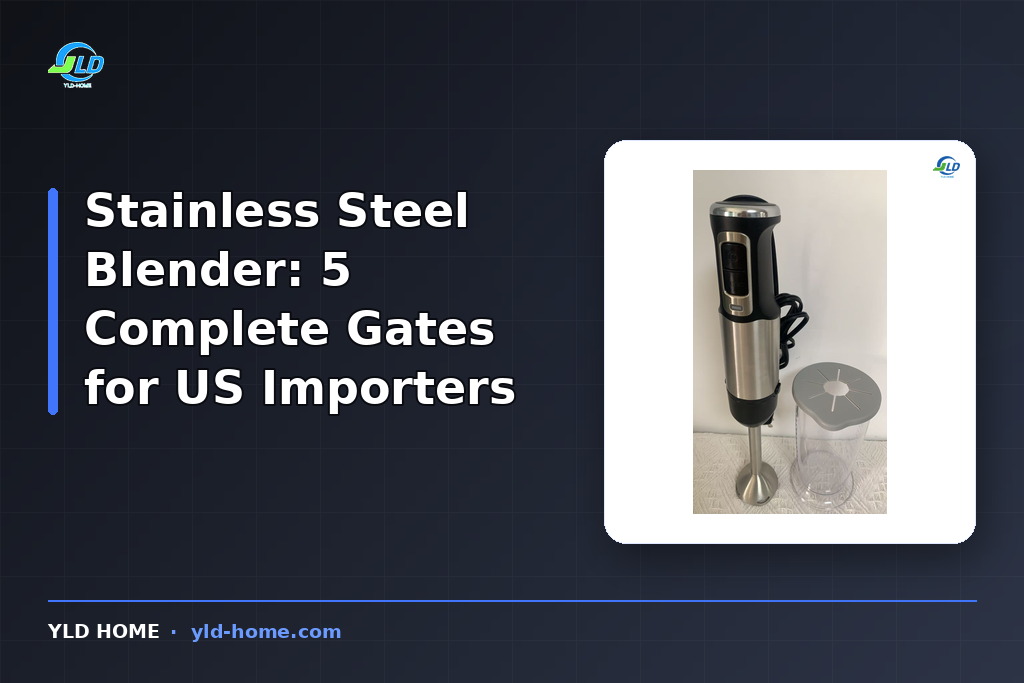
When a distributor in Houston calls us about a stainless steel blender, the first question is never about price. It’s about steel. Which grade? What wall thickness? Will the welds hold up after two years in a busy kitchen? We’re YLD Home, a Shenzhen manufacturer of hand blenders and stick blenders, and we’ve spent ten years building stainless steel blender lines for US importers, foodservice buyers, and private label brands. You can tour the hand blender and stick blender lines on our YouTube channel. This guide covers everything a stainless steel blender buyer should check before signing a PO: the grades, the finishes, the compliance paperwork, and the factory habits that separate a ten-year machine from a warranty claim.
Why a Stainless Steel Blender Earns Its Place in US Kitchens
Walk into any serious kitchen in New York, Chicago, or Miami and you’ll see the same pattern. The equipment that touches food every day is metal. Plastic housings crack, stain from tomato sauce, and pick up odors that no amount of sanitizer removes. A stainless steel blender avoids all of that. It shrugs off acidic ingredients, wipes down in seconds, and looks the same after a thousand shifts as it did on day one.
The demand shows up in our order books. Five years ago, maybe one in four blenders we shipped to the US had a full stainless shaft and bell. Last year it was closer to one in two. Restaurant groups, hotel kitchens across the hospitality industry, and meal-prep facilities all push toward stainless because their insurance carriers and health inspectors push too. Smooth surfaces are easier to keep clean. Clean surfaces pass inspections. It’s that direct.
There is a cost angle as well. A stainless steel blender costs more at the wholesale level than a comparable plastic unit, usually [fill actual: $2–$4 more per unit at container pricing], but it holds up under harsher treatment. Operators who used to replace stick blenders twice a year now run stainless units for three or four years. Over a five-year window, the stainless unit wins on total cost of ownership. That’s the case we make to every importer who walks in with a spec sheet written for cheap plastic. You can sell a cheaper blender once. You can sell a stainless steel blender to the same buyer for a decade.
Grade 304 vs 201 vs 316: What the Numbers Actually Mean
Here is where most sourcing mistakes happen. Every supplier will tell you their blender is “stainless steel.” That’s like saying a car “has an engine.” The grade decides whether the shaft survives daily contact with citrus, dairy, and caustic cleaning chemicals, or quietly pits and rusts.
| Grade | Nickel content | Corrosion resistance | Typical use in blenders | Relative cost |
| 201 | Low, about 4% | Fine for dry or light use | Budget housings, non-food parts | Mais baixo |
| 304 | 8–10.5% | Excellent for food contact | Commercial blender shafts, bells, blades | Mid |
| 316 | 10–14% plus molybdenum | Superior against chlorides and acids | Marine, seafood, heavy chemical exposure | Mais alto |
For a stainless steel blender sold into US foodservice, 304 is the baseline. It meets FDA food contact expectations, resists tomato acid and dairy residue, and stays bright through normal sanitizing cycles. Grade 201 is a cost cut. It works in a pinch for housings that never touch food, but we don’t put 201 anywhere near a blade or a shaft that sees liquid every day.
Grade 316 is reserved for special cases. Think seafood processing on the coast, or kitchens that run aggressive chlorine-based sanitizers. It costs more and is harder to source in volume. We stock 316 shafts for a handful of customers who need them, but the honest answer for 95% of US buyers is 304.
When we test a stainless steel blender at our factory, we verify the grade with a portable XRF analyzer on random units from each production batch. The certificate from the steel mill is not enough. We’ve seen suppliers buy 304 sheet for the visible parts and sneak 201 into hidden brackets. That’s exactly the kind of shortcut that shows up as rust streaks inside a distributor’s warehouse eighteen months later.
What to Demand from a Stainless Steel Blender Manufacturer in China
Sourcing direct from China is how most US importers get competitive pricing, but the factory you pick decides everything downstream. When you evaluate a stainless steel blender manufacturer in China, you’re really auditing four things: steel purchasing, welding, surface finishing, and quality control discipline.
Steel purchasing matters because cheap mills sell “304-like” material that fails a spectrograph test. A serious factory buys from named mills, keeps certificates of conformity for every coil, and can show you the paperwork. Ask for it. If the factory hesitates, that’s your answer.
Welding is where stainless dies young. Poor welds trap moisture, harbor bacteria, and crack under vibration. We weld shafts and bells with TIG where possible, and every weld gets passivated and brushed so the grain matches the surrounding metal. A good weld on a stainless steel blender is nearly invisible. A bad one is a food-safety incident waiting for an inspector to find it.
Surface finish is the part buyers see first. We offer a brushed finish at 320 grit as standard, with mirror polish on request for premium lines. The finish is not cosmetic theater. A smoother surface is harder for bacteria to cling to and easier to sanitize. Health departments in places like Los Angeles County look closely at food-contact surfaces, and a rough, pitted shaft gives them a reason to flag your customer’s kitchen.
Finally, QC discipline. Ask how many inspection points sit between raw steel and the shipping carton. At YLD Home, a stainless steel blender passes through incoming material checks, in-process dimension checks, a 30-minute run-in test on every unit, and a final visual and electrical inspection before packing. That sounds like a lot. It’s what keeps defect rates under [fill actual: 0.5%] for customers who buy from us by the container.
If you’re evaluating factories, our experience as a small kitchen appliance manufacturer in China is worth borrowing: bring a third-party inspector for the first two production runs, then grade the factory on how it handles the findings. Factories that fix issues fast are keepers. Factories that argue are not.
How We Test Stainless Steel Blenders Before They Ship
Testing is where the engineering team at YLD Home earns its keep. We don’t just check that a stainless steel blender turns on. We run a battery that mirrors real kitchen abuse — you can watch the checks in action in our Product Quality Control video.
The run-in test comes first. Every motor gets 30 minutes at full load before it’s approved for packing. That catches winding faults, bearing noise, and thermal issues that a 30-second bench check would miss. We also cycle the variable speed switch 20,000 times on a test rig, because that switch is the most common failure point in any immersion blender, stainless or not.
Then the abuse tests. We drop shafts from 1.5 meters onto a concrete floor to simulate a cook knocking the unit off a shelf. We run the blade in a bucket of sand and water to check seal integrity. We blend a 50/50 mix of ice and water for five minutes straight, twice, to see if the motor overheats. A stainless steel blender that survives our bench earns the right to leave the factory.
Food-contact testing happens separately. We verify that no component, including the silicone seals and the blade retaining ring, migrates detectable heavy metals into a simulated food solution. This is standard practice for any exporter selling into the US market, and the lab reports go into the file for every model.
We also test the shaft-to-motor lockup. Some cheap designs use a friction fit that slips under load. Ours uses a machined hexagonal coupling. You’ll feel the difference the first time you blend a thick soup: no chatter, no slipping, just a steady torque transfer. When we tested competitor units side by side last year, the ones with friction fits lost up to 30% of their effective power at the blade. That’s wasted motor hidden inside a pretty varinha mágica de aço inoxidável.
* alt:stainless steel blender *
Welds, Finishes, and FDA Food Contact Rules
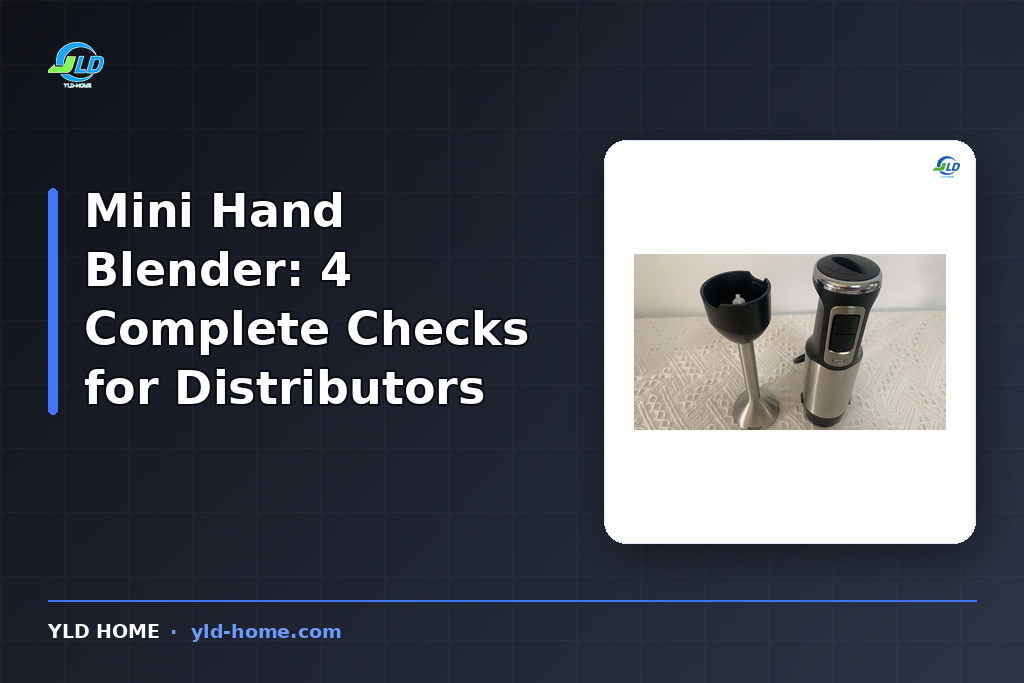
FDA food contact compliance is not a sticker. It’s an engineering constraint that runs through the whole design. For a stainless steel blender, the food-contact surfaces are the shaft, the blending bell, and the blade assembly. All three must be made from material that meets FDA requirements for repeated food contact, and all three must be finished so they can be cleaned properly.
The rules matter more than most importers think. Your customer’s blender is an FDA-regulated food-contact article. If a health inspector questions it, the operator needs documentation showing the materials are compliant. That documentation, material declarations, test reports, letters from the factory, should come with your shipment. We provide it as standard for every stainless steel blender we export to the US.
Weld quality feeds directly into this. A weld that leaves a crevice is a place where bacteria survive sanitizing. We design joints to be smooth and continuous, then brush them to match the parent metal. No pits, no porosity, no discoloration around the heat-affected zone.
One more detail: the silicone seal between the shaft and the bell. It has to be food-grade silicone, not industrial rubber. Industrial rubber can contain plasticizers that migrate into food. We specify food-grade silicone and test it. This is the kind of detail that never shows up in a product photo but shows up in a lab report, and later in the confidence of the US buyers who reorder from us.
MOQ, Lead Times, and Private Label for US Importers
Let’s talk numbers, because that’s what importers actually care about. Our standard MOQ for a private label stainless steel blender is [fill actual: 1,000 units per model per color]. If you’re testing the market, we can start with a smaller trial batch at a slightly higher unit price, then lock the better rate once volumes are steady.
Lead times run [fill actual: 30–45 days] from PO confirmation to ex-works, with another [fill actual: 15–25 days] for sea freight to Los Angeles, Oakland, or New York. Air freight is possible for urgent fills but it multiplies your landed cost. Most of our US customers plan eight to ten weeks from PO to warehouse and never touch air freight.
Private label is our bread and butter. You can put your brand on the stainless steel blender, choose the housing color, pick the box artwork, and adjust the accessory kit. YLD Home handles the tooling, the certifications, and the compliance files. Your only job is to sell it. A brand in Chicago has run the same private label program with us for six years, and their reorder pattern is so steady that we reserve production slots for them.
Two things to get right on your side. First, confirm the voltage early. Everything we ship to the US is 120V/60Hz, and that’s standard, but confirm it on the PO so nobody assumes. Second, decide whether you want the blades and accessories packed separately or assembled. Assembled units cost a bit more in freight but sell better in retail because the buyer can feel the weight immediately.
UL, ETL, FCC, FDA: The Compliance Checklist US Buyers Actually Need
US market compliance sounds like alphabet soup until you organize it into a checklist. For a stainless steel blender with a motor, you need four categories covered before product lands in a US store or kitchen. The standards and reports we hold for each model are listed on our appliance certification page.
UL or ETL certification covers electrical safety. Both are Nationally Recognized Testing Laboratories, and either one satisfies most US retailers and insurance requirements. We certify our electric blenders to UL 982 where the household standard applies, and to the commercial standard for foodservice models. The PressPro 1600W hand blender in our catalog, for example, carries UL certification to the applicable standard. Don’t accept a “test report” from a lab that isn’t an NRTL. Retailers check, and so do liability lawyers.
FCC covers electromagnetic interference. Any device with a motor that runs at 120V in the US needs to comply with FCC Part 15 and Part 18 rules. The cost is modest, and your factory should already hold the certificate for standard models. Verify it covers the exact model you’re importing, not just “similar products.”
FDA food contact is the one importers forget because it has no certificate that looks like UL’s. It’s a materials and testing requirement, which is why the documentation we discussed earlier matters. Keep the material declarations and test reports in your compliance file, and hand them to your customer with every quote.
Finally, the paperwork side. Your Customs broker will want the correct HTS code, legible country of origin marking, and any state-level registration. California’s Proposition 65 is the one that trips people up. It requires warnings for certain chemical exposures, and the evaluation has to be done by the importer or a consultant. Budget for it.
What Should a Stainless Steel Blender Supplier in the USA Offer?
A lot of buyers search for a stainless steel blender supplier in the USA and then wonder why the pricing is triple the factory-direct number. The answer is that a US supplier earns that margin by doing things a factory in Shenzhen can’t do from eight thousand miles away.
A good US-based supplier holds inventory, so you can reorder in small lots and restock fast. They handle warranty claims locally. When a distributor in Miami has a defective unit, the supplier ships a replacement the same week instead of opening a case with a factory across the Pacific. They carry the compliance files, the UL certificates, and the FDA material declarations, and they answer questions in your time zone.
The smart move for most importers is a hybrid: source the volume at factory-direct pricing from a stainless steel blender manufacturer in China, and keep a US distributor relationship for fill-in orders and emergency stock. That’s exactly the structure several of our customers run. Their container orders from us cover the base volume, and the US supplier absorbs the spikes.
If you’re considering becoming that US supplier yourself, holding inventory and servicing a region, the economics work when you have [fill actual: 1,000+ units per quarter] of committed demand. Below that, warehousing and return-handling costs eat the margin. Start factory-direct, prove the sell-through, then add the US stock position.
Planning Your First Container Order
The first container is the hardest, because everything is new at once: the factory relationship, the freight, the compliance, the sell-through forecast. Here’s the sequence that works for the importers we’ve guided through it.
Step one: order samples. Not one sample, three, from different production batches if possible. Run them in a real kitchen for two weeks. Blend hot soup, frozen margaritas, peanut butter smoothies. If the stainless steel blender survives a real menu cycle, it’s ready for your brand.
Step two: lock the spec. Model number, color, voltage, plug type, accessory kit, packaging artwork, carton dimensions, and the compliance documents you expect in the shipment. Put it all in a written spec sheet and sign it. This is the document that settles every dispute later.
Step three: plan the freight. A 20-foot container fits roughly [fill actual: 3,000–4,000 units] of hand blenders depending on packaging. Book with a freight forwarder who has experience with appliance imports through Los Angeles or Long Beach. Get the landed cost math done before you commit: FOB price, ocean freight, insurance, customs duties at [fill actual: 4–6%] depending on HTS classification, and warehousing.
Step four: plan the sell-through. Talk to your sales channel before the container sails, not after. Distributors want to know your fill rate, your warranty policy, and your margin structure. Have those answers ready. A distributor in Houston told us last year that the fastest way to lose a listing is to launch a product with no warranty plan. The 2-in-1 hand blender e o 3-in-1 hand blender are our two most reordered private label lines, and both sell best when the buyer knows exactly what the warranty covers.
Step five: set reorder triggers. The customers who manage this well set a minimum stock level and reorder the moment they hit it, which keeps the eight-week pipeline from becoming a stockout. A private label stainless steel blender line that sells out is a good problem. A line that sells out and stays out for three months is how you lose shelf space.
Perguntas frequentes
Q1: Is a stainless steel blender worth the extra cost over a plastic one?
For commercial buyers, yes, almost always. A stainless steel blender costs more per unit, but it lasts several times longer, cleans easier, and passes health inspections with fewer questions. Over five years, the plastic unit usually gets replaced twice. The stainless unit keeps running. For a high-volume kitchen, the payback is usually under a year when you count the labor saved on cleaning and replacement costs.
Q2: What grade of stainless steel should a blender use for food contact?
Grade 304 is the standard for food-contact parts in the US market. It resists the acids in tomatoes and citrus, handles daily sanitizing, and meets FDA food contact expectations. Grade 316 is better for marine or heavy-chemical environments. Grade 201 should stay out of food-contact parts entirely.
Q3: Can I private label a stainless steel blender from your factory?
Yes. Private label is a core part of our business. You choose the housing color, the accessory kit, the packaging artwork, and the brand name printed on the unit. We keep the compliance files current for every model we sell under your label.
Q4: What MOQ and lead times should I expect?
Our standard MOQ is [fill actual: 1,000 units per model], with lead times of [fill actual: 30–45 days] after PO confirmation plus sea freight to the US. Trial batches are available at a slightly higher unit price if you’re testing a new market.
Q5: Does the factory hold UL and ETL certificates for the stainless steel blender models?
We certify our electric blenders with recognized NRTL labs, and the certificates cover the specific models we export. Ask for the certificate covering your exact model number before you place the PO. YLD Home’s compliance team prepares the full folder with every shipment.
Q6: Can you match 120V US voltage on every order?
Yes. All of our US-bound production is 120V/60Hz with US plugs as standard. Voltage and plug type are confirmed on the PO so there’s no surprise at the warehouse.
Q7: Do you provide FDA food contact documentation?
Yes. Every shipment includes material declarations and food-contact test reports for the shafts, bells, blades, and seals. Keep these in your compliance file and pass them to your customers with each quote.
Official references
[[PAGEBREAK]]