











Most sourcing briefs that reach a factory desk say “hand blender, 500W, stainless” — and that is where the trouble begins. The phrase misturadora de emulsão vs misturadora de imersão is used interchangeably by retail buyers, trading companies and catalogues alike, yet the two tools are built on opposite priorities. One is a high-shear instrument for dispersing one liquid into another. The other is a volume tool for breaking down solids in a large vessel.
For a buyer the difference is not academic. It decides which motor, bell geometry, blade steel and certification file you pay for — and how many units come back as returns a year after launch. This guide compares the two from a procurement angle: what is inside each, what to write into a purchase order, how to test a sample, and where the price gap really sits.
What each tool actually is
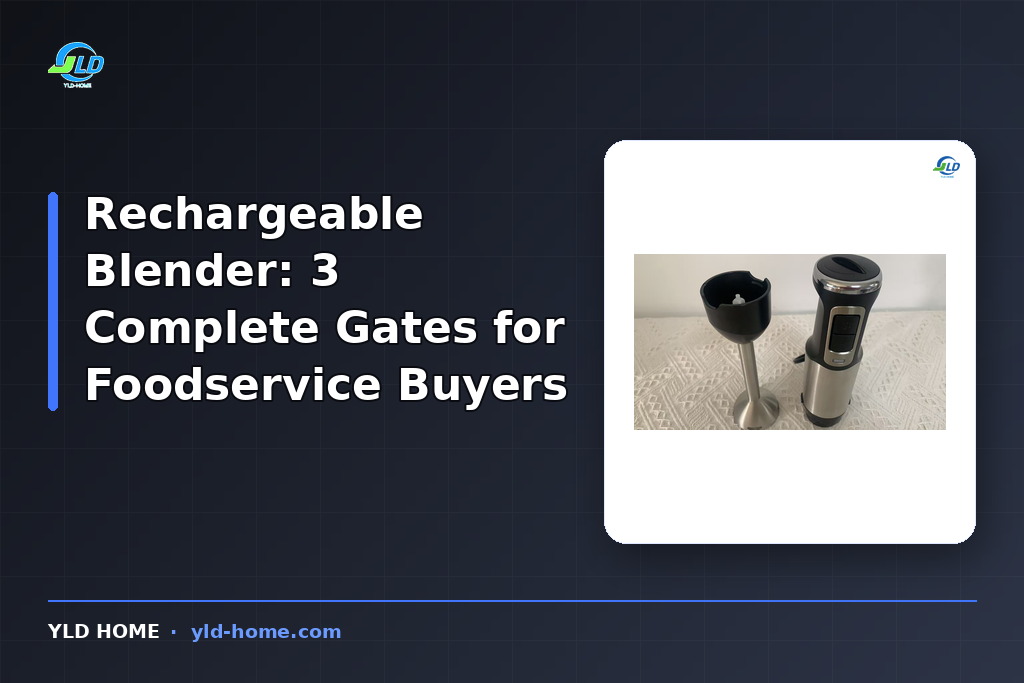
Um misturador de emulsão — also sold as an emulsion mixer, dressing blender or hand emulsion blender — is a narrow shaft ending in a small bell. Inside it, a short small-diameter blade spins at high speed in a confined chamber, with narrow intake slots and deliberately tight blade-to-wall clearance. Liquid is drawn up through the slots, sheared against the wall and pushed back down; that forced recirculation in a small volume builds a stable dispersion.
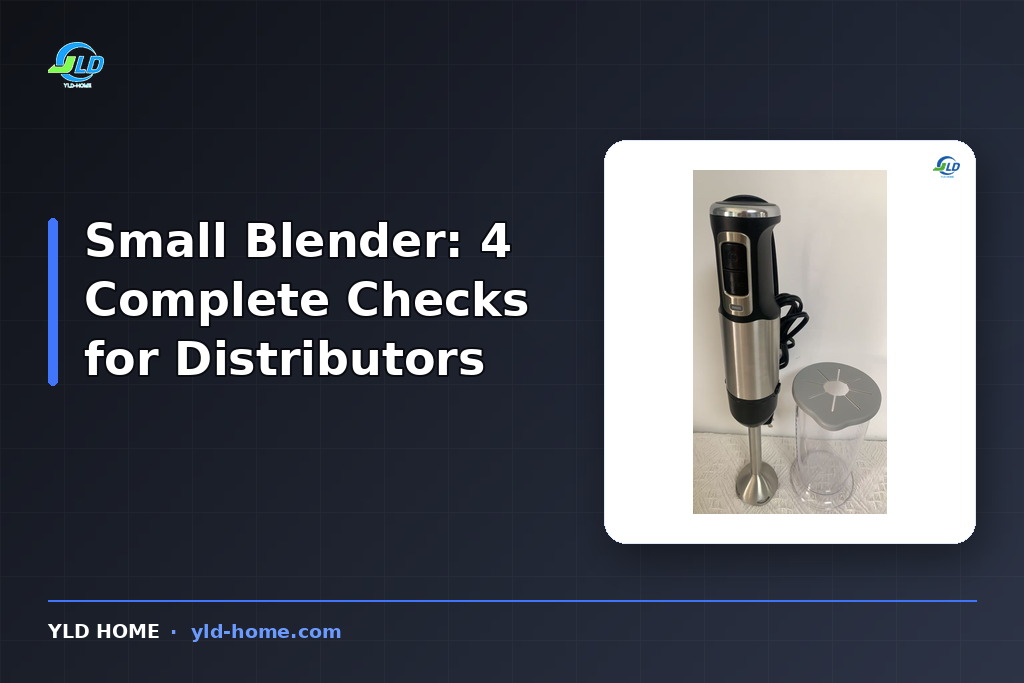
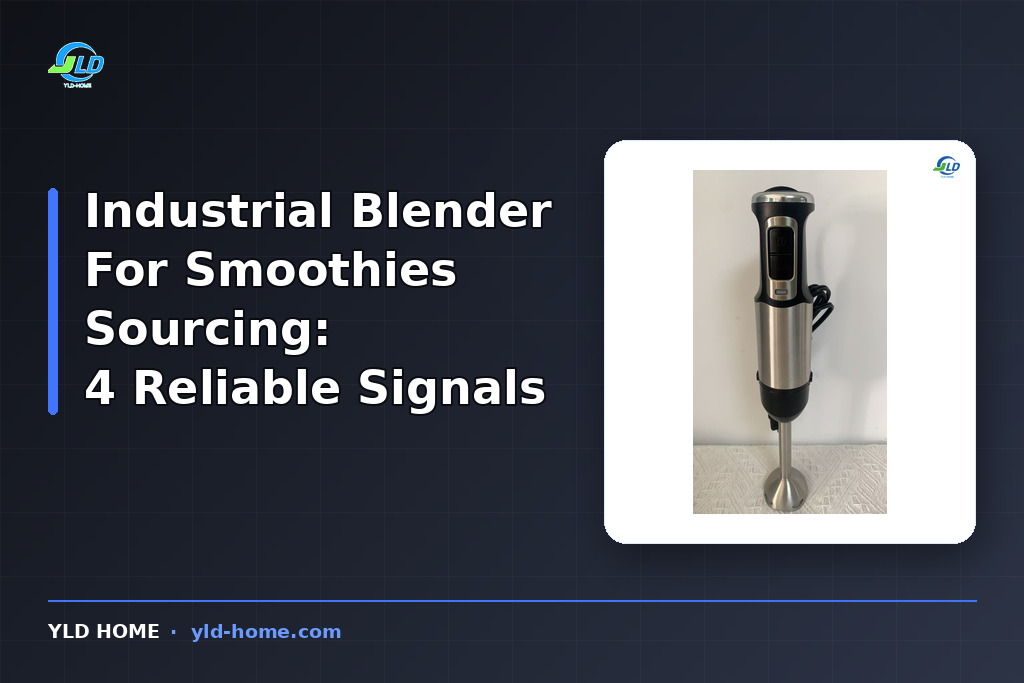
Um misturadora de imersão — stick blender, hand blender, hand-held immersion blender — uses the same architecture in different proportions: wider bell, open windows, longer shaft, bigger blade with swept-up tips. The job is to move a large volume and break solids apart, not to shear a small volume many times per second. That is why it purees a pot of soup in a minute and an emulsion blender does not.
Both are shaft-in-vessel tools, photographed the same way, both printing a wattage on the box. Those similarities cause most mis-specification in the category — and most complaints that read “this unit is weak” when the tool was simply bought for the wrong task.
Emulsion blender vs immersion blender: side-by-side
| Caraterística | Emulsion blender | Varinha mágica de imersão |
|---|---|---|
| Primary purpose | Disperse one liquid into another; hold the emulsion | Puree, blend, chop and crush across many tasks |
| Bell and slots | Small, narrow slots, tight clearance | Wide, open windows, clearance for solids |
| Blade | Short, fine, near-straight, low mass | Large, curved, upswept tips, thicker stock |
| Motor | Moderate wattage, high rpm, short bursts | Higher wattage, more torque, longer duty |
| Tasks | Mayonnaise, hollandaise, vinaigrette, dressings, cream bases | Soup, puree, baby food, smoothies, crushed ice |
| Batch size | Small — beaker, jug, sauce pot | Small to large, up to full stock pots |
| Hot liquids | Not intended; splash and seal risk | Designed for it on commercial models |
| Handling | Compact, light, minimal storage | Bulkier; often a set with chopper and whisk |
Read that table as a specification, not a ranking — the blender buying guides list every platform by type and wattage.
The bell housing is the real difference
Slot area sets the shear rate
Liquid can only leave the bell through the slots it entered by. A small bell with narrow slots forces the same volume through a smaller opening, so each particle passes the blade edge more often: more passes, more shear, finer droplets, more stable emulsion. A wide bell moves more material per minute but gives each portion far fewer passes, which is why a vinaigrette made in it separates on the plate.
Ask both shortlisted suppliers for three numbers: bell inner diameter, blade tip clearance, total slot open area. Different numbers mean different products, identical photographs notwithstanding.
Clearance, aeration and splash
Tight clearance also suppresses aeration. Air whipped into a mayonnaise or lotion base is a defect — pale, foamy, poor shelf stability. A wide-clearance bell at speed pulls air down the shaft and foams the batch. For dressings and creams, low aeration matters more than raw power, and it is a bell-and-blade property rather than a motor property.
Shaft length and motor placement
Commercial immersion blenders use shafts from a few hundred millimetres up to around half a metre, so the operator reaches the bottom of a stock pot without submerging the housing. Emulsion blenders stay short because the vessel is small. A long shaft adds bearing load and tip runout, so the bearing and coupling — not the wattage — become the durability limit. Specify shaft material, bearing type and whether the shaft is removable for washing.
Power curves: why the wattage number misleads
Every misturadora de emulsão vs misturadora de imersão comparison eventually reaches the label figure, and it is the least useful number on the box: input power at maximum load, not shaft power, and silent about gearing. A well-geared unit with a metal gearbox and a matched blade outperforms a higher-wattage unit with a plastic reduction gear.
Four figures actually describe behaviour, and all four are reasonable to request in writing:
- Rated input power — the label figure, under defined load.
- No-load and loaded rpm — the drop shows torque reserve.
- Duty cycle — the on/off pattern the motor is rated for; emulsion work fits a short burst, commercial soup pureeing does not.
- Thermal protection — whether a cut-out exists, its trip temperature, and whether it auto-resets.
So a 300–400W emulsion blender running thirty-second dressing batches is not underpowered; a 400W immersion blender asked to run five continuous minutes in hot soup is. Same number on the box, opposite outcome.
Which tasks belong to which tool
This part of the misturadora de emulsão vs misturadora de imersão question decides your listing copy: stating limits reduces “not as described” claims.
| Task | Correct tool | Porquê |
|---|---|---|
| Mayonnaise, aioli, hollandaise | Emulsion blender | High shear in a small confined volume holds the dispersion |
| Vinaigrette, dressings, marinades | Emulsion blender | Droplet size control, not throughput |
| Cream or lotion base, small batch | Emulsion blender | Low aeration, fine dispersion, stainless contact parts |
| Soup and stock, any volume | Varinha mágica de imersão | Throughput and torque; long shaft keeps the motor dry |
| Smoothies, frozen fruit, crushed ice | Varinha mágica de imersão | Heavy blade stock and upswept tips handle solids |
| Baby food, purees, mashed roots | Varinha mágica de imersão | Solids reduction is the primary job |
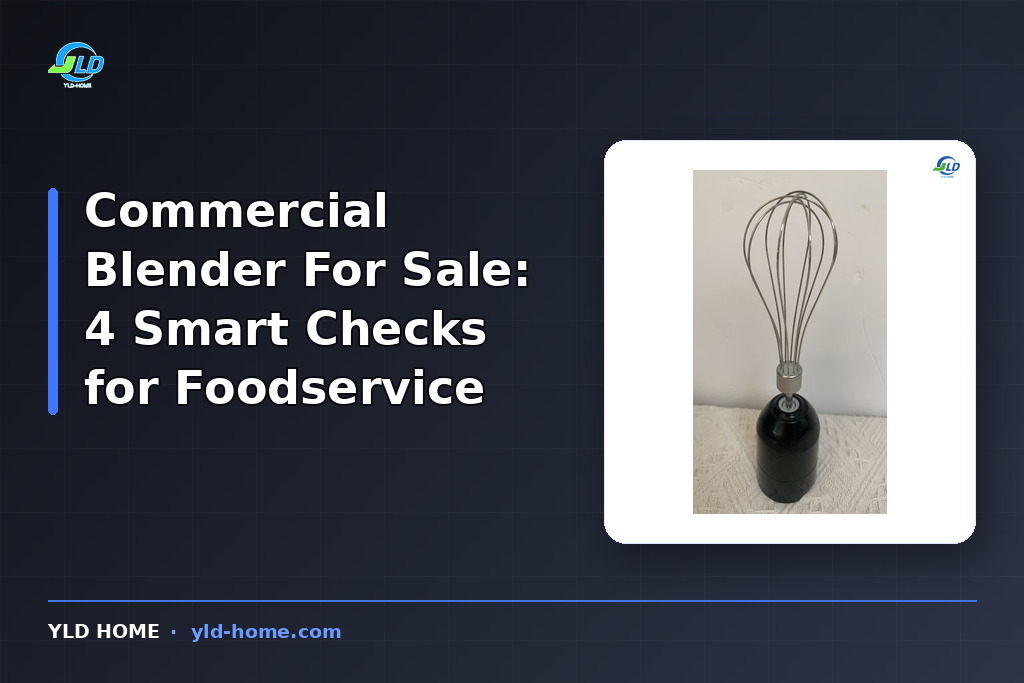
| Whipping cream or egg whites | Immersion blender with whisk | Attachment-driven; the bell is not used |
| Dry spices, coffee, dough | Neither | No dry-grinding or kneading capability |
What to verify before you place the order
For any misturadora de emulsão vs misturadora de imersão program, these parameters separate a working product from a claims file. Each is cheap to check at sample stage and expensive to fix after the container ships.
| Parameter | What to ask for | Why it matters |
|---|---|---|
| Blade steel | Grade and hardness; martensitic stainless for the edge, not a 304 blank | Austenitic steel dulls fast and stalls on fibrous food |
| Blade fixing | Welded or machined hub, not riveted or press-fit | Loose blades are the most common safety complaint |
| Gearbox | Metal reduction gear, lubricated; material of both gears stated | Plastic gears strip under thick loads and heat |
| Motor | Copper windings, brush card type, insulation class, cut-out temperature | Aluminium windings with no cut-out fail early in the field |
| Seals | Double lip seal or twin O-ring at the shaft entry | Single seals leak into the bell, then into the housing |
| Bell material | Stainless or reinforced engineering plastic; wall thickness stated | Thin plastic bells crack in the dishwasher and on impact |
| Coupling | Metal-to-metal shaft coupling with defined play | Plastic collars ovalise and the shaft starts to wobble |
| Switch and cord | Rated actuation count, sealed type, press-and-hold; cord length and strain relief | Latching switches left on under load cook the motor |
| Compliance file | Reports naming the exact model, plug and voltage | A sibling model’s report does not cover your SKU |
On compliance: for European retail, food-contact parts are assessed under the EU framework, and the European Commission food-contact pages set out the material requirements. In the United States, food-contact substances fall under FDA food-contact rules, with electrical safety via an NRTL listing such as UL or ETL. Both belong with the model’s test report; the certification overview shows how they are organised per model.
How to test a sample in one afternoon
No laboratory needed. Five checks on two or three units reveal most of what a field failure would tell you a year later.
- Emulsion test. Make mayonnaise twice, one batch per unit. Note how quickly it comes together, whether it holds after thirty minutes, whether the surface has bubbles. A unit that foams has a clearance problem, not a recipe problem.
- Viscosity ramp. Run the unit through water, a thin starch slurry, then a thick one. Listen for the motor note changing and whether the blade stalls before the motor does.
- Hot-liquid run. Five minutes continuous at serving temperature. Feel the housing each minute and smell for hot insulation; a cut-out in under three minutes means a household tool sold into a commercial channel.
- Endurance cycling. Thirty run-and-rest cycles at the rated duty pattern, then check shaft play, blade wobble, bell discolouration and coupling wear.
- Tear-down. Sacrifice one unit. Inspect the bell-end bearing, seal lips, gear material, solder joints and wire gauge — the only step that reveals what the others were predicting.
Log everything against serial numbers. A sample record with dates and unit IDs is far more persuasive when you raise a corrective action — and it is the evidence your own customer will eventually ask for. The quality control and inspection process describes the equivalent checks on the line.
Why units come back
Returns cluster around a handful of causes — on either side of the emulsion blender vs immersion blender question — and nearly all are specification decisions rather than manufacturing accidents.
- “It stopped working.” Thermal failure in a tool used beyond its duty cycle, worsened by a motor with no cut-out. Write both into the PO.
- “The blade came loose.” Riveted or press-fit hubs. Specify a welded or machined hub and verify it on the tear-down.
- “It sprays everywhere.” Wide bell, high speed, shallow liquid — the tool pulls air. Fix with bell geometry or a lower-speed start.
- “The sauce separated.” An immersion blender sold as an emulsion tool. The buyer was told the wrong thing at the point of purchase.
- “The plastic cracked.” Thin bell walls plus dishwasher heat. Change the material, or withdraw the dishwasher claim.
- “The attachment doesn’t fit.” Tooling drift between shaft collar and socket. Fix it with a gauge check, not a wider drawing tolerance.
Each line maps to something you can specify; preventing it is cheaper than servicing it.
Where the price difference comes from
Two quotes for a visually identical hand blender can sit far apart, and the gap is rarely in the moulding. It sits in parts no photograph shows: winding material, metal versus plastic reduction gear, hardened versus soft blade, single versus double seal, sealed rated switch, and how much testing the factory performs.
Certification is the quiet one. A model with market-specific reports, an NRTL listing and a food-contact file has cost the factory real money before the first unit ships. A quote without them is not a cheaper version of the same product but a different, unsupported one — and the gap lands on your desk as a customs hold or a marketplace delisting.
Packaging and tooling amortisation make up the rest: a gift box with moulded insert, a five-language manual and a drop-tested carton costs more than a plain brown box, and a program paying for its own tooling carries that cost per unit. When a quote looks too good, ask which of the three it removed.
Choosing by channel
The same platform rarely serves two channels well. Whichever side of the misturadora de emulsão vs misturadora de imersão divide your range sits on, what changes is the balance between cost, duty cycle, packaging and after-sales support.
- Supermarket private label. Cost-driven, one or two attachments. Priorities: thermal cut-out, cord quality, honest duty rating.
- Department store and kitchenware specialty. Higher wattage, stainless finish, set packaging with chopper and whisk. Priorities: finish consistency, attachment fit, manual quality.
- Online marketplace. The listing sells. Priorities: unboxing, carton strength for parcel networks, clear limitation copy, spare parts, a documented warranty path.
- Foodservice and HORECA. Continuous duty, long shaft, metal gearbox, removable shaft, spare blade kits. This channel pays for durability, not gift packaging.
- Cosmetic and small-batch processing. Emulsion-specific geometry, low aeration, stainless contact parts, no crevices.
If you are still choosing a platform, the guide to sourcing hand blenders from China covers selection, tooling ownership and factory-visit checks. New platforms appear under novos produtos, and current models can be quoted through the quotation request page.
Frequently asked questions
Can an immersion blender do everything an emulsion blender does?
It can emulsify, but not as well: the droplet size is coarser and the result is more likely to loosen overnight. If emulsified sauces are core to your range, do not settle the emulsion blender vs immersion blender question by buying only the more versatile tool.
Which tool makes better mayonnaise?
An emulsion blender, consistently. Small bell, tight clearance and high rpm create a fine stable dispersion in a confined volume. An immersion blender works, but the wide bell pulls air and the larger blade moves the mass faster than it shears it.
Can I use an emulsion blender for hot soup?
No. It is built for cold or warm dispersion in a small vessel, not volume work at serving temperature: splash risk, seal stress and motor duty all point the wrong way. Use an immersion blender with a shaft long enough to keep the housing clear of the pot.
Does higher wattage always mean better performance?
No. Wattage is input power at maximum load and describes neither gearing nor blade profile. Specify loaded rpm, duty cycle and thermal protection alongside it.
What bell size should I specify?
Match it to the task, not the pot: narrow bell with tight clearance for dressings and cream bases, wide bell with open windows for soup, puree and frozen fruit. Get the three bell numbers in writing so two quotes can be compared as products.
Why do hand blenders fail quickly in commercial kitchens?
Almost always duty cycle. A household-rated motor run continuously in hot liquid overheats: the cut-out trips or the insulation degrades. Commercial specification means a metal gearbox, a longer shaft, a continuous-duty motor and a removable shaft.
Which certifications should the export file contain?
For Europe, the safety test report for the exact model plus food-contact documentation for every part touching food. For the United States, an NRTL listing such as UL or ETL plus food-contact compliance. Both should name your plug, voltage, cord length and attachments.
Final thoughts
An emulsion blender is a precision instrument: small bell, fine blade, tight clearance, short bursts, narrow range, excellent at what it does. An immersion blender is a volume tool: wide bell, heavy blade, more torque, longer duty, broad range, adequate at many things. Confusing the two is the most common sourcing error here, and it surfaces as returns rather than as a line item.
For buyers, the misturadora de emulsão vs misturadora de imersão decision comes down to four questions: main recipe, batch size, run time without rest, and sales channel. Answer those in the brief, put bell geometry, blade fixing, gearbox material, duty cycle and the certification file into the purchase order, and test two samples before committing. The specification you write is the product your customer receives.