









Most buyers first meet a kitchen appliance factory in china as a PDF: a floor plan, a certificate pack, six product photos on the same grey background. Then samples arrive, the colour is close, and you order. Six weeks later you learn what the PDF never mentioned — that the shaft polishing is subcontracted, or that incoming inspection is one person with a torch.
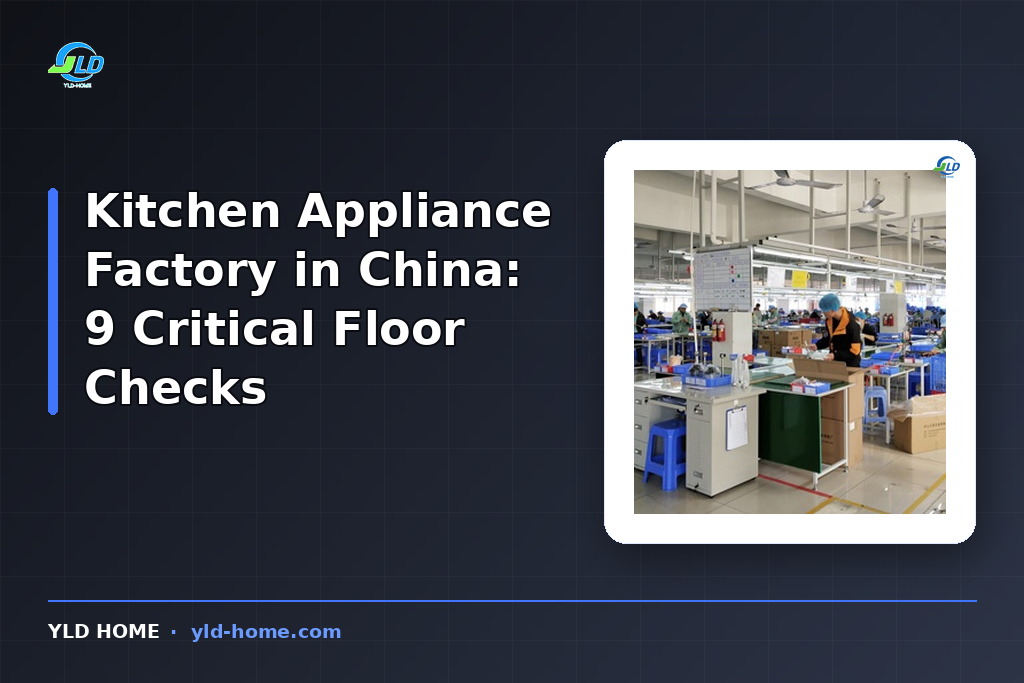
I spend my working weeks walking buyers through the YLD Home plant in Shipai, Dongguan. Not the showroom version, but the floor at 08:00, when the moulding bay is warm. This is that walk, stop by stop, including the parts where I tell buyers to look harder.
Why a floor walk beats any catalogue

A catalogue answers ‘what can you make’. A floor answers ‘what will you actually ship me in March’. Those are different questions, and the gap between them is where first orders go wrong.
Anyone can photograph a good sample. What you want is the boring machinery of consistency: a first-off sheet with today’s date on it, a torque driver whose calibration sticker is current, a rejection bin that actually holds rejected parts.
Three things become obvious within twenty minutes of walking a kitchen appliance factory in china, and none of them appear in a quotation:
- **Where the value is added.** If moulding, winding, PCBA and shaft work sit under one roof, your lead time has fewer handoffs. If they are bought in, each one is a queue you cannot see.
- **Whether the measuring is real.** Gauges on a bench mean nothing. Gauges in use, with a reading written down and a name next to it, mean something.
- **How the plant behaves when something fails.** Ask what happened the last time a batch failed in-line test. A vague answer is an answer.
The numbers on the gate
YLD Home has been building small kitchen appliances since 2012. The Shipai site covers 25,000 m², runs five production lines and 62 machines, and turns out roughly 600,000 finished appliances a month with about 300 people. The Shenzhen showroom in Bao’an is a 60-90 minute drive away, which is why most itineraries start there and finish here.
The nine stops, in the order you walk them
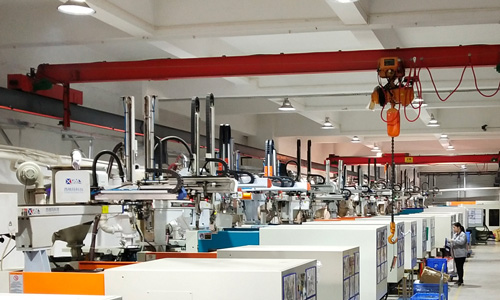
Every visit follows the same route, because the route follows the process. You start where raw material starts and finish at the container door — which is also the order in which problems would reach your shipment if any station were weak.
| # | Station | What is in front of you | What gets measured while you stand there |
|---|---|---|---|
| 1 | Incoming goods (IQC) | Granules, steel bar, motor and PCBA cartons, packaging | Batch labels vs approved list, granule moisture, steel grade certificate, AQL 1.5 visual |
| 2 | Tool room and moulding | Mould carts, tool bench, machine platens | Shot weight, cycle time, cavity count, first-off dimensions |
| 3 | Motor winding | Winding benches, stator stacks, tensioners, varnish | Turns count, resistance per phase, insulation test |
| 4 | PCBA and function test | Board stock, firmware bench, test fixtures | In-circuit test, function test against spec, burn-in sample |
| 5 | Shaft forming and polishing | Bar feed, forming station, polishing heads | Diameter by micrometer, runout by dial gauge, surface finish |
| 6 | Assembly and in-line test | Jigs, fixtures, torque drivers, end-of-belt bench | Torque vs setting, insulation resistance, power draw, leakage |
| 7 | QC laboratory | Dielectric bench, power meter, torque rig, life rigs | Withstand voltage, wattage tolerance, torque in Nm, cycle counts |
| 8 | Packing and transit test | Carton line, drop frame, barcode station | Drop height by weight class, barcode scan, pack-out vs proof |
| 9 | FQC, OQC and loading | Sampling tables, inspection reports, container at dock | AQL 1.5 major / 4.0 minor, signed report before the doors close |
Nine stops, roughly two and a half hours if you ask questions. Here is what each one is actually for.
Stop 1 — Incoming goods, where most quality is decided
Nothing on this floor can be better than what came through the IQC door, which is why the first stop is a receiving bay and not a showroom.
Pallets of granules with batch labels, steel bar cut to length, cartons of motors and boards waiting for release. The inspector checks three things: whether the batch number matches the approved supplier list, whether granule moisture sits inside the drying window, and whether the visual sample passes at AQL 1.5. Steel arrives with a grade certificate; without one, the pallet does not move. In a kitchen appliance factory in china this is usually the least photographed stop and the most informative one — ask to see a rejection. A receiving bay with none in a month is not clean, it is unsupervised.
Stop 2 — Tool room and moulding
A real factory separates itself from a trading company here, because tooling needs a home and a maintenance schedule, not a phone call.
Moulds sit on carts with a service record; the bench has a press for insert repairs and a shelf of spares. Before a job is released the operator runs a first-off check against the drawing: shot weight, key dimensions with a caliper, cavity count, cycle time logged. Watch two things: granule drying, because an under-dried material shows silver streaking on the part and again in your container six weeks later; and whether the same tool runs your job and someone else’s, since shared tooling is not automatically bad, but you should know.
Buyers new to a kitchen appliance factory in china spend too long at the machines and not enough at the maintenance bench. The bench is the tell.
Stop 3 — Motor winding
Wound stators, tensioners, a varnish station, and a bench where each stator is checked before it goes anywhere near an assembly line.
The sheet reads turns count and resistance per phase against the motor drawing for that model, then an insulation test on the winding. A stator that fails here costs minutes; the same stator found at the end of the line costs a unit and a strip-down. If you are buying a hand blender or a chopper, this station decides whether the unit sounds tight or tinny at speed.
Stop 4 — PCBA and function test
Boards arrive, get flashed with the firmware for the market they are going to, and go onto a fixture that runs the functions a user would actually perform: start, speed change, pulse, cut-out, and the safety interlock if the model has one.
In-circuit test catches assembly faults; the function test catches firmware and harness. Every board is tested, only a sample is burned in — normal practice in any kitchen appliance factory in china, and worth confirming rather than assuming. A burn-in sample runs longer, on the bench, with results written down.
Stop 5 — Stainless steel shaft forming and polishing
The shaft is the part buyers forget and the part that decides whether a blender runs true at speed. Bar stock is formed, then polished in stages; the inspector checks diameter with a micrometer, runout with a dial gauge between centres, and surface finish against a comparison plate. A shaft 0.02 mm out becomes vibration, then bearing noise, then a return.
Ask whether polishing is in-house. At YLD Home it is. In any kitchen appliance factory in china where it is not, ask which supplier does it and how often they are audited, because polishing shops are usually the least documented link in the chain.
Stop 6 — Assembly and in-line electrical test
The busiest part of the walk: jigs, fixtures, sub-assembly bins, torque drivers. Driver settings are checked against the work instruction rather than set by feel, so ask the line leader to show you the setting and the check sheet.
At the end of the belt every unit goes onto a test bench: insulation resistance, power draw at rated voltage, leakage current, limits taken from the standard the model is certified to. This is the stop where a kitchen appliance factory in china either shows you a record or shows you a speech. Failures are tagged and pulled, and the tag is the record. With fifteen minutes on the floor, spend them here and at the lab: assembly shows the pace, the bench shows the discipline.
Stop 7 — The QC laboratory
Four rigs, four questions. Dielectric withstand — does the insulation hold at test voltage, and what is the pass criterion. Potência — does the unit draw what the rating plate says, on a meter rather than an estimate. Torque — a number in Nm for anything with a blade, whisk or disc. Life test — units running counted cycles until they fail.
The lab is also where the paperwork lives: test reports per model, calibration records for the meters, the AQL plan that OQC follows. A factory that cannot show a calibration record for the meter it just used is offering a claim, not a measurement. The sampling plan follows the attribute tables in ISO 2859-1, which is why a competent supplier can tell you exactly what AQL 1.5 major and 4.0 minor mean for your lot size.
Stop 8 — Packing and transit test
Cartons, inserts, drop frame, barcode station. Packaging is where a good unit becomes a damaged unit, so the test is a drop at a height set by packed weight, then an inspection of unit and carton. The pack-out is checked against the artwork proof: language, warnings, model number, barcode, certification marks. A wrong barcode is a chargeback.
Stop 9 — FQC, OQC and the container
Final quality control runs on the finished lot; outgoing quality control runs on what is about to be loaded. The sampling tables come out, the report is filled in, and the container does not close until it is signed.
YLD Home works to AQL 1.5 for major defects and 4.0 for minor, and a pre-shipment report goes out before loading, with photos. Third-party inspection is welcome, so book it early: the last stop in a kitchen appliance factory in china that argues against inspection is the one you should inspect twice.
You can see the full sequence on the factory tour page, and the inspection criteria in more detail under quality control.
What the floor will not tell you
A tour is a sample, and samples are chosen. A walk does not prove capacity in your peak month, so ask for the loading schedule, not the monthly total. It does not prove sub-supplier quality, so ask which components are bought in and who audits them. Nor does it prove the line you saw will run your order — ask how many models share your tooling.
That is no reason to skip the visit. It is a reason to ask better questions — and any kitchen appliance factory in china that flinches at them has told you something too.
Ten questions to ask while you are standing on the floor
Print it and ask in order. The answers matter less than whether the person answering reaches for a record.
| # | Question | Why it matters | A good answer sounds like |
|---|---|---|---|
| 1 | Which processes are in-house and which are subcontracted? | Where your lead time and risk sit | A list, with the polished shaft, the motor and the board named either way |
| 2 | Can I see today’s first-off inspection sheet? | Inspection on a schedule, not on request | Today’s date, a part dimension, a signature |
| 3 | What is the calibration date on that power meter? | Turns a claim into a measurement | A sticker and a record you can photograph |
| 4 | How many units per hour does my model run at, on which line? | Turns capacity into a delivery date | A line number and a cycle time |
| 5 | What is the last batch that failed in-line test, and what did you do? | How the plant handles failure | A defect, a containment action, a date |
| 6 | Who owns the tooling if I pay for it, and can I take it? | Protects a custom mould investment | A written answer, in the contract |
| 7 | Which certificate does this model hold for my market? | The marks are not interchangeable | A certificate number and a report you can check |
| 8 | Do you accept third-party inspection, and at what stage? | Moves the argument from trust to evidence | Yes, before loading, we will book the slot |
| 9 | What is the AQL plan, and who signs the report? | Sets acceptance criteria before you order | 1.5 major and 4.0 minor, signed by QC |
| 10 | Can I see the pack-out against my artwork proof? | Prevents retail chargebacks | A side-by-side check before the run starts |
Certificates: what to check and where the paper comes from

The certificate pack is the part of the tour that happens in a meeting room, and the part buyers under-examine. In a kitchen appliance factory in china you will be shown a fan of marks; the work is matching them to your market.
YLD Home models are certified to CE, GS, CB, UKCA, ETL and FCC depending on the model and market. Those marks come from test reports against the relevant standard — for household appliances the IEC 60335 family, published by the IEC and adopted nationally with local deviations. A CB report is the useful one when you sell into several countries, because it is the document other certification bodies start from.
Three checks while the folder is open. The model number on the certificate matches the one on your invoice — trivial, and the commonest reason a shipment gets held. The mark matches the market: CE for the EU and UKCA for Great Britain are separate routes, ETL and FCC the US pair. The report is current, because a withdrawn edition will not help at customs.
The full list, with certificate numbers, sits on the certifications page. Ask for the PDFs, not a screenshot of a badge.
Sampling, MOQ and the calendar after the tour
Sampling runs five to seven days for a standard model in a stock colour. Production runs 25 to 35 days after sample approval and deposit, depending on model mix and season. MOQ is 1,000 pieces per model, terms FOB Shenzhen. That rhythm is typical of a kitchen appliance factory in china with in-house moulding: short sample loops, because the tooling exists.
Two of those numbers are fixed and one is not. The sample window follows existing tooling; the production window moves with the loading schedule, which is why you should ask to see it. MOQ is real for a stock model, but if you are developing something new the conversation changes — that is what the custom kitchen appliance development route is for, and it starts with a drawing and a target price rather than a catalogue page.
How to plan the visit
Most buyers do both sites in one day: the Shenzhen showroom in Bao’an in the morning for samples and packaging mock-ups, then the Dongguan factory in the afternoon. Long day, but you leave with a decision instead of a to-do list.
Bring three things: your own gauge, so you can check a dimension against a number you trust; your artwork proof, if packaging is in scope; and the ten questions above on paper. Book a week ahead and ask which model will be running — a serious operation tells you in advance rather than letting you find out at the gate.
Frequently asked questions
Can I visit the factory before I place an order?
Yes, and you should. Buyers fly in before the first order far more often than after the tenth. YLD Home schedules visits through the contact form: a morning at the Shenzhen showroom, an afternoon at the Dongguan plant.
How long does the tour take, and can I see the lab?
Two and a half hours for the nine stops, longer if you watch a full assembly cycle. The lab is stop seven and it is not a corridor glance — ask for the calibration records while you are in the room.
Can a kitchen appliance factory in china run my own tooling?
A factory with a tool room can, and the terms belong in writing before anything is cut: who pays, who owns, who maintains, and whether the tool leaves with you if you move. At YLD Home moulding and tool maintenance are in-house, so the answer to ‘who fixes it when it wears’ is not a third party.
Which certificates will actually arrive with my shipment?
Whichever ones your market requires and the model holds: CE, GS, CB, UKCA, ETL or FCC. The test report PDFs come with the order documents, and the marks on unit and carton must match the certificate.
What is the MOQ, and how fast can I get samples?
1,000 pieces per model, samples in five to seven days for a standard model, production in 25 to 35 days after approval. If your first order is smaller than the MOQ, the honest route is to pick a model that already runs.
Will you accept a third-party inspection?
Yes. SGS, BV and Intertek have all inspected shipments from this plant. Book the slot when you confirm the order, not the week the container is due.
What happens if OQC finds a defective lot?
The lot does not ship. It is held, sorted at AQL, reworked or rejected, then re-inspected. Ask for the hold tag from the last time it happened.
Can I combine hand blenders and other small appliances in one container?
Usually yes, and it is the fastest way to test a range without committing a full container to one model. The wholesale hand blender range e o portable kitchen appliances line come off the same floor.
Next three moves
If you are sourcing this quarter, the sequence is short. Pick the two models closest to your price band and request samples, so you are judging a unit, not a photo. Book the visit and walk stops four, six and seven with the question sheet in hand. Then send your specification, market and volume to the quote desk, and ask for the loading schedule alongside the price.
The floor is the part of a supplier that cannot be edited after the fact. Walk it once and you will read every quotation differently — which is why a kitchen appliance factory in china that invites the visit tends to keep the account.