









In this guide: Ranking Criteria · The 7 Supplier Types · Full-Line Factories · Dedicated Blender Makers · OEM Specialists · Commercial Suppliers · Trading Companies · UK Distributors · Marketplace-First Suppliers · Factory vs Trading · How to Choose · FAQ
Every UK distributor needs a shortlist of hand blender suppliers uk wholesale buyers can actually work with: partners who export to the UK, hold the right documents, tolerate the way distributors order, and survive contact with a demanding customer. This guide ranks the seven supplier types you will meet in 2026, scores them against real criteria, and explains which route fits your business model and your margin.
To see what factory-direct hand blender suppliers uk wholesale relationships look like in practice, watch the production floor tour below:
hand blender suppliers uk wholesale
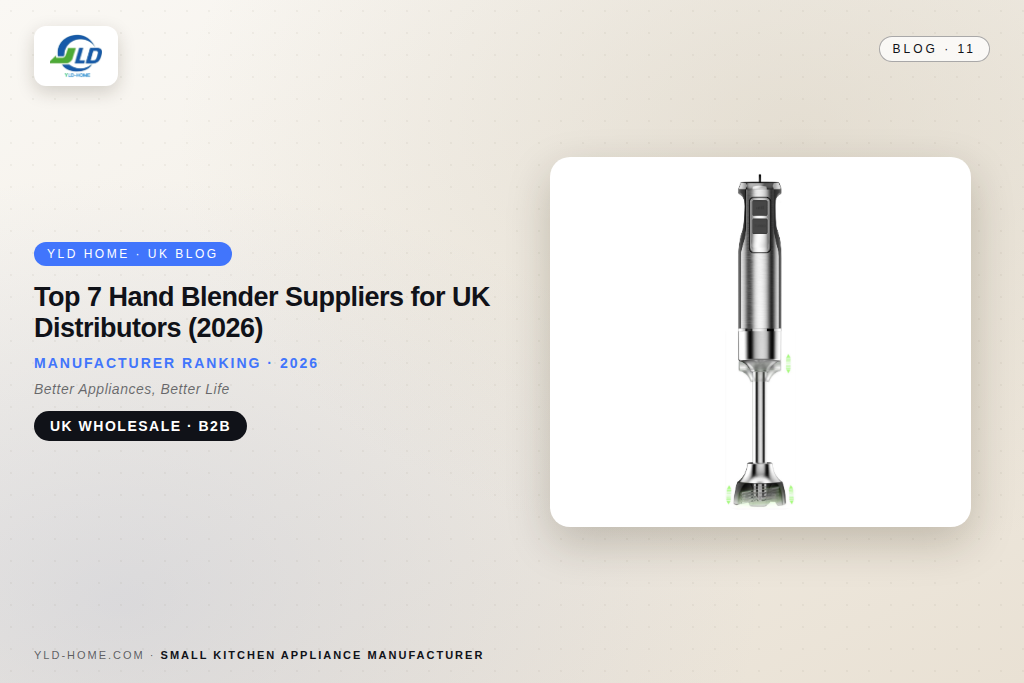
How We Ranked Hand Blender Suppliers UK Wholesale Distributors Can Trust
The ranking in this guide is based on what we’ve seen UK distributors actually experience, not on catalogue size or factory glamour. We evaluated suppliers against eight criteria across three months of document checks, sample testing and reference calls with UK importers: UK compliance readiness, product quality consistency, MOQ and mixed-load flexibility, private label capability, communication speed, delivery reliability, price competitiveness and after-sales support.
The weighting matters as much as the list. UK compliance readiness carries the heaviest weight because a supplier who cannot deliver UKCA documents, a UK Type G plug and 220-240V configuration makes everything else irrelevant: the product simply cannot be placed on the UK market legally. The charity Electrical Safety First publishes independent guidance on electrical appliance safety, and UK buyers frequently use it to benchmark supplier claims before committing. Product quality comes second, because distributors sell on repeat orders, and a good-looking first batch that fails in the field kills the relationship with the retailer, not just the factory.
The other criteria separate good suppliers from great ones. MOQ and mixed-load flexibility decides whether a distributor can test new models cheaply. Private label capability decides whether the distributor can build a brand instead of reselling commodity stock. Communication speed predicts how painful every future order will be. Delivery reliability protects against the shelf-empty scenario that destroys distributor margins.
A final note on method: this ranking evaluates supplier types, not individual company names, because the market changes faster than any static list. YLD Home, a Shenzhen-based small kitchen appliance manufacturer, was one of the suppliers benchmarked while building the criteria, and its documentation structure shaped the compliance checks below. What matters is that a distributor can recognise each type, know its strengths and weaknesses, and verify any individual candidate against the same criteria. The type-level view is what survives contact with reality. We also publish updated supplier benchmarking notes on the YLD Home blog as the market changes.
The 7 Supplier Types and How They Score
Across the UK wholesale channel, the same seven supplier types keep appearing. Learn to spot them and the market stops looking chaotic.
| Supplier type | Typical profile | Best suited for | Main risk |
|---|---|---|---|
| 1. Full-line kitchen appliance factory | Large plant, broad catalogue, strong systems | Volume distributors, own-brand programmes | Slower to customise small orders |
| 2. Dedicated hand blender manufacturer | Specialist lines, deep category knowledge | Distributors focused on blenders | Narrower product spread |
| 3. OEM and private label specialist | Flexible branding, packaging, manuals | Brands building their own label | Higher unit cost at low volume |
| 4. Commercial and catering-grade supplier | 1000W+ models, spare parts, B2B focus | Horeca and foodservice distributors | Less retail-oriented packaging |
| 5. Trading company or export agent | Wide catalogue, no own factory | First-time importers, mixed baskets | Margin layers, less control |
| 6. UK-based distributor or import agent | Local stock, fast delivery, credit terms | Small retailers, urgent restocks | Higher prices, limited range |
| 7. Marketplace-first e-commerce supplier | Dropship-style, Amazon-focused SKUs | Online sellers testing demand | Thin documentation, brand conflicts |
Each type has a legitimate place, and the scoring in this guide reflects how well each type serves a UK distributor’s core needs. The pattern that emerges is clear: across the hand blender suppliers uk wholesale market as a whole, factory-direct types score highest on margin and control, while UK-based and marketplace types score highest on speed and convenience. The right answer depends on what the distributor is building.
Type 1: Full-Line Kitchen Appliance Factories
The full-line kitchen appliance factory is the heavyweight of the industry. These plants, the classic small kitchen appliance manufacturer in China model, typically produce dozens of categories, from kettles and toasters to food processors, blenders and mixers, with hundreds of SKUs and thousands of workers across multiple buildings. Their advantages are scale, systems and documentation: they hold ISO 9001, BSCI and export certification, run established quality systems, and their compliance departments produce the UKCA, CE and food contact files without drama.
For a distributor, the full-line factory is the safest first choice when you need volume and reliability. They have mature supply chains, proven logistics and the capacity to absorb order spikes. Their pricing is competitive at scale, and their documentation tends to be the most complete in the industry, which matters enormously when a UK retailer asks for the full compliance file on a Tuesday afternoon.
The trade-off is flexibility. Full-line factories are structured around large production runs, and small or highly customised orders can be slow or expensive. If a distributor wants a private label box with special artwork for a 300-unit trial, a full-line factory may quote minimums that defeat the purpose. Communication can also be slower, because the account sits inside a large organisation with layers of sales staff and production planners.
The verdict? Use full-line factories for your volume lines, the models you reorder every quarter, and negotiate the compliance and packaging package as part of the framework agreement. Do not use them for experiments. When evaluating one, ask for their export list to the UK, visit or video-audit the line, and verify that the model you want already has UKCA and Type G configuration rather than assuming it.
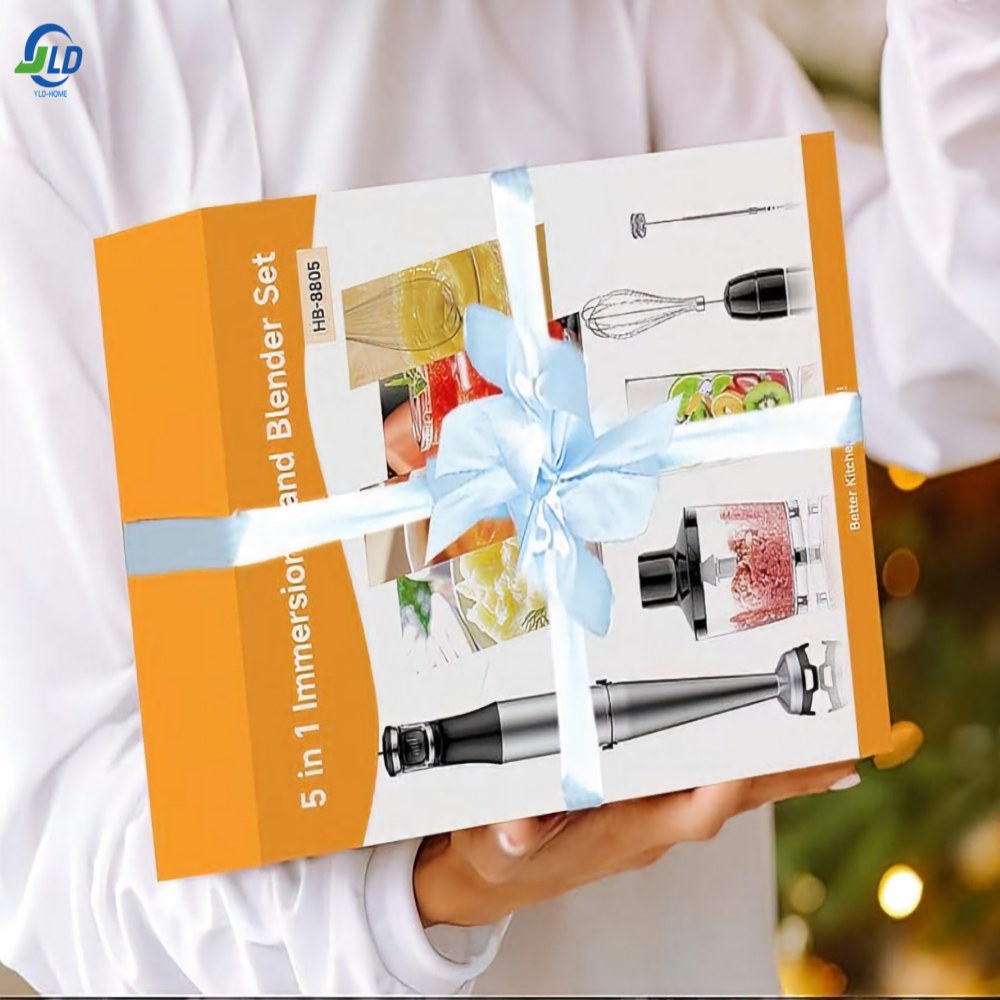
Type 2: Dedicated Hand and Stick Blender Manufacturers
The dedicated hand blender manufacturer does one thing and does it deeply. These factories live inside the blender category: they know every variant of motor, blade, shaft and coupling, they hold the tooling for dozens of models, and their engineers can talk about immersion blender performance the way other factories talk about toasters. YLD Home is a good example of the type, with lines built entirely around hand blenders, immersion blenders and their accessories, and the category’s naming and specification differences are explained in our immersion blender vs hand vs stick blender guide. For a distributor whose business is blenders, this depth is gold.
The practical advantage is a better product for the money. Because the factory specialises, its tooling is amortised across a high volume of blender-only output, which lowers unit cost, and its quality systems are tuned to the failure modes that actually occur in blenders: shaft sealing, blade balance, motor overheating and food contact materials. A dedicated manufacturer usually offers more models within the category, including commercial-grade lines, cordless variants and multifunction sets, so one factory can cover a distributor’s whole blender range.
The risk is concentration. A distributor who builds the entire range on one dedicated manufacturer is exposed if that factory has capacity problems, raises prices or changes ownership. The category focus also means that when the distributor wants to expand into kettles, air fryers or mixers, they need a second supplier anyway.
The verdict: dedicated hand and stick blender manufacturers are the strongest match for a specialist blender distributor, and often the best value in the hand blender suppliers uk wholesale market because their whole cost structure is built around this one category. Verify the same way you would verify any factory, but expect the food contact documentation, blade material specs and motor test data to be noticeably more detailed than at a full-line plant. For distributors who want a direct line into the factory team, YLD Home’s export director Sherry publishes sourcing notes and new-model updates on LinkedIn.
Type 3: OEM and Private Label Specialists
OEM and private label specialists are the suppliers behind the brands you see on UK shelves. Their core competency is not making a better blender; it is making your blender: your logo on the housing, your colours, your box, your manual, your warranty card, your marketplace listing photos. For a UK distributor who wants margin beyond commodity resale, this capability is the difference between selling a blender for £12 and selling your brand of blender for £22.
The typical private label process starts with a base model and a customisation menu: housing colour, logo printing or in-mould decoration, packaging design, manual language and compliance documentation in the buyer’s name. YLD Home, for instance, offers a structured customisation menu for UK brands, with per-step pricing that lets a distributor see the cost of each option before committing tooling. Good specialists offer this kind of clarity, so a distributor can decide how far to go based on budget. The supplier should also keep the brand assets and tooling organised per customer, so your logo never shows up on a competitor’s shipment.
The trade-offs are cost and lead time. Private label adds tooling charges, art approval cycles and higher minimums, because the factory must stop the line for your configuration. A distributor ordering 200 units with custom packaging will pay meaningfully more per unit than for the same unbranded model. Lead time also stretches, often by two to four weeks for the first branded order.
The verdict: private label specialists are the right choice once a distributor has validated demand with unbranded or lightly branded stock and knows which models sell. The classic mistake is branding too early, before the data exists. When you are ready, negotiate the customisation menu up front, including future reorder pricing, so your margin story is locked before the first branded container ships.
Type 4: Commercial and Catering-Grade Suppliers
Commercial and catering-grade suppliers serve the professional kitchen, and they operate differently from consumer appliance factories. Their products are 1000W to 1600W immersion blenders with long shafts, heavy-duty motors, metal couplings and replaceable parts, built for continuous use in restaurants, hotels, care homes and food production; the 1600W PressPro hand blender is a typical example of the commercial specification. The customers are horeca distributors, catering equipment dealers and foodservice operators, who buy on durability and spare parts rather than colour and price.
The commercial channel is attractive for UK distributors because margins are healthier and competition is less brutal than in retail. A commercial immersion blender at £180 wholesale carries a different margin structure than a household model at £8, and the customers reorder parts and accessories with loyalty. The downside is a smaller customer base, longer sales cycles and the need to stock spare parts, which ties up cash.
Suppliers in this category are judged on spare parts availability, warranty terms and technical support. A distributor should confirm that blades, shafts, motors and couplings are stocked and shippable quickly, because a caterer with a broken blender needs a replacement part this week, not next quarter. Documentation should include commercial-grade food contact reports, since professional kitchens are exactly where the migration conditions are most demanding.
The verdict: if your UK distribution business serves foodservice, a commercial-grade supplier is a strategic necessity, not an option. Pair a commercial line with a consumer line from another factory and you cover both halves of the market. For the hand blender distributor UK factory direct route, commercial lines are also the highest-margin products to import, because the specification, not the brand, justifies the price.
Type 5: Trading Companies and Export Agents
Trading companies and export agents sell products made by other factories. They carry no production line of their own; instead they curate catalogues, consolidate orders and handle the export mechanics. Their great advantage is convenience: one contact, many products, mixed orders, and someone who speaks the buyer’s language and manages the freight. For a first-time importer testing several categories, a trading company can compress months of supplier research into one quotation round.
The disadvantages are structural. Every trading company sits between you and the factory, and that layer costs money in margin and control. You do not know which factory made your goods, you cannot audit the line, and your ability to influence quality, tooling or documentation runs through a middleman. When something goes wrong with a batch, the trading company’s incentive is to smooth things over rather than dig into the factory’s processes.
Trading companies are not all equal. The good ones add real value: consolidated inspection, document management, currency handling and dispute resolution. The weak ones simply forward quotations. The test is whether the trading company can show you the factory, arrange a factory visit, and put you in direct contact with the quality team when needed. If the answer is no, the “trading company” is a broker with a spreadsheet.
The verdict: use trading companies for exploration, mixed product baskets and markets you do not know yet, and graduate to factory-direct as soon as a category proves itself. A distributor who stays with a trading company forever pays a permanent tax on every unit. For the wholesale stick blenders supplier uk route specifically, the margin difference between trading company pricing and factory pricing is usually the difference between a viable distributor business and a marginal one.
Type 6: UK-Based Distributors and Import Agents
UK-based distributors and import agents hold stock in Britain, sell in pounds, deliver quickly and extend credit. For a small retailer or a distributor testing a niche, they are the most convenient option in the market: no container, no customs, no six-week lead time, just an order that arrives tomorrow. Many UK wholesalers started as importers and now supply other importers, and their catalogues often include the same Chinese factory models under their own brand.
The strengths are speed, service and risk reduction. Buying from a UK-based supplier means the product is already compliant, already tested, already on UK shelves, and if there is a problem, the supplier is a phone call away rather than a time-zone away. Credit terms and local returns make cash flow predictable, which is valuable for young businesses.
The weaknesses are price and control. The UK-based supplier carries warehousing, financing, compliance and logistics costs, and those appear in the unit price. A distributor buying the same model factory-direct can typically save 30 to 50 percent, which is precisely why distributors who grow past a certain volume switch to direct sourcing. There is also a ceiling: the UK-based supplier’s range is what they chose to stock, and their brand strategy may compete with yours.
The verdict: UK-based distributors are the right on-ramp for testing demand, filling gaps and covering urgent restocks, and many experienced distributors keep a local account open even after going factory-direct, as a safety valve. The blender trade supplier Sheffield scene, like most UK cities, has a handful of established wholesalers who know the category well; they are excellent for benchmarking prices and testing sell-through before you commit to a container.
Type 7: Marketplace-First E-commerce Suppliers
Marketplace-first suppliers are built for Amazon, eBay and TikTok Shop sellers. They typically offer dropship arrangements, marketplace-ready listings, UK warehouse stock and small-order flexibility, and their products are tuned to what converts on a marketplace listing page: multifunction sets, attractive bundles and competitive price points. For an online seller who wants to test a hand blender without holding inventory, they are the fastest route to market.
Their weaknesses mirror their strengths. Documentation can be thin, because the model was built for speed rather than regulatory completeness; food contact reports and batch traceability are sometimes missing until a seller asks for them. Brand conflict is a real risk: the same model is often sold to dozens of sellers simultaneously, which collapses prices and turns the category into a race to the bottom. And because the supplier serves everyone, your listing advantage is temporary at best.
The verdict: marketplace-first suppliers work for testing demand and for sellers who treat small kitchen appliances as a volume game with thin margins. They are not the foundation for a brand. If a distributor’s goal is a differentiated product with stable pricing, the marketplace-first route eventually becomes a competitor rather than a supplier, and the exit path is private label with a factory that does not sell the same model to your competitors.
Factory or Trading Company: Choosing the Route
The factory-versus-trading decision is the fork in the road for every UK distributor, and the answer depends on where the business is in its lifecycle. First-time importers and broad-catalogue testers should not be ashamed to start with a trading company: the convenience and consolidated service genuinely de-risk the first year. The key is to treat the trading relationship as a learning phase with a clear exit.
| Comparison | Factory-direct | Trading company |
|---|---|---|
| Unit cost | Lowest, no middle layer | Higher by 10-30 percent typically |
| Documentation control | Direct, in your hands | Dependent on the middleman |
| Customisation | Direct negotiation with engineers | Filtered through the agent |
| Communication | Direct, time-zone and language work required | Smoothed, but diluted |
| Mixed categories | Limited to factory’s range | Broad catalogue |
| Audit and quality control | Full access | Restricted by design |
Once a distributor knows which models sell, the economics flip decisively, and the verification steps for the factory route are laid out in our guide to hand blender manufacturers in China. At a few hundred units per model per order, the factory-direct saving on a hand blender range is often enough to fund a warehouse or a marketing campaign by itself. The practical recommendation is a hybrid: use a trading company for the categories outside your core, whilst moving your core blender lines to a factory that can prove its compliance, quality and export record to the UK.
How to Choose Between Hand Blender Suppliers UK Wholesale Options
Choosing between hand blender suppliers uk wholesale options comes down to a five-step process that works regardless of supplier type. Step one: define the job. Write down the models, volumes, target price points and compliance requirements for the next twelve months, because a supplier that looks great for one job can be wrong for another.
Step two: build a shortlist of three to five candidates across at least two supplier types, so you are comparing structures, not just prices. Step three: run the verification sequence on each candidate: export records to the UK, UKCA and food contact documents for the exact models, sample orders with UK plugs, and a reference call with an existing UK customer. Step four: price the total cost, not the unit price, including freight, duties, VAT, inspection and the cost of your time managing the relationship. Step five: start with the smallest order the supplier will take and measure everything. Our UK clients hear this constantly: a trial order with a checklist beats a five-year contract based on a brochure.
Two practical notes. First, UK compliance is not negotiable: if a candidate cannot produce UKCA documentation and a UK Type G plug configuration for the exact model, remove them immediately, regardless of price. Second, private label capability is worth paying for, because the distributor who owns a brand owns the shelf. YLD Home is one example of a manufacturer serving UK distributors with UK-configured models, per-model compliance files and private label support from first trial orders upward, and its hand blender range is a useful benchmark when you build your shortlist. Its wholesale blenders page lists the UK-configured stock models distributors order first, compliance files included. The principle to copy is the structure, not the name: documents, samples and small orders before volume.
Perguntas frequentes
How Do I Verify Supplier Certificates?
Ask for the UKCA declaration and food contact reports for the exact model numbers, then confirm the documents with the issuing laboratory. A certificate that names a different model proves nothing. YLD Home follows this verification flow for every UK distributor account, and expects buyers to check rather than trust.
What Is a Realistic MOQ From a Factory?
1,000 units per model for standard stock production, with mixed loads lowering the practical entry point because quantities combine across SKUs. Private label adds its own minimums per customisation. YLD Home quotes per-model minimums in writing so distributors can plan cash flow around them.
Factory-Direct or Trading Company for a First Order?
Start with whichever de-risks the first year, often a trading company for a single trial container, then move to factory-direct once volumes and specifications justify it. YLD Home supports UK distributors from small trial orders upward, so the switch does not require changing supplier.
Do Suppliers Provide UK Plugs and 220-240V?
Reputable UK-exporting suppliers configure Type G plugs and 220-240V as standard, and it should be written into the specification rather than assumed. YLD Home ships UK Type G configuration as standard on its wholesale models, with the plug and fuse named in the data sheet.
Can I Mix Models in One Container?
Yes. Most factories and trading companies support mixed loads, and it is the cheapest way to test several models before committing to depth on any single SKU. YLD Home accepts mixed first orders across its blender range, planned carton by carton at 2 PCS/CTN.
How Long Does a Typical Order Take From China to the UK?
Sample production takes about 7 to 15 days, production 2 to 4 weeks, and sea freight 4 to 6 weeks to a UK port, so plan on 8 to 11 weeks end to end. YLD Home confirms the schedule per order inside the quotation.
What Is the Difference Between OEM and ODM?
OEM applies your branding to an existing model; ODM develops a new model or specification for your brand, including tooling changes. ODM costs more and takes longer, but it differentiates the product. YLD Home offers both routes to UK distributors, with certification included.
Do Suppliers Handle UKCA Documentation?
Usually yes. A UK-exporting supplier provides the technical file and declaration for the models it ships, while your importer duties and customs broker handle the declaration at the border. YLD Home includes the technical file and Declaration of Conformity with each UK order.
Official references: Electrical Safety First
Before you commit, score each supplier on certificates, duty-cycle support, spare-parts stock and reference sites, then compare quotes on landed cost rather than unit price. YLD Home answers distributor enquiries at MOQ 1,000 units, ships samples in about seven days and sends the document pack with the quotation.
The clip above is an excerpt. The full footage, with the shot-by-shot transcript and buyer notes, is on its own page: Hand Blender Factory Video: A Floor Walk in 2 Minutes 23