









In this guide:
- Why US buyers end up sourcing from a hand blender manufacturer in China
- What to prepare before you contact any factory
- The 8-point factory audit checklist
- Certifications that separate real factories from resellers
- Quality control: where good factories and cheap factories diverge
- Production capacity, lead times, MOQ, and real pricing
- Private label, logistics, and financing for US imports
- FAQ and official references
Type “hand blender manufacturer” into a search engine and you’ll get a hundred factories claiming the same things: 15 years of experience, UL certification, low MOQ, professional team. The hard part of sourcing isn’t finding a hand blender manufacturer. It’s telling the factory that ships consistent product from the one that ships headaches. This guide is the audit checklist we use when US buyers vet suppliers — the documents to ask for, the tests to run, and the red flags that kill deals. YLD Home is a hand blender manufacturer in Shenzhen, and we wrote this from the factory side because we’ve seen how the good buyers work.
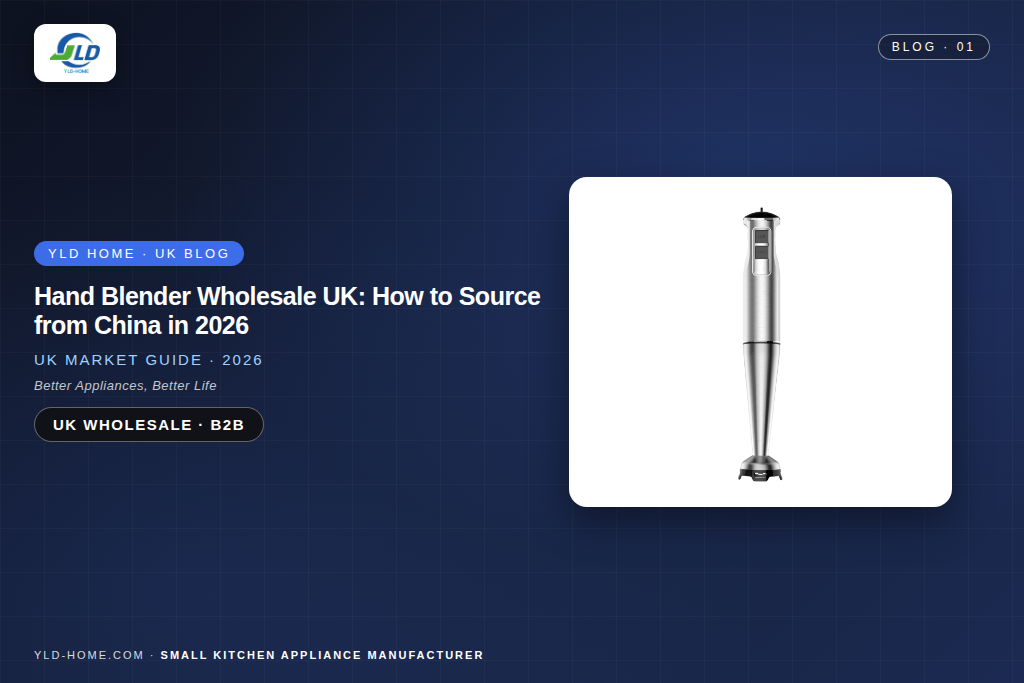
Why the Search for a Hand Blender Manufacturer Leads to China
Here’s a fact US buyers live with: most of the small kitchen appliances sold in America are made in China. That’s not a secret, and it’s not a problem when the supply chain is managed properly. The reason the search ends in Guangdong is simple — that’s where the ecosystem is.
Shenzhen and the surrounding cities have the full stack: motor winding shops, shaft and blade stamping, mold makers, injection molding, packaging printers, and testing labs. A factory in Shenzhen can source a motor, a stainless steel shaft, a housing mold, and a retail box within a few kilometers. That density is why lead times are short and why a US buyer can run a private label order without flying to Asia twice.
Compare that with sourcing the same product in the US. Domestic factories exist, but most focus on commercial heavy-duty equipment with price points that don’t work for retail stick blenders. For the “hand blender factory supplier usa” searches we see from buyers, the honest answer is usually a Chinese factory with a US-facing export program — which is what most US importers end up using.
YLD Home has been building hand blenders, stick blenders, and immersion blenders in Shenzhen since 2012, exporting to the US market for most of that time. We’re not the biggest factory in Guangdong, and we don’t want to be. We built our program around US wholesale buyers who need certification files, consistent QC, and a supplier who answers email.
Before You Call: What US Buyers Should Prepare
The buyers who get the best quotes from any hand blender manufacturer are the ones who show up prepared. A factory can’t quote what you haven’t defined. Here’s the prep list we hand to new US buyers:
- Target spec: wattage, speed settings, shaft material and length, blade design, cord length, attachments
- Packaging plan: retail box, hang tab, polybag, or bulk carton; UPC codes needed or not
- Compliance targets: UL or ETL, FCC, FDA food contact, and who carries the certifications
- Volume forecast: first order size, annual volume, and expected growth — this shapes your negotiating position on MOQ and price
- Target price: your landed cost ceiling, so the factory knows what range to quote
- Timeline: when you need samples, when production has to ship, when the season starts
- Import plan: your forwarder, customs broker, and warehouse, or a request for the factory’s recommendations
Buyers who send a one-line email asking “what’s your price” get a catalog link and a number. Buyers who send a spec sheet get a serious quote within three business days. It’s that simple.
Also decide who you are in the chain. An importer buying containers, a distributor buying mixed pallets, and a private label brand building a kitchen line all need different things from the same factory. Tell your supplier which one you are.
Factory Audit Checklist: The 8 Things We Check
A real audit doesn’t require flying to Shenzhen, though it helps. Most US buyers do a document audit first, then a video call factory tour, then a third-party inspection on the first order. Here’s the checklist we use when we audit factories ourselves, and it’s the same one we invite US buyers to run on YLD Home:
| # | Audit Item | What to Ask | Red Flag |
|---|---|---|---|
| 1 | Legal entity | Business license, export license, years in business | License in a different name than the website |
| 2 | Production lines | How many lines, how many units per month, how many customers share the line | No production floor photos or video |
| 3 | Certification files | UL/ETL file numbers, FCC reports, FDA food contact declarations | “Certification comes after the order” |
| 4 | QC process | IQC on incoming parts, in-line checks, final inspection, AQL levels | No QC documentation at all |
| 5 | Component suppliers | Who makes the motors, shafts, and blades | Motors from “a partner factory” that can’t be named |
| 6 | Test equipment | Hipot tester, motor test bench, torque gauge, drop test rig | Test equipment shown in photos only, never in video |
| 7 | Labor and safety | Worker count, shift patterns, BSCI or SEDEX audit reports | Evasive answers about worker conditions |
| 8 | US export experience | US customers, what certifications they required, recall history | No US customers after years in business |
Run the checklist twice: once on the documents, once on the factory tour. If a factory passes both, put them on the short list. If it fails one item, ask why. If it fails two, move on.
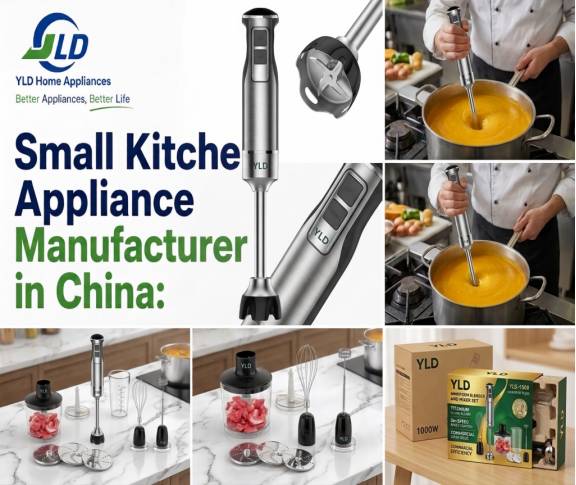
Certifications: What a Real Hand Blender Manufacturer Should Show You
A factory serving the USA market should have the certification stack before you ask, not after. Here’s what “certified” actually looks like:
- UL or ETL listing: a file number you can verify on the agency’s public database. The file ties the model to the safety standard — UL 982 for blenders. If the factory gives you a number that doesn’t resolve, that’s your answer.
- FCC compliance: a test report showing the 120V model meets emission limits. US Customs can hold product without it.
- FDA food contact: material declarations for the shaft, blade, and attachments. Ask for the specific materials, not a generic letter.
- ISO 9001: a quality management system, worth asking about even though it’s not a legal requirement.
- Social audits: BSCI, SEDEX, or similar, which US retailers increasingly demand from their vendors.
“Certified” versus “certifiable” is the distinction that matters. A factory that says “we can get UL after you order” is asking you to be the test customer. A factory that holds the files and shows them on the first call is a factory that has shipped to the US before.
When US buyers search “hand blender manufacturer usa,” they usually mean a factory that already holds the US certification stack. And when they ask us how to verify a supplier’s certifications, we tell them the same thing every time: check the file number on the agency’s site yourself. It takes five minutes, and it removes the entire category of fake-certification factories.
Quality Control: Where Good Factories and Cheap Factories Diverge
Certifications say the design passed a test. QC says every unit off the line meets that standard. That’s where factories split apart.
The QC points that matter for a hand blender:
- Motor burn-in: motors run on a test bench before assembly, because most motor failures happen in the first hours of life
- Electrical safety testing: hipot and ground continuity on every unit, not a sample
- Shaft straightness and blade balance: a wobbling blade destroys soup texture and customer confidence
- Speed control consistency: dial positions should match actual speed within a narrow tolerance
- Cord strain relief: the most common field failure on cheap units is the cord pulling out of the housing
- Packaging drop test: retail boxes survive the trip from Shenzhen to a shelf in Ohio
When we tested samples from five factories for a US buyer last year — a comparison that took three weeks — the cheap unit failed on the cord, the mid-price unit had a blade that wobbled, and the difference between the top two was the QC documentation, not the build. That’s the pattern: the cheapest quote fails in the field, and the savings evaporate in returns.
The shortcuts we see from factories cutting corners: certification photos instead of verifiable files, a “partner factory” that can’t be named, quotes far below every comparable factory, samples from a “different line,” lead times that stretch every time you ask, and no US customers after years in business. When a factory shows you three of those, walk away.
At YLD Home, we run every unit through electrical safety testing before packing, and we invite buyers to book a third-party pre-shipment inspection at the agency’s daily rate. Inspectors who see the line know what to look for.
Production Capacity and Lead Times
Capacity questions come up in the first call with every US buyer. Here’s the honest shape of the numbers:
- Monthly capacity at YLD Home: 600,000 units across our stick blender and hand blender lines — including the 6018 1000W powerful stick blender и 6019 1000W powerful stick blender models that anchor our US commercial orders
- Sample lead time: 7 days, including your approval
- Production lead time: 3 to 4 weeks after deposit, at high line utilization
- Peak season: August to October, when US buyers stock for the holidays — capacity goes to reservation first
- Tooling time for a new private label mold: quoted per project after drawing review
Ask any factory three questions: how many lines you run, how many customers share a line, and what happens when a line goes down. A factory with one line and ten customers is a queue, not a partner. A factory that can show you spare capacity in writing is a factory that can actually meet your launch date.
We reserve production slots for US buyers who commit early. A buyer who books in June for an October container gets a slot. A buyer who calls in September joins the queue. That’s not a sales tactic; it’s how factories work everywhere.
MOQ, Pricing, and the Real Cost of Cheap Units
Pricing from a hand blender manufacturer in China follows a predictable structure. Here’s the cost stack for a typical 1000W stainless steel hand blender:
| Cost Component | Typical Range | Notes |
|---|---|---|
| Motor | Quoted per model | The biggest single cost; quality varies wildly |
| Shaft and blade assembly | Quoted per model | Stainless steel grade matters |
| Housing and molding | Quoted per model | Tooling amortized into unit price |
| Аксессуары | Quoted per model | Chopper, whisk, measuring cup |
| Упаковка | Quoted per model | Retail box, manual, inserts |
| Labor and overhead | Quoted per model | Assembly and QC |
| Factory margin | Quoted per order | The honest part of the price |
MOQ from a hand blender manufacturer for stock models runs 1,000 units; private label starts around 1,000 units. Buyers searching for private label from China usually want the private label math, and the honest answer is that your MOQ, color count, and packaging complexity set the price per unit. More colors, more SKUs, and fancier boxes all push the unit price up.
The real cost of cheap units shows up off the quote. A slightly cheaper factory price becomes a far larger return and refund problem when the motor dies in month three. Multiply that by a full container and the “cheap” supplier is the expensive one. We’ve watched US buyers learn this lesson on their first container; the smart ones learn it on a sample order.
Private Label: Your Brand on a Factory Line
Private label is how most US buyers turn a hand blender into their own product. The package from the factory includes:
- Your logo on the housing, pad-printed or molded
- Your retail box, manual, and insert cards
- Your UPC codes and regulatory marks
- Your color scheme, from a standard palette or custom Pantone
- Your warranty terms, honored through your channel
- Certification files that carry your brand name where possible
The importer of record question comes up again here. In a private label deal, you’re the importer of record, the factory provides compliant product and documents, and you handle customs clearance, FDA Prior Notice where it applies, and your retailer compliance. Factories that promise to “handle everything” usually mean they’ll handle it until something goes wrong.
Сайт ручной блендер с измельчителем is the model US private label buyers ask about most after the core stick blender — the combo gives a kitchen line two products from one motor platform. The ручной блендер rounds out the lineup, and the 6021 1000W powerful stick blender covers buyers who want a commercial-grade option in the same container.
Logistics, Customs, and Duties for US Imports
Getting units from Shenzhen to a US warehouse is a solved problem, but the details decide your landed cost:
- HTS code: hand blenders and stick blenders fall under 8509.40, duty set by the HTS rate in force on the day of entry
- Ocean freight: 18 to 22 days to Los Angeles, 25 to 30 days to New York via the canal, 25 to 30 days to Houston
- Container math: at 2 PCS per carton, a 40HQ holds several thousand units depending on box size
- Air freight: several dollars per unit for urgent restocks — expensive but faster than a container
- Customs: your broker files the entry; FDA Prior Notice applies to food-contact items like blender shafts
- Sample shipments: DHL or FedEx, 3 to 5 days door to door
Importers in California, Texas, and New York handle this every week. The mistake we see is buyers who ignore the broker step until the container is on the water. Line up your customs broker before the order ships, and ask the factory for the packing list format your broker prefers.
A 40HQ container of stick blenders is a real commitment. Budget the full landed cost — factory price, freight, duty, broker fees, warehousing — and you’ll know your margin before the container leaves Shenzhen, not after it lands in Long Beach.
One question US buyers ask us more than any other: do you arrange the freight or do we? The answer is both, and we quote it both ways. Buyers who are new to importing usually start with our recommended forwarder for the first container, then switch to their own once they’ve seen the process. Either way, get the landed cost number on paper before you sign the order, and leave a buffer for exchange rates — the dollar moves, and so do motor prices.
Financing and Planning Your First Import
The first container is the hardest one to finance. Between the deposit, the balance against the bill of lading, freight, duty, and warehousing, a buyer can have real cash tied up before the first unit sells. Planning for that cash flow is half the battle.
The U.S. Small Business Administration publishes practical resources for small businesses that import and export, from market research to financing programs — the SBA’s website is the place to start. Working capital loans and lines of credit can carry the gap between paying the factory and selling the container.
Beyond SBA resources, the standard toolkit for import financing includes:
- T/T terms with the factory: typically 30% deposit, 70% against the bill of lading
- Letters of credit for larger orders, which shift risk to the banks
- Trade credit from your freight forwarder for the freight portion
- Inventory financing from a US lender once you have a sales history
The buyers who run out of cash on their first container almost always underestimated the timing, not the cost. The container takes 18 to 30 days at sea, then customs, then delivery, then selling time. Plan for three to four months from deposit to first revenue, and the numbers stop being scary.
When you’re ready to move, ask for the wholesale quote and a sample from YLD Home. We’ll send the certification files with the quote, not after.
Get Wholesale Quote — send us your spec sheet and volume forecast, and we’ll come back with a factory quote, certification file list, and sample lead time in 7 days.
See the plant before you audit it
A checklist is easier to use once you know what the floor looks like. This walk-through was filmed inside the plant: automated injection moulding, hardware stamping, ultrasonic welding, assembly lines, the quality lab and the certifications wall.
Watch the factory tour on YouTube (1 min 41 s, English) — or read the station-by-station version on our kitchen appliance factory tour page.
Часто задаваемые вопросы
Q1: How do I verify a hand blender manufacturer before placing my first order?
Run the 8-point audit checklist: legal entity, production lines, certification files, QC process, component suppliers, test equipment, labor and safety, and US export experience. Then verify every certification file number on the agency’s own database, and test a sample the way your customers will use it.
Q2: What certifications should a Chinese manufacturer have for the US market?
UL or ETL listing with a verifiable file number, FCC compliance, and FDA food contact declarations for the shaft and attachments. ISO 9001 and social audits like BSCI or SEDEX are strong signals for a factory that ships to US retailers.
Q3: What is a typical MOQ from a factory in China?
1,000 units per model for stock colors, and 1,000 units for private label with custom packaging. Samples are always available first.
Q4: Can you do private label for my US brand?
Yes. Logo, packaging, manual, colors, and warranty terms are all customizable, and certification files can carry your brand name. The hand blender with chopper and hand held stick blender models are popular starting points.
Q5: How long does production take after I approve a sample?
Typically 3 to 4 weeks for stock models and 4 to 6 weeks for private label. Add lead time during peak season from August to October.
Q6: Should I hire a third-party inspection company?
Yes, on the first order at minimum. A pre-shipment inspection runs a few hundred dollars per day and catches the defects that photos can’t show. Many US buyers keep inspections on every order.
Q7: What payment terms do factories usually offer?
The standard is 30% deposit and 70% against the bill of lading. Letters of credit work for larger orders. Every term should be in writing before production starts.