









Most hand blender enquiries that stall do not stall in the factory. They stall because the buyer’s document was never a brief — it was a wish list with a target price attached. The moment an engineer tries to quote it, three invisible variables become three months of email: which platform the product is built on, who owns the tooling, and what “about 200 mm tall” means once a motor stack has to fit inside it.
This article describes the opposite kind of document. Shenzhen YLD Home Appliances Limited receives a steady flow of enquiries from European and North American brand owners and independent product developers, and the good ones share an anatomy: they state the platform boundary, separate cosmetic change from material change, name who pays for tooling and certification, ask for one working prototype before volume pricing, and set a lifetime quantity rather than only a first order.
Start with the platform boundary
The most expensive ambiguity in hand blender development is the word “custom”. A buyer asking for “a custom hand blender” may mean a new colour and logo on an existing platform, or a new motor, gearbox, and housing with a new tool set. Those differ by roughly an order of magnitude in tooling cost, engineering time, and certification scope, and a supplier cannot guess which you meant.
- Existing platform, cosmetic change. Motor, gearbox, shaft geometry, and switch stay. You change colour, texture, trim, packaging, possibly accessories. Tooling is often one new housing mould, or nothing at all for a paint variant.
- Existing platform, functional change. One or two subsystems move: a different shaft length, a stainless blade guard, a variable-speed trigger, a new beaker or chopper bowl. Some tooling is reused, some inserts are cut, and certification is partially retested because the electrical and thermal envelope moved.
- Clean-sheet development. New motor selection, new gearbox ratio, new housing architecture, new tooling for every plastic part. This is a genuine programme measured in months.
A European buyer wanted a 12-cup drip coffee machine — an established ODM platform — with one rule: no plastic in the hot water path. The riser tube, showerhead, filter basket, and carafe lid were to become 304 stainless steel; chassis, electronics, and warming plate stayed as they were. The boundary was explicit — a material substitution on a fixed platform, not a new machine — and that is what removes weeks of ambiguity.
What changing plastic to 304 stainless steel actually costs
“Make the water path stainless” sounds like a purchasing instruction. It is a manufacturing project, with cost in four places.
Tooling. Stainless does not behave like ABS. A thin-wall plastic duct is moulded in one shot; the stainless equivalent is usually deep-drawn, welded, or machined and pressed. Deep drawing needs a progression of dies, and welded assemblies need fixtures to hold alignment and control distortion at the seam. If the stainless part replaces a moulded part that carried a snap fit or a screw boss, the interface is redesigned, which can cascade into the mating plastic part.
Forming and joining. 304 has springback, and wall thickness control is tighter than in moulding. Welding introduces heat-affected zones, and any part that holds water must be leak-tested as a process step, not a final inspection.
Finishing. Food-contact stainless needs deburring, polishing, and passivation. Passivation restores the chromium oxide layer after welding and mechanical finishing; without it the part is more prone to pitting in humid, chlorinated service. Polishing complex geometry is hand labour, and hand labour is the least predictable line in a quotation.
Food contact testing. The change raises a compliance question even where the polymer it replaced was compliant. Under EU Regulation 1935/2004, food contact materials must not transfer constituents in quantities that endanger health or change the food’s composition, and that obligation attaches to the material actually used — grade, surface finish, and welding consumables included. “It is 304” does not satisfy it. Test the finished part.
The coffee machine buyer handled this honestly: the brief set the unit price target at the ODM base price plus ten US dollars to cover the stainless conversion. That tells the supplier which cost bucket the buyer has already sized, and it invites a conversation about where the estimate is thin rather than an argument about whether the change is free.
Who pays for tooling and certification
Tooling payment is not a commercial detail. It determines whether engineering resource is allocated at all.
When a supplier funds tooling it must recover it through unit price or volume commitment, and both require confidence in reaching volume. On a 1,000-unit first order that confidence does not exist: a supplier-funded tool at that volume either carries a very high unit price or does not get built.
When the buyer funds tooling, three things change. The supplier can quote parts and labour rather than capital amortisation. The buyer acquires a claim on the tool, including the right to move it. And the programme acquires a date, because a paid tool order is a scheduled event.
Certification follows the same logic, and it is the part of hand blender development that most surprises first-time buyers. “We need ETL” without a funding discussion describes an outcome, not a plan. A new motor, heating element, creepage distance, or enclosure material can each invalidate a listing, and testing is invoiced whether or not the product ships. The coffee machine buyer paid for moulds and ETL work and said so plainly.
A brief needs one sentence, not a price: “Tooling is buyer-funded, paid on PO at kick-off, quoted separately.” At YLD Home tooling is always a separate line, so that one unit price compares to another.
Prototype first, with the approval gate in writing
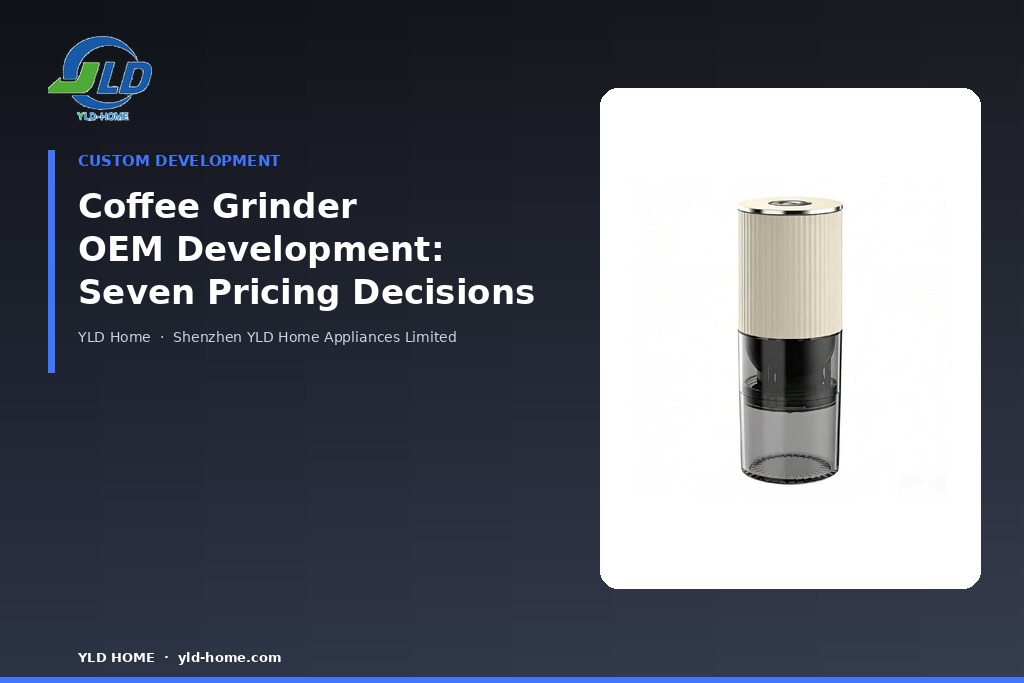
The most professional enquiries carry a clause like this: build one working prototype first; volume is contingent on written approval of that prototype; this enquiry does not authorise paid work. We have seen precisely this structure from a product developer based in Germany, working on a USB-C rechargeable dry grinder.
That clause does two things. It protects the buyer from funding tooling on a design never held in the hand, and it forces the prototype to be a test article rather than a mock-up, because if approval is the gate to volume then the prototype is what gets approved.
The grinder requirement set was unusually concrete: cylindrical body 68 mm diameter by 148 mm tall, electric grinding with controlled reverse rotation, overload protection, lid-open interlock, a separate ground-material chamber, a closable pour spout, a 1.5–2 g raw material chamber, a 130 mm paper storage compartment, and tool-free dismantling for cleaning.
Notice what is left open: the envelope is fixed, the functions and safety behaviours named, but nothing about which motor, gear ratio, cell, or plastic. The buyer owns the requirement, the supplier owns the solution.
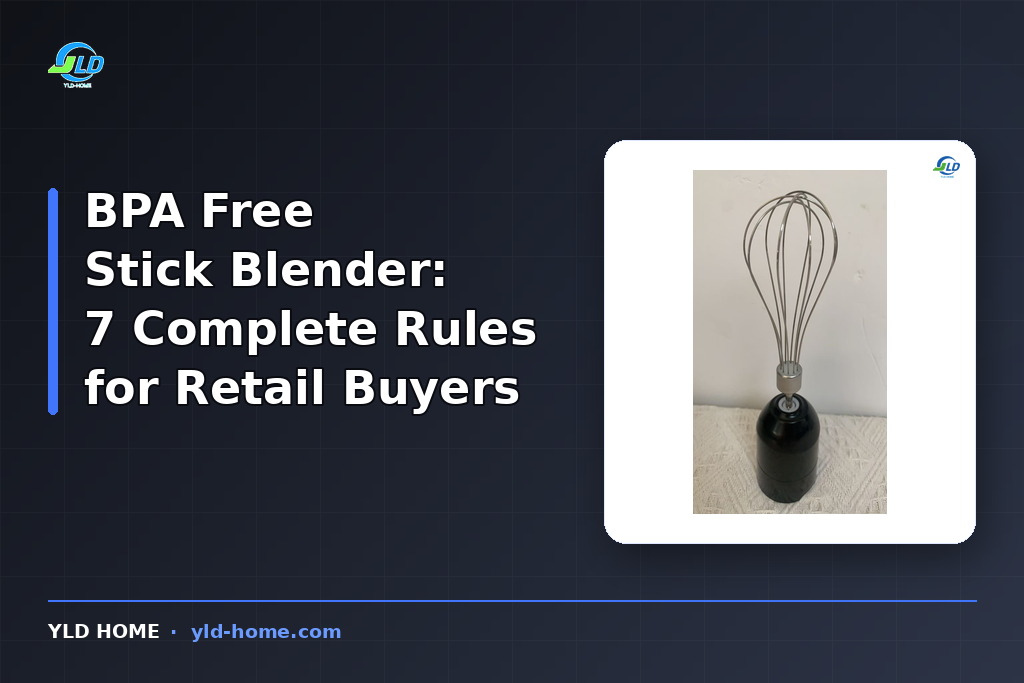
For hand blender development the test article usually has to prove four things physically: the motor and gearbox survive the intended load without early thermal cut-out; the shaft and bell produce the flow pattern the recipes assume; the detachable coupling survives repeated attach and release; and the controls feel right in the hand. None can be assessed from a drawing. A production platform such as the YLD-5513 hand blender shows the level of detail a modification brief can reasonably start from. One schedule consequence: an electrically functional prototype consumes engineering time before tooling is released, so the project has two dates — the prototype and the production date.
MOQ and lifetime volume are two different numbers
Buyers often send one quantity, and it is usually the first order. That is the number that matters least to a factory’s long-run cost model in hand blender development, and the one that makes quoting hardest.
A hand blender is assembled from a motor, gearbox, shaft assembly, blade, bell, coupling, switch, housing, cord set or battery, and packaging. Several have their own upstream minimum batch: motors are wound in batches, blades stamped in batches, packaging has its own run length. A 1,000-unit order sits close to where those batches stop being absorbable, which is why 1,000 is a realistic entry point and also where unit pricing is least favourable.
Lifetime volume changes what the supplier will invest. A buyer stating 1,000 units first order and 50,000 units over the product’s life is describing two useful facts. The first sets batch size and near-term cost. The lifetime figure justifies engineering attention, allows tool wear and spare inserts to be planned, and opens pricing that steps down across volume bands.
The coffee machine enquiry did exactly this: 1,000+ units initially, 50,000+ units lifetime. Those two numbers together are why a material conversion could be discussed seriously instead of being dismissed as uneconomic. Our wholesale hand blender range is organised on the same logic, with model families that carry volume better than one-off variants.
Give the lifetime figure a duration, and ask about MOQ flexibility: colour splits within a run, a reduced first order at a higher price, or a staged ramp.
Sizing: give an envelope, not a number
“It should be about this big”, attached to a single dimension, is a common cause of redesign. A hand blender’s length is an output of a chain: motor stack, coupling, shaft, bell depth. Fix the total and you have constrained all four before anyone knows which motor fits.
- Overall height, assembled: a range, for example 380–410 mm with the beaker removed, plus whether packaging, shelf space, or cabinet height drives it.
- Maximum diameter at the grip: a maximum, because hand ergonomics do not scale.
- Bell diameter: driven by beaker diameter and required flow, so state the beaker internal diameter.
- Shaft length: state the immersion depth required in the vessel, not the shaft length, because the shaft is the supplier’s answer to your depth requirement.
- Detachable interface: state whether the coupling must be backward compatible with an existing accessory range. That single question can decide whether a platform is usable, since the 500 W range and the more powerful models do not share every interface.
The grinder brief is an envelope done well: 68 mm by 148 mm as the constraint, a functional list attached, internals left to the supplier. What mattered — that it fit a defined pocket — was expressed, and nothing beyond it was over-specified. In hand blender development the two numbers that cause most trouble are grip diameter and the bell-to-beaker relationship.
Certification and market coverage
Certification is usually treated as one line item called “certificates”. It is not. Different marks answer different questions.
| Mark | Market | What it addresses | Typical retest trigger |
|---|---|---|---|
| CE | EU/EEA | Attestation against applicable directives — LVD, EMC, RoHS | New motor, PCBA, creepage, charger, enclosure material class |
| GS | Germany, accepted across the EU | Voluntary third-party mark, stricter than self-declared CE on some mechanical points | Any change to safety-relevant construction, including blade guarding |
| ETL | América do Norte | Third-party listing against the applicable UL standard | New motor or heating element, changed insulation, cord set |
| FCC | EUA | Radio frequency emission, where there is a switching supply or charging circuit | New electronics, new switching frequency |
| UKCA | Great Britain | UK conformity marking, parallel to CE | Same triggers as CE, separate declaration |
Two implications matter most. USB-C rechargeable products sit in a different regulatory place from mains products: a lithium cell and charging circuit bring battery safety, charger compliance, and transport rules into scope, separately from the appliance safety file. A material change can also be a certification event with the electronics untouched. If a hot water path becomes stainless, the food contact declaration changes and surface temperatures may shift enough to require re-verification, which is one reason the coffee machine buyer funded ETL work as part of the conversion. In the US the parallel question is whether the material is a food contact substance used as intended under the FDA framework.
Be precise about what a supplier holds versus what it can obtain. YLD Home can produce to CE, GS, ETL, FCC, and UKCA and support the testing, but cannot promise a certificate it does not hold on a timeline a laboratory has not quoted. If your brief needs a specific mark by a specific date, say so early: the laboratory queue is often the longest lead time in hand blender development.
How to read a price
A quotation that cannot be compared with another is not useful. Three terms decide comparability.
EXW versus FOB. EXW covers goods at the factory gate. FOB Shenzhen covers goods loaded on board, putting inland transport, export clearance, and terminal handling inside the number. On cartoned appliances the gap is real, so state the basis you are asking for.
Tooling in or out. A unit price that quietly amortises tooling cannot be compared with a unit price sitting next to a separate tooling invoice. State the expectation: tooling quoted separately, buyer-funded, paid at kick-off.
Validity. Material and freight costs move. Thirty days is a normal validity, and a brief that says “we will decide next quarter” will receive a price reflecting that.
A credible quotation for hand blender development separates the base unit cost from the cost of the change. If your project is a conversion, ask for the delta: what does the base unit cost, and what does the conversion add. Ask what is excluded too — moulds, certification, artwork plates, packaging tooling, freight, payment fees. A quotation that names its exclusions is more trustworthy than one that appears to include everything.
Sampling cadence and iteration count
Timelines are usually mis-set not because factories are slow but because buyers plan for one prototype when the project needs three. A first sample in five to seven working days is achievable where existing tooling is reused, because the work is assembly and configuration rather than mould cutting. Sample charges are typically creditable against the bulk order, and worth confirming in writing. New tooling changes the arithmetic: tool making, trial shots, and dimensional verification happen first.
In hand blender development, three rounds is normal for a modification: round one proves the concept and exposes fit problems, round two fixes them and proves the feel, round three is the pre-production confirmation build. Two is possible when the change is genuinely cosmetic. More than four usually means a requirement was never written down, and the cheapest fix then is to stop sampling and rewrite the brief.
Two habits help: batch comments per round rather than sending them as they occur, and deciding in advance what “approved” means and who signs it. On a clean-sheet project the cadence stretches, and the first article proves both the design and the mould.
Quality control and acceptance
A brief that specifies price and dimensions but not acceptance criteria leaves the last argument of the project undefined.
Ask for the inspection standard and the test set: hipot and insulation resistance, power and current draw against rating, torque at the shaft, life testing to a stated cycle count, salt spray on exposed metal, and drop testing on the packaged unit. YLD Home lines run IQC on incoming material, IPQC in process, and OQC to MIL-STD-105E with critical at zero, major at 1.5, and minor at 4.0, and buyers can request third-party inspection before shipment. Our quality control process documents the laboratory scope, and a factory tour answers what no document does: how the moulding shop is laid out, whether winding is in-house, how the lab is equipped.
A one-page template
If the sections above are the reasoning, this is the artefact — the format YLD Home works from.
| Brief element | What you provide | What we return |
|---|---|---|
| Platform boundary | Modification, functional change, or clean-sheet; name the reference platform | Which tooling is reusable, which must be cut, revised timeline |
| Material and compliance | Every material change and the function it performs | Process route, tooling implications, retest list |
| Tooling and certification | Who pays and when; which marks by what date | Separate tooling quotation, certification scope, lab lead times |
| Prototype gate | Requirement list, envelope, sign-off authority | One working prototype, test-article spec stated up front |
| Volume | First order and lifetime quantity, with duration | Price bands by volume, MOQ position including colour splits |
| Size envelope | Ranges with the binding constraint named | Dimensioned proposal with trade-offs shown |
| Commercial basis | EXW or FOB Shenzhen, tooling separate | Itemised quotation, exclusions named, stated validity |
| Sampling | Iteration rounds expected, approval definition | Sample dates per round, sample charge position |
FAQ
Is hand blender development on an existing platform cheaper than a new design? Substantially. The motor, gearbox, and shaft architecture stay fixed, so tooling is limited and certification is partially retested. A new design means new motor selection, tooling for every plastic part, and a full certification programme. In hand blender development the two paths differ by an order of magnitude.
How much does custom tooling cost? There is no useful single number. It depends on how many parts are new, how complex the geometry is, and whether the change is a mould modification or a new mould. A cosmetic change may need no new tool at all, while a clean-sheet housing set needs several. Ask for a quotation against a boundary, not a range.
Who should pay for moulds and certification? The buyer, in most custom programmes. Buyer-funded tooling lets the supplier quote parts and labour rather than capital recovery, and gives the buyer a claim on the tool. Certification is best treated the same way, because testing is invoiced whether or not the product ships.
What is a realistic MOQ and can it be negotiated? 1,000 units per model is a common entry point and it is negotiable. Colour splits within a run, a reduced first order at a higher price, or a staged ramp are all discussable. What matters more is pairing MOQ with a lifetime volume, because that is what allows stepped pricing.
Will a material change force new certification? Often. Replacing a plastic hot water path with 304 stainless changes the food contact declaration and may shift surface temperatures enough to require re-verification. Electronics changes almost always trigger retesting.
What should a prototype prove before I approve volume? That the motor and gearbox survive the intended load without early cut-out, that the shaft and bell produce the flow pattern your recipes assume, that the coupling survives repeated attach and release, and that the controls feel right. If it cannot show those four it is a mock-up, and approving volume against a mock-up transfers design risk to you.
Where to start
If you are assembling a brief for hand blender development, the highest-leverage paragraph is the platform boundary and the second is the prototype gate. They determine whether the project is a modification or a programme, and whether you are buying a sample or a design. Everything else becomes arithmetic once those are fixed.
Shenzhen YLD Home Appliances Limited has built kitchen small appliances in Dongguan since 2012, with injection moulding, motor winding, PCBA, assembly, and a QC laboratory in-house across a 25,000 m² facility and five production lines, so a hand blender development project here does not depend on outside process partners. Review the hand blender range, then send your brief through the quotation request.