









In this guide: Why soup programs standardize on a stick mixer · The specs that matter: power, duty cycle, shaft · 120V commercial power · Certifications US kitchens verify · Wholesale and foodservice buying paths · The YLD Home lineup for soup production · Case study: a Chicago restaurant group · Stick blender vs food processor
Every commercial kitchen that runs a soup program ends up in the same conversation: which stick mixer for soup production do we standardize on? The answer matters beyond the soup pot, because the same machine purees sauces, emulsifies dressings, and finishes purees for service. This guide is written for US foodservice buyers — restaurant groups, commissaries, distributors and equipment dealers — and covers the specifications that matter at 120V commercial power, the certifications US kitchens verify, and how wholesale buying works for this category.
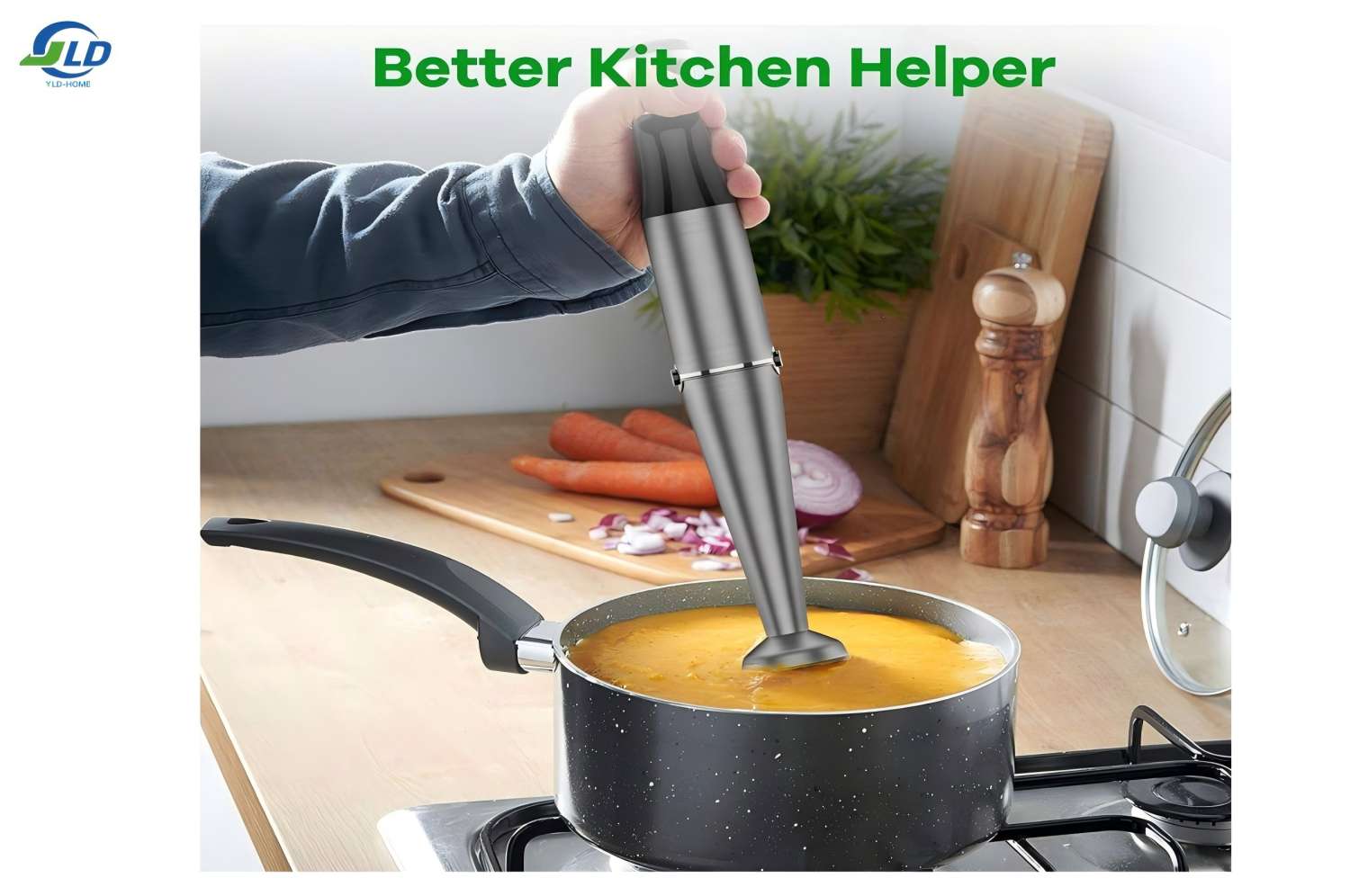
Why Commercial Kitchens Standardize on a Stick Blender for Soup
Soup is one of the highest-margin items on a US menu, and it is also one of the most equipment-dependent. A kitchen can braise, roast or sauté with basic gear, but a smooth, consistent soup needs blending done right, in the pot, at volume. That is the job of a stick mixer for soup: it purees directly in the kettle, hot or cold, without transferring product between vessels.
Standardization matters for three reasons. Training: a kitchen with one blender model can train every cook once, including agency staff. Consistency: the same machine produces the same texture shift after shift, which matters when the soup is on the menu for months. Parts and service: one model means one spare parts kit, one warranty contact, and one replacement plan. Restaurant groups we work with standardize on a stick mixer for soup the same way they standardize on an oven line — by spec, not by whoever is cheapest that week.
There is also a food safety angle. Blending in the pot means less transfer, less splash risk, and fewer vessels to sanitize. For kitchens inspected under US food safety rules, a blender that is easy to disassemble and clean is easier to keep compliant. We will come back to cleaning and certification in the compliance section.
The menu math explains the attachment. A restaurant selling 40 bowls of soup a day at $7 a bowl runs a soup line worth over $100,000 a year per location, and the blender that protects that line is a rounding error in the budget. Operators who see the category that way buy commercial-grade equipment the first time, instead of replacing household units every few months.
The Specs That Matter: Power, Duty Cycle, Shaft Length
Commercial soup blending is harder than it looks. A 10-gallon kettle of potato soup is thick, hot and heavy, and the blender has to run continuously while the cook moves it through the pot. Three specs decide whether a stick mixer for soup survives that job: power, duty cycle, and shaft length.
Power: 600W handles light household-style soup programs. Commercial kitchens should start at 800W and go up; 1000W is the practical sweet spot for US foodservice, and higher-watt models handle thick chowders and frozen purees without bogging down. Duty cycle is the number most buyers skip: it tells you how many minutes the motor can run before it needs to cool. A residential blender rated for 1-minute runs will fail in a soup program that blends in 5-minute passes. Ask for the duty cycle in writing.
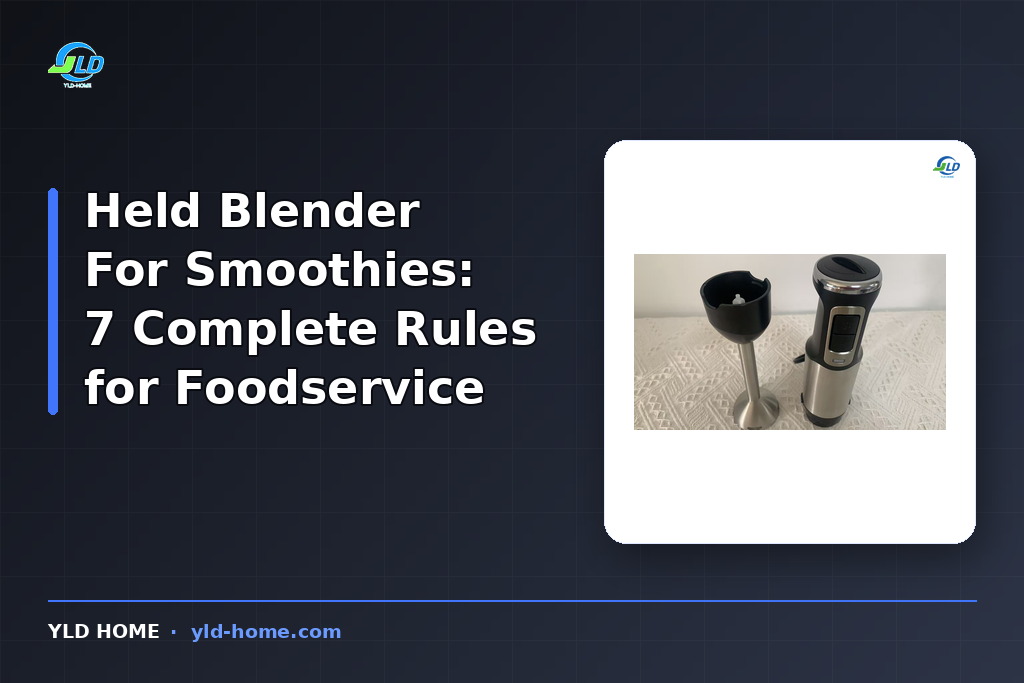
Shaft length: an immersion blender for soup in a 10-gallon kettle needs an 18-inch-plus shaft to reach the bottom without splashing the operator’s arm into hot liquid. Blade design matters too — a bell-shaped blade guard with a fixed blade blends without sucking the shaft into the product, which is the failure mode cooks complain about. When we spec equipment for US kitchens, we put these three numbers on the first line of the datasheet.
Ergonomics is the fourth spec, and kitchens learn it the hard way. A heavy blender held over a hot kettle for five minutes tires the arm, so weight distribution and grip design matter. Look for a balanced handle, a comfortable switch position, and a model light enough for a full shift of use. When we watched cooks blend a 10-gallon kettle line in a Philadelphia commissary, the ergonomic difference between two otherwise identical blenders was obvious within an hour.
| Spec | Ménage | Light commercial | Full commercial |
|---|---|---|---|
| Puissance | 300-500W | 600-800W | 1000W+ |
| Duty cycle | 1 min | 3-5 min | Continuous with cooldown |
| Shaft length | 8-10 in | 12-14 in | 18 in+ |
| Typical use | Home soup pots | Cafés, delis | Restaurants, commissaries |
120V Commercial Power: What to Ask For
US commercial kitchens run on 120V or 208V, and most soup stations are wired for standard 120V outlets. That constrains the motor: a 120V hand blender tops out around 1000-1200W of real continuous power, which is plenty for soup production when the design is right. What matters more than raw wattage is how the motor holds up at 120V under load, and that is a design question, not a spec-sheet question.
Ask the supplier three things. First, what is the motor’s rated duty cycle at 120V with the blade under load — the honest number, not the no-load number. Second, what is the inrush current, and does it trip standard GFCI outlets in older US kitchens? Third, what happens at the end of a long blend — thermal cutoff, or a smoke smell? We have replaced more blenders for thermal shutdown than for broken blades.
Corded 120V units are the workhorses of US soup lines because they deliver consistent power without battery sag. Cordless has a place in mobile catering and front-of-house finishing, but for a soup program running kettles all day, corded is the dependable answer. The cord should be at least 6 feet with a US plug, because soup stations are rarely next to the outlet, and the housing should be sealed against splash.
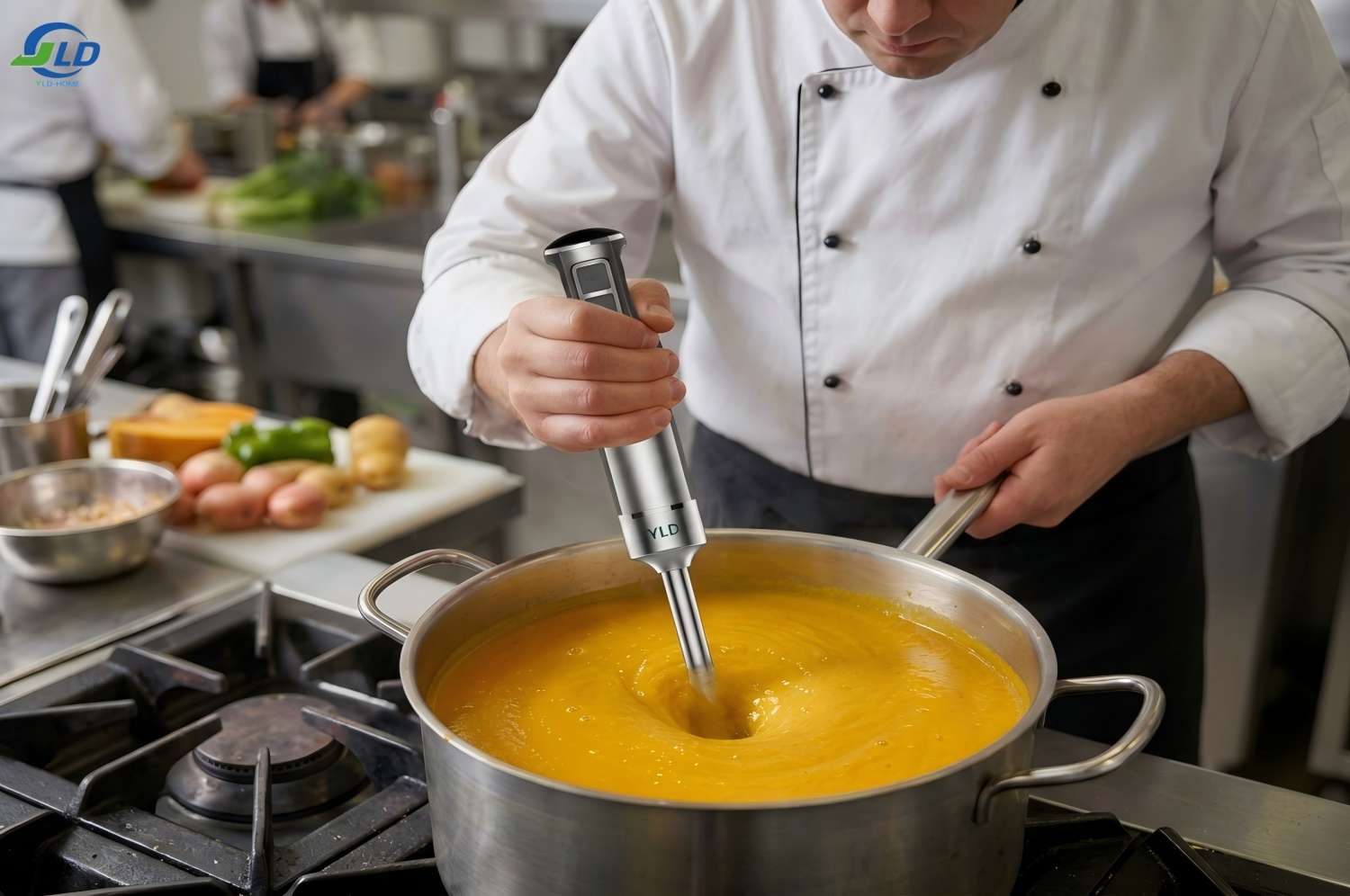
UL, NSF and FDA: Certifications US Kitchens Verify
Foodservice equipment in the US gets bought with a certificate checklist, and the list for a stick mixer for soup is specific. UL or ETL covers electrical safety; the report must name the exact model. NSF certification is the mark many US health departments and chain operators expect for food-contact equipment; NSF/ANSI 2 covers food equipment, and NSF/ANSI 8 covers commercial food service equipment. FDA food-contact compliance covers the shaft, blade and any surface that touches food.
| Certification | Scope | Who asks |
|---|---|---|
| UL / ETL | Electrical safety | Dealers, chains, inspectors |
| NSF | Food equipment sanitation | Health departments, chains |
| FDA food contact | Materials touching food | Dealers, commissaries, brand owners |
| Prop 65 statement | California market | California distributors, retailers |
A distributor in Chicago told us his dealer customers now ask for the certificate set before they ask for the price. That is the new normal in US foodservice: documentation is part of the product. Buyers should keep a compliance file per model — report, statement, and a photo of the marking on the housing — and confirm who owns the certificates in OEM programs before branding.
Smaller operators should not panic at the list. A UL report and an FDA statement cover most needs, and many US health departments accept the manufacturer’s documentation in place of an on-site NSF listing for hand-held equipment. The chain and commissary buyers are the ones who will push for the full set, so tier your certificate expectations by customer rather than buying everything up front.
Wholesale and Foodservice Buying Paths for Soup Programs
The stick mixer for soup wholesale usa foodservice channel runs through four paths. Equipment dealers buy for restaurant clients and need catalogs, certificates and warranty terms. Distributors stock the category and serve dealers, needing mixed loads and dependable reorders. Restaurant groups buy direct or through a dealer for multiple sites, needing standardization and a spare parts plan. Commissaries and central kitchens buy in volume and need duty-cycle proof and service support.
The wholesale entry point is the same in every path: samples, testing, then a first order sized to real demand. We encourage US buyers to test an immersion blender for soup the way the kitchen will use it — blend a thick chowder for five minutes straight, wash it, and blend again. That test tells you more than any datasheet. One dealer in Dallas runs this test with every candidate brand and has cut his warranty rate in half since he started.
Pricing for the category follows volume tiers, and the landed cost includes freight, duty and the certificate stack. Distributors typically start with two models — a 600W household tier and a 1000W commercial tier — and let dealer demand set the ratio. That two-tier start is the cheapest way to map the market without over-committing inventory.
Margin structure differs by path, and it is worth mapping before you price. Dealers work on a markup from distributor cost; distributors work on volume tiers from the factory; restaurant groups negotiate direct pricing with a service component. A factory that can quote each path without channel conflict — and publish consistent tiers — makes the whole chain easier to run. Ask how the supplier handles direct restaurant group orders versus dealer orders, because the answer reveals whether the channel will fight.
The YLD Home Lineup for Soup Production
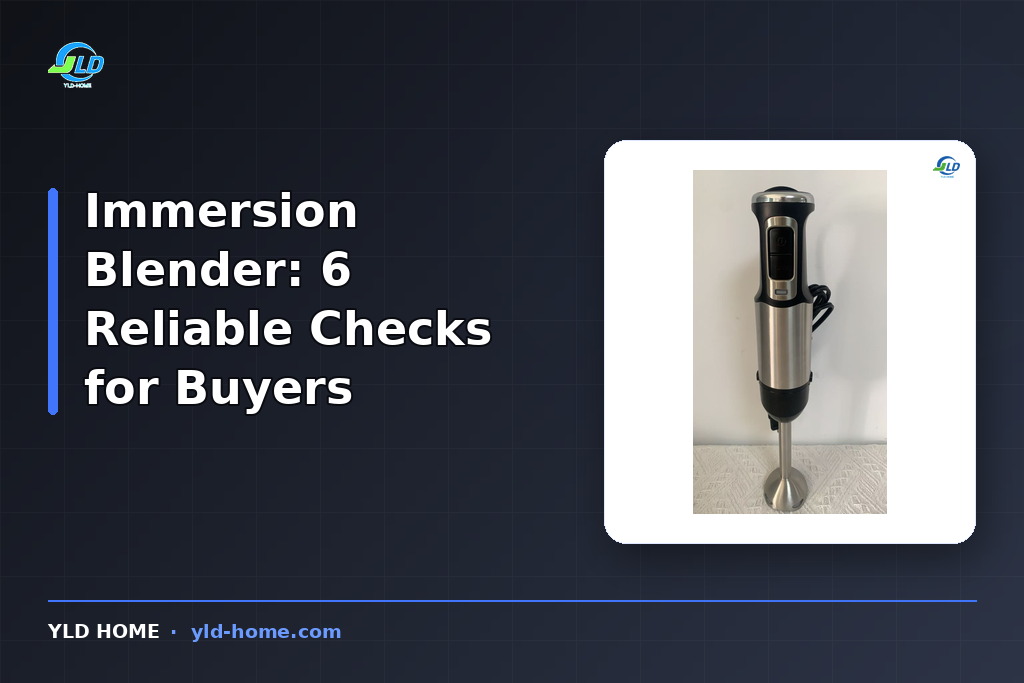
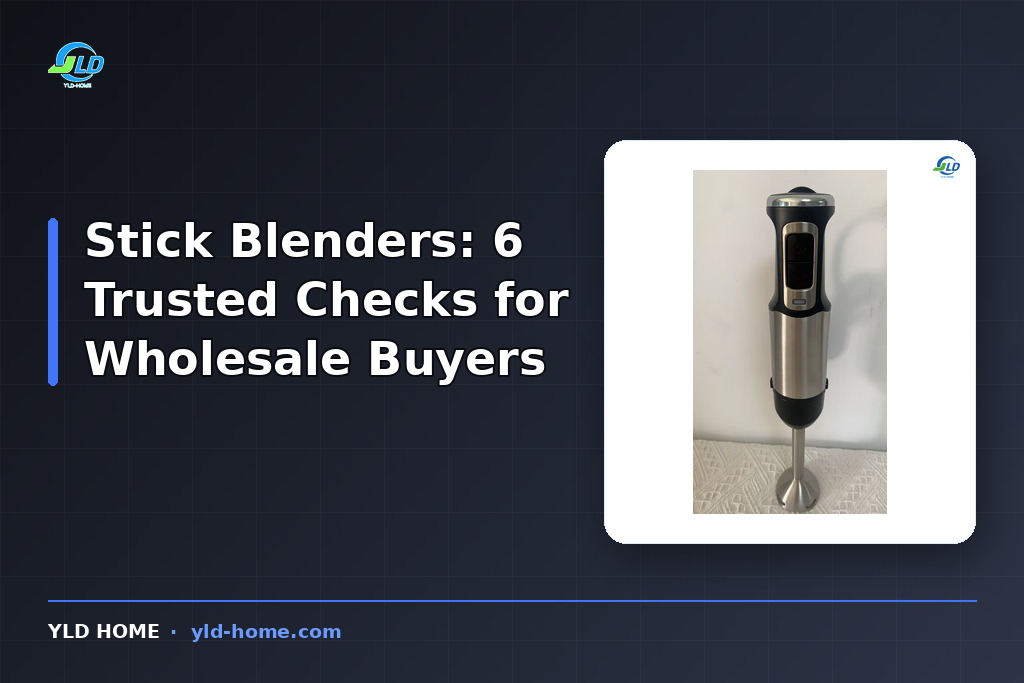
YLD Home builds the 120V commercial stick blenders US kitchens reorder, and the lineup maps to the spec table above. The 6006L powerful stick blender covers cafés and light commercial soup programs. The 6007 puissant mixeur à bâtons et 6008 puissant mixeur à bâton handle general retail and lighter kitchen duty. For full commercial soup lines, the 6018 1000W powerful stick blender delivers continuous-duty blending, and the 6019 1000W powerful stick blender adds the torque and shaft options for thick chowders and large kettles. For the complete spec library, the hand mixer page lists every model and configuration in the stick blender family.
| Modèle | Puissance | Duty cycle | Best fit |
|---|---|---|---|
| 6007 | 500W | Light | Entry retail, small cafés |
| 6006L | 600W | Light-medium | Cafés, delis, general retail |
| 6008 | 600W+ | Moyen | Retail, light foodservice |
| 6018 | 1000W | Continuous | Restaurants, commissaries |
| 6019 | 1000W | Continuous | Large kettles, thick soups |
All models ship in 120V commercial configuration with UL-ready documentation, FDA food-contact coverage, and sealed housings built for daily splash. You can see how we build and test them in our product quality control video. When a restaurant group in Chicago standardized on the 6018 for six locations, the first thing their kitchen director checked was the duty cycle — and the second was the spare parts kit, which we ship from the factory to their warehouse.
Case Study: A Chicago Restaurant Group’s Soup Line
Buyers searching for a stick blender supplier chicago can find plenty of dealers; the harder find is the factory that stands behind the dealer. A Chicago restaurant group running five casual dining locations came to us through their equipment dealer in early 2025. Their soup program was growing — two soups daily per location, plus a catering arm — and their existing blenders kept dying mid-service. The dealer asked YLD Home to run the chowder test, and we sent three sample units from the 6018 and 6019 lines.
The group tested the units in two kitchens for three weeks, blending 10-gallon kettles of potato and broccoli cheddar soup through full service. Two things came out of the test: the 6018 held its blend speed under load, and the shaft length reached the kettle bottom without splashing. They standardized on the 6018 across all five locations, with one 6019 per location for the catering kettles.
The results were measurable. Blender failures in service dropped to zero in the first quarter, the parts kit shrank to one model’s spares, and the group’s kitchen director told us the soup consistency complaints — the “lumpy soup” tickets — stopped. That is the real ROI for a hand blender for soup: not the unit price, but the service incidents you never log. For more on why operators stick with us, our Why YLD Home is reliable video covers the factory side of that story.
Lead Times, MOQ and Support for US Foodservice
Wholesale MOQ for the commercial line starts at 1,000 units per model, and mixed loads across models count toward it. Samples configured for the US market, 120V with US plugs, take about 7 days. Production runs 20 to 30 days depending on quantity. Sea freight to Los Angeles or Long Beach runs 18 to 22 days; to Chicago via West Coast rail, or to East Coast ports, budget 25 to 35 days door-to-door. A first order lands in 8 to 11 weeks.
Foodservice buyers should plan two extra things: backup units and spare parts. A soup line without a blender is a soup line that sells nothing, so operators typically carry one spare unit per site and a shaft-and-blade kit. YLD Home supports US warranty claims through a single contact, and spare parts ship to your warehouse or dealer. For groups standardizing across sites, we can agree a parts contract that keeps the kit current with the installed base.
Customs and compliance paperwork ride along with every shipment. US foodservice equipment clears faster when the commercial invoice, packing list and certificate set are filed together, and most brokers will handle this if the documents are clean. Keep the certificate stack per model in a shared folder with your broker, your dealer and your compliance team, and re-verify dates annually, because a lapsed report is a hold at the border.
| Planning item | Recommendation |
|---|---|
| Backup units | 1 per site |
| Spare shafts | 2-3 per site |
| Parts kit | Shaft, blade, seal per model |
| Reorder trigger | 60% of stock |
Stick Mixer for Soup vs Food Processor: Which Line Wins
The comparison question we get most from US kitchens is stick mixer for soup versus food processor, and the honest answer is that they do different jobs. AN immersion blender for soup purees in the pot: hot product, direct blending, no transfer. A food processor — the countertop machine with a work bowl and discs, described in detail in the Wikipedia article on food processors — chops, slices, shreds and mixes in volume, but the product has to go into the bowl and come out again.
For soup production specifically, the hand blender wins: it blends in the kettle, handles hot liquid safely, and cleans in seconds. The processor wins for prep: vegetables for the soup mirepoix, shredded cheese, sliced toppings. Most US kitchens end up owning both, and the buying order should follow the menu. If soup is a daily program, buy the stick mixer first and the processor when prep volume proves the need. If prep dominates, reverse the order. Dealers we work with tell buyers exactly this, because a kitchen that buys the wrong machine first buys twice.
Volume shifts the answer at the top end. A commissary producing thousands of servings a day may run both machines in sequence: processor for prep, stick blenders at the kettle line. At that scale, blade life and parts availability dominate the decision, and the two-machine kitchen becomes a small production line. Spec the machines as a system, with one supplier for both, and the parts inventory collapses to one kit.
The table below is the one our clients pin to the kitchen wall when the budget conversation starts.
| Task | Stick mixer | Robot ménager |
|---|---|---|
| Blending soup in the kettle | Excellent | Needs transfer |
| Hot liquid pureeing | Excellent | Not suitable |
| Chopping prep vegetables | Pauvre | Excellent |
| Slicing and shredding | Pauvre | Excellent |
| Emulsifying dressings | Bon | Bon |
| Cleaning time | Seconds | Minutes |
Batch Soup Base Production: One Kettle, One Standard
Commissaries and central kitchens that prepare soup bases in bulk run the same routine daily: roast or sauté, add stock, blend, cool, portion, and hold. The blend step is where the standard is set, because a base that comes out lumpy at 6 a.m. makes every bowl of the day lumpy. Operators who batch bases keep the equipment simple — one commercial immersion blender per kettle line, sized to the largest kettle, with a spare shaft on the rack. When a hand blender for soup is specced for batch work, the numbers that matter are duty cycle under load and shaft length, both covered above. YLD Home supports batch programs with the 6018 and 6019 lines, plus a parts contract that keeps shafts and seals on hand before a failure stops a shift. Ask us for the batch-production spec sheet when you quote a stick mixer for soup for your commissary.
Questions fréquemment posées
Q1: What is the best stick mixer for soup for a US commercial kitchen?
For a full soup program, spec 1000W, a continuous duty cycle, and an 18-inch shaft; that combination is what the 6018 and 6019 lines deliver. AN immersion blender for soup at 600W covers cafés and lighter programs.
Q2: What is the MOQ for commercial stick blenders?
Wholesale MOQ starts at 1,000 units per model, and mixed loads across models count toward the MOQ.
Q3: Are your commercial blenders certified for US foodservice?
Yes — 120V configuration, UL/ETL reports per model, FDA food-contact coverage, and documentation support for NSF programs.
Q4: How long does a first order take to arrive?
About 8 to 11 weeks from deposit to a US port, including samples, production and sea freight.
Q5: Do you provide spare parts and warranty support in the US?
Yes — YLD Home runs warranty claims through a single contact, with spare parts shipped to your warehouse or equipment dealer.
Q6: Can a stick mixer replace a food processor in my kitchen?
For soup and sauce production, yes; for prep volume, no. Most US kitchens buy both, and YLD Home can quote both categories on one order.
Q7: What duty cycle do I need for a soup program?
For kettles blended in 3 to 5 minute passes, spec a continuous-duty motor; ask for the under-load figure in writing.
Q8: Can you OEM our brand for foodservice distribution?
Yes, OEM and private label are available on the commercial line, with certificate ownership agreed in writing.