







By YLD Home | import kitchen appliances from China
Most buyers who want to import kitchen appliances from China don’t get stuck finding a product. They get stuck on everything that happens between the factory floor and their warehouse: customs paperwork, compliance certifications, HS codes, freight decisions, and payment terms that pile up faster than expected. The good news is that this process follows a repeatable sequence once you see it laid out clearly, and this guide covers all six steps, from supplier selection to container delivery — the same process we run with buyers every week at YLD Startseite, a Shenzhen-based kitchen appliance manufacturer.
| Step | What it covers | Key decisions |
|---|---|---|
| 1 | Supplier selection | Direct factory vs trading company, vetting |
| 2 | Classification & cost | HS codes, Section 301 tariffs, landed cost |
| 3 | Compliance | UL/ETL/FCC, importer responsibility |
| 4 | Freight strategy | LCL vs FCL, air freight, port selection |
| 5 | Customs documentation | Invoice, packing list, ISF, broker |
| 6 | Sample & scale | Sample verification, FOB pricing, MOQ, container |
The importers who do this well solve complexity before it starts. They work with factories that already hold the certifications, maintain the documentation, and have logistics relationships in place. That means less independent compliance work on your end, faster timelines, and a supplier relationship grounded in verifiable documentation rather than verbal assurances.
1. Find a verified factory, not a middleman
Who you buy from is one of the most consequential decisions in your entire import operation. A trading company adds margin, controls your information flow, and often can’t answer technical compliance questions because they don’t manufacture anything. A direct factory has tooling records, lab test reports, and engineers on staff who built the product. When you’re sourcing kitchen appliances from China, that distinction shapes everything downstream, from pricing flexibility to certification documentation. A direct manufacturer like YLD Startseite publishes its product line openly and answers compliance questions from engineering staff, not sales reps.
Factory vs. trading company: how to tell the difference
The signals are practical and verifiable. A factory will have a business license classified as a manufacturer, will show you their facility on a video call or in person, and can provide original test reports from an accredited third-party lab. A trading company typically lists dozens of unrelated product categories spanning everything from textiles to electronics. Both types appear on Alibaba and Made-in-China, so the listing platform alone tells you nothing useful. You can watch a factory introduction video or browse the YLD Home YouTube channel to see what a real production floor and showroom look like before you even request a quote.
Key vetting questions before you request a sample
Several questions reliably separate real manufacturers from resellers. Can the supplier provide the original UL or ETL test certificate, with the listing number, for this specific model? What is their in-house QC pass rate and how is it documented? Can they share production capacity records for the relevant product line? Answers to these questions should be verifiable in a public database or supporting document, not just verbal claims on a call.
What a reliable China kitchen appliance supplier looks like in practice
A fully capable supplier brings an in-house facility, dedicated R&D, pre-certified product lines, and established freight contacts. Look for a factory that has operated for a decade or more, maintains meaningful production floor space, and documents quality control with third-party audit reports. When the factory already holds the certifications, you’re verifying rather than commissioning, and that difference is measured in weeks and thousands of dollars. Among Chinese kitchen appliance manufacturers, those that carry product-level UL or ETL listings and can share listing numbers on request are the ones worth shortlisting — which is why YLD Home maintains its appliance certification page with the certificate scope visible for buyers to check.

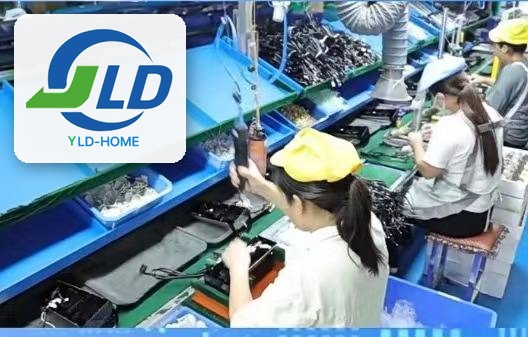
Inside the YLD Home production floor: automated assembly line in operation.
Beyond the equipment, ask to see the people you will be dealing with. YLD Home’s export team and visiting buyers regularly record walkthroughs together, and you can watch a customer visit video to see how a real buyer evaluates the factory in person before placing an order. A supplier that is comfortable showing both its machines and its client relationships on camera is a supplier with nothing to hide.
2. Classify your products and calculate your true landed cost when you import kitchen appliances from China
Many first-time importers budget for FOB price and freight, then get surprised by duty, brokerage, and inland delivery costs at the other end. Those surprises compound when Section 301 tariffs enter the picture. This section closes that gap before you place an order by covering HS classification, current duty stacks, and a working landed cost formula.
HS codes for common kitchen appliances
Electric kitchen appliances generally fall under Chapter 85 of the HTSUS. Motorized food-prep appliances like blenders and stand mixers fall under HS 8509, with hand blenders classified at 8509.40.0015 and stand mixers at 8509.40.0025, both carrying a 4.5% base duty rate. (Verify current rates at the USITC Tariff Database or with your customs broker, as subheading-level rates can change.) Air fryers, electric kettles, and similar heating appliances typically fall under HS 8516, often at a free (0%) base duty rate. Non-electric cookware lands in Chapters 73 or 76. You need the full 10-digit HTSUS code to determine your exact duty treatment; the 6-digit HS heading is not sufficient. If your range spans multiple categories — say a 2-in-1 hand blender, a Handmixer und eine Saftmixer — classify each SKU separately rather than assuming one code covers the container.
| Appliance type | HS chapter / heading | Base duty rate (2026) | Notes |
|---|---|---|---|
| Hand blender | 8509.40.0015 | 4.5% | Motorized food-prep, Chapter 85 |
| Stand mixer | 8509.40.0025 | 4.5% | Motorized food-prep, Chapter 85 |
| Entsafter | 8509.40 / 8509.80 | 4.5% | Depends on extraction mechanism |
| Air fryer | 8516.60 | 0% (base) | Heating appliance, Chapter 85 |
| Elektrischer Wasserkocher | 8516.10 | 0% (base) | Heating appliance, Chapter 85 |
| Cookware (non-electric) | 73 / 76 | varies | Stainless steel / aluminium chapters |
| Section 301 (most small appliances) | stacked on base duty | up to 37.5% (25% + 12.5%) | Verify against USTR list |
Section 301 tariffs and what they add to your costs
Section 301 tariffs on Chinese goods stack on top of the base MFN duty rate and materially affect your landed cost. As of 2026, most small kitchen appliances from China carry a 25% Section 301 tariff under Lists 1, 3, per USTR guidance. A forced-labor Section 301 duty of 12.5% took effect in July 2026, meaning the Section 301 component alone can reach 37.5% (25% + 12.5%) for affected products. Verify the current tariff status for your specific HTSUS code against the USTR Section 301 list and CBP guidance before you price your product, because an outdated assumption at this stage will kill your margin.
How to calculate landed cost before you order
The formula is: product cost, plus international freight, plus insurance, plus duty, plus brokerage, plus inland delivery. A working example: $10,000 in goods at a 4.5% base duty rate with a $1,200 ocean freight quote, $100 insurance, $150 broker fee, and $300 inland delivery gives a total landed cost of $12,200 before Section 301 tariffs. Add the applicable Section 301 rate to the product cost and the landed number changes significantly. Run this math before you commit to any pricing. When you request quotes from YLD Home, our export team provides the product cost and MOQ structure up front, so the landed-cost calculation starts from a number you can verify, not a placeholder.
3. Clear US compliance requirements before you import kitchen appliances from China
Compliance is the step most first-time importers underestimate. Getting it wrong can result in seized goods, refused retailer listings, or Amazon ASIN suspensions. The US has specific safety marking requirements for electrical appliances that are entirely separate from European standards, and the consequences of missing them fall on the importer, not the factory. YLD Home ships to US buyers with UL/ETL and FCC documentation as standard — the certificate scope is published on our appliance certification page so you can verify it before ordering.
UL vs. ETL: what’s actually required to sell in the US
Both UL and ETL are marks issued by OSHA-recognized National Recognized Testing Laboratories and are treated as legally equivalent for electrical safety purposes. CE certification is a European standard and does not satisfy US safety requirements. Retailers, Amazon, and commercial buyers routinely require a UL or ETL listing before they’ll carry your product. Verify any claimed certification directly in the UL Product iQ database or the Intertek ETL directory using the exact listing number and model. Never accept a certification claim based on a label alone.
FCC compliance and when it applies
FCC compliance is required when the appliance contains digital electronics, switching power supplies, displays, or any radio-frequency-emitting components. Many modern kitchen appliances with touch interfaces or smart controls will trigger this requirement. Your supplier should provide an FCC Supplier’s Declaration of Conformity or a test report from an accredited FCC lab for any model with these features.
How pre-certified factories reduce your compliance burden
Working with a factory whose products are already certified dramatically reduces the time and cost you spend on compliance. When evaluating OEM kitchen appliances from China, prioritize factories that can share original test certificates with listing numbers for each relevant mark — UL, ETL, FCC, RoHS, and any others required by your sales channel. A buyer importing pre-certified products requests the original certificate and listing number, verifies it in the public database, and satisfies retailer and platform requirements without commissioning independent testing from scratch. That sequence saves weeks and meaningfully reduces pre-launch spend. At YLD Home, our pre-certified hand blender, hand mixer and juicer lines cover the marks US retail channels expect, and the wholesale blenders collection shows which models carry which certifications.
4. Choose the right freight strategy for your shipment
Freight decisions affect your cash flow timeline and your per-unit landed cost. The right choice depends on order size, urgency, and your US distribution point.
Ocean freight: LCL vs. FCL and when each makes sense
LCL (less-than-container load) is priced per cubic meter and works for smaller trial orders, but kitchen appliances are bulky and relatively heavy, which makes LCL expensive at scale. FCL (full-container load) uses a flat container rate and is almost always more cost-efficient once you’re moving enough volume to fill a 20ft container. A 20ft FCL from Shenzhen, Shanghai, or Ningbo to US West Coast ports has historically run roughly $1,500 to $4,500 in ocean freight, with 14 to 22 day transit times, though market rates shift with season and carrier availability, so confirm current quotes with your freight forwarder. East Coast ports like New York and Savannah add roughly 10 to 13 days and typically cost more.
Air freight: when speed justifies the cost
Air freight makes sense for urgent replenishment, launch SKUs, or high-value, low-volume shipments where transit time outweighs freight cost. For standard wholesale kitchen appliances from China, ocean freight is the default. If your inventory position demands a faster turnaround, most freight forwarders handling China-origin goods offer air options running approximately 5 to 10 days door-to-door, at a cost roughly three to five times higher per kilogram than ocean.
Port selection and inland delivery planning
West Coast ports like Los Angeles, Long Beach, and Oakland are the fastest and typically the cheapest for China-origin goods. East Coast ports make sense when your warehouse is on the East Coast and inland freight costs would otherwise cancel out any ocean savings. Factor inland delivery into your landed cost estimate before committing to a routing, not after the goods arrive.
5. Prepare your customs documentation
US Customs and Border Protection requires a specific set of documents for every commercial shipment. Missing even one can trigger a hold or require a formal entry amendment that costs time and money you didn’t budget for.
Documents required for every kitchen appliance shipment
The core set includes a commercial invoice with accurate declared value, HS code, and product description; a packing list; a bill of lading or air waybill; and applicable certificates such as UL or ETL listing documentation and an FCC Supplier’s Declaration of Conformity if required. For ocean shipments, you also need an Importer Security Filing (ISF) submitted at least 24 hours before vessel departure. For formal entries, your customs broker prepares the CBP Form 7501 Entry Summary. Section 301 tariffs must be reported accurately on the entry, and your goods must be marked “Made in China” or “Made in PRC.”
Working with a licensed customs broker
Use a licensed customs broker for any shipment above the de minimis threshold, especially on your first import. A broker classifies your goods, prepares the entry, communicates with CBP, and handles ISF submission. Broker fees typically run $150 to $300 per entry, a small cost relative to the penalty exposure or delay cost of a misclassification or customs hold. Ask your freight forwarder for a referral if you don’t already have a broker in place.
6. Place your sample order and scale to a full container
This is where the plan becomes action. Experienced importers follow a two-stage model: samples first to verify quality and documentation, then a container once both are confirmed.
Sample order strategy and what to verify
A sample order serves two purposes: physical quality evaluation and document verification. Request the product sample alongside the test certificate, the factory’s business license, and a completed spec sheet. Some factories offer free or low-cost samples for new buyers; others charge a nominal sample fee that is credited against the first order. Either way, the cost is worth it — verifying everything before committing to volume is standard practice among experienced importers of wholesale kitchen appliances from China. At YLD Home, new buyers can request samples through our wholesale blenders page or contact our export team directly, and sample fees are credited against the first container order.
Before you commit, watch the product your sample order will actually deliver. This short product video shows the multi-function immersion blender set that US buyers order most often — the main unit, whisk, frother and stainless steel shaft are the exact items that arrive with the sample:
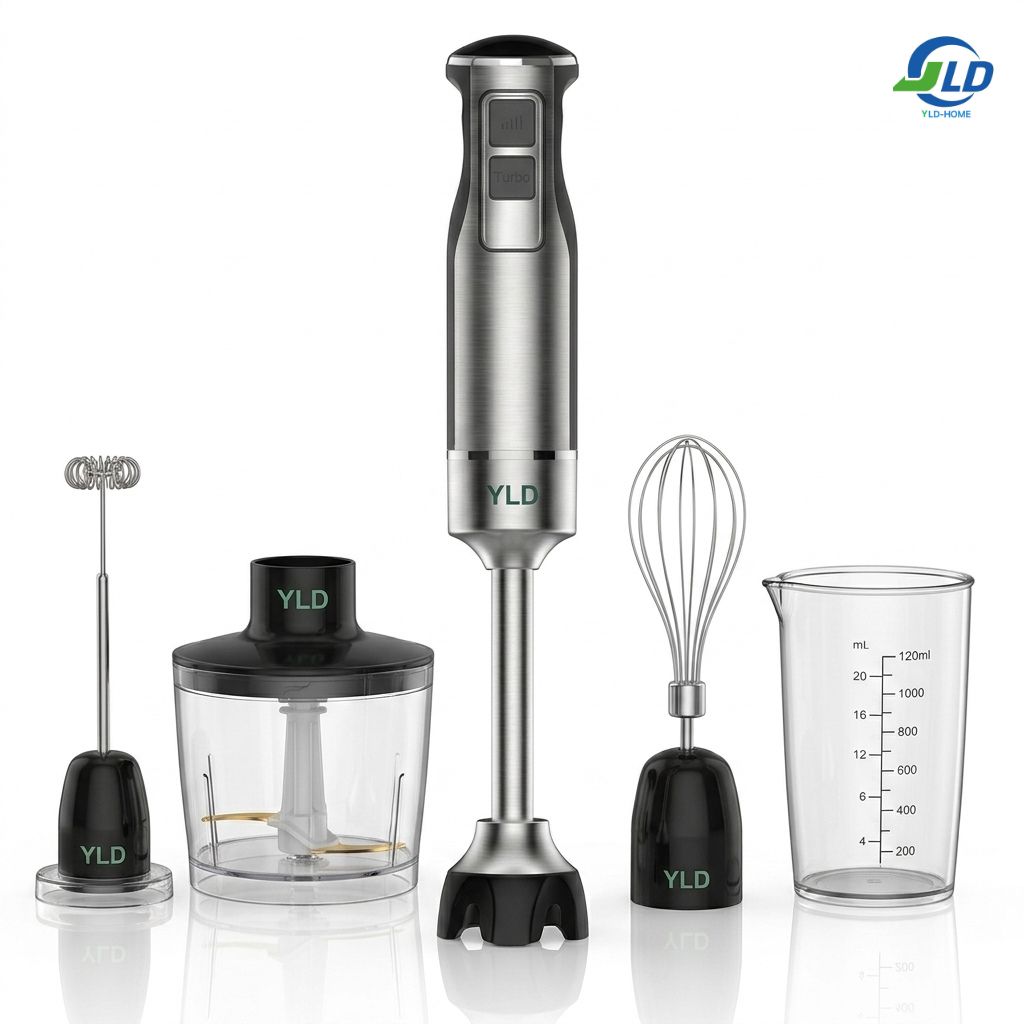
The multi-function immersion blender set US buyers order most often: main unit, whisk, frother and stainless steel shaft.
Existing buyers also leave public reviews on the products they import, and those reviews are a faster credibility check than any marketing page. The clip below shows the kind of feedback YLD Home products receive from importers and end customers:
Every YLD Home shipment passes documented quality inspection before it leaves the factory.
FOB pricing benchmarks by appliance type
Use these ranges as planning benchmarks before you request formal quotes. Hand blenders run $4 to $18 FOB for basic models and $18 to $35 for OEM or higher-spec units — the 2-in-1 hand blender with its 1000W motor and whisk attachment sits at the higher end of that band. Air fryers sit in the $12 to $35 range depending on size and wattage. Electric kettles range from $2 to $15 depending on material and features. MOQs typically start at 500 to 1,000 units for most small appliances, with volume pricing stepping down meaningfully at 3,000 units and above. YLD Home’s standard MOQ is 500 units per model, with mixed-model containers available for first orders.
| Appliance type | FOB price range (basic) | FOB price range (OEM / higher spec) | Typical MOQ |
|---|---|---|---|
| Hand blender | $4 – $18 | $18 – $35 | 500 – 1,000 units |
| 2-in-1 hand blender (1000W) | $12 – $18 | $18 – $35 | 500 units |
| Air fryer | $12 – $20 | $20 – $35 | 500 – 1,000 units |
| Elektrischer Wasserkocher | $2 – $8 | $8 – $15 | 1,000 units |
| Handmixer | $3 – $10 | $10 – $18 | 500 – 1,000 units |
| Entsafter | $5 – $15 | $15 – $28 | 500 – 1,000 units |
Volume pricing steps down meaningfully at 3,000 units and above; confirm current quotes with your supplier before committing.
Your import readiness checklist before placing a container order
Clear these six checkpoints before you commit to an FCL order:
- Supplier verification complete, including factory tour or video walkthrough — you can watch YLD Home’s factory introduction video for a pre-call look at the production line
- Correct HTSUS code confirmed with your customs broker
- UL or ETL certification verified in the public database by listing number and exact model
- FCC compliance documentation obtained if the appliance has digital electronics
- Freight forwarder and customs broker engaged and briefed on the shipment
- Landed cost calculation completed using current duty, Section 301 tariff, freight, and brokerage rates
Start with a sample, scale with confidence
To import kitchen appliances from China successfully, you need more than a good product — you need a repeatable process. Every step in this guide is executable more than once, and the buyers who do it right share the same foundation: verified factories, numbers that account for every cost before the order is placed, and compliance documentation that holds up under retailer and customs scrutiny.
Working with established Chinese kitchen appliance manufacturers, the kind that carry product-level UL or ETL listings, document QC with third-party audits, and have freight relationships already in place, compresses the timeline and reduces the compliance work you have to manage independently. YLD Home, a Shenzhen-based wholesale small kitchen appliance manufacturer supplying US buyers directly, is one example of this type of factory-direct relationship — you can review our product range, check our certification page, and follow more sourcing guidance on the YLD Home blog.
Start by requesting samples and certification documentation from your shortlisted factory. Verify the listings in the public database. Run your landed cost with current tariff rates before you commit to a single unit. That sequence, repeated consistently, is how importers move from a first container to a predictable, scalable sourcing operation.
For a direct conversation about your import project, connect with Sherry Liu on LinkedIn or subscribe to the YLD Home newsletter for monthly sourcing tips, tariff updates and new product launches.
Häufig gestellte Fragen
1. What is the best way to find a verified kitchen appliance factory in China?
Start with direct factories rather than trading companies, and verify three things: a manufacturer-classified business license, original test reports from an accredited lab, and a willingness to show the facility on video or in person. Suppliers like YLD Home publish their product lines and factory capabilities openly, and our wholesale blenders page lists the models and certifications buyers can check before requesting a sample.
2. What certifications do I need to import kitchen appliances to the US?
For electrical appliances you generally need a UL or ETL listing (OSHA-recognized NRTL marks) and, for models with digital electronics, an FCC Supplier’s Declaration of Conformity. CE alone does not satisfy US requirements. YLD Home ships US orders with UL/ETL and FCC documentation as standard, and the certificate scope is published on our appliance certification page so you can verify listing numbers before you buy.
3. How much does it cost to import kitchen appliances from China?
Plan for product cost plus freight, insurance, duty, brokerage and inland delivery. As a benchmark, a 20ft FCL from Shenzhen to the US West Coast runs roughly $1,500 to $4,500 in ocean freight, and Section 301 tariffs can add up to 37.5% on top of base duty for affected products. YLD Home provides product cost and MOQ structure up front in every quote, so your landed-cost calculation starts from a verifiable number.
4. What is the minimum order quantity (MOQ) for kitchen appliances?
Most small appliances start at 500 to 1,000 units, with volume pricing stepping down at 3,000 units and above. YLD Home’s standard MOQ is 500 units per model, and we offer mixed-model containers on first orders so new buyers can test several SKUs without committing to one full run.
5. Can I get a sample before placing a bulk order?
Yes — experienced importers always sample first. Request the product together with the test certificate, business license and spec sheet, and verify the certification in the public database before scaling. At YLD Home, sample fees are credited against your first container order, and you can start the process through our 2-in-1 hand blender product page or by contacting the export team directly.
6. How long does shipping from China to the US take?
Ocean freight from Shenzhen, Shanghai or Ningbo to US West Coast ports typically takes 14 to 22 days; East Coast ports add roughly 10 to 13 days. Air freight runs about 5 to 10 days door-to-door at three to five times the cost per kilogram. YLD Home coordinates freight and documentation with our logistics partners, so buyers receive current quotes and transit timelines at the quotation stage.
7. Do I need a customs broker for my first import?
Yes, for any shipment above the de minimis threshold. A licensed broker handles classification, entry preparation, CBP communication and ISF filing — typically $150 to $300 per entry. YLD Home’s export documentation (invoice, packing list, certificates) is prepared to broker-ready standards, which shortens the entry process on your first container.