









Custom Kitchen Appliance Development: ODM Projects
Development work for buyers who arrive with a defined brief: a platform to modify, a material to change, or a mechanism to build. Engineering, tooling, injection, motor winding and electronics sit in the same plant, so a development project does not become a relay race between four suppliers.
R&D capability inside the plant
Custom kitchen appliance development is an engineering problem before it is a manufacturing problem, and every custom kitchen appliance development project we quote starts with the same question: which parts move, and which must not. The reason a brief can be answered in weeks rather than quarters is that the people who design the part, cut the tool and test the sample work in one building.
| Fähigkeit | What it means for your project |
|---|---|
| Engineering | Mechanical design, DFM review and tolerance work on SolidWorks; electrical and PCBA design in-house. Prototypes from 3D print and CNC before a single die is cut. |
| Tooling | Mould and die sourcing controlled by our own tooling engineers, with first-article inspection on every new tool and a tooling register kept per project. |
| Injection | In-house moulding across the tonnage range needed for appliance housings and internal parts, with colour matching against an approved sample. |
| Motor winding | Winding and motor assembly on site, which is why motor changes on a development project do not become a third-party scheduling problem. |
| Electronics | PCB assembly and firmware for speed control, battery management, interlocks and thermal cut-out. |
| Validation | QC lab with hipot, power, torque, life-cycle, salt spray, drop and moisture benches, so a prototype can be tested before it leaves the building. |
What we do on a development project
Six services, usually combined. Each can be quoted separately if you already have part of the work covered — most custom kitchen appliance development projects use three of them.
Development case studies
Three real projects, described the way the brief arrived rather than the way a brochure would tell it. Client names are withheld; the technical detail is not.
How a development project runs
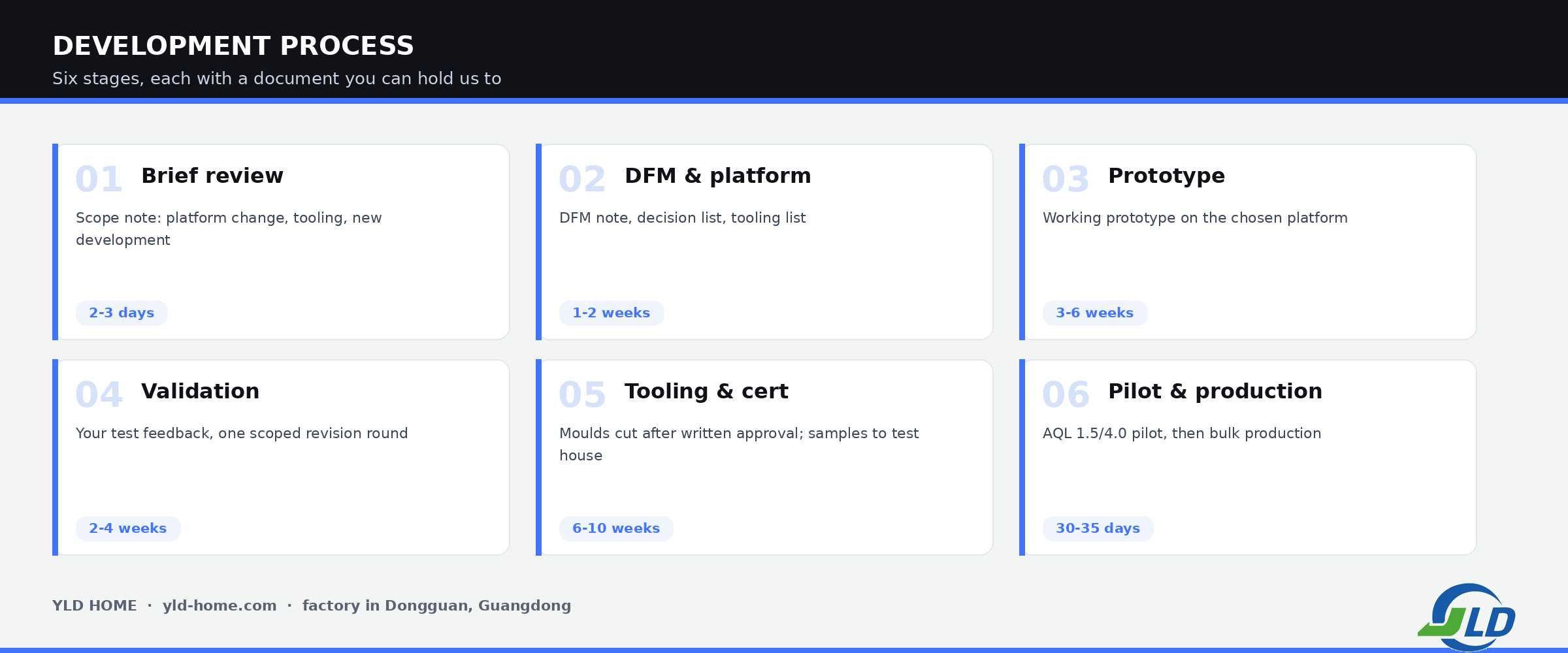
Six stages, each with a document you can hold us to. Durations are indicative and confirmed at the DFM stage.
| Stage | What happens | Indicative time |
|---|---|---|
| 1. Brief review | Scope note: what is a platform change, what is tooling, what is new development, and what we would decline. | 2-3 working days |
| 2. DFM and platform choice | DFM note, decision list, tooling list and a preliminary cost model labelled as preliminary. | 1-2 weeks |
| 3. Prototype | Working prototype on the chosen platform, with 3D-printed or CNC parts where tooling does not yet exist. | 3-6 weeks |
| 4. Validation and revision | Your test feedback, then a scoped revision round. Further rounds quoted separately, not assumed. | 2-4 weeks per round |
| 5. Tooling and certification | Moulds and dies cut after your written approval; certification samples submitted in parallel. | 6-10 weeks |
| 6. Pilot and production | Pilot run inspected to AQL 1.5 / 4.0, then bulk production 30-35 days from deposit and approved artwork. | 30-35 days |
Who pays for what
Development projects fail when the commercial split is left vague. Ours is written down before the first drawing.
| Item | Paid by | How it works |
|---|---|---|
| Tooling, dies and fixtures | Käufer | Paid upfront, owned by the buyer, drawings handed over |
| Certification and test reports | Käufer | Paid to the test house; we prepare samples and documentation |
| Prototype and samples | Käufer | Sample charge credited against the bulk order |
| Production | Käufer | 30% deposit, balance before shipment |
| Freight, duties and taxes | Käufer | Excluded, quoted separately under EXW or FOB |
The questions buyers arrive with
These are the phrases buyers use when they start looking, and the short answer to each. If your question is not here, it is probably in the FAQ further down.
ODM, OEM, private label or full custom — which one are you actually buying?
The four terms get used interchangeably in enquiries, and they price very differently. This is how we use them.
| Modell | What changes | Cost profile | Typical buyer |
|---|---|---|---|
| ODM (our design, your brand) | Existing platform, your logo and packaging | Lowest tooling, fastest start | Retail brands entering a category |
| ODM with modification | Existing platform, specific parts redesigned — brew path, gearbox, housing | Medium tooling plus re-testing | Buyers with a product idea but no base design |
| OEM (your design, our build) | Your drawings or your existing supplier’s design, built in our plant | Tooling as required by the design | Brands moving production or adding a second source |
| Full custom development | Clean-sheet design from a concept brief | Highest tooling and engineering, longest timeline | Product developers and funded startups |
What actually drives the unit price
Buyers often anchor on a target price before the platform is chosen. These are the drivers that decide whether that target is reachable, in the order they usually matter.
| Driver | What it does to the price | How buyers usually reduce it |
|---|---|---|
| Tooling amortisation | Spread across the first order only, or across lifetime volume | Commit to volume in writing, or accept a higher first-order price |
| Material substitution | 304 stainless adds material cost, polishing, passivation and re-testing | Limit the stainless to the food-contact path, keep structure in plastic |
| Mechanism choice | Deep-drawn versus stamped-and-welded; blade versus burr; metal versus nylon gears | Let us quote both and compare total cost, not tooling cost alone |
| Certification scope | A new material or mechanism usually means a new test file | Reuse the existing platform wherever the change does not touch the tested construction |
| Verpackung | Gift box, printed carton, manual languages, inserts | Start with one packaging variant and add colours later |
| Order structure | Mixed models in one container versus one model per container | Assort colours, not mechanisms, in the first order |
How long development really takes
Indicative ranges, confirmed at the DFM stage. The variable that moves most is not manufacturing — it is how fast both sides respond to drawings and test feedback.
| Stage | Indicative duration | What it depends on |
|---|---|---|
| Brief to scope note | 2-3 working days | A written description is enough to start |
| Scope note to DFM package | 1-2 weeks | Needs your drawings or a decision to use our platform |
| DFM to working prototype | 3-6 weeks | Depends on how many parts need 3D-printed or CNC work |
| Prototype to approved design | 2-8 weeks | One revision round included; more rounds add time |
| Tooling and first samples | 6-10 weeks | Longer for deep-drawn stainless or multi-cavity moulds |
| Zertifizierung | 6-10 weeks | Runs in parallel with tooling wherever possible |
| Production | 30-35 days | From deposit and approved artwork |
Terms used in development projects
| Term | Meaning |
|---|---|
| ODM | Original Design Manufacturing — the supplier owns the design and builds it under your brand. |
| OEM | Original Equipment Manufacturing — you own the design, the supplier builds it. |
| DFM | Design for Manufacture — a review that finds the parts which cannot be moulded, stamped or assembled economically. |
| T1 sample | The first sample from a new tool, used for fit and function before any cosmetic work. |
| AQL | Acceptable Quality Limit — the sampling standard used at final inspection. Ours is MIL-STD-105E at 0 / 1.5 / 4.0. |
| Tooling ownership | Who owns the moulds and dies. In our projects the buyer owns them once they are paid for. |
| Food-contact compliance | The rules covering materials that touch food or drink — EU 1935/2004 in Europe, FDA requirements in the US. |
| Pilot run | A small production batch run on the real tooling, inspected before bulk production is authorised. |
What we will not do
- No free prototypes. Engineering time and prototype parts are paid work, even when the project is still speculative.
- No firm price without a platform. A number before the platform decision is a guess, and we label it as one.
- No certificate we do not hold. We quote the testing lead time instead of promising a document.
- No production before written prototype approval. Your approval gate is also our protection.
- No learning on your tooling budget. If a mechanism is outside our competence, we say so at brief review.
Development questions
Do you take on projects outside your current product range?
Selectively. We take projects that sit on or close to our platforms — kitchen appliances with a motor, a heating element, a battery or a moulded housing. Where the core mechanism is outside our competence, we say so at brief review rather than learn on your tooling budget.
Will you sign an NDA before we send drawings?
Yes. Send the NDA and we return it signed before anything technical is exchanged. If you prefer, we start with a scope note based only on a written description.
Is the first feasibility review paid?
A brief review that ends in a scope note and a decision list is free. A full DFM package — part drawings, tooling list, tolerance stack — is paid engineering work, credited against your first production order.
Can you quote a unit price before a platform is chosen?
We can give a range, labelled preliminary, with the assumption it rests on. A firm EXW or FOB price follows the platform decision, because tooling and assembly sequence change with it.
What is the smallest order on a new tooling project?
1,000 units per model is our normal minimum. Below that the tooling amortisation dominates the unit price, so we say no early rather than quote something unbuildable.
Who owns the tooling?
You do, once it is paid for. We hold and maintain it at our plant, hand over the drawings and tooling list, and ship it on your written instruction if the project moves.
How many prototype revisions are included?
Agreed in the prototype quotation, not assumed. We normally include one revision round after your test feedback, with further rounds quoted as a separate engineering task.
Which certifications can you support?
CE, GS, ETL, FCC and UKCA documentation on models we build. Where a market needs a scheme we do not hold for that model, we quote the testing lead time and the test house.
Send the brief, we answer with a scope note
Market, volume, what changes and what must not — the four lines that turn an enquiry into a custom kitchen appliance development plan — that is enough for a first written response.
Reply within one working day · factory in Dongguan, Guangdong · quote valid 30 days
