










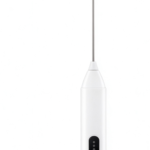
Hand blenders, juicer cups and small cooling fans are the three volume categories where an ODM BLDC motor changes the product more than the price does. In each, the factory can retune speed, torque shape, winding, sensor strategy and driver board without touching the housing. That is the practical scope of ODM work.
Everything downstream — tooling, certification files, retail claims — depends on decisions taken in that first meeting. What follows is the comparison data, customization list and validation sequence needed to hold it properly, written from the factory side.
Where a BLDC motor earns its place
Hand blenders. Short bursts at high shaft speed, with load spikes when the blade meets fibrous food. A brushed motor droops as load rises; a controlled BLDC holds setpoint by reading current and adjusting commutation, which is why the same wattage feels stronger in the hand.
Juicer cups and personal blenders. Very high speed, sealed liquid environment, almost no airflow path: thermal design, not torque, is the binding constraint. BLDC losses sit in the stator, which conducts into a metal bracket far better than brush losses do — if the bracket is clamped to the stack.
Fan-type loads: tower fans, circulators, range hoods. Long duty cycles at modest torque, where efficiency and acoustics outweigh peak power. Sinusoidal drive removes slot-order noise, and speed holds against filter loading without a tachometer.
BLDC versus brushed, as bought in volume
Cost figures are relative; the gap moves with copper, magnet and semiconductor pricing, and with volume band.
| Criterion | Brushed / universal | BLDC |
|---|---|---|
| Service life | Brush wear and commutator film; the brush is a consumable | No brush contact; life set by bearing grease and capacitor ageing |
| Wirkungsgrad | Brush drop, rotor copper, commutator friction; falls off at part load | Losses in stator and inverter; part-load efficiency stays high |
| Noise | Slot order and brush chatter; tonal, hard to mask | Smoother torque; the problem moves to PWM carrier and structural resonance |
| Unit cost | Lower BOM, no electronics, but copper-heavy | Higher BOM: magnets, position sensing, inverter, controller |
| Controller | A triac often suffices; speed control is crude and load-dependent | Gate driver, current sensing, firmware, EMC filtering; adds development time |
| EMI | Broadband brush arcing, handled with suppression capacitors at the terminals | Narrowband harmonics at the switching frequency; needs a designed filter |
| Speed holding | Drops with load and supply voltage; the user compensates | Closed-loop; constant setpoint to the torque limit, and soft-start is free |
Brushed wins on first cost and development time; BLDC wins on everything the consumer feels and the service department absorbs.
What an ODM BLDC motor program can change
ODM means the platform is the factory’s and the buyer’s specification sits on top. These items are worth negotiating explicitly; each changes tooling, firmware or validation scope.
Speed and torque curve
Declare the operating point, not the wattage. A blender needs torque that rises steeply below setpoint so the blade recovers from a stall; a fan needs a flat, low-torque curve tuned for acoustics. Turns, stack length and commutation angle move one stator toward either.
Winding
Winding sets Kv — speed per volt, and current per unit torque. A low-Kv winding buys torque headroom and lower peak current at the cost of top speed. State insulation class for the ambient inside the housing, warmer than the bench.
Rotor and magnet grade
Magnet grade, rotor skew and air-gap tolerance drive cogging, and therefore low-speed smoothness. Skew costs a little torque and buys a lot of quiet. Fix it before tooling.
Hall or sensorless
Hall sensors give dependable zero-speed torque but add five wires, a connector and a failure mode in a wet product. Sensorless back-EMF removes the harness and costs less, but cannot start under load without an open-loop ramp. A blender starting in food argues for Hall; a fan starting free does not.
Driver board
The controller usually ships inside the motor package. Specify input voltage, mains or battery supply, control interface, the protection set (stall, over-current, over-temperature, under-voltage) and the thermal path from inverter to housing. A driver quote without that path is incomplete.
Certification and EMC
Household appliances are built against IEC 60335-1 and the relevant part 2, published by the International Electrotechnical Commission. An ODM BLDC motor sold into North America is additionally assessed as a component against UL 1004. Both should be designed for from the start and on file before the first run; our certification library is organised the same way, by standard and market.
EMC is where BLDC projects slip. Emissions fall under CISPR 14-1, immunity under CISPR 14-2, adopted in Europe as EN 55014. Three points:
Filter design follows switching frequency, not the motor. A conducted-emissions failure at the PWM carrier cannot be fixed with a capacitor at the plug. The filter lives on the driver board, return path short.
Test the appliance, not the motor. A bare motor on a bench has a different impedance path than the same unit bolted into a housing with a metal jar. Only pre-compliance on the assembly predicts the final scan.
Ask for the EMC report of a comparable unit early. A supplier who cannot produce one is asking you to fund their first attempt, and the quality control agreement should name who pays for a retest.
Sampling and validating an ODM BLDC motor
| Stage | What is built | What is measured | Exit criteria |
|---|---|---|---|
| 1. Engineering sample | Hand-wound stator, soft-tooled rotor, bench driver | Back-EMF shape, Kv, phase resistance, cogging torque | Operating point reached on target supply with current margin |
| 2. Application build | Motor in the real housing with the real load | Speed holding, startup time, inrush current, end-turn temperature | No stall on worst case; winding inside insulation class |
| 3. Life bench | Production-intent units on the declared duty cycle | Bearing noise, capacitor drift, insulation resistance | Acoustic and current signature stable; no protection trips |
| 4. EMC pre-scan | Assembled appliance, final harness, production board | Conducted and radiated emissions at worst-case speed and load | Margin below the CISPR 14-1 limit, not at the line |
| 5. Pilot run | Production tooling, production line, first article inspection | Dimensional and electrical spread across the batch; test yield | Spread inside the stage 2 band; yield stable across shifts |
| 6. Mass production | Serial build with lot-based sampling | Routine electrical test, hi-pot, acoustic sample per lot | Agreed AQL held; deviation triggers a hold, not rework |
Two stages get compressed and should not. Stage 2 is where thermal surprises appear: a motor that runs cool on a bench sits inside a sealed housing. Stage 4 is where schedules slip, because the filter change that fixes emissions also changes driver-board temperature. The sourcing guides cover how those dates are staged.
Common failure causes
Most ODM BLDC motor failures trace back to a short list, and every item is cheaper to design out than to rework.
Inadequate heat path. The stator is the heat source and the housing is often plastic. Without a clamp or thermal pad to a metal bracket, the winding runs far hotter than the bench suggested. Measure at the end turns, not on the housing.
Startup current. A blender starting in food draws a spike well above running current. Set protection at the running value and the appliance nuisance-trips; set it too high and the supply sags. Specify a soft-start ramp and a limit above the stall transient, then confirm in the application build.
Controller matching. The three most expensive words in a BLDC project are “same rating”. A board chosen on wattage alone may have the wrong bus range, the wrong current-sense gain, or a commutation table tuned to another magnet grade. Motor and controller are one system; change either and stages 2 to 4 restart.
Questions buyers ask before the first sample
Can a brushed design be converted without new tooling?
Occasionally the housing survives, rarely unchanged. The stack is usually longer, the rear needs room for the driver, and the shaft must carry the sensor magnet. Plan it as a mechanical project with an electrical component.
Hall sensors or sensorless?
Start from the startup condition. Load present at zero speed — a blender in food, a pump with head — needs Hall or a hybrid scheme. No load at start with a long duty cycle favours sensorless, which removes cost and a wiring failure mode.
Why does the same wattage feel stronger?
Because it holds speed instead of drooping. A brushed motor slows as load rises, exactly when the food resists most. A closed-loop BLDC raises current to hold setpoint until it hits its torque limit.
Which certifications sit with the motor and which with the appliance?
The appliance carries the safety approval for its market, built on IEC 60335-1. The motor as a component is assessed against UL 1004 in North America. EMC sits with the appliance under CISPR 14-1 and 14-2. Confirm which file the supplier holds.
What is a realistic minimum order for a custom winding?
It depends on whether tooling moves. A winding or firmware change on an existing platform runs at modest quantities; a new lamination or magnet grade must amortise tooling over larger volume. Ask for the split: engineering, tooling, unit price per band.
How should an ODM BLDC motor brief be written so quotes compare?
Quote against a defined operating point, never a wattage. State supply voltage and type, load curve, speed range, duty cycle, ambient inside the housing, startup condition, sensing method, control interface and target markets. Our quote desk works from that list, and the neue Produkte pages show which platforms are already tooled.
None of this makes the decision for you. It means it rests on torque curves, thermal paths and certification scope rather than a number printed on a retail box — the only basis on which an ODM BLDC motor program stays on schedule after the first tooling payment.
