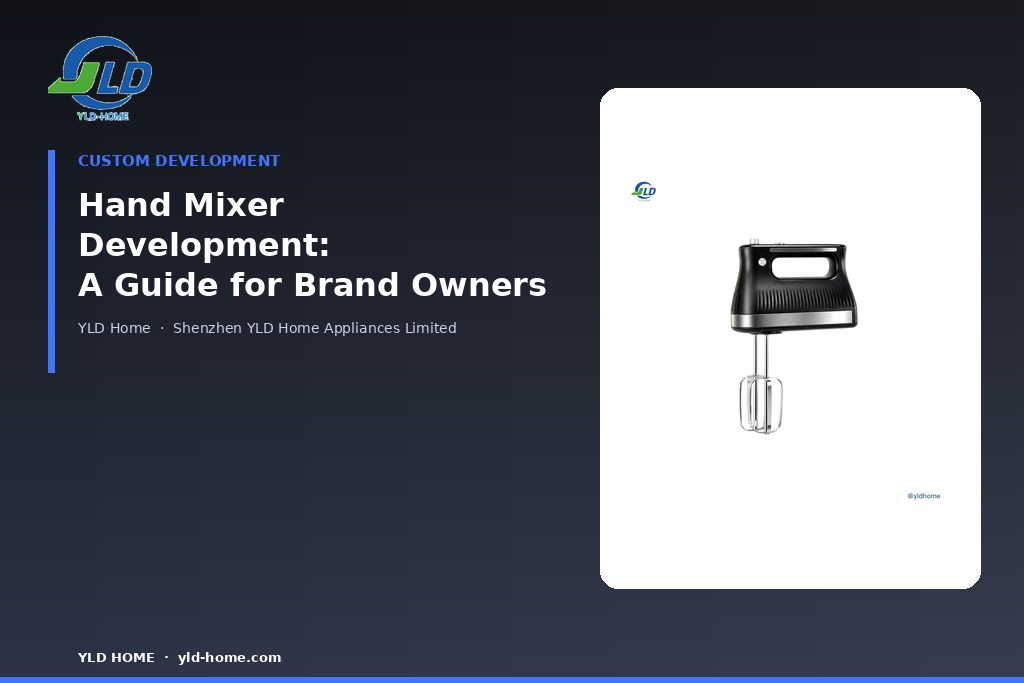










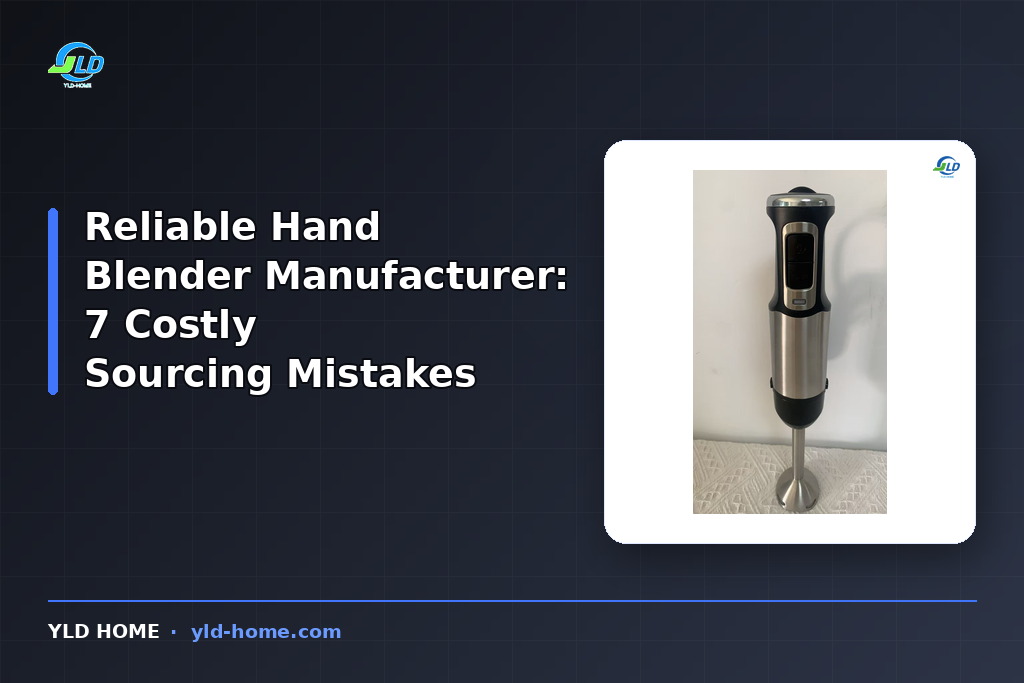
Most hand blender enquiries land in the same shape: a product photo, a target retail price, and one line asking for the MOQ. The photo is the easy part. A 500W stick blender looks like a 500W stick blender in a JPEG. What separates a container that survives a retail stress test from one that comes back as returns in month four stays invisible at that stage — winding density in the motor, the grade of the shaft bearing, whether the PCBA is tested before assembly or only after.
So the work of choosing a reliable hand blender manufacturer is less about catalogues than about how a supplier behaves when something goes wrong. You are not buying a sample. You are buying 20,000 units that must look identical in month eleven, clear customs without a certificate argument, and avoid a single safety incident report.
This guide comes from the factory side of the table, written for brand owners, importers and purchasing managers in Europe, North America and the Gulf. It is not a checklist to tick. It tells you what to look at, what to ignore, and where money quietly leaks out of a hand blender programme.
What “reliable” means once you’re buying at volume
Reliability has three parts. Suppliers only ever talk about one.
Electrical reliability is the obvious one: the appliance doesn’t fail, overheat, or trip a customer’s residual current device. Consistency is the second: unit 4,000 matches unit 40, in colour, in sound, in the feel of the speed button. Commercial reliability is the third, and it is where most sourcing disasters start — your supplier tells you the truth about lead times, certification scope and component substitutions before you find out at the port.
A factory that ships a good product late costs you more than one that ships a mediocre product on time. Late means air freight, missed retail windows, and a buyer who now questions everything you say.
When you shortlist a reliable hand blender manufacturer, put change control in the first call rather than the fifth. How does an engineering change get approved? Who notifies you? Does the change go back through sampling? The buyers who ask those questions are the ones who come back for a second order. If a supplier can’t answer them, the rest of the audit matters very little.
Audit the floor, not the PDF
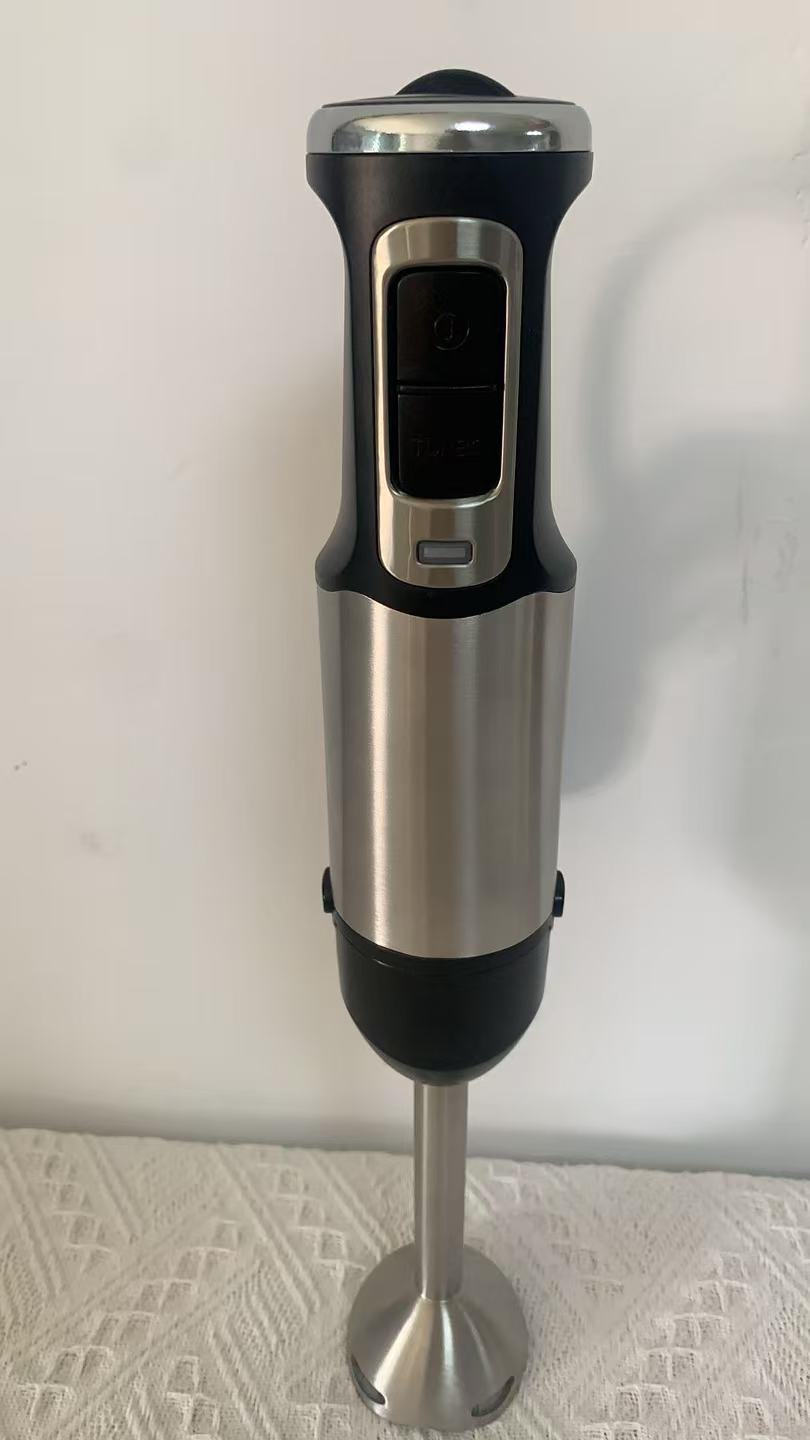
Ask for a live video walk, then go in person. Twenty unedited minutes tells you more than a week of brochures. Ask them to pan the injection moulding hall, the winding area, the PCBA benches, the assembly line and the QC lab in one continuous call — no cuts, no music. Edited footage is easy to produce. A continuous walk with an operator waving at the camera is not.
Then test the claims against the building.
| Claim | What to verify | Why it decides your order |
|---|---|---|
| “We do our own moulding” | Machine count and tonnage, mould maintenance log, who owns the tooling | Tooling ownership controls your housing colour, your cosmetics, and whether you can move the mould later |
| “We wind our own motors” | Winding machines on site, stator test station, wire gauge records | A bought-in motor is the most common silent substitution in this category |
| “PCBA in-house” | SMT line or manual soldering, functional test fixture per model | An untested board fails in the customer’s kitchen, not in your OQC report |
| “Five production lines” | Rated output per line, shift pattern, last month’s actual output | Line count means nothing if it is spread over forty SKUs |
| “We have a QC lab” | Which tests run in-house, which are outsourced, calibration stickers | An uncalibrated lab is a photo opportunity, not a control |
YLD Home runs 25,000 m² in Shipai, Dongguan with five lines and 62 machines, and the reason that matters is not the square metres. It is that moulding, winding, shaft polishing, PCBA and assembly sit inside one gate, so a problem in one process reaches the next one the same shift instead of the next container.
A reliable hand blender manufacturer will also let you stand at the rework bench. Most won’t offer. Ask anyway.
Four processes decide whether your blender survives warranty
If you only have time to audit four things, audit these. Everything else is packaging.
Motor winding. A 500W hand blender lives or dies on the stator. Ask how many turns, what wire grade, and whether every stator is tested before it reaches the line. Machine winding versus hand winding matters less than whether the winding is tested at all. A stator that passes a resistance check but carries a loose lamination will sing at speed and die young — usually inside the warranty window, which means it becomes your cost, not theirs.
Shaft forming and polishing. The shaft is the part your customer touches and the part that decides whether the bell housing sits true. An off-centre shaft gives vibration, noise and premature bearing wear, and it will not show up in a five-second run test. In-house forming and polishing keeps that tolerance under one roof. Buying finished shafts means inheriting whatever the vendor shipped that week.
PCBA and functional test. Ask to see the fixture. If the board is checked by plugging the unit in for three seconds, you will meet the thermal cut-out in the field, at your cost. A proper fixture runs each speed, checks current draw, and rejects out-of-band boards before they are screwed into a housing.
Assembly with an electrical test on every unit. Hi-pot and earth bonding where applicable, plus a run test. Then ask the question that separates real factories from assembled ones: what happens to a unit that fails? Watch where the operator puts it. If failed units go back into the same flow without a red tag and a rework record, your OQC numbers are decoration.
Those four checks are also the fastest way to tell a reliable hand blender manufacturer from a trading company with a sample room.
Certifications: what a reliable hand blender manufacturer can and cannot hand you
This is where enquiries go wrong, so let’s be blunt.
A real factory holds reports, not logos on a homepage. For the EU you need CE documentation covering the Low Voltage Directive and EMC, built on the safety standard for kitchen machines — for hand blenders that is the IEC 60335-2-14 family, which is where the IEC work starts. For Germany, GS is usually a retail requirement rather than a legal one, and CB reports cut the cost of multi-country approval. For the UK, UKCA. For North America, an ETL listing tested to UL 1082 / 982, plus FCC for the electromagnetic side.
Food contact is a separate file, and buyers forget it until a retailer asks. The bell, the shaft and any beaker that touches food fall under EU Regulation 1935/2004, with migration testing per material. Ask for a declaration of compliance and test reports per material. One certificate for the finished appliance is not the same document and will not satisfy a serious retailer.
Here is the part nobody says out loud: certification is per model and per configuration. A supplier who shows you a CE certificate for one 500W model and then quotes a 700W variant with a different motor has not certified your product. Change the motor, the plug or the electronics, and the file has to be revisited before the first container, not after.
YLD Home holds CE, GS, CB, UKCA, ETL tested to UL 1082 / 982 and FCC for its hand blender range, and the documents are model-specific. If your compliance team wants the actual PDFs before an NDA is signed, ask. A supplier who hesitates on that request is telling you something useful.
Samples in 5-7 days, production in 25-35 days: what the clock really tests
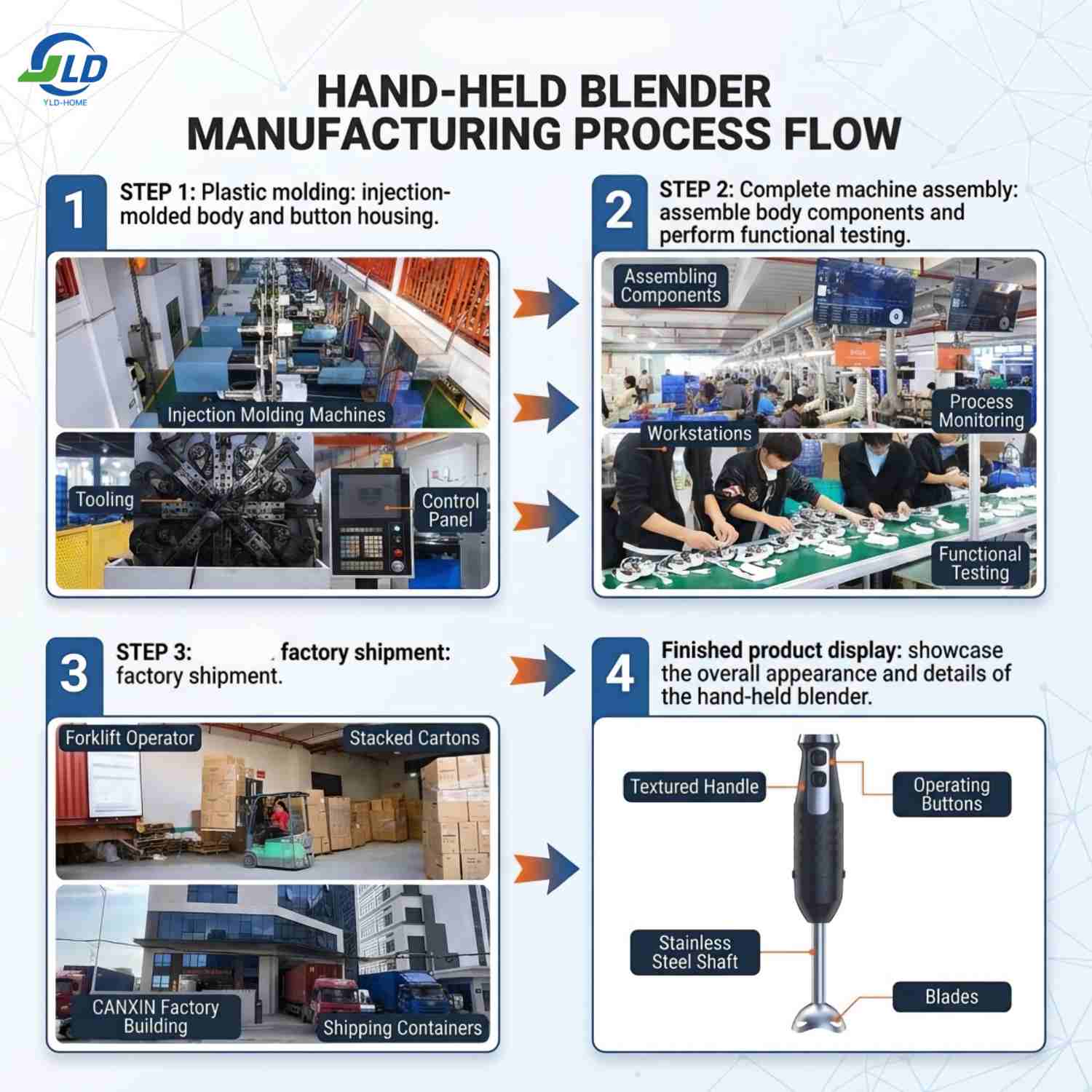
Fast sampling is a sales function. It proves the factory has a sample room, spare housings, and someone who can pull a unit together quickly. It does not prove they can run your volume in October.
Five to seven days for samples and 25 to 35 days for mass production, FOB Shenzhen, is a realistic pattern for a mature hand blender platform — the kind where the tool exists and only colour, logo, packaging and plug change. If someone quotes fifteen days on a brand-new housing, ask what they are skipping. Usually it is the pre-production run, and that is the run that finds the mould problem.
Freeze a golden sample. Sign it, date it, keep one at the factory and one in your office. Most arguments in month six are settled by that unit and a photograph, not by email history.
Ask what triggers a re-sample: a new motor supplier, a resin change, a different cable vendor. Then ask to be notified in writing before any of them happen. The answer tells you more than the price list does.
MOQ maths: why 1,000 pieces is an honest number
MOQ is not a negotiating tactic. It reflects set-up cost: mould change, colour change, packaging print run, line clearance, and the hours lost while a test fixture is switched to your model.
At 1,000 pieces per model, a colour-matched housing and a printed colour box make financial sense for both sides. Below that, you either pay a set-up premium or — more common — the factory quietly substitutes a standard housing colour and a generic carton and hopes you notice nothing until the pallets arrive. YLD Home sets 1,000 pieces per model on the main hand blender range and 100 pieces on the portable series, where tooling is shared and set-up is shorter.
The useful question is not “can you do 500?” but “what changes at 500?” A reliable hand blender manufacturer will name the substitution before you find it on the packing list.
QC gates: the four letters that actually protect you
IQC checks what comes in: resin, wire, bearings, boards, cords. IPQC checks the line while it runs: first-off approval, in-process dimensions, torque on the shaft nut, runtime. FQC checks finished goods. OQC checks the shipment and produces the report you attach to your PO file.
AQL 1.5 for major defects and 4.0 for minor is a common retail-grade arrangement, and it is worth knowing what you are agreeing to. AQL is a sampling scheme, not a promise of zero defects. At 1.5 major, a small percentage of a shipment may carry a major defect and still pass inspection. That is normal across the industry. What matters is whether your supplier inspects to the same standard you do, and whether the report is generated before or after the container is loaded.
Ask for the last three OQC reports on a comparable SKU, not a blank template. Then ask whether third-party inspection is welcome. A factory that resists SGS, BV or Intertek is telling you the OQC report is the only version of the truth you will get. YLD Home ships with a pre-shipment report and accepts third-party inspection; the quality control process is documented rather than improvised.
What to put in the RFQ so the quotes compare
Most quote comparisons fail before the first reply, because the RFQ asked for a price and nothing else. Send the same document to every supplier, and make it specific.
Name the model or attach a 2D drawing with the key dimensions. State the motor rating, the voltage and the plug standard per market. List the certification scope you actually need, not “all certificates”. Describe the packaging: colour box, master carton, barcode, any retail-specific labelling. State the AQL you expect. Ask for two dates — sample date and production date — and define when the clock starts. Confirm the Incoterm and the port. Ask who owns the tooling.
Then add one line that most buyers leave out: “List any component you intend to substitute, and the approval process for that substitution.” A reliable hand blender manufacturer answers that line before it answers the price question. The answers will separate your shortlist faster than any factory tour.
Compare three quotes without getting fooled
Three quotes with a 20% spread usually means three different products, not three prices for the same product. Line them up on one sheet.
| What to compare | What the cheap quote hides | What to demand in writing |
|---|---|---|
| Motor | Lower copper fill, bought-in stator, no stator test | Wire grade, turns, stator test step, motor supplier name |
| Housing resin | Regrind blended into virgin, thinner wall | Resin grade, regrind cap, colour tolerance |
| Shaft and bearing | Unpolished shaft, unbranded bearing | Material spec, polishing step, bearing brand or approved equivalent |
| Cable and plug | Cheaper cord, plug without the right approval | Cable spec, plug standard per market, cord length |
| Zertifizierung | Report for a different model or configuration | Model-specific reports, listed on the quote |
| Inspection | OQC only, no third-party access | AQL levels, report timing, inspection rights |
| Tooling | Tooling owned by the factory, amortised into unit price | Ownership, maintenance responsibility, transfer terms |
| Lead time | Clock starts at “order”, not at approved sample and deposit | Definition of day one, written into the contract |
Putting a reliable hand blender manufacturer and a broker on the same sheet is where the 20% gap usually disappears. A quote that will not state its AQL is not a cheaper quote. It is an unfinished one.
Red flags: when to walk
You will meet these. Every one of them is something a reliable hand blender manufacturer would never do on a first order. Walk away from the first three without negotiating.
- The certification PDFs carry another company’s name, or the model number does not match the unit you were sent.
- They cannot show the winding area on a live call, only in edited video.
- They promise a lead time shorter than the lead time of their own components.
- Every question gets “no problem” and no detail. Real factories push back on something.
- The sample arrives with the wrong plug or voltage and nobody flags it.
- They cannot name the supplier of their magnet wire or their bearing.
- Tooling or sample fees are requested to a personal account.
None of these are about price. All of them predict what month seven looks like.
Where YLD Home fits, honestly
YLD Home has been building small kitchen appliances since 2012, with the plant in Shipai, Dongguan and a showroom in Bao’an, Shenzhen, and around 300 people across the two sites. The range covers a 500W stick blender, multi-function sets with whisk and chopper attachments, cordless kitchen appliances, portable juicer cups, coffee grinders, kettles, air fryers and toasters. You can walk the plant on the factory tour page, or go straight to the wholesale hand blender range und die 500W hand blender range.
Where we are the right call: you need a 500W platform with in-house motor and shaft work, model-specific certification files, third-party inspection allowed, and 1,000 pieces per model to begin. Where we are not: a 300-piece trial in five colours with your logo on the housing. We will say so rather than take the PO and improvise. The portable series at 100 pieces exists for smaller tests, and custom development is the route for buyers who need a housing change rather than a label.
If cordless is on your roadmap, the cordless kitchen appliances line and the portable kitchen appliances range are the places to start. Both carry their own battery and transport documentation requirements, which is a longer conversation than a plug-in blender, and it is better raised at enquiry stage than at the sample stage.
Frequently asked questions
How do I verify a reliable hand blender manufacturer before placing an order?
Start with a live, unedited video walk of the moulding, winding, PCBA and assembly areas, then match every certificate to the exact model you are buying. Ask for the last three OQC reports on a similar SKU. YLD Home does the video walk before an NDA and sends model-specific documents after one, which is the order most compliance teams prefer.
Which certifications should a hand blender factory hold for EU and US retail?
For the EU, CE documentation covering LVD and EMC, with GS and CB as commercial advantages. For the UK, UKCA. For the US and Canada, an ETL listing tested to UL 1082 / 982 plus FCC. Food-contact materials need their own declaration under EU 1935/2004. A reliable hand blender manufacturer shows files per model, not a wall of logos.
What MOQ is realistic for a private-label hand blender?
1,000 pieces per model is the point where a custom housing colour and a printed colour box stop costing extra. YLD Home works to that number on the main range and 100 pieces on the portable series, where tooling is shared. If a supplier offers 200 pieces on a custom colour, ask what they are substituting.
How long do samples and mass production take?
Five to seven days for samples, and 25 to 35 days for production after sample approval and deposit, FOB Shenzhen, on existing tooling. New tooling adds its own timeline, and any quote that ignores that is guessing. YLD Home puts both dates in writing.
Can I send my own inspection company?
Yes, and you should on the first order. SGS, BV and Intertek are all accepted at YLD Home, and the pre-shipment report is issued regardless. A factory that discourages third-party inspection is telling you what its own report is worth.
What should I check on the first production run?
Freeze the golden sample before the run, approve the first-off units against it, and watch the rework bench rather than the finished pallets. Confirm the AQL, the report timing, and who signs the pre-shipment report. Then keep one unit from the run in your office, unopened, as your reference for the next order.
Do you supply cordless and portable models as well?
Yes. YLD Home builds cordless kitchen appliances and portable juicer cups alongside the corded hand blender range, each with its own battery and transport documentation. Those programmes need a longer compliance conversation than a plug-in model, so raise them early rather than at the sample stage.
Three moves for this week
Ask three shortlisted factories for a continuous video walk and give them 48 hours. Send the same specification to all three, including the AQL you expect and the certification scope you need, so the quotes are comparable. Then request one model-specific certificate and one recent OQC report before anyone talks about price.
The suppliers who answer all three without hesitating are your shortlist. The ones who send a brochure and a number are not the reliable hand blender manufacturer you want behind a programme you have to defend at retail. When you want a real quotation, the quote page reaches the same team that runs the line, and the Zertifizierungen file is there to read before you write.