










Hand mixer development looks like the easier half of a small-appliance catalogue, and in some ways it is. There is no wet end, no shaft seal to leak, and a shorter bill of materials than an immersion blender. What makes it difficult is that four engineering problems sit inside a housing you can hold in one hand: motor temperature rise, gearbox life, the fit between whisk and bowl, and electromagnetic compatibility. Each is settled by tolerances rather than features. A unit can carry every feature on the competitor’s box and still fail because the beaters wobble at speed five, the bowl clip releases under a heavy dough, or the thermal protector opens four minutes into a cake batter.
This guide is for brand owners, product developers and sourcing teams in Europe and North America commissioning a hand mixer or egg beater, and who want to know what the work consists of, where the money goes and which decisions belong on their side of the table. It reflects how we build these products at YLD Home, a manufacturer with a factory in Shipai, Dongguan and a showroom in Bao’an, Shenzhen, making small kitchen appliances since 2012. Where a figure depends on your specification, we say so.
What Hand Mixer Development Covers: Four Product Families
Four families cover most of the market, and each one moves the difficulty somewhere else.
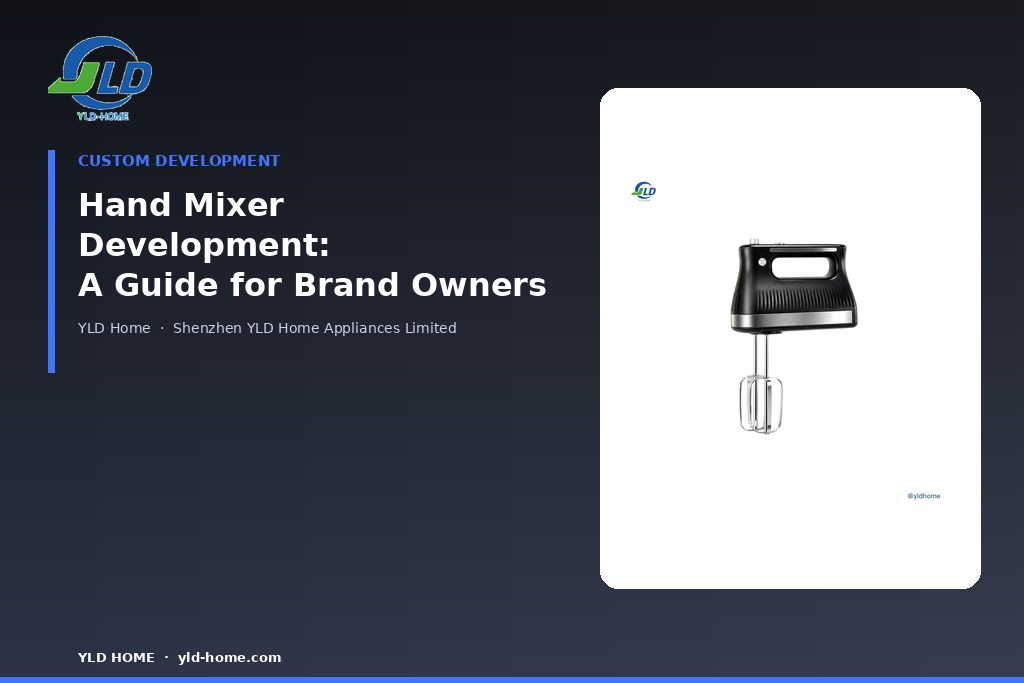
Handheld. Motor, switch, speed control and gearbox in the handle, beaters below. The work is packaging density and heat: waste heat has nowhere to go except through the housing, so vent geometry, the air path and the duty cycle you advertise all interact.
Bowl models. The mixer ships with its own bowl and a cradle or turntable, which adds an interface: the bowl has to locate, rotate under load, and stay put when a user lifts the unit by the bowl. Bowl material and clip geometry join the tooling plan.
Base or stand models. A stand carries the head and rotates the bowl. The tilt mechanism creates a second joint that must survive torque without developing play, and the base footprint drives carton size, which quietly drives landed cost.
Cordless. Cells, a charging circuit and a battery management board replace the mains cord. Voltage sag changes the torque curve, so a gearbox tuned on mains power feels different on a half-discharged pack, and charging, EMC and transport documentation change with it.
If you are still choosing, the hand mixer range sets out how the four families differ in tooling and price structure, and the Schneebesen page covers the lighter batter-focused builds where hand mixer development is mostly a motor and whisk exercise.
Motor and Temperature Rise: Choosing Between 300 W and 500 W
Power rating is the first line of every brief and the least useful number on its own. A 300 W machine and a 500 W machine can share a frame if the winding and cooling differ, and the label says nothing about how long either will run stiff cookie dough before the thermal protector opens.
What matters is the combination of winding, ventilation and duty cycle. For sponge, cream and pancake batter, a 300 W class motor with a well-vented housing runs long enough that the user stops before the machine does. Bread and cookie dough ask the motor to hold torque at low speed for minutes at a time. That is where a 500 W class motor with a larger rotor and better airflow earns its cost, and where an under-specified 300 W unit trips its cut-out and comes back as a warranty claim.
We treat thermal behaviour as a test result, not a claim. Before quoting, we run the load profile you describe — batter viscosity, batch size, run and rest pattern — and record winding temperature, housing surface temperature and the moment the protector opens. If it opens inside your advertised duty cycle, the honest options are a bigger motor, more vent area, or a shorter stated continuous run.
A cut-out that resets after a rest is normal on a 500 W unit working stiff dough, so write the duty cycle you can defend and let the specification follow it. YLD Home winds stators and rotors in-house, so a change of wire gauge or brush grade is a scheduling question rather than a supplier negotiation. The Handmixer page lists the motor classes we currently build.
Gearbox Life: Metal Gears, Nylon Gears and Reverse Torque
The gearbox decides a hand mixer’s reputation. Nylon gears are quiet, inexpensive and adequate for batters and cream. Metal gears cost more, transmit more torque, and are the sensible choice wherever a dough hook works against resistance. The usual failure is not a tooth stripping in normal use. It is wear at the pinion after a few hundred hours, or a rattle that appears at high speed because the mesh has opened up.
Reverse torque is the part buyers underestimate. When a dough hook meets a stiff lump, the motor does not stop instantly. Energy stored in the rotor and gear train has to go somewhere, and it travels back through the teeth and into the housing. A gearbox built only for forward torque passes a bench test and fails where someone holds the mixer still while the dough resists.
We test for that on a loaded cycle rig: run to your duty cycle, stall the beaters at intervals, reverse where the control allows it, and record sound level at each check point. Grease quantity matters as much as gear material. Too little and the pinion runs dry; too much and the housing chatters at speed. Both faults appear as noise long before they appear as failure.
Ask for the cycle count your gearbox was tested to and how it failed at the end. A supplier who cannot answer both has run the gearbox rather than tested it. Our own routine, described on the quality control page, treats a life test as a document with a failure record, not a pass stamp.
Whisks, Beaters and Dough Hooks: Wire, Insertion Force, Wobble
Three components, one interface. The whisk, beater and dough hook are what the user touches, judges and puts in the dishwasher, and they are the parts most often specified loosely.
Wire. Food-contact components in our builds use 304 stainless, generally in the 1.4 mm to 2.0 mm range depending on the tool and the load. Thinner wire whips cream faster and deforms sooner; thicker wire lasts and feels heavy in a light batter. Wire ends are welded or formed so no loop can trap food and no wire can work loose into the bowl.
Insertion force. The socket carries a spring clip or detent, and the force needed to seat and remove a tool is a specification. Too light and the whisk drops out mid-batch; too heavy and a user with a weak grip cannot change tools. We define an insertion and extraction window in newtons and check it with a push-pull gauge at incoming inspection.
Wobble. Runout at the whisk tip is what people read as cheapness. It comes from socket depth, clip concentricity, shaft straightness and bearing play, and it grows as the gearbox wears. Assembly stations check tip runout before the unit reaches electrical test, and the fixture limit comes from your approved prototype, not a generic figure.
Because these parts touch food, the destination market sets the declaration work in any hand mixer development project. In the EU that means Regulation (EC) No 1935/2004 on food contact materials; in the US it means the FDA’s food contact framework. Tell us the market in the brief and the declarations are planned with the design.
Bowl and Base Fit: Clip Tolerance, Rotation Lock, Dishwasher Testing
Bowl fit is a tolerance stack, and it produces the most common complaint in this category: the prototype was fine, the production run is not. Bowl, cradle, turntable, housing and clip each carry a tolerance, and they add up.
The clip has to engage with one hand, hold a full bowl lifted by its handle, and release when asked. That is geometry with a wear problem attached, because the clip material relaxes after hot washes. Rotation lock has to transmit torque without skipping. We run bowls and beaters through domestic dishwasher cycles and inspect for crazing, warping, clip creep and loss of gloss. A bowl that survives one wash and fails at thirty is a return, and the check is cheap before tooling is signed off.
Material choice drives the mould. Transparent SAN or AS, opaque PP or stainless each shrink differently, so clip geometry is cut with steel-safe allowance and adjusted after the first trial rather than retooled. On bowl models the bowl mould is often the largest tool in the project.
EMC and Safety: What Forces a Retest Under EN 60335-2-14
Electrical safety for hand mixers in Europe follows EN 60335-1 with EN 60335-2-14 for kitchen machines. North America runs the equivalent UL 60335 requirements under an ETL or UL listing. EMC means EN 55014-1 and EN 55014-2 for emission and immunity, plus harmonic current limits in EN 61000-3-2. Cordless units add the charger, which brings its own safety and EMC files, and the cells bring transport documentation.
Changes that in our experience require a new EMC or safety evaluation:
- a different motor: stack length, winding, brush grade
- any change to the speed-control board, including triac, suppression choke, X and Y capacitors, or layout
- adding or removing soft start or speed feedback
- vent area or housing changes that alter shielding and airflow
- charger or battery changes on cordless units
- longer whisks on units where the whisk behaves like an antenna
Cosmetic changes such as colour, print or handle texture do not normally trigger an EMC retest, but they can trigger a safety review if they alter creepage distances or access to live parts.
On certification, we would rather be boring than optimistic. CE, GS, ETL, FCC and UKCA can be arranged. Where a report exists for a platform we share it; where it does not, we quote the test cycle and sample requirement rather than imply a certificate exists. A GS certificate names a factory and a model, so a new model means a new certificate even on a proven platform.
What a Useful Hand Mixer Development Brief Contains
The brief is the cheapest part of hand mixer development and the one that decides whether the quotation means anything. Nine lines, answered honestly, are enough for a price both sides can hold each other to.
| Element | What you provide | What we return |
|---|---|---|
| Product family and market | Handheld, bowl, base or cordless; EU, UK or US | Platform recommendation with tooling implications |
| Performance target | Bowl size, dough type, continuous run you will advertise | Motor class, venting proposal, thermal test plan |
| Duty cycle and life | Uses per week, target hours or cycles | Gear material, grease specification, cycle test protocol |
| Tools | Whisk, beater, hook set, wire preference, dishwasher use | Drawings, insertion force window, runout limit |
| Bowl and base | Material, capacity, lock behaviour, wash requirement | Tolerance stack, mould plan, dishwasher test |
| Compliance | Destination markets, marks required, who pays fees | Standards list, test plan, cycle time |
| Volume | First order, 12-month forecast, lifetime volume | MOQ and price break structure |
| Commercial terms | Incoterm, currency, quotation validity | FOB Shenzhen or EXW price, 30-day validity |
| Sample expectation | Prototype, golden sample, approval process | 5-7 working days, sample fee credited on order |
A brief that says “like the market leader but cheaper” produces a price nobody can defend six months later. These nine lines produce a quotation you can compare against another supplier line by line. When you are ready, the Zitat form carries the same fields.
Cost Structure and Quotation Basis: EXW, FOB, Tooling, MOQ
Cost in hand mixer development comes down to four things: motor class, gear material, whether a bowl or base is included, and order quantity.
EXW against FOB. An EXW price stops at the factory gate; inland transport, export documentation and loading are yours. An FOB Shenzhen price includes those up to the vessel. Both are legitimate, and confusing them is how quotes get compared unfairly.
Tooling, in or out. State whether tooling sits inside the unit price, is amortised over a quantity, or is invoiced separately. We quote it separately, because a per-unit price that hides a mould changes the moment volume changes. Tool cost depends on cavity count, steel grade and slider count, so it is quoted once the 3D is frozen, and ownership terms are written into the quotation before the first cut.
MOQ and lifetime volume. Our MOQ is 1,000 units per model, and it is negotiable. Below that, setup and material minimums dominate. Lifetime volume matters as much: 50,000 units can pay for hardened cavities and a better gear set; 3,000 cannot.
Samples run 5 to 7 working days with the fee credited against the order, production 30 to 35 days after sample approval, quotations valid 30 days. Behind those figures sits a 25,000 m² plant in Dongguan with five production lines, 62 machines, around 300 people and capacity for 600,000 finished units a month, plus in-house injection moulding, motor winding, PCBA and assembly. The factory tour page shows the layout. YLD Home quotes from that capacity, so a 1,000-unit trial and a 50,000-unit programme come off the same floor.
Prototype First, Written Approval Second
The clearest brief we have worked from came from a product developer based in Germany. The product was a USB-C rechargeable dry grinder, Ø68 × 148 mm, with electric grinding, controlled reverse, overload protection and a lid interlock, a separate collection chamber with a closable pour spout, a 1.5 to 2 g material chamber, a 130 mm paper chamber, and removable parts for cleaning. Then one paragraph that mattered more than the specification: deliver one working prototype first; production of 1,000 or 2,000 units is conditional on written approval of that prototype; the enquiry does not authorise any paid work.
That structure protects both sides. The buyer does not fund tooling before holding a unit that does what the brief says, and the factory does not cut steel against a drawing nobody has run. Written approval also creates the golden sample, the reference production is measured against under MIL-STD-105E at 0 / 1.5 / 4.0 AQL. Without it, “the prototype was fine” becomes an argument nobody can win, and it happens after the money is spent.
The mechanics stay simple if agreed early. Prototype scope is written down, including which parts are production-intent and which are temporary. Approval is recorded with a signed sample, photographs and the test report. Anything changing after approval — motor, gear set, whisk length, bowl clip — goes through a delta approval instead of sliding in as a running change.
How Little You Have to Change: A European Coffee Machine Brief
Not every development project is a new product. A European buyer came with an existing ODM 12-cup drip coffee machine and a narrow request: change the hot water path only. Riser, spray head, filter basket and lid moved to 304 stainless. Housing, electronics, carafe and controls stayed exactly as they were.
The commercials were equally narrow. Initial order just over 1,000 units, lifetime volume above 50,000, tooling and ETL certification fees paid directly by the buyer, and a unit price target set as the base price plus USD 10.
It worked for three reasons. The change touched parts where stainless solves a real problem: taste, staining and life in a hard-water market. Compliance was understood before the purchase order, because new food-contact parts and a new ETL file were priced in from the start. And the buyer owned the certification cost, so the factory price stayed a factory price.
Translated to a hand mixer, the same logic covers a stainless bowl, a metal gear set or a different whisk wire. Change the parts that carry the value, leave the platform alone, and price the difference rather than the whole machine. That is a shorter route to a sellable product than a clean-sheet design.
FAQ
How long does hand mixer development take from brief to production? Where a platform exists, samples take 5 to 7 working days and production runs 30 to 35 days after sample approval. A new housing or bowl needs tooling, and we quote that lead time once the part design is frozen.
What is the minimum order for a custom hand mixer? 1,000 units per model, negotiable. Treat that as the point where setup, material minimums and inspection stop dominating the unit price. Below it, the conversation is about which platform to start from, not which discount to ask for.
Can you supply CE, GS, ETL, FCC and UKCA? Yes, all five can be arranged. Where a report exists for a platform we share it; where it does not, we quote the test cycle and sample requirement and name the laboratory that issues the mark. Fees are usually carried by the buyer.
Which approvals does a cordless hand mixer need that a mains unit does not? The charger brings its own safety and EMC files, and the cells bring transport documentation. Charging under a partly discharged pack also changes the torque curve, so set the gearbox and whisk specification with that in mind.
How much can we change on an existing platform before it counts as new work? Change parts, not architecture. Colour, print, wire gauge, gear material, bowl material and tool geometry are usually contained. Motor class, speed-control electronics, vent layout or a cordless conversion change the safety and EMC files, and are priced as new.
Do you accept third-party inspection? Yes, at any stage. Our own inspection follows MIL-STD-105E at 0 / 1.5 / 4.0 AQL, and an inspector from your nominated agency is welcome during production and before loading.
What do you need from us to quote a hand mixer development project? The nine lines above: family and market, performance target, duty cycle, tools, bowl or base, compliance, volume, commercial terms and sample expectation. With those, YLD Home can quote a platform build in days and say where a clean-sheet design would cost more than it returns.
Where to Start
Hand mixer development rewards the buyer who arrives with boundaries: a duty cycle they will defend, a market they will certify for, a volume they can forecast, and a clear line between what they will pay for and what they will not.
Send the nine-line brief and ask for a quotation with tooling, certification and MOQ stated separately. YLD Home will say which parts are already solved on a platform, which need new tooling, and which one will trip a thermal protector in year one.