







In this guide: Project Background · The Customer Challenge · Technical Solution · Prototyping and Tooling · Quality Control Before Shipping · Compliance, Packaging and Logistics · Project Results · Scaling Up · Lessons for Other UK Brands · FAQ
When a UK brand decides to launch its own hand blender, the fastest route to market is an ODM project with a factory that already builds the platform. Choosing the right odm hand blender manufacturer uk partner decides everything downstream: how quickly you sample, what tooling costs, whether the packaging is retail-ready, and whether the first container clears customs without drama. This case study follows a 2026 project for a kitchen brand based in Edinburgh, from the first brief to the first reorder, and shows what ODM hand blender development for UK brands actually looks like in practice, including the numbers that made the project work.
Before you compare quotations, it helps to see the platform behind an ODM project: the footage below shows YLD Home’s factory line, where the Edinburgh brand’s hand blender is moulded, assembled and tested before the container ships.
odm hand blender manufacturer uk
Project Background: The Edinburgh Brand’s Brief
The client was a mid-size Edinburgh kitchenware brand with a strong retail presence in Scotland and growing marketplace sales across the UK. Their existing range covered utensils, bakeware and storage, and hand blenders were the natural next category: high repeat purchase, strong gifting demand, and a visible gap between commodity imports and premium European brands. They wanted their own product, not a rebadged generic unit, which is exactly what a custom hand blender project Edinburgh needed a factory to deliver.
The brief was specific. A 500W household model with a stainless steel shaft, a whisk and a chopper cup, in two colours, with the brand name on the motor housing and retail packaging in their design language. Target retail price under £50, launch inside 90 days of signing, and a first production run no larger than a single 20-foot container. The brand had no design team, no factory contacts and no experience of importing, so the factory would have to carry the project through design, tooling, compliance and shipping.
The brand evaluated three routes: buying stock units from a trading company, commissioning a private label from a generalist OEM, or running a proper ODM project with a specialist small kitchen appliance manufacturer in China. The trading route failed on branding, the generalist route failed on packaging depth and compliance experience, and the specialist route won. They shortlisted two factories and chose YLD Home on the strength of UK export history, in-house tooling and a project manager who could explain factory decisions in retail terms. That clarity, more than price, was what closed the deal. For a brand without in-house engineering, the practical test of any odm hand blender manufacturer uk is whether they can show past UK projects, name the laboratories behind their certificates and put a single project manager in front of you. YLD Home passed all three checks in the first meeting.
The Customer Challenge: How Far Is a Concept from a Retail Shelf?
The customer challenge was not the product; it was the distance between a concept and a retail-ready SKU. Four problems dominated the project. First, the brand had zero factory experience, so every decision, from motor selection to carton size, had to be explained in retail terms rather than manufacturing terms. Second, the timeline was aggressive: the brand had booked marketplace advertising for Q3 and a trade show in Birmingham, so the sample had to be right early, not perfected late.
Third, compliance was unfamiliar territory. The brand knew UKCA existed but had never managed a conformity file, and they needed the marking on the product, the packaging and the documentation for both retail listings and marketplace approval. Fourth, the brand wanted a distinctive look, but a full custom mould for the motor housing can cost tens of thousands of pounds, which a first container could not justify. The challenge was to capture most of the customisation value for a fraction of the tooling cost.
The solution was a structured ODM process with clear decision gates. The factory’s design engineer translated the brand’s visual references into a feasible specification, the commercial team mapped every cost line to a decision point, and the project manager set a weekly review so the brand always knew what was decided, what was pending and what was at risk. That structure turned an intimidating project into a checklist. This is the real value of working with an experienced odm hand blender manufacturer uk rather than a parts trader: the process is the product.
Technical Solution: Custom Design for the UK User
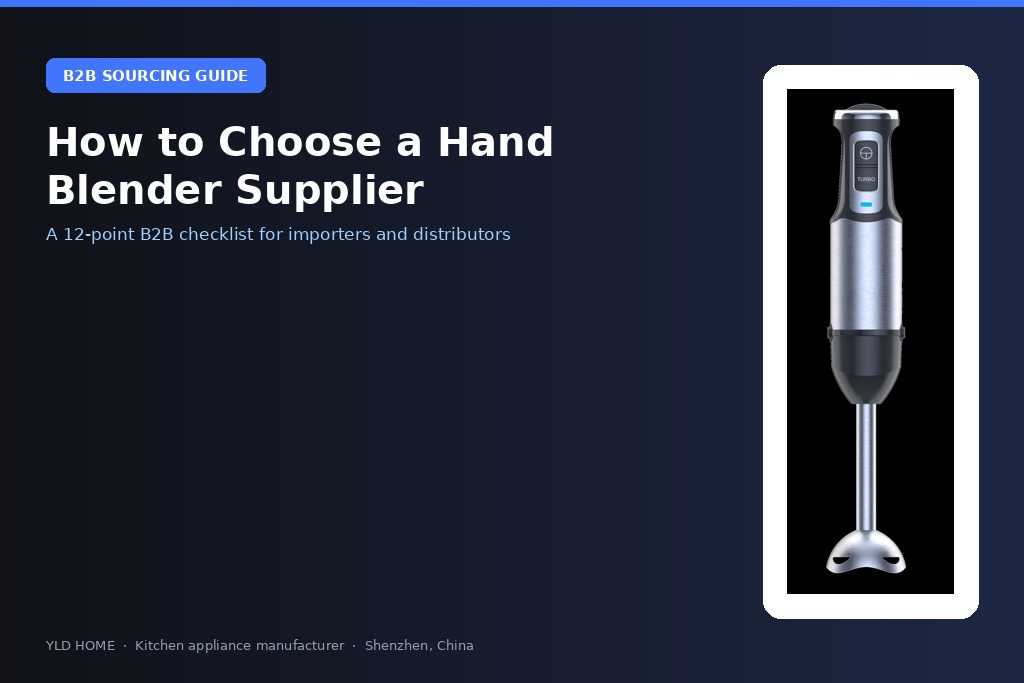
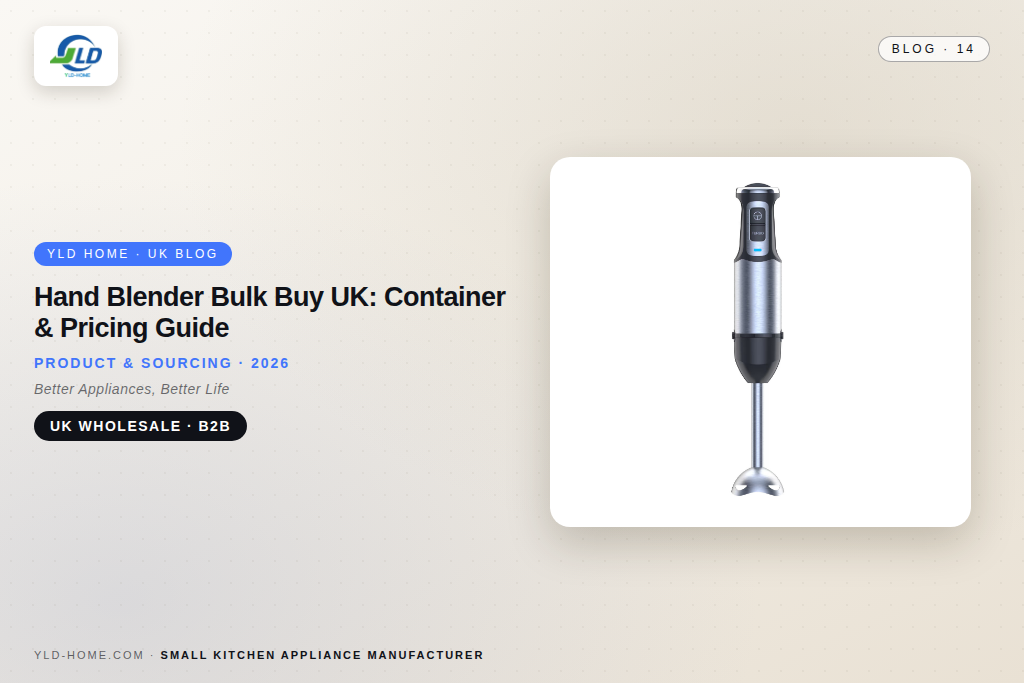
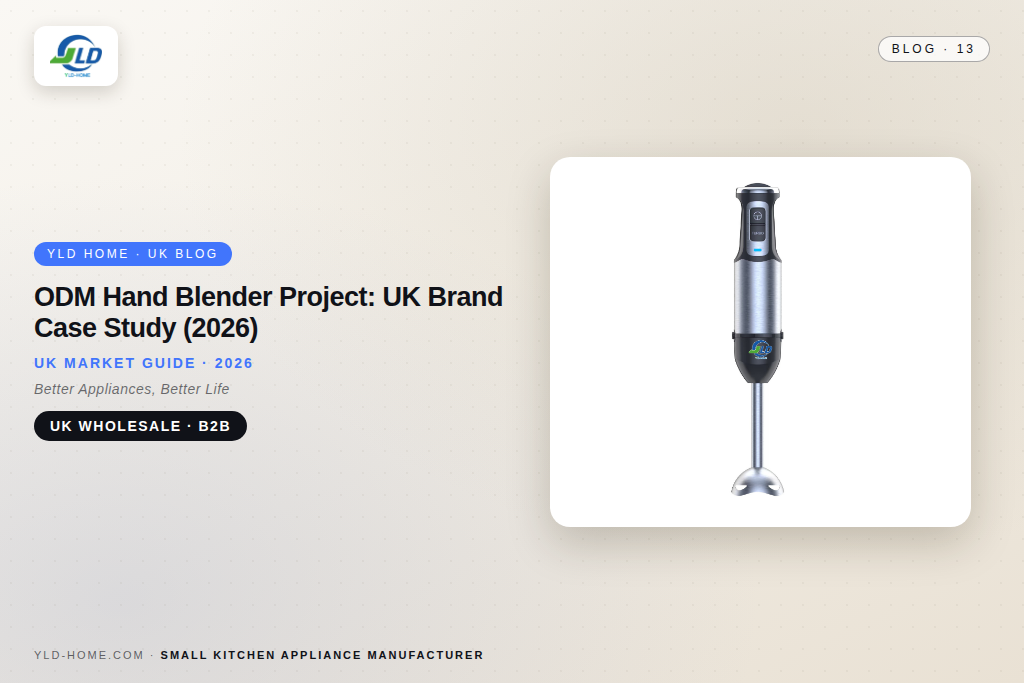
The technical solution started with the hand blender custom design factory China advantage: a mature platform, modified precisely for the UK user. The base platform was a proven 500W motor with a detachable stainless steel shaft and a four-blade assembly, a configuration that had already passed the factory’s lifecycle testing across multiple export markets, the same engineering family as the 2026 PressPro 1600W hand blender that YLD Home supplies to commercial UK kitchens. From that base, the project customised four areas: power and speed, ergonomics, accessories and appearance.
Power was set at 500W with two speed positions and a turbo button, tuned for UK cooking patterns of soups, sauces and smoothies rather than the higher-power commercial spec. The shaft was sized at 20cm so the blender reaches the bottom of a standard UK stock pot without splashing. Ergonomics followed UK retail feedback: a soft-touch grip, a balanced centre of gravity when the whisk is attached, and a button layout that works one-handed, including for left-handed users, which is a detail UK reviewers notice. YLD Home’s design engineer sized the grip and button spacing from UK retail review analysis rather than factory convention.
The accessories were where the brand differentiated. The whisk was upgraded with a gear-driven mechanism for egg whites and cream, the chopper cup was sized at 600ml for the UK household, and a milk frother was added as a bundle, pushing the set from commodity to giftable. Appearance was handled without new tooling: the motor housing colour was matched to the brand’s palette in the factory’s standard mould, with the logo applied in-mould and on the shaft collar. The result looked bespoke while the tooling cost stayed inside a first-container budget, and the factory handled UK plug configuration and UKCA documentation as standard project scope. That end-to-end scope is the practical difference between a parts vendor and an odm hand blender manufacturer uk: the brand changed the shaft length, the whisk mechanism and the colour in one project without managing three suppliers.
ODM Hand Blender Manufacturer UK: Prototyping and Tooling
The prototyping phase ran in three rounds over five weeks, and it is where the odm hand blender manufacturer uk relationship is truly tested. YLD Home’s tooling shop kept every round on a fixed weekly cadence, and round one used a 3D printed housing, the same rapid-prototyping approach documented in the 3D printing literature, so proportion and button-feel problems were caught in plastic before any steel was cut.
Round one was a hand-built sample using existing parts to check proportions, button feel and accessory fit. Round two added the brand colours and logo, and corrected the two issues found in round one: the turbo button travel was too short for gloved hands, and the whisk gearbox was noisier than the brand’s benchmark. Round three was the pre-production sample, built from the final bill of materials with production tooling, and it passed sign-off within one round of minor changes. Each round followed the documented process in YLD Home’s hand blender manufacturer in China guide, so the brand always knew what to expect before a sample arrived.
The tooling decision was a fifty-fifty split: the brand paid for the logo insert tooling and colour-matched housing parts, while the factory absorbed the standard mould cost into the unit price across the first two production runs. That structure is common in ODM deals, but the terms must be written into the agreement before sampling begins, not negotiated after the samples look good. Both sides also agreed the scrap allowance, the defect threshold and the inspection standard in the same document, which prevented arguments later.
| Project stage | Duration | Key activity |
|---|---|---|
| Brief and feasibility | Week 1 | Spec freeze, cost map, decision gates |
| Round one sample | Weeks 2-3 | Proportions, ergonomics, accessory fit |
| Round two sample | Weeks 4-5 | Colour, logo, noise and button fixes |
| Pre-production sample | Weeks 6-7 | Final BOM, production tooling, sign-off |
| Mass production | Weeks 8-9 | 20ft container run, inline QC |
| Shipping | Weeks 10-16 | Sea freight to Felixstowe, UK delivery |
The mould and sampling lessons are worth repeating for any brand: always test the sample with the accessories you plan to bundle, always run the noise test at full power, and never sign off a sample from photos alone. The Edinburgh brand approved each round by video walkthrough and third-party inspection, and it worked because the factory ran a documented sample process that produced comparable results every round, with measurements, photos and test data attached to every sign-off.
What Does Quality Control Look Like Before Shipping?
Quality control ran as a four-layer process, the standard an odm hand blender manufacturer uk should apply to every UK order, because a hand blender that fails in the first month damages a young brand faster than any pricing mistake. Layer one was component incoming inspection: motors, switches and blades were batch-tested on arrival at the factory. Layer two was inline QC during assembly, with torque and run tests on a sample from every production hour. Layer three was a pre-shipment inspection by an independent third party against a checklist agreed with the brand in writing.
Layer four was the factory’s own durability testing on units pulled from the production run: a 200-cycle soup blending test, a 100-cycle whisk test, a drop test from 80cm onto a hard surface, and a four-hour continuous run test on the motor. The results were shared in a test report with the inspection certificate, and the brand’s marketplace team used that report as part of the listing compliance file. Two units were also air-freighted to the UK ahead of the container so the brand could photograph, review and start building listing content while the goods were still at sea.
One defect was found in the pre-shipment inspection: a batch of chopper cup lids had a moulding mark that could crack under repeated impact. The factory quarantined the lids, re-moulded the batch, and the container shipped four days late but fully compliant. For the brand, that four-day delay was the best evidence of the factory’s integrity. A supplier that hides a defect to hit a shipping date is a liability; one that shows you the defect and fixes it is a partner worth reordering from.
Compliance, Packaging and Logistics
Compliance was handled as a fixed part of the ODM scope. The factory provided the UKCA declaration of conformity and test reports for the exact model, following the certification standard documented on our appliance certification page, and configured the units at 220-240V with moulded UK Type G plugs, and applied the UKCA mark to the product, the packaging and the manual. The brand’s customs broker received the complete documentation file before the container sailed, which is the correct order: documents first, goods second, because a missing certificate at clearance costs more than the certificate itself.
Packaging was designed around the UK retail channel. The outer carton was sized to fit 24 units per layer on a standard Euro pallet, and the retail box carried the brand’s design language with the UKCA mark, the importer’s details and safety instructions in English. For marketplace sales, the brand requested FBA-ready cartons with no outer branding, so the same production run served both retail shelves and Amazon UK fulfilment without re-boxing. That single packaging decision saved the brand roughly two weeks of warehouse time and one full repack cycle.
Logistics ran through Felixstowe with sea freight of six weeks, followed by delivery to a 3PL warehouse in the Midlands. The factory provided shipping marks, pallet counts and a packing list that matched the commercial invoice exactly, which kept customs clearance routine. The brand’s only logistics surprise was the timing of import VAT: it is payable at clearance, so they budgeted cash flow accordingly. YLD Home’s project manager walked them through the landed cost calculation before production, so the surprise was planned, not discovered at the border.
Project Results: Launch and First Reorders
The results justified the process and validated the brand’s original choice of odm hand blender manufacturer uk as much as the margin did. The product launched in week 17 after kickoff, one week inside the original 90-day target, and the first container sold through in eleven weeks across the brand’s website, Amazon UK and two Scottish retail chains. The second container, ordered at week 14 after launch, added a third colour and a commercial 1000W variant for the horeca channel, specified with the commercial immersion blender selection guide YLD Home shares with UK catering buyers, after two catering customers asked for a heavy-duty version.
| Result | Outcome |
|---|---|
| Time to launch | 17 weeks from brief to shelf |
| First container sell-through | 11 weeks |
| Marketplace return rate | 2.1% (category average 4-6%) |
| Repeat orders | Second container at week 14, third at week 26 |
| Range expansion | Third colour plus 1000W commercial model |
The retail chains reordered because the packaging was right and the product performed; the marketplace rating settled above 4.5 stars because the noise level and build quality beat the commodity competition. The brand’s margin landed 18 points above their previous imported model, which they attributed to factory-direct ODM pricing plus the premium a branded product can command. For a first project, the numbers were strong enough that the brand moved their next category, a milk frother line, into ODM development within a year.
Scaling Up: From One Container to a Full Range
The first container answered the question every new brand asks: does the product sell? The second and third containers answered the harder question: can the range scale without the founder managing every detail? The Edinburgh brand’s second order added a third colour and the commercial 1000W variant, and the third order, placed at week 26, consolidated the range into a standing production slot with the factory, which changed the relationship from transaction to supply partnership.
Standing slots change the economics. Instead of ordering container by container, the brand agreed a quarterly production forecast with the factory, paid the deposit against the slot, and received priority scheduling during peak production months. Stock levels stopped swinging between empty and overfull, the brand could promise retail chains reliable lead times, and the forecasting discipline carried into purchasing, warehousing and cash flow, because every department now worked from the same numbers.
The other scaling lesson was spares and after-sales. The brand held a small stock of blades, shafts and whisk gearboxes from the start, priced at cost by the factory, and the marketplace return rate stayed at 2.1% partly because replacement parts arrived within days. The original choice of odm hand blender manufacturer uk now pays for itself operationally: one account manager, one document set, one quality standard across the whole range, and a factory that already knows the brand’s packaging, colours and tolerances. Scaling stopped being a sourcing project and became a supply conversation, which is exactly what a second-year brand needs.
Lessons for Other UK Brands
We’ve run ODM projects for UK brands for years, and four lessons from this project keep showing up in our debriefs. First, structure beats instinct: agree the spec, the cost lines and the decision gates before sampling, because changes after tooling are ten times more expensive. Second, test like the customer: blend real soup, whisk real cream, drop the unit, and judge the noise at full power, because these are exactly the complaints that generate marketplace returns.
Third, keep compliance inside the project scope. A factory that treats UKCA, UK plugs and importer labelling as extras will hand you a container that customs holds. A factory that builds them into the standard ODM package removes the most common reason UK brand launches stall. The project also proved that a reliable odm hand blender manufacturer uk removes the two biggest launch risks, compliance and quality, in a single contract, which is why the Edinburgh brand’s second project took half the management effort.
Fourth, plan the second container before the first arrives. The Edinburgh brand’s sell-through was faster than forecast, and only their safety stock prevented a stockout; the rushed reorder had to use air freight at higher cost. Finally, treat the factory as a partner rather than a vendor. The best ODM relationships work because both sides share risk: the factory absorbs mould costs into unit pricing, and the brand commits to production volume in return. When that balance is written down clearly, both sides win, and ODM hand blender development for UK brands becomes repeatable rather than lucky. For a feasibility review of your own project, contact YLD Home through our website with your target price point and volume, or browse the Stabmixer range that already ships to UK brands. For project-specific questions, the export team is available on LinkedIn.
Häufig gestellte Fragen
- What does ODM mean for a UK hand blender brand? Put simply: the factory designs and builds the product platform, and you customise the look, branding, accessories and packaging for your market. That is the exact model YLD Home runs for UK brands: our engineering team owns the platform, and your brand layer is added at every step from housing colour to retail packaging.
- How long does an ODM hand blender project take? Honestly, it depends on tooling and how many sample rounds you need. A typical household model runs 12-18 weeks from brief to first container [fill actual for your project]. YLD Home confirms the project timeline in writing before sampling starts, so the schedule is fixed rather than estimated.
- What is the tooling cost for a custom hand blender? It depends on how much you customise: logo inserts and colour changes are cheap, full custom moulds are expensive, and many factories absorb mould costs into the unit price over volume. YLD Home structures tooling the same way for ODM clients, with the cost split written into the agreement before any sample is cut.
- Do I need my own design team? No, that’s the whole point of ODM. YLD Home provides design engineering, prototyping and packaging design as part of the project, so a brand with no factory experience still gets a retail-ready product.
- Who handles UKCA compliance in an ODM project? The factory should provide the declaration of conformity and test reports for the exact model, as standard scope for any odm hand blender manufacturer uk project; your customs broker handles the import declaration. YLD Home includes UKCA documentation as standard scope in every ODM project, so the compliance file arrives with the samples.
- What is the MOQ for an ODM hand blender project? MOQ depends on the model and customisation level [fill actual]. YLD Home confirms the per-model MOQ at quotation, with first containers sized to a 20-foot load.
- Can the factory help with UK packaging and marketplace-ready cartons? Yes, YLD Home designs UK retail boxes and FBA-ready cartons as part of the ODM scope, so the same run serves shops and marketplaces.
- What is the difference between ODM and private label? Private label usually means changing the logo on an existing product; ODM means the product is developed and customised for your brand, including specification changes. YLD Home can quote both routes for the same model so you can compare the economics.
Official references: 3D printing – Wikipedia