








In this guide:
- Why smoothie programs keep growing across US foodservice
- Can a stick blender for smoothies replace a countertop unit?
- Power, shaft, and blade specs that matter for frozen drinks
- Real tests: frozen fruit, ice, and thick bases
- Compliance for US kitchens: UL, ETL, NSF, and FDA
- Wholesale and private label for chains and distributors
- Cost per cup: the menu math behind smoothie programs
- Cleaning and maintenance in a busy US kitchen
- Sourcing from China: finding an immersion blender vendor USA buyers rely on
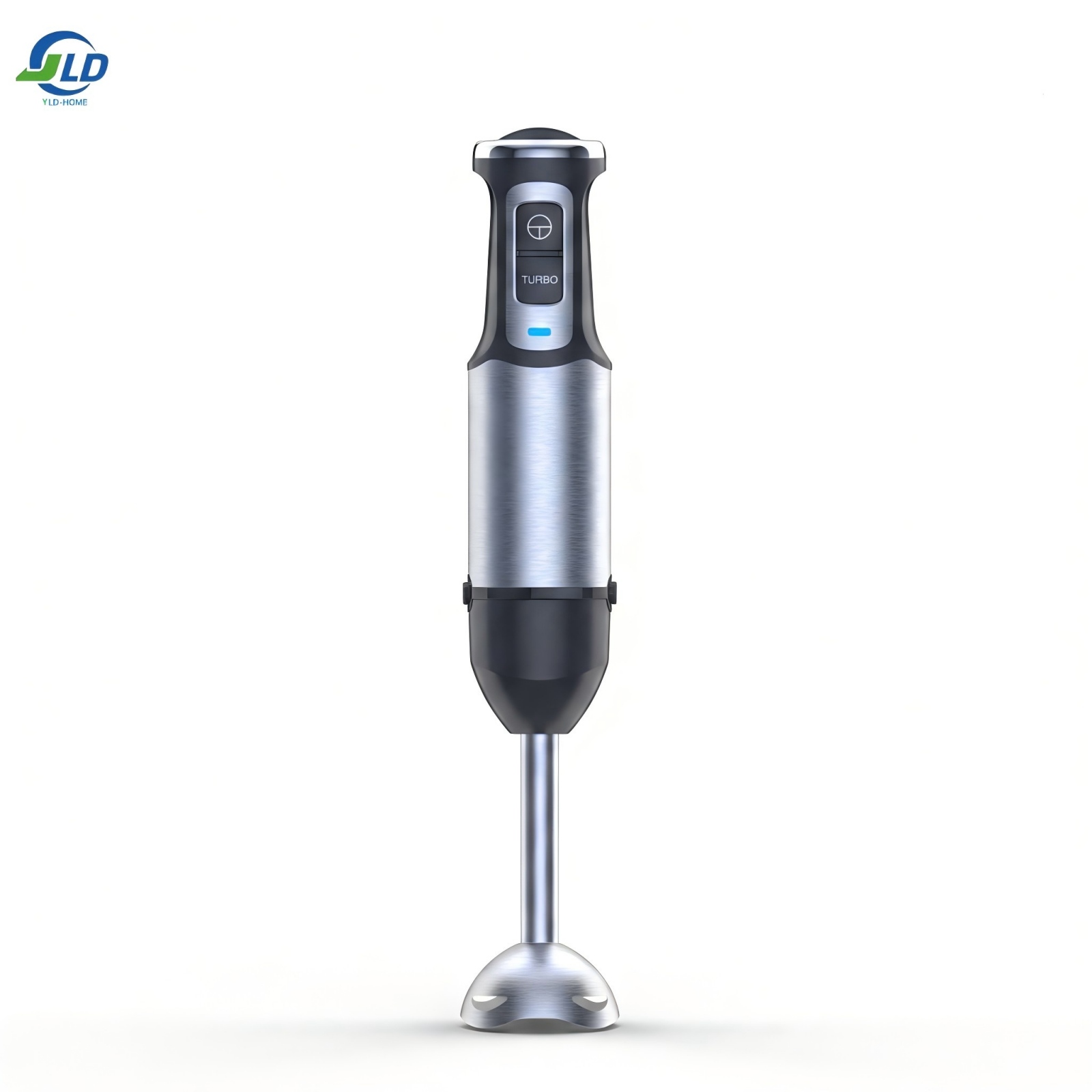
Smoothies are no longer a niche product in American foodservice. They’re on the menu at fast-casual chains, juice bars, coffee shops, gyms, hospitals, and school cafeterias, and the equipment that makes them matters more than the menu item itself. A stick blender for smoothies is the tool a growing number of US operators use to keep that program fast, clean, and profitable. YLD Home builds these units at our factory in Shenzhen, and we supply them to US distributors, foodservice buyers, and private-label brands. Our YouTube channel shows the factory floor and the appliance family behind those shipments. This guide covers everything a buyer needs to know, from blade specs to certification to wholesale pricing.
Why Smoothie Programs Are Everywhere in US Foodservice
The numbers behind the smoothie boom are hard to ignore. Food-service and drinking places sales in the United States have climbed for years, and the U.S. Census Bureau tracks that growth quarter by quarter. Beverage programs, especially blended drinks, are one of the fastest-growing parts of the foodservice pie. A coffee shop in Portland added smoothies and watched its afternoon ticket average jump by double digits. A hospital cafeteria in Chicago put a smoothie station near the entrance and started selling several hundred cups a day. The pattern repeats everywhere.
What changed is the customer. Smoothies stopped being a health-food store item and became an everyday purchase for commuters, parents, and gym members. That means volume, and volume means operators need equipment that keeps up. A countertop blender can make two smoothies at a time, but it ties up counter space, takes time to clean between flavors, and struggles with hot prep. An immersion mixer for smoothies blends directly in the serving cup or a large batch pitcher, which changes the workflow completely.
For foodservice buyers, the smoothie trend also changes procurement. Chains now buy blending equipment in volume, often with private label branding, and they need suppliers who can deliver certified, consistent units. That’s where factory-direct sourcing comes in. When you buy a stick mixer for smoothies wholesale from a manufacturer like YLD Home, you control the spec, the price, and the supply chain, instead of paying retail markup through a distributor who doesn’t own the production.
Immersion Blender for Smoothies vs a Countertop Unit
Short answer: for most US operations, yes. Long answer: it depends on your menu and your volume. The classic countertop blender is still the right tool for very high-volume smoothie bars that blend in batches of four to six cups at a time and need a 2-horsepower motor chewing through ice all day. But those machines are expensive, loud, and heavy, and they occupy prime counter space. A hand-held unit does the same job at a fraction of the cost, with less noise and a much smaller footprint.
Here’s the workflow we see working across US cafés and juice bars. The operator builds the smoothie in the serving cup: fruit, liquid base, protein powder, ice. Then they insert the stick blender for smoothies and blend for 20 to 40 seconds. No pitcher to carry, no second container to wash, no transfer step. The cup is the blending vessel. That saves several minutes of labor per hour compared to a pitcher-based workflow, and in foodservice, labor is the biggest cost line on the P&L.
The honest limits: if you’re doing 300 smoothies a day with heavy ice loads, you want a high-wattage unit, 500W or more, with a hardened blade. If your menu includes thick acai bowls that need a tamper, a countertop unit with a tamper is still the better fit. And if you need to blend directly in a 5-gallon batch for catering, the immersion unit wins easily. Most operators end up with both, but for the majority of smoothie programs, the hand-held unit becomes the daily driver. If you’re still deciding, our comparison of immersion vs hand vs stick blender explains the differences in plain language.
Power, Shaft, and Blade: What to Spec for Frozen Drinks
Blending frozen fruit and ice is the hardest job a hand blender can do, so the specs matter more here than for soup or sauce work. Start with the motor. For smoothies, we recommend a minimum of 400W continuous output, and 500W for operations that run all day. That’s the difference between crushing frozen strawberries in 25 seconds and beating them into warm mush in 90 seconds. The wattage printed on retail boxes is often peak wattage, which inflates the number; ask for continuous output.
| Spec | Minimum for smoothies | Recommended for high volume |
|---|---|---|
| Motor (continuous) | 400W | 500W+ |
| Shaft length | 7 inches | 9–10 inches |
| Blade type | 4-blade hardened | 4-blade hardened, reinforced |
| Speed control | 2 speeds | Variable + turbo |
| Duty cycle | 10 min continuous | 20+ min continuous |
| Shaft material | 304 stainless | 304 stainless |
The blade is where cheap units fail. Smoothie blending needs a blade that stays sharp through thousands of cycles with ice and frozen fruit. We use hardened four-blade assemblies with a slight upward pitch that pulls the product down into the vortex, so you don’t have to stir by hand mid-blend. The blade guard matters too: a welded guard stays tight, while a pressed one can loosen and start rattling within months. A juice bar owner in Austin told us the blade was the first thing they checked when a new supplier quoted them, because their previous units had needed blade replacements twice a year.
Shaft length depends on your cups and pitchers. For standard 16-ounce to 24-ounce cups, a 7-inch shaft is enough. For large batch pitchers and 5-gallon catering containers, go with 9 to 10 inches, or add an extension. One more detail: the shaft should be 304 stainless, not 201 or plated steel. Acidic fruit, especially citrus and pineapple, will corrode lower-grade steel over time, and that corrosion ends up in the food. The material certificate is a one-page document that settles this question; ask for it with your quote.
Real Tests: Frozen Fruit, Ice, and Thick Bases
We test smoothie blenders the way your customers will actually use them, which means frozen ingredients, not just water. Here’s our standard smoothie test at the factory. We blend a 20-ounce cup with 6 ounces of frozen mango, 2 ounces of frozen strawberries, 8 ounces of milk base, and 4 ounces of ice, and we measure the time to a consistent puree with no chunks. A passing unit does it in under 40 seconds at full speed. Then we run the same test twenty times in a row to check heat build-up, because that’s what a morning rush looks like.
The second test is the thick base. Peanut butter smoothies, protein shakes, and green smoothies with leafy greens are much harder to blend than fruit-and-juice combos, because they’re viscous and sticky. We test with a peanut butter and banana base and check that the unit doesn’t stall or overheat. A stall is usually a motor problem, not a blade problem, and it’s the most common complaint we get from foodservice customers. If a unit can’t handle a thick base, it can’t handle a real smoothie menu.
The third test is ice. We blend a cup of straight ice cubes with a little liquid and check for consistent crushing and the noise level. Ice is brutal on bearings and seals, so the ice test is also a durability test. Units that pass all three tests get the green light for foodservice; units that don’t get reworked or scrapped. When we send samples to US buyers, we tell them to run the same three tests in their own kitchen. A distributor in Miami did exactly that and told us the frozen mango test separated their shortlist instantly. And for operators who also prep dressings and whipped toppings, our hand mixer vs stand mixer guide sorts out which tool earns the counter space.
Compliance for US Kitchens: UL, ETL, NSF, and FDA
Selling a blending unit into US foodservice means certification, full stop. The electrical safety listing, UL or ETL, is the baseline. It certifies that the unit was tested for fire and shock risk at 120V, and US retailers, health departments, and insurance companies expect it. Always request the certificate for the exact model number you’re buying. Some suppliers show a certificate for a similar model, which is not the same thing, and it’s the kind of shortcut that surfaces during an inspection.
For foodservice specifically, NSF certification is the marker most operators look for. Health departments in many US jurisdictions, plus procurement rules at schools, hospitals, and chain restaurants, reference NSF standards for food-contact equipment. An NSF-listed hand blender for smoothies makes your sales conversation easier at every level. We offer NSF-listed versions of our foodservice models, and the price difference is modest at wholesale volume.
FDA food-contact compliance covers the materials themselves: the stainless shaft, the blade, and any plastic that touches the drink. Acidic smoothie ingredients make material quality non-negotiable. Ask for the material certificates and keep them in your compliance file. And don’t forget the cord and plug: everything ships with a US 120V plug and a cord long enough to reach from the outlet to the prep area without daisy-chaining extension cords, which health inspectors dislike. If you’re serving commercial customers, spec the certified package from day one, not as an afterthought. Our appliance certification page lists the standards and reports for every foodservice model we ship.
Wholesale and Private Label for Chains and Distributors
Smoothie equipment is sold in volume, and the wholesale side of the business is straightforward once you know the levers. YLD Home’s standard foodservice models start at a MOQ of 1,000 units. Private label with your brand color, logo, and packaging starts at 1,000 units. Full custom programs, with a dedicated mold and your own design, start at 2,000 units over the life of the tooling. Lead time for standard production is three to four weeks after sample approval, plus 30 to 45 days of sea freight to a US port.
Chains usually buy through a distributor or directly from us with a multi-year agreement. The typical chain program locks a spec, a price, and a delivery schedule, with buffer stock held by the distributor. A regional juice chain with 40 locations in Texas and Florida buys through a distributor we supply, and their reorders arrive monthly without a single stock-out in two years. That reliability is what a chain buyer is really purchasing, more than the unit itself. And if your foodservice customers also stock hand mixers for prep work, our hand mixer egg beater manufacturer line shares the same motor platform and QC flow, so one supplier covers both SKUs.
Private label is where the margin lives for most of our US customers. The same 500W unit that we sell wholesale under our brand carries a higher wholesale price under a private label with better packaging and a story attached. We handle the logo printing, the custom colors, the manuals, and the box design, and we keep the design exclusive to you in your market by contract. If you’re building a housewares or foodservice brand, start with our how to choose a commercial immersion blender guide, then talk to us about the private label roadmap.
Cost per Cup: The Menu Math Behind Smoothie Programs
Let’s do the math that buyers actually run, because equipment decisions come down to dollars per day. A 500W immersion mixer for smoothies costs a fraction of a commercial countertop blender that does the same job, and it needs no heavier motor base and far less counter space. If the hand-held unit replaces a countertop unit at one station, the equipment saving alone is real. But the bigger numbers are in labor and waste.
Labor: a cup-based workflow with an immersion unit takes noticeably less time per smoothie than a pitcher workflow, including cleaning. At a busy counter and $18 an hour loaded labor cost, that saving compounds every shift and adds up to a real annual number per station. Waste: blending in the serving cup means no transfer loss, and a clean blade between flavors means no flavor carryover, which is the quiet killer of smoothie margins. A café in Seattle told us they measured a double-digit percentage drop in wasted ingredients after switching from pitcher blending to cup blending.
Here’s a sample daily P&L for a single smoothie station, based on the numbers operators share with us:
| Line item | Countertop unit | Stick mixer for smoothies |
|---|---|---|
| Equipment cost | Más alto | Lower |
| Labor per day | Más alto | Lower |
| Waste per day | Más alto | Lower |
| Counter space | 2 sq ft | under 1 sq ft |
| Payback period | — | Inside the first season |
The equipment payback usually lands inside the first season when you count labor and waste together. That’s the number to put in front of an owner or a purchasing committee. Nobody buys a blender for fun; they buy it because the math works. When we sell to foodservice distributors, we give them a one-page cost sheet exactly like this, because it closes deals faster than any spec sheet.
Cleaning and Maintenance in a Busy US Kitchen
A smoothie station runs nonstop during peak hours, so cleaning has to be fast and the unit has to survive the abuse. The good news: a stick blender for smoothies is the easiest blending tool to clean in the entire kitchen. After each smoothie, disconnect the unit, hold the shaft under running water for five seconds, and pulse it in a cup of clean water for five more. That’s the whole cleaning routine, and it’s why operators prefer it over pitcher machines that need full wash-down between flavors.
End of shift, the unit gets a deeper clean. Blend soapy water for fifteen seconds, rinse, wipe the shaft dry, and store it hanging or on a dry rail. Never submerge the motor housing, and don’t run the unit dry, ever. Dry running is the number one killer of these units; the seal runs hot and warps. We print that warning on the packaging and on a laminated card that ships with every wholesale order, because we know training turnover is constant in foodservice.
Maintenance is a short list. Check the shaft seal monthly for leaks, replace the blade assembly when it gets dull or starts rattling, and keep the vents on the motor housing clear of dust. Order spares with your initial stock: one blade assembly per five units and one seal kit per three units. A distributor in New York told us that the spare parts they stocked at launch paid for the whole program, because their customers needed blade replacements faster than anyone predicted. Plan for it, and you’ll never have a customer down for a week waiting on a part.
Sourcing From China: Finding an Immersion Blender Vendor USA Buyers Rely On
The last step is choosing the supplier, and that decision determines everything else. When you look for an immersion blender vendor USA foodservice buyers can rely on, you’re really looking for three things: a factory that owns its production, a compliance package that’s real, and a partner who answers questions in plain language. YLD Home has been that vendor for US importers and distributors for years, and we can tell you what separates us from the trading companies that flood the market with lookalike products.
Start the search with the factory question. Can you visit the production line? If not, a real factory can show live video of it — our hand blender and juicer maker factory tour takes you through the floor. Who owns the molds, and what happens to them if you stop ordering? What’s the defect rate target, and who does the pre-shipment inspection? A real factory answers these directly. A trading company deflects. Then check the paperwork: UL or ETL certificate for the exact model, FCC documentation, FDA material certificates, and NSF if you need it. If any document is missing or vague, treat it as a deal-breaker.
Finally, check the track record. Ask for the names of US customers who will talk to you, and ask about reorder behavior, because reorders are the truest signal of a working relationship. Our US customers range from single-location juice bars buying through distributors to national brands running private label programs, and they all come back for the same reasons: consistent quality, honest lead times, and a factory that picks up the phone. If you’re building a smoothie equipment line for the US market, that’s the kind of vendor you want behind it, and our small kitchen appliance manufacturer in China page shows you the full product family we build.
Preguntas frecuentes
Q1: Can an immersion blender for smoothies handle frozen fruit and ice?
Yes, if you spec the right unit. You need at least 400W continuous output, a hardened four-blade assembly, and a 304 stainless shaft. With that spec, a 20-ounce smoothie with frozen mango, strawberries, and ice blends in under 40 seconds. Consumer-grade units with peak-wattage motors and thin blades will struggle, overheat, and leave chunks. For a foodservice program, buy the 500W version and you’ll never think about it again.
Q2: How is an immersion blender for smoothies different from a countertop blender?
The immersion unit blends directly in the serving cup or batch container, so there’s no pitcher to transfer, wash, or store. Countertop blenders blend in a fixed jar and are better for very high volumes and thick acai-style bowls. The immersion unit is cheaper, quieter, smaller, and easier to clean, which is why it’s become the daily driver at most US smoothie stations. Many operations keep one of each, using the countertop unit for specialty items.
Q3: What certifications does a smoothie blender need for US foodservice?
UL or ETL electrical safety listing at 120V, FCC compliance, FDA food-contact materials, and NSF if you sell to restaurants, schools, hospitals, or chains with NSF procurement rules. We build certified versions of all our foodservice models, and the certificates are issued for the exact model number you import. Keep the certificate files with your records; every serious buyer will ask to see them.
Q4: How many smoothies can one immersion blender make per hour?
A trained operator using the cup-based workflow can produce 30 to 45 smoothies per hour with a single 500W unit, including the rinse between flavors. In a two-unit station, that doubles. The limiting factor is almost never the blender; it’s the prep and the register. A juice bar in Miami runs a two-unit station through 150 smoothies over their lunch rush without the units overheating, because the duty cycle is rated for continuous use.
Q5: What’s the MOQ for wholesale smoothie blenders?
Standard foodservice models start at 1,000 units. Private label starts at 1,000 units, and full custom programs start at 2,000 units over the life of the tooling. A distributor in Texas started with a trial order of 1,000 units for their café customers, proved the demand in two months, and then placed a container order.
Q6: Can YLD Home do private label for my smoothie blender line?
Yes, and it’s one of the most common programs we run. You choose the model, the color, the logo treatment, the manual, and the packaging, and we handle production and certification. The design stays exclusive to you in your market by contract. Most US brands start with color-and-logo private label, prove sell-through, and move to custom tooling on the next generation.
Q7: How do I clean an immersion blender between smoothies?
Rinse the shaft under running water for five seconds, then pulse it in a cup of clean water for five seconds. That clears fruit residue and prevents flavor carryover. At the end of the shift, blend soapy water, rinse, wipe the shaft dry, and store it on a dry rail. Never submerge the motor housing and never run the unit dry. Those two rules will keep a unit alive for years.
Q8: What lead time should I expect for a smoothie blender order?
Standard production takes three to four weeks after sample approval, plus 30 to 45 days of sea freight to the US depending on your port. Air freight is available for launch quantities. A first order from signed PO to your warehouse typically runs 12 to 16 weeks. Plan the first order six months before you need stock, and reorders will be faster, because the sample, tooling, and freight setup are already done.
Official references
How YLD Home keeps stick blender for smoothies supply predictable
Every stick blender for smoothies order runs through IQC on incoming parts, IPQC on the line and OQC before packing, and YLD Home shares inspection and loading photos so you see the shipment before it sails. Ask for the stick blender for smoothies test report set for your market.