









Ask five European importers what changed in kitchen appliance sourcing over the past two years and you will get five different answers, all correct. One will talk about ocean freight that tripled, fell back, then spiked again on a single Red Sea diversion. Another will talk about General Product Safety Regulation paperwork that now sits between a confirmed order and a loaded container. A third will talk about retail buyers demanding ten functions at a three-function price. A fourth will describe moving volume to Vietnam, only to find the motor supplier and the moulds did not move with it.
This outlook is written for the people who carry that risk: importers, distributors, wholesalers and private-label owners buying small kitchen electrics from Asia for European, North American and Middle Eastern markets. It is a structural read of where cost, compliance, capacity and channels are heading in 2026, and what that means for how you negotiate, specify and audit.
If you take one idea from this article, take this: the unit price is no longer the main lever. Documentation, tooling ownership and sub-tier visibility now decide whether stock lands before your selling season.
1. The Cost Structure Behind a Kitchen Appliance in 2026
Most price negotiations fail because both sides argue about one number while seven cost layers move underneath it. A 500 W hand blender retailing at €39 in a German discounter is a stack of imported components, converted energy, printed packaging and paperwork, and each layer has its own price cycle.
Three layers are genuinely volatile. Plastics follow oil-linked resin: ABS for housings, PP for bowls and beakers, SAN and Tritan for jugs. Copper windings and motor steel follow metal markets, and motor cost also depends on magnet grade, the least predictable line item since 2023. Stainless steel for shafts, blades and bowls moves more slowly but has never returned to pre-2021 levels.
Two layers move on policy rather than markets. Electricity is a direct line in factory overhead, and industrial power tariffs vary by province and season, so identical products cost different amounts at factories 200 km apart. Packaging has become a compliance cost as much as a materials cost: multilingual cartons, recycling marks and separate print runs for UKCA and EU stock.
The layer buyers most often underrate is the cost of the order itself. Tooling amortisation, line changeover and minimum-run spreads are not fixed costs; they are cost per unit that falls as volume rises. That is why the same specification can be quoted at two very different prices without either factory lying.
| Cost layer | Indicative share of FOB price | Direction of travel | What actually moves it |
|---|---|---|---|
| Motor, gearbox and copper windings | 18–26% | Up | Copper and magnet-grade volatility, efficiency targets |
| Plastics: ABS housing, PP bowl, SAN jug | 12–18% | Volatile | Oil-linked resin, mould cycle time, colour changes |
| Stainless steel shaft, blades, bowl | 8–14% | Up modestly | Steel grade, blade geometry, polishing steps |
| Electronics, switch, cord set, plug | 7–11% | Down | Chip supply normalised; extra plug variants add cost |
| Packaging and multilingual labelling | 5–8% | Up | Board prices, compliance marks, per-market print runs |
| Direct labour and line overhead | 9–14% | Up | Coastal wage growth, shift patterns, turnover |
| Factory overhead, energy, QC and testing | 8–12% | Up | Power tariffs, test-house fees, AQL sampling |
| Tooling amortisation and MOQ spread | 3–8% | Down with volume | Order quantity, new mould or existing platform |
| Supplier margin | 8–12% | Partly recovered | Capacity utilisation, payment terms, order predictability |
Shares are indicative modelling ranges, not quotations. They shift quarter to quarter with resin, metal, energy and freight, and differ by specification, motor rating and volume.
The practical lesson: two cents engineered out of the design — a smaller motor with equal finished performance, one fewer plastic part, a carton that fills the pallet more efficiently — is worth more than two cents argued off a fixed specification. Engineering is where the margin is. Price pressure is where the relationship is spent.
2. Freight, Cash and Why the Unit-Price Conversation Is Exhausted
Landed cost, not FOB price, is what your finance director signs off. For a 40HQ container from South China to a European or Gulf port, freight alone can swing by a factor of two within a single year, and it is the most policy-sensitive line in the model. Red Sea routing, canal transits, peak-season equipment shortages and carrier capacity discipline all show up in a number that has nothing to do with the product.
| Corridor (40HQ, indicative spot) | Typical range | Transit time | What drives the swing |
|---|---|---|---|
| Shenzhen / Yantian → Rotterdam | USD 2,400–4,800 | 30–38 days | Peak-season equipment shortages, route diversions, capacity |
| Shenzhen / Yantian → Felixstowe or Southampton | USD 2,600–5,000 | 32–40 days | UK port congestion surcharges, inland haulage |
| Shenzhen → Jebel Ali | USD 1,800–3,600 | 16–22 days | Shorter leg, but rerouting can add ten to fourteen days |
| Ningbo → destination | ±10–20% vs South China | Comparable | Regional equipment availability, feeder schedules |
Indicative ranges only. Ocean rates are quoted per sailing and change weekly; treat any figure older than one quarter as expired.
Freight volatility has a second-order effect that matters more than the rate: it pushes buyers towards whole containers. A buyer committing to a mixed 40HQ of hand blenders, food processors and hand mixers absorbs a freight spike far better than a buyer shipping four partial loads. That rewards factories able to mix models on one line without a cost penalty.
Cash flow is the other half of the problem. Longer transit times and stricter compliance checks stretch the gap between deposit and revenue, so payment terms and shipping-date reliability matter as much as unit price. A supplier quoting two per cent higher and shipping three weeks earlier is usually cheaper once working capital is priced in.
3. Compliance Is Now the Critical Path, Not a Formality
The most consequential change in this industry is not a tariff line. It is that product compliance documentation now determines whether a container ships on time. Ten years ago, certificates were chased at the end of a project. Today the file is the project.
The clearest example is the EU General Product Safety Regulation, in force since 13 December 2024. It places obligations on the economic operator established in the EU, not merely on the manufacturer, and requires a named responsible person, traceability back to the batch, a documented risk assessment, and the ability to act on a safety issue after the goods are on shelves. The manufacturer must therefore supply consistent batch identification and technical documentation on request. A factory that cannot produce a coherent technical file puts your registration at risk, not just your shipment.
This runs alongside an older framework that has also tightened. Electrical safety, electromagnetic compatibility, restriction of hazardous substances, the Registration, Evaluation, Authorisation and Restriction of Chemicals regulation, and eco-design rules for energy-related products all apply to different parts of the same appliance. Harmonised standards in the International Electrotechnical Commission 60335 series sit behind most of them, and wireless features pull in the Radio Equipment Directive. None of this can be waived by a purchase order, and none of it is satisfied by a certificate naming a different model, voltage or plug.
| Markt | Electrical safety | EMC / wireless | Chemicals | Eco-design and energy | Product safety and traceability | Marking |
|---|---|---|---|---|---|---|
| Europäische Union | Low Voltage Directive 2014/35/EU; EN 60335 series | EMC Directive 2014/30/EU; Radio Equipment Directive for wireless | RoHS; REACH including SVHC disclosure | Eco-design for energy-related products; energy labelling where in scope | GPSR (EU) 2023/988, in force since 13 December 2024; EU responsible person; batch traceability | CE |
| Great Britain | Electrical Equipment (Safety) Regulations 2016 | Electromagnetic Compatibility Regulations 2016 | UK REACH; UK RoHS | Eco-design for Energy-Related Products Regulations | General Product Safety Regulations; UK responsible person | UKCA |
| United States | UL or ETL listing to the relevant UL 982 / UL 1083 style standard | FCC Part 15 Subpart B; Part 15C for wireless | California Proposition 65 | Department of Energy rules where applicable | Consumer Product Safety Act; permanent tracking label | UL or ETL mark |
| Canada | CSA or ULC certification | ICES requirements | Provincial substance rules | Natural Resources Canada efficiency rules | Canada Consumer Product Safety Act | cUL / CSA mark |
| GCC and Saudi Arabia | SASO technical regulation referencing IEC 60335 | GSO EMC requirements | GSO chemical restrictions | Energy efficiency rules where in scope | SABER platform registration; conformity certificate per consignment | G-Mark |
Two consequences follow. First, testing lead time is now project risk. Safety and immunity testing at an accredited laboratory, chosen from the EU list of notified bodies, takes two to five weeks per configuration, and a wireless variant or a new motor is a new configuration. Buyers who finalise specification six weeks before their shipping window have effectively chosen to ship late.
Second, certification is no longer a one-off purchase. Renewals, change notifications, factory inspection cycles and consignment-level conformity certificates for Gulf markets all recur. A supplier that treats compliance as a service, with a named owner of the file, saves an importer more time than one that treats certificates as a document to email once. Reputable testing houses such as TÜV are used routinely for this work, and buyers should expect a factory to be comfortable with them.
4. Supply Chain Reshaping: Fragmentation, Dual Sourcing and Sub-Tier Risk
Three structural shifts are visible at factory level, and they point the same way: orders are getting smaller and more frequent while supply chains are getting longer and harder to see.
Fragmentation. Retail demand has become more volatile, so importers hold less inventory and place smaller, more frequent orders. Where a distributor once booked one annual container per SKU, they now book three or four smaller consignments. This punishes factories built purely for long runs and rewards flexible changeover and mixed-model lines. It also raises per-unit cost unless the factory recovers efficiency elsewhere, which is why the smallest orders are rarely the cheapest per unit.
MOQ under pressure. Minimum order quantities are drifting down for stock models and colourways, because flexible tooling and shared mould platforms make smaller batches viable. They are not drifting down for genuinely new tooling: a new housing mould is still a five-figure investment with a physical minimum run. The practical answer for most private-label buyers is to launch on an existing platform with brand-specific colour, handle, carton and accessory set, and invest in new tooling only after sell-through is proven.
Capacity diversion versus supply depth. Vietnam, India, Thailand and increasingly Malaysia have absorbed a meaningful share of new small-appliance capacity. For simple assemblies the case is often good; for a ten-in-one hand blender set it is more complicated. The finished product may be assembled outside China while the motor, gearbox, blade stamping, food-grade moulding and printed carton still come from Chinese sub-suppliers. The origin of assembly is not the origin of the supply chain, and moving assembly without moving the sub-tier adds cost, lead time and risk.
That leads to the least discussed risk in the category: sub-tier subcontracting. When a factory is busy, part of a run is often subcontracted, or components are sourced from a different motor or resin supplier than the approved sample. This is how a shipment lands with a motor one grade lower and still passes casual inspection. The controls that prevent it are contractual: a documented bill of materials with named sub-suppliers, a change-notification clause, lot-level traceability, and inspection against the golden sample rather than the drawing alone.
5. Channels and Product Trends Shaping the Range You Buy
Private label keeps taking share. Retailers, marketplaces and buying groups continue to expand own-brand small appliances because the margin is better and the shelf is controllable. That shifts the buyer’s job from selecting a catalogue item to specifying one: performance targets, motor rating, noise, accessories, carton design, instruction languages, warranty terms and packaging compliance all become your decisions. It also makes tooling ownership a commercial question rather than a technical one — if you paid for the mould, the mould should be documented as yours.
Marketplace requirements are packaging requirements. Amazon, OTTO, Kaufland and comparable platforms impose their own last-mile constraints. Cartons must survive a meaningful drop test without concealed damage, because marketplace returns are expensive and the reason is often recorded as a product defect. Packaging must carry the right recycling and traceability marks per market. Aesthetics matter less than test performance: an elegant carton that fails the drop test produces a returns rate that erases the margin.
Multi-function versus single-function is a retail logic problem. The ten-in-one argument is easy to sell online and hard to defend in the kitchen. Multi-function kits raise average order value and reduce the number of SKUs a buyer must carry; single-function products win on performance, cleanability and price. The sensible range strategy in 2026 is layered: a ten-in-one starter kit as the volume hero, a two or three function set for buyers who want performance, and a single-function everyday blender at entry price. Range questions are usually answered by a platform sharing one motor and shaft family, not by dozens of unrelated tools.
HORECA demands durability, not features. Hotels, restaurants and catering buyers judge a blender on continuous-run capability, duty cycle, shaft and bearing wear and blade replacement cost. A domestic-grade unit that survives a home kitchen will fail in a professional one. If you sell into foodservice, the conversation should be about motor duty rating, sealed bearings, stainless steel grade and spare shaft availability — not accessory count.
6. A Practical Buyer Decision Checklist for the 2026 Order Cycle
Buyers who get this right run the same checks on every supplier, in the same order, before they argue about price. The list is deliberately short, because a checklist nobody uses protects nobody.
| Check | What good looks like | Gewicht |
|---|---|---|
| Certification file | Test reports and declarations naming the exact model, voltage and plug; EU or UK responsible person in place; batch traceability documented | Hoch |
| AQL inspection | Pre-shipment inspection at 1.5 major / 4.0 minor or tighter; third-party inspection welcomed, not resisted | Hoch |
| Drop and transit testing | Documented carton drop and vibration testing; packaging validated for marketplace and pallet handling | Mittel |
| Tooling ownership | Mould ownership, custody and retrieval terms in the agreement, with drawings and part numbers attached | Hoch |
| Spares and after-sales | Defined spare parts list, price and lead time; warranty terms; English service documentation; named contact | Mittel |
| WEEE and packaging compliance | Clear split of registration duties: producer responsibility for electrical equipment and LUCID packaging registration on the importer side, with the data the factory must supply | Hoch |
| Capacity and sub-tier visibility | Named sub-suppliers for motor and key mouldings, change-notification clause, realistic monthly capacity commitment | Mittel |
| Change management | Written notification of any material, component or production-site change, with re-approval required | Mittel |
Run this as a weighted scorecard rather than a set of yes-or-no questions, because very few suppliers score well on everything. The point is not to find a perfect factory, but to know exactly which risk you are accepting, and to price it.
Two items deserve emphasis because buyers most often leave them to chance. The first is the responsible-person structure: under EU rules including GPSR, and equivalent UK rules, the obligation lands on an operator established in the market, so the importer or an appointed representative must be identifiable on the product or its packaging. That is a structural commitment, not a document. The second is packaging registration. Extended producer responsibility schemes, including the LUCID register in Germany, sit with the party placing packaged goods on the market. Factories can supply data on volume, material and weight, but they cannot register on your behalf. Deciding who does what before the print run is far cheaper than deciding afterwards.
7. How YLD Home Is Structured for This Cycle
We do not think the answer to a harder sourcing environment is a lower price. It is a supply chain that absorbs variability without breaking.
YLD Home operates a 25,000 m² manufacturing workshop with five production lines and a monthly finished-goods capacity of 600,000 units. Four quality checkpoints run through every order: incoming quality control on materials, in-process inspection on the line, final quality control before packing, and outgoing quality control before the container is sealed. Sampling is set at AQL 1.5 for major defects and AQL 4.0 for minor defects, and third-party inspection is welcome at any stage, not only at the end. We would rather a buyer finds a problem in our workshop than in their warehouse.
Because we run both stock platforms and private-label projects, we can support buyers who need a small first batch to test the market and then scale, on the same motor and shaft family, into volume. Colour, handle, accessory set, carton and instruction languages can all be specified under your brand. Tooling, documentation and certifications are prepared against the exact configuration you will import, and the same specification drives inspection, so what is approved is what is shipped.
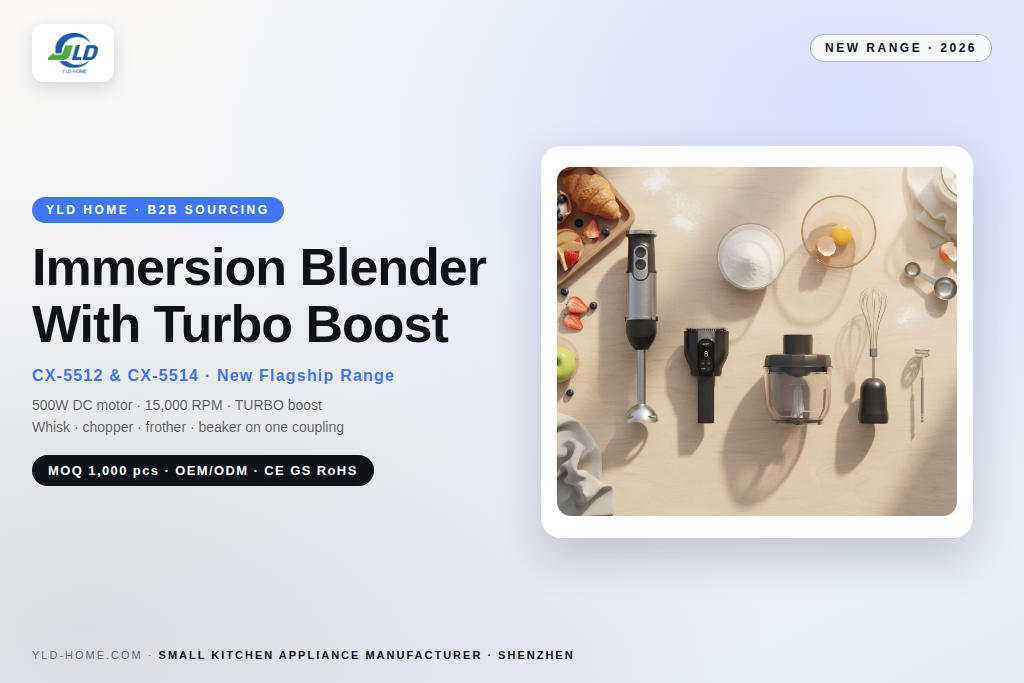
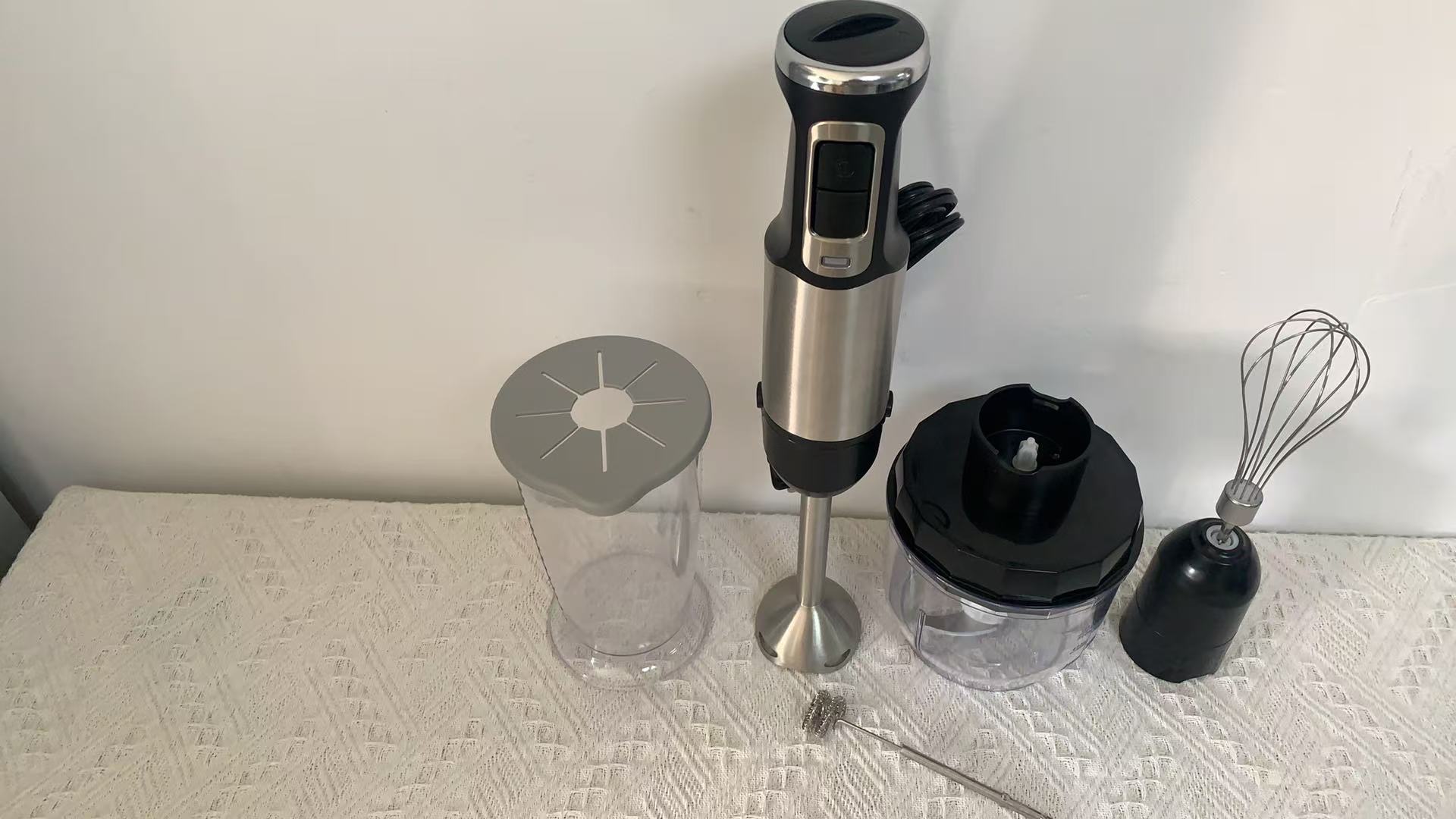
That is the model behind our wholesale hand blender range: one platform, several configurations, so a distributor can build a coherent shelf without a dozen unrelated tooling investments. The same thinking applies to the Stabmixer-Set family and our Küchenmaschine line, and it is why buyers visiting the factory usually spend more time in the quality control area than in the showroom. The fastest way to shorten your due-diligence cycle is to tour the factory and inspect the line that will run your order; the customer visits archive shows how other importers structured their projects, and the answers to the questions above are published in our FAQs.
Häufig gestellte Fragen
How much will kitchen appliance costs rise in 2026?
Nobody can give you an honest single number. Direction is more useful: motor and copper-linked content, labour and compliance testing costs are moving up, while electronics and tooling spreads move down. Use ranges, re-quote every quarter, and treat any price held for six months as a price that already contains a buffer. YLD Home quotes against the specification you actually need, so you can see which line items move when the specification changes.
Does GPSR apply to small kitchen appliances, and who is responsible?
Yes. The EU General Product Safety Regulation has applied since 13 December 2024 and covers consumer products including small kitchen electrics not already governed by specific sector legislation. Responsibility sits with the manufacturer, importer or authorised representative established in the EU, and it requires traceability, documented risk assessment and the ability to take corrective action. YLD Home supplies batch-level identification, technical documentation and change records so our customers’ responsible person has what they need; the market-side registration stays with the operator placing goods on the EU market.
What is a realistic MOQ for a private-label hand blender?
It depends on whether the tooling already exists. On an existing platform with your own colour, handle, accessory set and carton, minimum order quantities are modest and can be discussed per project. A new housing mould, however, sets its own minimum. YLD Home handles both, and will tell you honestly whether your design needs new tooling or whether an existing platform gets you to market faster.
Can I have third-party inspection before shipment?
Yes, at any stage. YLD Home inspects internally through four checkpoints — IQC on incoming materials, IPQC on the line, FQC before packing and OQC before the container is sealed — at AQL 1.5 major and 4.0 minor. Third-party inspectors are welcome on top of that, and we schedule access so inspection does not delay the sailing.
Who owns the mould if I pay for the tooling?
The buyer. If your brand pays for a mould, ownership, custody and retrieval terms should be written into the agreement with drawings and part numbers attached. YLD Home documents tooling ownership explicitly, so there is no ambiguity later if you move production or change supplier.
How long does certification take, and what can run in parallel?
Safety and EMC testing at an accredited laboratory typically takes two to five weeks per configuration, and a new motor or wireless variant is a new configuration. Specification freeze, artwork, packaging data and responsible-person arrangements run in parallel. YLD Home prepares the technical documentation package and coordinates with the test house so laboratory, packaging and production timelines overlap rather than queue.
Can you support mixed containers and small first orders?
Yes. Mixed loads of hand blenders, hand mixers and food processors on one container are a normal request, and one of the better defences against freight volatility. YLD Home runs five production lines and 25,000 m² of workshop space, so we can sequence a small first batch for market testing and scale it once sell-through data arrives, without changing the platform underneath.
What to Do in the Next Ninety Days
The buyers who will have the easiest 2026 are those who treat sourcing as a documentation and engineering exercise rather than a negotiation. Freeze the specification, name the responsible person, agree the tooling terms, validate the packaging, and put inspection in the plan before the sailing date.
If you would like to work through these points against your own range, our team will quote against your specification, share the certification and inspection documentation you need, and arrange a factory visit at your convenience.
Request a quote from YLD Home and we will come back with specification, compliance file and lead time on the same page, so the first conversation is about your product rather than paperwork. For buyers comparing suppliers in parallel, keep the checklist above and score every candidate on it: a factory that answers all eight lines clearly is worth a second meeting, and yld-home.com is happy to be measured on that basis.