










Immersion Blender Demand in the Middle East Foodservice Sector
Walk into the back kitchen of a hotel in Dubai or a catering operation in Riyadh and you will find the same tool doing the heavy lifting: a long-shaft immersion blender buried in a pot of soup or a five-litre drum of hummus. The Middle East runs on fast, high-volume food, and the equipment that keeps that food moving is bought by operators, not shoppers. That distinction is what makes immersion blender foodservice demand so different from anything you will encounter in the retail channel.
This guide is written for importers, distributors and catering-equipment suppliers servicing the Gulf and the wider Middle East. It explains where immersion blender foodservice volume comes from, what commercial kitchens actually need from a machine, how certification differs by country, and how to build a supply programme that survives the duty cycle of a working kitchen.
Why the Middle East Buys So Many Immersion Blenders
The region’s foodservice sector expanded faster than almost any other part of the world’s hospitality market, driven by tourism, mega-events, cloud kitchens and a young population that eats out often. Hotels, restaurants, cafés, catering companies and central kitchens all blend something every day. Hummus, baba ghanoush, soups, sauces, marinades, smoothies and desserts are staples, and each one calls for fast, repeatable blending in large vessels.
Immersion blender foodservice buyers do not shop on looks. They buy on duty cycle, shaft length, motor durability and the cost of keeping the kitchen running. A machine that overheats halfway through lunch service is a machine that will be returned and replaced from a competitor.
Retail Blender vs Commercial Immersion Blender
The difference between a consumer stick blender and an immersion blender foodservice model is not cosmetic. Domestic units run for thirty seconds at a time. Commercial units run for minutes, repeatedly, through thick mixtures and hot liquids.
| Merkmal | Retail Hand Blender | Immersion Blender Foodservice Unit |
| Motor | 200–800W, intermittent | 500–1,200W, continuous-rated |
| Duty cycle | Short bursts | Repeated long runs |
| Shaft | Plastic or short stainless | Long stainless steel, often 30–50 cm |
| Vessel compatibility | Small cups | 20–100 litre pots and drums |
| Cooling | Passive | Fan or heatsink, thermal cut-out |
| Anhänge | Whisk, chopper | Whisk, heavy-duty blade bell |
A commercial buyer expects the machine to survive a working kitchen, not a weekend kitchen. Suppliers who understand the immersion blender foodservice segment build accordingly.
Who the Buyers Are in the Middle East
Immersion blender foodservice demand flows through several distinct buyer types, and each one buys differently.
- Hotel groups and resorts** buy in volume, demand brand consistency and expect service support across multiple properties.
- Restaurant chains and cloud kitchens** prioritise durability and fast replacement, because downtime costs covers.
- Catering and central kitchens** need large-batch capacity and heavy daily duty cycles.
- Catering-equipment distributors** stock a range for resale to operators and want margin, spare parts and training material.
- Institutional buyers** such as hospitals, schools and military kitchens run procurement processes and value warranty terms.
Mapping which of these you serve decides the model mix you import, the certifications you need, and the spare-parts stock you hold.
Applications That Drive Volume and Specification
The recipes themselves set the specification. A kitchen making hummus every morning needs a blade bell that handles dense chickpea paste without stalling. A soup kitchen needs a long shaft that reaches the bottom of a tall pot. A juice bar needs a machine that blends fruit fast and cleans quickly.
Common immersion blender foodservice tasks include:
- Large-batch hummus, tahini and dips.
- Soup and stew finishing directly in the cooking pot.
- Sauce and gravy emulsions.
- Marinades and spice pastes for grills.
- Smoothies, lassi and dessert bases.
- Baby food and puréed dishes in hospital and hotel kitchens.
Each task stresses the motor differently. A supplier who asks what your customers blend will match motor, shaft and blade to the job rather than guessing.
Motor Power and Duty Cycle for Commercial Kitchens
In an immersion blender foodservice unit, the duty cycle matters more than the peak wattage. A kitchen does not need a 1,200W motor that runs for forty seconds; it needs a 700W motor that runs reliably for twenty minutes.
The technical points to confirm:
- **Continuous rating.** The rating label should reflect the intended commercial use, not a short burst.
- **Thermal protection.** A cut-out that trips cleanly protects the motor and avoids a fire risk.
- **Cooling design.** Ventilation and heatsinks keep the winding temperature down during long runs.
- **Gear and bearing quality.** Heavy mixtures load the drive, so bearings and gears must be specified for commercial duty.
YLD Home builds hand blenders and immersion units around motor transparency, specifying the winding material and duty cycle up front so buyers know exactly what they are placing in a working kitchen.
Certification by Country in the Middle East
Certification is where Middle East imports get complicated, because each Gulf state has its own scheme layered on top of the regional standards. Buyers of immersion blender foodservice equipment should prepare for:
| Country | Scheme | Notes |
| GCC-wide | G-Mark | Regional mark for low-voltage appliances |
| Saudi-Arabien | SABER / SASO | Registration and shipment certificates |
| UAE | ESMA / ECAS | Product registration before sale |
| Kuwait | KUCAS | Technical conformity and labelling |
| Katar | QGOSM | Standards conformity |
| Oman | DGSM / MoCI | Conformity assessment |
The Gulf standards body publishes the technical regulations behind the G-Mark, and a regional body such as the GCC Standardisation body coordinates that framework. A supplier experienced in the region will know which scheme your destination country applies and will prepare the technical file accordingly.
| Common Requirement | Detail | Buyer Action |
| Voltage / frequency | 220–240V, 50Hz | Confirm the build is 220–240V |
| Stecker | Type D / G / C variants | Specify per country |
| Language | Arabic and English labels | Check the packaging artwork |
| Food contact | Safe for food use | Request the material report |
| Rating label | Model, voltage, importer | Verify before shipment |
Immersion blender foodservice stock that clears customs without a hitch almost always comes from a supplier who has done this before.
Regional Cooking and Model Selection
The Middle East is not one kitchen. Levantine cuisine leans on dips and grilled meats, Gulf cuisine on rice dishes and stews, and the region’s large South Asian population adds curries and lentil dishes to the menu. An immersion blender foodservice range should cover all of them.
Model selection usually follows three tiers:
| Tier | Typical Power | Shaft Length | Target Operator |
| Light commercial | 500–700W | Short to medium | Cafés, juice bars |
| Standard commercial | 700–900W | Mittel | Restaurants, hotels |
| Heavy commercial | 900–1,200W | Lang | Central kitchens, catering |
Stocking the wrong tier for your buyers is the fastest way to lose an immersion blender foodservice account.
Sanitation, Hygiene and Food Safety
Commercial kitchens are inspected, and equipment that is hard to clean becomes a hygiene problem. Buyers look for detachable shafts, dishwasher-safe components where possible, and smooth surfaces that do not trap food. A blade bell that is difficult to strip down slows the kitchen and raises the risk of a failed inspection.
Food-contact materials should be confirmed safe, and the supplier should provide material reports on request. In an immersion blender foodservice programme, hygiene documentation is as important as the motor specification.
Buyers also ask about material durability, because commercial cleaning uses stronger detergents and higher temperatures than a home kitchen. Stainless steel shafts and food-grade plastics resist that routine far better than cheaper substitutes, and they keep their finish through years of service. Ask your supplier for the material specification and the cleaning guidance, then pass both to your distributors so kitchens use the equipment correctly.
Matching the Machine to the Workload
A cloud kitchen making hundreds of portions a day stresses a motor differently from a hotel pastry section preparing small batches. Matching the machine to the workload is the supplier’s job, and it begins with a simple question: how many litres does this kitchen blend in a day, and in what burst length? The answer decides the power tier, the shaft length and the attachments you order, and it prevents the all-too-common mistake of selling a light commercial unit into a heavy commercial job.
Freight, Documentation and Customs
Every immersion blender foodservice shipment needs the technical file matched to its destination. Keep the conformity documents, the commercial invoice and the packing list aligned, because a mismatch at customs holds the container and delays an operator waiting for equipment. Work with a clearing agent who knows the region, and confirm the documentation set before the goods leave Shenzhen. Preparation at the factory stage is what keeps a Gulf shipment moving.
Spare Parts and Service in a Working Kitchen
Downtime is the hidden cost of commercial equipment. A restaurant cannot send a blender away for three weeks; it needs a replacement blade, a new shaft or a spare motor within days. Distributors serving the immersion blender foodservice channel should stock the parts that fail: blades, seals, shafts, motors and switches.
YLD Home keeps spare parts on site and holds a 12-month warranty on finished models, which lets distributors support kitchens locally without waiting on a long return cycle. Ask any supplier how fast they can ship a replacement shaft before you commit to a container.
MOQ, Samples and Lead Time
Sample an immersion blender foodservice unit before you order volume. Run it through thick hummus and hot soup, on repeat, and check the motor temperature afterwards.
YLD Home works from 100 units per model, with a 500-unit minimum on hand blender platforms that carry heavier tooling. Samples ship in 5 to 7 days and the fee is credited against the first production order. Volume production runs 25 to 35 days from deposit and approved artwork, on FOB Shenzhen terms with a 30% deposit and the balance before shipment. Our guide to MOQ, samples and lead times covers the detail.
Logistics Into the Gulf
Most immersion blender foodservice cargo enters the region through Jebel Ali in the UAE, with Dammam and Jeddah serving Saudi Arabia and Hamad serving Qatar. As with any long ocean route, carton strength and pallet stability matter; a master carton that crushes in transit damages the tool inside.
Plan the freight route before you fix your landed cost. Sea freight to the Gulf is cost-effective for volume, but lead times are long, so build slack around major hospitality openings and event seasons.
Building a Distributor Programme
If you are a catering-equipment distributor, an immersion blender foodservice programme should include more than product. Ask your supplier for:
- Marketing images and technical sheets in English and Arabic.
- Demonstration videos showing the machine in a working kitchen.
- Spare-parts kits and a parts list with prices.
- Warranty terms and a clear claims process.
- Training material for your sales team.
A supplier that provides the commercial package, not just the machine, turns a one-off order into a repeat relationship.
Choosing the Right Supplier
Shortlist suppliers who already sell into commercial kitchens. Test them on the technical questions: duty cycle, cooling design, blade material, seal quality and spare-parts availability. A supplier who cannot answer these is a supplier who has only experience with retail.
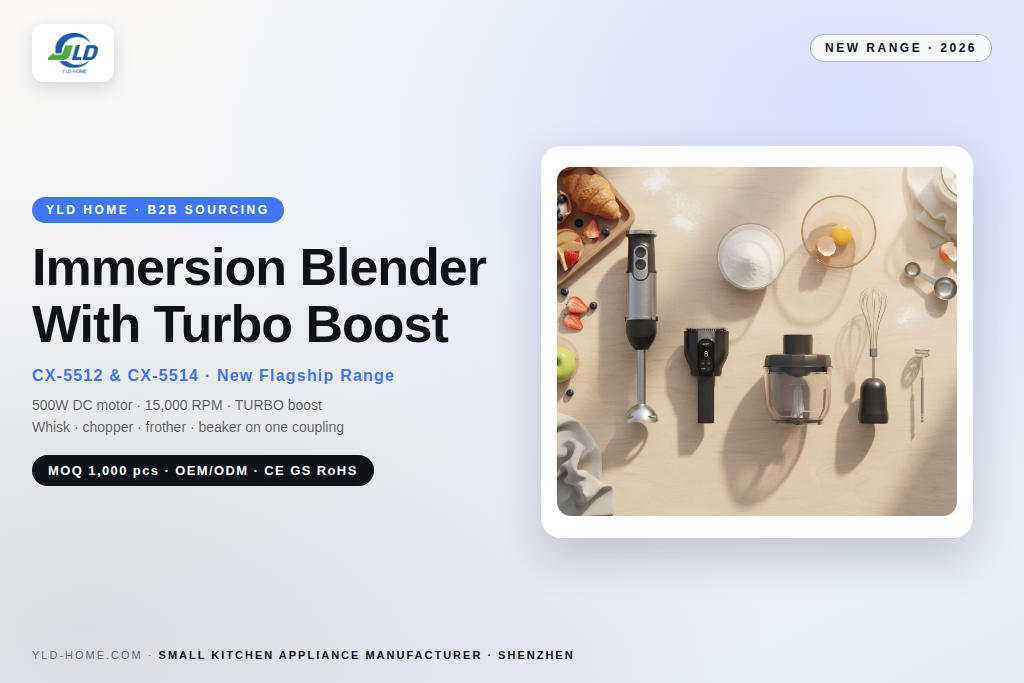
YLD Home manufactures small kitchen appliances in Shenzhen, with a 15,000 m² plant, five production lines and 62 machines, and more than a decade of export experience. Its hand blenders and immersion units are built to the voltage, plug and packaging each market requires, and the range can be configured for commercial use. For a broader view of supplier evaluation, our B2B buyer checklist for choosing a hand blender supplier applies well to commercial sourcing.
Mistakes That Cost Middle East Importers
- Ordering retail-rated units and selling them into commercial kitchens.
- Assuming one plug fits the whole region.
- Ignoring country-specific conformity schemes until the shipment arrives.
- Under-stocking spare parts and losing a distributor to a competitor’s service.
- Choosing the cheapest motor and paying for it in warranty claims.
- Skipping the duty-cycle question because the wattage looked impressive.
Each of these has ended a Middle East immersion blender foodservice programme, and each is avoidable with a short technical checklist.
Training and Demonstration Support
Commercial buyers want to see the machine work before they commit. Provide demonstration videos and, where practical, a sample unit for your distributor’s showroom. Kitchens buy what they can picture in their own space, so a clip shot in a working kitchen converts better than a specification sheet.
Ask your supplier for demonstration content in English and Arabic. YLD Home prepares product imagery, specification sheets and multilingual manuals for its clients, which shortens the path from enquiry to a foodservice order.
Warranty and Service Contracts for Commercial Use
Commercial equipment is used harder than domestic appliances, so the warranty conversation starts earlier. Agree what the immersion blender foodservice warranty covers, how long it runs, and how a replacement reaches a working kitchen. A distributor who can swap a unit within a day protects both the operator’s service and their own reputation.
Expect to negotiate the commercial warranty separately from a retail term, because duty cycles differ. A supplier who understands commercial use will set realistic conditions rather than pretend a domestic warranty covers a busy kitchen.
Energy and Noise in a Busy Kitchen
A noisy immersion blender foodservice unit disrupts a narrow kitchen, and buyers notice. A quieter motor at the same power sells better in open kitchens and cafés. Ask for the noise level at typical load and test it alongside the power rating. Energy use matters too, since a higher-efficiency motor costs less to run across thousands of service hours, and operators watch running costs closely.
Corded or Battery: What Commercial Kitchens Choose
Corded units still dominate immersion blender foodservice sales, because a working kitchen runs far longer than any battery. Battery models suit light service and novelty menus but rarely survive a full catering shift. For most Middle East buyers, a corded 220–240V unit with a long shaft remains the sensible default, and it comes without the charging downtime that slows a service line.
Building a Catering-Equipment Distributor Programme
Distributors are the fastest route into the immersion blender foodservice channel. Give them more than product: technical sheets, demonstration videos, spare-parts kits, a clear price list and training material. A distributor who understands the machine sells it confidently and supports it well, which protects the brand long after the container is unloaded.
Keep a small buffer of your best-selling models in stock, because kitchens decide fast and buy fast when equipment fails. A distributor who turns away an urgent immersion blender foodservice order because the next container is still at sea loses that customer to a competitor.
Authoritative sources
- [European Commission single market for goods](https://single-market-economy.ec.europa.eu/)
- [International Trade Administration market guides](https://www.trade.gov/country-commercial-guides)
Häufig gestellte Fragen
What makes an immersion blender foodservice model different from a retail one?
The motor rating, duty cycle, shaft length and cooling design all change for commercial use. YLD Home specifies the winding material, duty cycle and thermal protection up front, so an immersion blender foodservice unit can run repeatedly through thick mixtures and hot liquids without overheating.
Which certifications do I need for the Gulf?
Most Gulf states require the G-Mark, with Saudi Arabia using SABER and SASO, the UAE using ESMA, and Kuwait, Qatar and Oman running their own schemes. YLD Home issues CE, CB, EMC, LVD, REACH, RoHS, UKCA, ETL and FCC documentation and prepares the market-specific file each destination needs.
What voltage and plug should I specify?
The Middle East runs on 220–240V, 50Hz, so order that build rather than a 120V unit. Plug types vary by country, with Type G, Type D and Type C found across the region. YLD Home builds to the configuration your market uses and labels accordingly.
What is the minimum order quantity?
YLD Home starts at 100 units per model, with a 500-unit minimum on hand blender platforms that carry heavier tooling. Samples ship in 5 to 7 days and the fee is credited against your first production order.
How quickly can spare parts ship?
YLD Home keeps motors, blades, shafts and seals on site so replacement parts move quickly. That matters in an immersion blender foodservice programme, where a kitchen cannot wait weeks for a new blade or shaft.
How long does production take?
Volume production runs 25 to 35 days from deposit and approved artwork on FOB Shenzhen terms. YLD Home confirms a milestone schedule at the start and shares inspection photos so you can follow the batch before it sails.
Can I add my own brand and packaging?
Yes. YLD Home runs OEM, ODM and private-label programmes covering your logo, colour, rating label, gift box and manual, with Arabic and English packaging options and certification re-issued in your brand name where required.
Next Steps for a Gulf Programme
Building an immersion blender foodservice range for the Middle East starts with the buyer, not the product. Decide whether you serve hotels, restaurants, central kitchens or distributors, then match motor power, shaft length and attachments to the work those kitchens do. Confirm the voltage, the plug and the conformity scheme for each country, stock the spare parts that fail, and sample before you order volume.
YLD Home has manufactured small kitchen appliances in Shenzhen for more than a decade, with hand blenders and immersion units at the core of its export range. If you are preparing an immersion blender foodservice order for the coming season, request a sample and a full document pack, then judge the response as carefully as the spec sheet.
Browse the hand blender range und die hand mixer range, take the factory tour, read the wholesale FAQs, oder request a quotation with your target specification and volume.