










Two controllers on one blanket looks like a marketing feature until you have to build it, cost it, certify it, and take it back as a return. Then it becomes an engineering and commercial decision. A dual control electric blanket is not a single-zone blanket with an extra plug moulded on: it carries two independent heating circuits, two sensing points, two switching paths, and two failure modes a buyer will notice separately.
For retail buyers, brand owners, and distributors adding heated bedding to a range, five questions decide the programme: how the two sides are wired, what the second zone adds to landed cost, why king and queen sizes need it, whether one controller can be replaced, and what it does to the return rate.
This guide answers them with manufacturing detail rather than brochure language, from YLD Home, a kitchen appliance manufacturer since 2012 that now builds heated bedding on the same controlled assembly and test lines.
What a Dual Control Electric Blanket Actually Contains
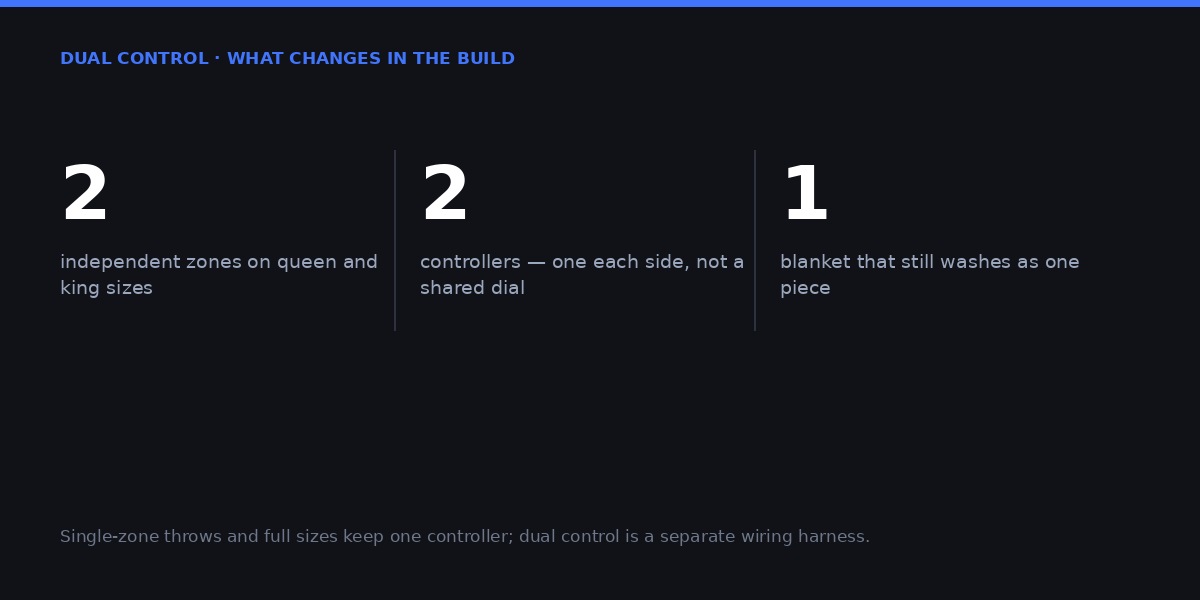
Strip the cover off a dual control electric blanket and you find four things a single-zone blanket does not have: a second resistive circuit, a second temperature sensor, a second switching device inside a second controller, and a physical separation between the halves so the circuits never overlap.
Everything else is shared: one textile shell, one overheat protection strategy, one carton. The cost of dual control therefore sits in a narrow band of components and a slightly longer test cycle, not a different product architecture, which is why it runs on the same line as a single-zone model.
| Mattress width | Typical size name | Zones | Controllers in carton | Typical total output |
|---|---|---|---|---|
| Under 115 cm | Single, twin | 1 | 1 | 60–80 W |
| 115–140 cm | Double, full | 1 (two optional) | 1 | 90–110 W |
| 145–160 cm | Queen, small double | 2 | 2 | 2 × 55–65 W |
| 165–200 cm | King, super king | 2 | 2 | 2 × 60–70 W |
How the Two Controllers Are Wired
The wiring question is where most sourcing conversations go wrong, because “two controllers” can describe three architectures with very different service and cost profiles.
Two independent circuits, not one wire folded in half
The heating element in a dual control electric blanket is produced as two parallel resistive circuits, split down the centre line. Each is a continuous path from its own connector pin, across one half of the bed, and back. They share only the incoming supply and the mechanical construction.
Between the halves sits a dead band, typically 40–60 mm wide at the centre spine, where there is no heating element at all. If the two circuits overlapped, the overlap would run at roughly double the watt density of the rest of the surface, creating a hot spot precisely where body weight concentrates — the exact condition the thermal cut-out exists to catch.
Each zone has its own thermal protection
Inside each element tail, in series with the heating circuit, sits a non-resettable thermal fuse, typically rated 90–110 °C. It opens permanently if that zone overheats. This changes your service strategy: a dead zone is not automatically a dead controller. It may be a fuse that did its job, so the blanket, not the controller, is the failed part.
The controller adds a second layer: a current fuse, a double-pole switch, an auto-off timer in the 1–10 hour range, and either a bimetal thermostat or an NTC sensor loop. The two are not interchangeable when you source a spare.
- Bimetal controllers switch on temperature directly over a two-core connection. Cheap, robust, imprecise: expect hysteresis of several degrees.
- NTC controllers read a sensor in the element tail over a third wire and drive a relay or triac against a curve. Tighter control, higher cost.
A dual control electric blanket built on NTC control gives the side-to-side consistency premium listings advertise. It also means a replacement controller must match the sensor curve, not just the plug.
What happens at the connector
Two architectures exist, and they cost almost the same while behaving very differently in the field.
1. Two separate keyed connectors at the foot end, one per zone. Colour coding or moulded L/R marking lets a user match controller to zone. Service is easy: a controller is a standalone part.
2. A single moulded Y-lead carrying both zones through one 6- or 8-pin plug into a splitter, with two controllers plugged into the splitter. Cleaner at retail, but the splitter becomes the single point of failure and the spare part is now a lead assembly.
Ask your supplier which architecture they use before you ask for a price. The answer decides whether your after-sales programme is a 5 USD part or a 40 USD return.
Dual Zone vs Single Zone: The Real Cost Difference
The component delta is modest. The retail delta is not, which is why dual control is one of the better margin upgrades in heated bedding, provided the quality supports the higher price.
Typical figures below are for a 160 × 200 cm blanket at 3,000-piece volume, in US dollars, and are the ranges YLD Home quotes on request rather than list prices.
| Cost line | Single zone | Dual zone | Delta |
|---|---|---|---|
| Heating circuit and sensor | 1 circuit | 2 circuits, 2 sensors | +0.90–1.40 |
| Centre dead band construction | None | 40–60 mm separation | +0.15–0.25 |
| المراقب المالي | 1 × 2.10–2.80 | 2 × 2.10–2.80 | +2.10–2.80 |
| Harness and connector set | 1 lead | Y-lead or second lead | +0.35–0.60 |
| Assembly and test time | 1 zone test | 2 zone tests plus balance check | +0.30–0.55 |
| Packaging and documentation | 1 controller pocket | 2 pockets, zone labels | +0.10–0.20 |
| Total FOB delta | — | — | +3.60–5.80 |
Against that delta sits a retail uplift usually between 15 and 30 in the same currency, because the shopper is buying a solved argument rather than a component. Two adults sharing a bed do not want the same temperature at the same time, and no amount of single-zone thermostat quality fixes that.
Three cost traps are worth flagging:
- Cheap controllers, expensive returns. A controller that saves 0.60 USD on the BOM but fails at 3% in the field costs more than the saving in the first season, because the return is a whole blanket.
- One controller, two zones. Some low-cost offers use a single controller with two output channels and a splitter. It looks like dual control and prices like single control, but the zones then share one timer, one sensor reference, and one failure point.
- Skipping the balance check. Two zones with different element resistance heat at different rates, so the mismatch arrives as “my side is colder”.
Why Only King and Queen Sizes Need Two Zones
Width is the whole argument. A controller regulates temperature where its sensor sits, and in a blanket that is one location, so the further the sleeper is from it, the less the setpoint means.
Three effects push the requirement upward as the blanket gets wider:
1. Thermal gradient. On a 180 cm wide blanket with one controller, the far edge can run several degrees cooler than the sensor location, especially under a duvet where heat accumulates unevenly.
2. Two bodies, two preferences. Adults differ by 2–4 °C in preferred sleeping temperature, and one of them is usually colder. A single zone forces a compromise that shows up as a return, not a review.
3. Coverage per watt. Spreading 100 W across 180 cm gives a lower watt density than 100 W across 90 cm, so heat-up stretches and the customer reads it as weak performance.
The practical rule holds across markets: below roughly 120 cm, one zone is correct and dual control is a cost you cannot recover. Between 120 and 145 cm it is optional and usually decided by price positioning. At 150 cm and above, a dual control electric blanket is the only version that meets expectations, which is why queen and king programmes almost always carry two controllers and single and twin programmes almost never do.
Can You Replace Just One Controller?
Sometimes, and the condition is mechanical rather than commercial. If the blanket has two separate keyed connectors and the controller part number is still in production, one controller can be replaced and the blanket stays in service. If it has a single moulded Y-lead with a sealed splitter, the answer is no: the replacement part is the lead assembly.
| Situation | Replace one controller? | Action |
|---|---|---|
| Two keyed connectors, part in production | نعم | Ship matched controller, confirm wattage and sensor type |
| Single moulded Y-lead, sealed splitter | لا يوجد | Replace lead assembly or blanket |
| Controller wattage or sensor curve unknown | لا يوجد | Replace the pair, or the blanket |
| Element insulation brittle, blanket over 7 years old | لا يوجد | Scrap, do not repair |
| Claim inside 24-month warranty | Usually paired | Send a matched pair to avoid mismatch claims |
A controller and an element are a matched pair. Fitting a controller rated for a higher wattage zone, or one built for a different sensor curve, can push the element past its design temperature. The thermal fuse may then open, converting a cheap repair into a dead blanket — and the product as reassembled is no longer the product that was certified.
Two practices make that realistic:
- Hold spares at 1–2% of order quantity. A 5 USD part replaces a 35–60 USD return once you count freight both ways, inspection, refurbishment, and markdown on resale.
- Freeze the controller part number for the life of the programme. A mid-season controller change without a matching element change is the fastest route to a batch of unfixable claims.
How Dual Control Affects Return Rates
Dual control moves the return rate in both directions, and the net result depends on documentation and serviceability.
Where it reduces returns. On king and queen sizes, “too hot” and “partner cannot sleep” are among the most common reasons a heated blanket comes back, and no single-zone design solves them. Two zones remove the shared setpoint, and running one side while the other stays off gives the shopper an energy argument that supports the price.
Where it increases returns. A dual control electric blanket has two controllers, two connectors, two fuses, and two timers, so roughly twice the electro-mechanical failure surface of a single-zone model. It also creates a new class of user error: a controller plugged into the wrong zone, one side’s timer set to an hour while the other runs all night, or a zone deliberately switched off and then reported as broken.
That last group is bigger than most buyers expect. In the no-fault-found reports we review with retail partners, a substantial share of “one side does not heat” claims trace back to the timer, an unseated connector, or a controller swapped between zones.
Net effect, in the shipments we audit: a well-documented, serviceable dual control electric blanket programme in king sizes typically lands half a point to a point and a half below the return rate of the equivalent single-control king, because the comfort returns it removes outweigh the controller failures it adds. The same programme with no spare parts and a sealed splitter can land one to two points above it, because every controller fault returns a whole blanket.
Quality Control Checks That Predict Field Failure
Field failures on two-zone blankets cluster in a short list, and each item is testable on the line:
- Per-zone continuity and resistance, recorded separately for left and right, with the wattage difference between zones held inside a tight band.
- Dielectric strength and insulation resistance on the assembled blanket with both controllers connected, at the voltages the destination market requires.
- Thermostat and sensor calibration at two setpoints per zone, checking that each controller holds its own zone rather than drifting with the other.
- Overheat and timer function, including a check that each timer counts independently and that the auto-off opens the circuit.
- Controller drop and cord strain test, because the controller is the part most often dropped, stood on, and yanked.
- Wash-cycle sampling, which is where connector seals and element-to-tail joints either survive or do not.
YLD Home runs these checks as standard on heated bedding, with per-zone test records retained against the production batch. The protocol is published on our quality control page; buyers auditing a new supplier should ask for the equivalent, specifically the per-zone records rather than a single pass/fail sheet.
Certification Scope for a Two-Zone Build
Heated bedding is regulated as a heating appliance, not a textile, and the two-zone configuration adds test points. The core references for most export programmes are UL 964 for electrically heated bedding in North America, published through the UL Standards store, and IEC 60335-2-17 for blankets and similar flexible heating appliances, available through the IEC Webstore.
The point for buyers is scope. A report must list the dual configuration, both controller types, the wattage per zone, and the connector arrangement; where a factory offers one report for a whole family, check the family definition includes a two-controller variant. Our coverage is listed on the YLD Home certifications page.
Building the Range: Where Dual Control Fits
The sensible structure is a single-zone core and a dual-control halo. Single and double sizes carry volume at an accessible price; queen and king carry margin and the brand impression. Current two-zone programmes sit under YLD Home new products, and the wholesale structure is on the electric blanket wholesale page.
الأسئلة الشائعة
Is a dual control electric blanket worth the extra cost?
For queen and king sizes, yes. Above roughly 150 cm of width, a single controller cannot hold an even temperature across the bed, and two adults rarely want the same setting. The added cost is typically 3.60–5.80 USD at FOB on a 160 × 200 cm blanket against a retail uplift of 15–30. Below 120 cm, the second zone adds cost without comfort, so YLD Home does not recommend it there.
Why is one side of my blanket not heating?
Work through four causes in order: the controller for that zone is switched off or its timer has expired, the connector is not fully seated, the controller is plugged into the other zone, or the thermal fuse in that element circuit has opened. The first three cost nothing to fix. A blown thermal fuse means the blanket, not the controller, is the failed part.
Can I replace only one controller on a dual control electric blanket?
Only if the blanket has two separate keyed connectors and the exact controller part number is still available. The replacement must match the zone wattage and sensor type, because a controller and an element are a matched pair. If the blanket uses a single moulded Y-lead with a sealed splitter, or the part number has changed, replace the pair or the blanket.
Do both controllers have to be plugged in for the blanket to work?
No, on a correctly designed two-circuit build. Each zone is independent, so one side can run while the other is unplugged. Some low-cost designs use one controller with two output channels instead; there, unplugging one output usually disables the whole blanket. Confirm the architecture with YLD Home before you print the instruction sheet.
Why is there a cool strip down the middle of a two-zone blanket?
That strip is the centre dead band, a 40–60 mm separation between the two heating circuits. It prevents the circuits from overlapping, which would create a hot spot under body weight. Every dual control electric blanket has one, and it should be described on the packaging, because otherwise a proportion of customers read it as a fault.
Does dual control use more electricity?
Not necessarily. Total output on a king-size two-zone blanket is typically 120–140 W, close to a single-zone model of the same size, and heating one side only often cuts consumption in practice. The US Department of Energy publishes consumer guidance on managing household electricity costs at energy.gov, a useful reference when writing retail copy about running costs.
Next Three Moves
1. Test the architecture, not the photo. Request one sample pair per zone configuration and confirm whether the controllers are separate keyed parts or a sealed Y-lead. That answer determines your spare-parts cost for three years.
2. Write serviceability into the purchase order. Specify the controller part number, a spare ratio of 1–2% of order quantity, and a no-change clause for the life of the programme.
3. Verify certification scope before the deposit. Confirm the safety report names the two-controller build, both controller types, and the per-zone wattage, then request a quotation for the exact configuration on the YLD Home quote page.
Two zones are simple engineering. The commercial result depends on whether the second is documented, serviceable, and certified for its market: get that right and dual control earns its premium; skip it and it becomes the most expensive return reason in the range.
Related reading for buyers
- Electric Blanket Wattage: 6 Honest Numbers Buyers Check
- Electric Blanket Cord Replacement: 4 Safe Steps for Distributors
- Electric blanket wholesale range — dual control, certification, service parts
- Certifications and compliance: what each market requires
- Request pricing, carton data and the certificate list