







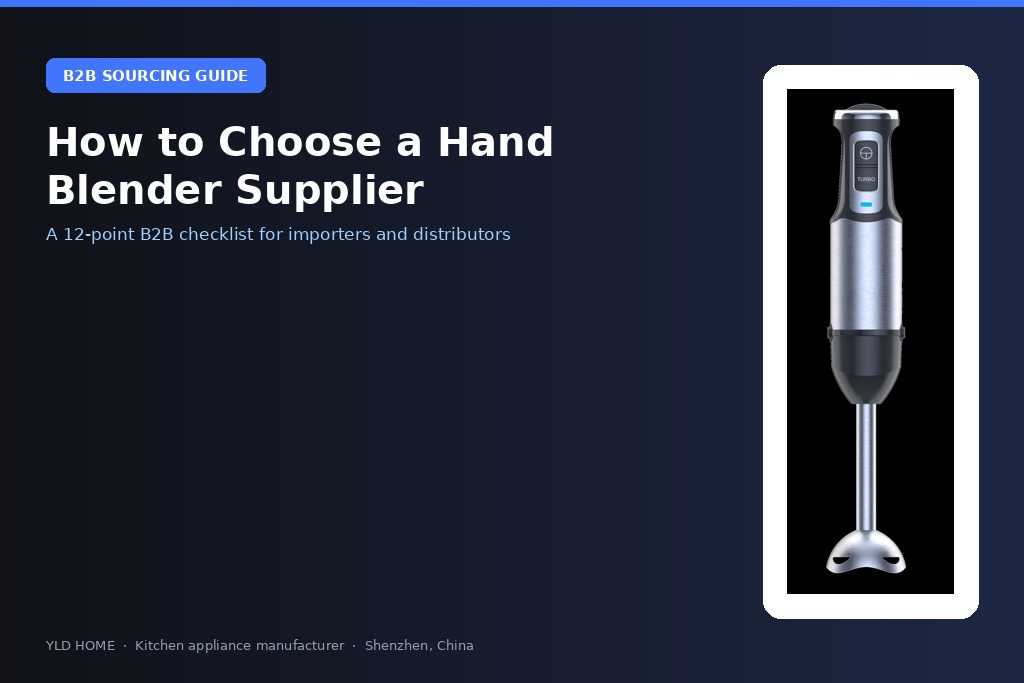
How to Choose a Hand Blender Supplier
For an importer or distributor, the electric hand blender on your shelf is never just a product. It is a bet on a factory you may never visit in person, a production line you will not supervise, and a certification file you must defend at customs. Sourcing is not a purchase; it is an operating decision that shapes your margins for years. Choosing the wrong hand blender supplier means delayed shipments, rejected containers, warranty claims in three languages, and a retail partner who refuses to reorder. Choosing the right one builds a private-label line you can scale across seasons and continents.
This guide is written for buyers in the European Union, South Africa, North America, and South America who source hand blenders, stick blenders, and immersion blenders at wholesale volume. It gives you a practical, field-tested checklist that separates a genuine manufacturer from a trading desk that simply forwards your order to the lowest bidder.
Why Supplier Selection Decides Your Margin
Most importers assume the factory price is the main cost driver. In reality, the total landed cost of a hand blender is shaped far more by the manufacturer’s process discipline than by a few cents on the unit price. A partner that ships late, mixes a bad batch of motors, or provides an incomplete certificate package will cost you more in air freight, penalties, and returns than a competitor charging 4% more per unit.
Three hidden costs decide whether your program is profitable:
- Rework and rejects. A motor that fails at 200 hours instead of 1,000 triggers a recall, not a repair. Incoming component control determines this.
- Customs and compliance cost. Missing CE, ETL, INMETRO, or SABS documentation stops a container at the port. Storage, inspection, and re-testing are paid by the importer, not the factory.
- Time-to-market. Realistic lead times protect your seasonal launch. Overpromising drains your working capital.
A disciplined manufacturer removes these costs before they appear. That is the entire purpose of the checklist below.
Market-by-Market Requirements You Cannot Ignore
Voltage and certification requirements differ by region, and an experienced hand blender supplier will already know them. If you have to explain the basics, that is a warning sign. The table below summarizes what each major market expects before a container clears customs.
| Market | Voltage / Frequency | Core Certification | Buyer Notes |
|---|---|---|---|
| União Europeia | 220–240V, 50Hz | CE, RoHS, Declaration of Conformity | LFGB or EU 10/2011 for food-contact parts |
| Reino Unido | 230V, 50Hz | UKCA | Dual EU/UK labeling across shared SKUs |
| África do Sul | 230V, 50Hz | SABS approval or Letter of Authority | Required by retailers and wholesalers |
| América do Norte | 110–127V, 60Hz | UL or ETL listing, FCC | Add cUL or CSA for Canada |
| América do Sul | 127V or 220V | INMETRO (Brazil), NOM (Mexico) | Portuguese and Spanish labeling |
União Europeia
The EU market demands 220–240V, 50Hz appliances with CE marking and a compliant Declaration of Conformity. Hand blenders must satisfy the Low Voltage Directive, the EMC Directive, and RoHS restrictions. Buyers increasingly request LFGB or EU 10/2011 food-contact documentation for parts that touch food, plus the WEEE and packaging compliance that underpin retailer onboarding. German discounters and French hypermarkets will not list a SKU without a complete technical file.
Reino Unido
Post-Brexit, the UK requires UKCA marking and 230V, 50Hz compatibility. Many importers now order a single range that satisfies both EU and UK requirements, which pressures the manufacturer to maintain dual documentation and dual labeling.
África do Sul
South Africa uses 230V, 50Hz and requires SABS approval or a Letter of Authority for electrical appliances. Retailers and wholesalers will not accept stock without it. A supplier experienced with the South African market will have tested product variants and can supply the supporting test reports, plus 15-amp plug configurations where required.
América do Norte
North America runs on 110–127V, 60Hz. Hand blenders sold in the US typically need UL or ETL listing, plus FCC compliance for any electronic components. Canadian buyers may also ask for cUL or CSA equivalents. Because the motor, cord set, and plug all change between 220V and 110V builds, a manufacturer must genuinely produce both variants rather than relabel one for the other.
América do Sul
South America is fragmented. Brazil enforces INMETRO certification and 127V or 220V depending on region. Mexico relies on NOM. Argentina, Chile, and Colombia each add their own import documentation. Portuguese and Spanish packaging is often mandatory. A supplier that ships into South America regularly understands the labeling and language requirements that trip up first-time exporters.
The B2B Buyer’s Checklist: 12 Points That Matter
Use this checklist as a scorecard. A qualified hand blender supplier should pass at least ten of the twelve points without hesitation. Any supplier that fails three or more should be removed from your shortlist before you invest in samples.
1. Verifiable Factory, Not a Trading Company
Confirm the partner is a manufacturer. Ask for a business license, factory floor-area figures, production-line photos with visible timestamps, and an audit report. A real factory will welcome a video walkthrough or a third-party inspection. A trading company will deflect and change the subject to price.
2. Motor and Component Transparency
Ask exactly which motor is used, its rated power, its duty cycle, and its expected service life. The best suppliers quote a specific DC motor brand, gearbox specification, and overload protection. Vague answers about a “high quality copper motor” hide cheap aluminum windings that overheat and fail in the field.
3. Certifications and Test Reports
Request certificates by market: CE and RoHS for the EU, UKCA for the UK, SABS or a Letter of Authority for South Africa, UL or ETL plus FCC for North America, and INMETRO or NOM for South America. Ask for test reports, not just logos. A capable supplier keeps current reports on file and shares them under NDA.
4. Power and Speed Specifications
Confirm wattage options, number of speed settings, and whether a turbo or boost function is available. Match the specification to your market positioning. Entry-level retail channels may want 200W units; premium kitchen brands may want 800W or 1,000W with variable speed and a stainless-steel shaft. A flexible manufacturer offers multiple power tiers on shared tooling, which keeps your range coherent while serving different price points.
5. Quality Control Process
Ask how the factory controls incoming materials, in-process assembly, and final inspection. Look for 100% functional testing before packing and a documented AQL sampling plan. Request the defect-rate history for your target model. Anything above a 1–2% return rate deserves scrutiny and an improvement plan.
6. MOQ and Pricing Tiers
Understand the minimum order quantity and how price steps down at volume. A genuine MOQ of 500–1,000 units for standard models is reasonable for a mid-size importer. Be cautious of suppliers promising a 100-unit MOQ on custom tooling; the economics rarely work and quality usually suffers.
7. OEM and ODM Capability
If you want private label, confirm the supplier can handle your logo, color, packaging, and manual. OEM means building to your specification; ODM means adapting an existing design. A strong partner offers both, plus tooling for custom housings and attachments such as whisks, chopping bowls, and frothers.
8. Packaging and Private Label
Packaging is part of the product. Ask for retail-ready options: color box, gift box, blister, or master carton. Confirm barcodes, multilingual manuals, and market-specific labeling. A factory that controls its own printing and packing reduces lead time and protects your brand presentation on the shelf.
9. Lead Times and Production Capacity
Get a written lead time for samples, first production, and repeat orders. Distinguish between sample lead time, which is often fast, and bulk-production lead time, which is what affects your launch. A reliable partner will state monthly capacity so you can plan reorders before stockouts, especially ahead of retail peak seasons.
10. Payment Terms and Incoterms
Clarify whether pricing is EXW, FOB, CIF, or DDP. FOB is common for importers who control freight; DDP suits buyers who want a landed price without logistics work. Payment terms matter as much as price: a 30% deposit with the balance against a bill of lading is standard, and a strong supplier will support letters of credit for larger orders.
11. After-Sales Support and Spare Parts
Ask what happens when a unit fails. A serious partner provides spare motors, shafts, seals, and blades, plus technical support for your service network. Warranty terms, replacement-parts pricing, and response times should be documented in the contract, not promised verbally across a chat window.
12. Communication and Responsiveness
Throughout the sourcing process, watch response quality. A supplier that answers questions in detail, flags risks early, and proposes solutions is a partner. One that only confirms and price-drops is a liability. Communication during sampling predicts communication during a crisis, when you need clarity most.
Sample Testing: The Step Most Importers Skip
Before you commit to a container, test the sample against the conditions your customers will create. Run a hand blender through five to ten minutes of continuous blending, then let it cool and repeat. Check for motor heat, vibration, noise level, and shaft wobble. Blend fibrous vegetables, frozen fruit, and thick soups. Overload a batch deliberately and confirm that the thermal cut-out engages before the motor burns.
Document every test and share the results with the supplier. A manufacturer that welcomes feedback and adjusts the sample is telling you how it handles production problems. One that disputes every observation will be difficult when a real defect appears six months into a program.
Red Flags That Disqualify a Hand Blender Supplier
Walk away from any partner that:
– Refuses a third-party inspection or a live video factory tour
– Cannot provide test reports for the certifications it claims
– Quotes a price far below the market without explaining the difference
– Changes the quoted specification after you place a deposit
– Has no spare-parts program or refuses to define warranty terms
– Communicates only through vague, templated replies
– Pushes you to bypass a purchase contract
None of these are cosmetic issues. Each one correlates with a failure that lands on your balance sheet, and each one is far cheaper to avoid before the order than to fix after the container has sailed.
How YLD Home Meets the Checklist
YLD Home is a kitchen appliance manufacturer serving importers and distributors across Europe, Africa, and the Americas, with hand blenders, stick blenders, and immersion blenders at the core of its range. Here is how the company maps against the checklist above.
- Factory transparency. YLD Home operates its own production lines and supports video tours and third-party inspections, so buyers can verify capacity before committing to volume.
- Component clarity. YLD Home specifies motor brand, rated power, duty cycle, and gearbox detail up front, so importers know precisely what they are buying.
- Multi-market certification. YLD Home prepares CE, UKCA, RoHS, ETL/UL, SABS, and INMETRO documentation for the markets its clients sell into, shortening customs clearance.
- OEM and ODM. From logo printing to custom housings and attachment sets, YLD Home handles private-label programs for both established brands and new entrants.
- QC discipline. YLD Home applies incoming inspection, in-process checks, and 100% functional testing before packing, with documented defect rates shared with clients.
- After-sales. YLD Home maintains a spare-parts program covering motors, shafts, seals, and blades, and supports importers building local service networks.
For an importer who needs a hand blender supplier that understands voltage differences, certification obligations, and private-label timelines across four continents, YLD Home is a practical starting point. Requesting a sample and a certification pack from YLD Home is the fastest way to test whether the partnership fits your program.
Building a Long-Term Sourcing Relationship
The best supplier relationships are built on shared planning, not one-off orders. Once you qualify a manufacturer, treat the relationship as an operating partnership:
– Share your annual forecast so the factory can reserve capacity and raw materials.
– Agree on a rolling reorder cadence that keeps your stock ahead of demand.
– Review defect data quarterly and set improvement targets.
– Co-develop new models so your range stays ahead of competitors.
– Keep two qualified suppliers for your top SKUs to reduce single-source risk.
A partner that participates in this level of planning is not just a vendor. It becomes part of your product development and your margin protection, and it will prioritize your orders when capacity tightens.
Total Cost of Ownership, Not Just Unit Price
Sophisticated importers evaluate a hand blender supplier on total cost of ownership. Build a simple model that includes the unit price, freight, duty, certification cost, expected return rate, spare-parts support, and lead-time risk. When you lay these figures side by side, the cheapest quote is rarely the cheapest supply chain. A supplier that is 5% more expensive per unit but cuts your return rate in half and arrives on schedule will win on the bottom line every quarter.
Negotiation Points That Protect Your Program
When you negotiate, secure more than a price. Pin down the specification in writing, including motor, power, speed settings, attachments, and packaging. Set delivery windows with defined penalties for late shipment. Agree on a sample-approval process so mass production matches what you signed off. Define warranty terms, spare-parts pricing, and defect remedies. Lock in certification support and market-specific labeling. These clauses turn a supplier from a risk into a controlled process.
Warranty, Defects, and Remedy Planning
Warranty is where a sourcing relationship is tested. Before you order, agree on a warranty period by market, because consumer-protection law differs sharply between the EU, North America, and South Africa. Define what counts as a defect, how claims are submitted, who pays return freight, and whether remedies are repair, replacement, or credit. Set a cap on the annual claim rate and a process for recovering costs when the rate is exceeded. A manufacturer confident in its quality control will accept a defect cap because it does not expect to breach it. One that refuses to discuss remedies is telling you it expects problems. Document every term in the purchase contract, and keep serial-number records so you can trace a failing batch back to its production window.
Common Mistakes Importers Make
– Choosing on price alone and ignoring process capability
– Skipping sample testing to save two weeks
– Accepting logos instead of certificates
– Forgetting that 220V and 110V builds are different products
– Ignoring after-sales and spare parts until a claim arrives
– Relying on a single hand blender supplier for every SKU
– Failing to document the agreed specification in the contract
Each of these mistakes is avoidable with the checklist above, and each one is expensive to correct after a container has shipped.
Perguntas frequentes
What is the minimum order quantity for a hand blender supplier?
Most manufacturers set MOQ between 500 and 1,000 units for standard models. Custom tooling and new housings usually require higher volumes because the tooling cost must be amortized. A factory with in-house tooling can often offer more flexibility than one that outsources molds.
How do I verify that a supplier is a real factory?
Request a business license, factory audit report, production-line photos, and a live video tour. Ask for the address and cross-check it against shipping documents from previous orders. A genuine manufacturer will provide these without resistance.
Which certifications should a hand blender supplier provide?
For the EU, ask for CE, RoHS, and a Declaration of Conformity. For the UK, add UKCA. For South Africa, request SABS or a Letter of Authority. For North America, require UL or ETL plus FCC. For South America, expect INMETRO or NOM depending on the country.
Can a manufacturer handle private label?
Yes, if the supplier offers OEM and ODM services. Confirm that it can manage your logo, colors, packaging design, and multilingual manuals. Ask for examples of completed private-label programs and lead times for tooling and print plates.
What lead time should I expect?
Samples often ship in one to two weeks. Bulk production typically takes 25 to 45 days depending on model, customization, and season. A reliable supplier will quote both sample and production lead times separately and flag capacity constraints in advance.
How much should I pay up front?
A 30% deposit with the balance against a copy of the bill of lading is standard. For larger programs, negotiate a letter of credit. Never pay a full deposit to a new supplier before a sample is approved and the specification is documented.
Why does voltage matter so much?
A 220–240V hand blender and a 110–127V hand blender use different motors, cord sets, and plugs. They are distinct products that must each be certified for their market. A competent hand blender supplier manufactures both variants and never relabels one as the other.
Considerações finais
Choosing a hand blender supplier is a structured decision, not an instinct. Verify the factory, audit the components, confirm the certifications, test the sample, and negotiate the terms. Do this for every market you serve, because Europe, South Africa, North America, and South America each impose their own requirements. When a supplier passes all twelve checklist points, you are not just buying blenders. You are securing a supply chain that protects your brand and your margin.
YLD Home supports importers and distributors with verifiable manufacturing, multi-market certification, private-label programs, and documented quality control. If you are building a hand blender range for 2026, request a sample and a full certification pack from YLD Home, and measure the response against this checklist before you place your first order. The supplier that answers every question clearly is the one worth your container.
Ready to source? Contact YLD Home for wholesale hand blender pricing, OEM and ODM programs, and certification documentation for your market. Send your target specification and volume, and we will return a quotation with sample lead time and production schedule.
Further reading: [hand blender range](https://yld-home.com/product-category/hand-blender/) · [hand mixer range](https://yld-home.com/product-category/hand-mixer/) · [factory tour](https://yld-home.com/factory-tour/) · [wholesale kitchen appliance FAQs](https://yld-home.com/faqs/) · [request a quotation](https://yld-home.com/quote/)