




OEM vs ODM vs Private Label Kitchen Appliances: Which Model Fits Your Business?
URL: /oem-vs-odm-vs-private-label-kitchen-appliances/ | Focus keyword: OEM kitchen appliances | Markets: EU, South Africa, North America, South America | Audience: importers, distributors, brand owners | CTA: Get Wholesale & OEM Quote
If you import small appliances, you have faced the same fork in the road: buy stock, put your name on someone else’s design, or build something new from the ground up. Each route has a different cost, a different timeline, and a different level of control. This guide breaks down OEM vs ODM vs private label kitchen appliances in plain procurement terms — what each model actually means, who it suits, and how to pick the one that fits your channel.
By the end you’ll have a decision framework you can take to a factory meeting tomorrow. We’ve walked this path with importers in Germany, South Africa, the USA and Brazil, so the examples below come from real conversations, not theory.

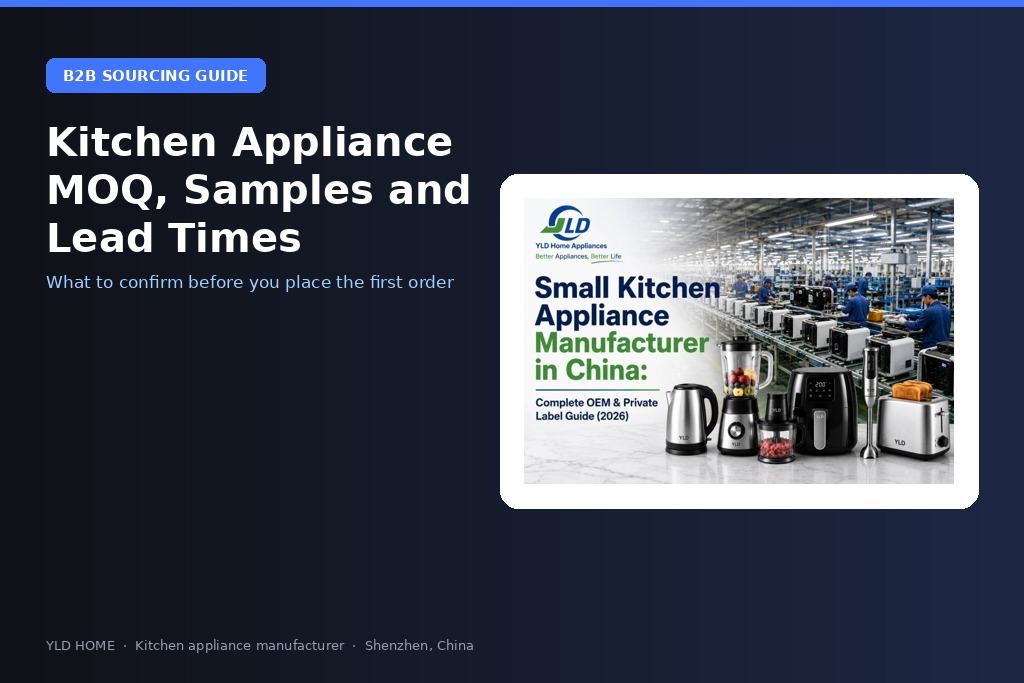
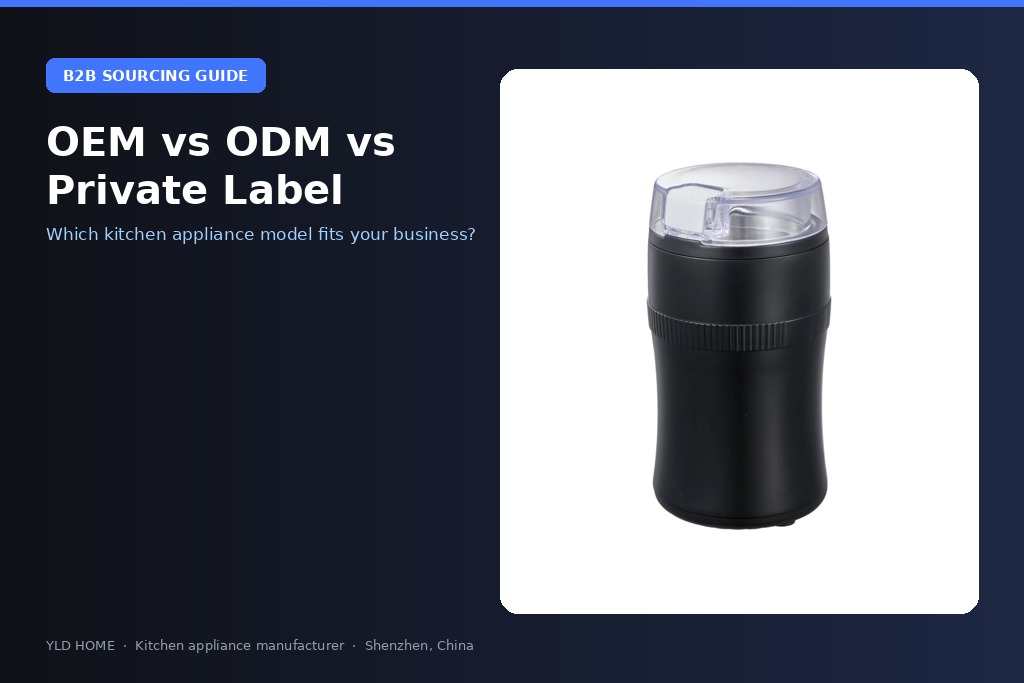
*Image alt: OEM kitchen appliances model comparison for importers and distributors*
| Modèle | Who designs it | Typical MOQ | Tooling cost | Time to first shipment |
|---|---|---|---|---|
| ODM (stock design) | Accueil du YLD | 100-500 units | None | 25-35 days |
| Private label | YLD Home design, your brand | 500-1,000 units | None | 30-40 days |
| OEM (custom design) | You and YLD Home together | 2,000-3,000 units | One-off tooling fee | 45-70 days |
What Does OEM Mean in Kitchen Appliances?
OEM stands for Original Equipment Manufacturer. In the appliance trade, buying OEM kitchen appliances means you take an existing, proven product design and put your own brand on it. You control the label, the packaging, the colour if the factory allows it, and your own carton artwork. You do not pay for new tooling or design work.
Think of it as rebranding done right. A blender, air fryer or electric kettle that has already passed certification and shipped in volume becomes your SKU with your logo. Because the engineering is settled, the risk is low and the timeline is short.
For a distributor entering a new category, OEM kitchen appliances are usually the fastest route to a sellable range. You validate demand with real buyers before you spend a cent on custom development.
What Does ODM Mean?
ODM stands for Original Design Manufacturer. Here the factory designs and engineers the product, and you buy that design — either as-is or with tweaks. You might ask for a bigger motor, a different control panel, a new colour range, or a modified basket size.
The difference from OEM is who owns the design work. With ODM, the factory’s R&D team does the heavy lifting. You get a differentiated product without running your own design department. The trade-off: the design may also be sold to other buyers unless you negotiate exclusivity.
ODM suits brand owners who want a product that looks and feels distinct from the commodity imports filling marketplace listings today.
What Does Private Label Mean?
Private label is the lightest-touch model. You pick an existing product, apply your branding, and ship. There’s often no design change at all — just your logo, your packaging and your barcode.
Private label is not “cheap OEM”. It’s a deliberate choice to compete on brand, channel and price rather than product differentiation. Retail chains use it heavily because the product is proven and the margin math is predictable.
If your goal is speed and your budget is tight, private label gets you to market in weeks.
OEM vs ODM vs Private Label: Side-by-Side
Here’s the comparison buyers ask us for most often:
| Factor | OEM | ODM | Private Label |
|---|---|---|---|
| Who designs the product | Factory (existing design) | Factory (custom design) | Factory (existing) |
| Your input | Logo, packaging, colour | Design brief + specs | Branding only |
| Tooling cost | None | Sometimes shared | None |
| Typical MOQ | Moyen | Plus élevé | Le plus bas |
| Lead time | Court | Long (design + tooling) | Shortest |
| Product exclusivity | Faible | Negotiable | Faible |
| Meilleur pour | Fast range launch | Differentiation | Speed + margin |
Read the table one way and it’s simple: the more control you want, the more time, money and volume you commit. There is no model that gives you maximum exclusivity at minimum order quantity. Anyone who promises that is not being straight with you.
Which Model Fits Your Business?
The right model depends on three things: your channel, your volume, and whether you need a product that’s genuinely different.
If you sell through general retail or marketplaces and your edge is price and availability, private label or OEM kitchen appliances usually win. You move fast, test demand, and keep cash free.
If you’re building a brand with its own identity — think a design-led line for European kitchens or a premium range for North American specialty retail — ODM earns its cost. A unique housing, a better motor, or a smarter control layout gives buyers a reason to choose you over the next importer’s identical unit.
If you’re a large distributor covering multiple markets, a mixed strategy works best. Use private label for volume SKUs and ODM for two or three hero products that anchor your catalogue.
The Real Cost of Each Model
Let’s talk numbers, because this is where buyers get surprised.
Private label carries the lowest upfront cost. You pay per unit, and the factory’s existing certification covers the base model. Your spend is essentially stock plus packaging.
OEM kitchen appliances add a one-time cost for your logo tooling, plates and carton artwork. It’s small next to development but real — mould stamping and print runs for custom boxes aren’t free.
ODM is the biggest commitment. Design, engineering, tooling and fresh certification can run into serious money and several months before a single sellable unit exists. The payoff is a product nobody else imports.
The mistake we see most: buyers chase ODM when their channel can’t support the volume needed to amortise tooling. Start with OEM, prove the SKU sells, then graduate to ODM on the winners.
Certifications by Market
Whichever model you choose, certification follows the destination, not the design. Request current certificates from the factory — never accept a logo image as proof.
| Marché | Typical requirements |
|---|---|
| L'UE | CE (LVD + EMC), RoHS, WEEE registration |
| ROYAUME-UNI | UKCA (or CE during transition), UK plug |
| USA / Canada | ETL or UL, FCC for electronics, cUL where required |
| Afrique du Sud | SABS / SANS compliance, NRCS letter of authority |
| Brésil | INMETRO certification |
| Rest of Latin America | 110–127V versions, local mark requirements |
One detail that trips up first-time importers: voltage and plug type must match the market, and they must be locked before tooling for ODM. Changing them later means new certification.
How to Choose a Kitchen Appliance Factory
The model matters less than the partner. A weak factory will make any model painful; a strong one makes the process smooth.
- Years in the trade. Ask for export history, not just a founding date.
- In-house R&D and mould capability. Factories with their own motor and mould teams customise faster.
- Certification portfolio. Current CE, ETL and FCC documents, verifiable with the issuing body.
- QC structure. IQC, IPQC and FQC in place, with inspection records you can see.
- Sample speed. A real factory ships samples quickly. At YLD Home, sample production typically runs about 7 days.
- Spare parts and after-sales. A product with available spares keeps your retail customers returning.
- Honest MOQ. A factory that quotes an unrealistic MOQ is telling you something about how organised it is.
YLD Home is a Shenzhen-based small kitchen appliance manufacturer that runs all three models — private label, OEM and ODM — under one roof, with sample testing and prototyping before mass production.
Engineering, Tooling and Lead Times
Timelines differ sharply by model, and it helps to know what’s actually happening behind the quote.
For private label, the product already exists. Production slots depend on the factory’s line schedule and your order size.
OEM kitchen appliances add artwork approval, print plates and logo tooling. Expect a short ramp before the first production run.
ODM is a project, not an order. Design review, prototyping, tooling fabrication, trial production, certification and mass production each take time. Build a realistic calendar and add buffer — tooling delays are common across the industry, not a sign of a bad factory.
For any model, sea freight from China to Europe, Africa or the Americas typically runs several weeks, and customs processing adds variable time. Plan reorders around that, not around the factory’s shipping date alone.
MOQ, Pricing and Payment Terms
MOQ is where model choice hits the bottom line. Private label often carries the lowest minimum because the factory amortises setup across many clients. OEM sits in the middle. ODM carries the highest, because tooling costs must be recovered.
Pricing is volume-driven. Ask for tiered quotes so you can see where the price breaks fall, and combine volume across markets if you operate in several. Total volume is where your negotiating power comes from, not per-market volume.
On payment, first orders commonly use a 30% deposit with 70% balance before shipment, or an irrevocable letter of credit for larger contracts. Agree the quote currency and its validity period early, especially if you buy across regions with different currency exposure. Confirm Incoterms per destination, because freight and insurance responsibility shifts a lot between FOB, CIF and DDP.
Treat every figure here as a placeholder to confirm with your chosen partner. MOQ and lead times vary by product and season, so lock the actual numbers in writing before you commit.
OEM vs ODM: Where the Line Blurs
In practice the labels overlap, and that’s fine. A factory might call a job “OEM with light ODM” when you start from an existing platform but change the housing colour, the handle and the packaging. The category name matters far less than the scope you agree in writing.
What actually separates the two is where the cost and risk sit. If the factory absorbs design and tooling and sells you a finished concept, that’s ODM. If you bring the specification and the factory builds to it — or you simply take a proven model and brand it — that’s closer to OEM or private label.

*Image alt: OEM kitchen appliances assembly line at a small kitchen appliance factory*
Watch for one specific trap: some suppliers market a slightly recoloured existing product as “ODM” to justify a higher price. Ask directly whether the moulds are new or borrowed. New moulds cost real money and take real time; borrowed ones don’t. That single question tells you whether you’re paying for genuine development or a marketing label.
A second trap is exclusivity language. “ODM” does not automatically mean the design is yours alone. If you need protection, get it in the contract — defined as a minimum quantity per year, a market territory, and a clear remedy if the factory sells the same design elsewhere.
Questions to Ask a Factory Before You Commit
Bring this list to every first meeting. The answers tell you more about a partner than any brochure.
On capability: How many moulds do you own, and how many are in production this quarter? Do you have an in-house motor team, or do you buy motors in? What’s your monthly capacity on the product I want?
On quality: What’s your QC flow — do you run IQC, IPQC and FQC? What’s your defect rate on the product in question? Can I see inspection records from a recent order?
On compliance: Which current certificates do you hold for my target market, and can I verify them with the issuing body? Who pays if a redesign triggers new testing?
On commercial terms: What’s the real MOQ, and does it drop after the first order? What lead time should I plan for, including tooling if we go ODM? What are your payment terms?
On support: What spare parts do you hold for this model? Who handles after-sales if my customer reports a fault? Can I visit the factory or send a third-party inspector?
A factory that answers these clearly, without dodging, is usually the one worth your first trial order. Vague answers are a warning sign, not a detail to sort out later.
Common Mistakes Importers Make
Three mistakes show up again and again.
The first is choosing the model before defining the product. Decide what your market needs, then pick the model that delivers it — not the other way round.
The second is underestimating certification in ODM. A new design means new testing, and that testing can delay your launch by months. Budget for it.
The third is chasing the lowest unit price. A factory that undercuts everyone is often cutting corners on components, QC or after-sales. In small appliances, a cheap motor or a poor seal costs you returns that wipe out the margin you thought you saved.
The fix for all three is the same: sample before you commit, ask for references, and talk to the people who actually run production.
Regional Buying Behaviour
Where you sell shapes which model pays off.
In the EU, energy labelling, safety rules and consumer expectations push buyers toward certified, well-specified products. ODM differentiation works well in design-led European retail.
In South Africa, formal retail and wholesale distribution dominate, and English documentation is standard. OEM kitchen appliances with SABS-compliant specs suit the volume end of the market.
In North America, marketplace competition is fierce and private label thrives. A proven model with your brand and strong listing content moves quickly.
In Brazil and Spanish-speaking Latin America, local certification and language are non-negotiable. INMETRO for Brazil, Spanish or Portuguese packaging elsewhere. A distributor who localises wins the shelf.
A mixed catalogue usually fits best across regions: private label for volume, OEM for branded lines, ODM for the hero products that define your range.
From Sample to Container: A Practical Workflow
Here’s the sequence that works, whatever model you choose.
Start with a sample request on one or two candidates. Test them the way your customers will. Then confirm specifications, voltage and plug for your market. Request current certificates and verify them.
Agree pricing tiers, MOQ and lead time in writing. Place a trial order to validate quality and logistics before scaling. Inspect production, ideally through a third party for larger volumes. Then confirm packaging, carton markings and barcodes. Finally, plan reorders with freight lead time in mind, and keep safety stock on your best sellers.
Move to OEM or ODM only once a SKU has earned it. Data beats enthusiasm every time.
FAQ: OEM, ODM and Private Label Kitchen Appliances
What’s the simplest difference between OEM, ODM and private label kitchen appliances?
Private label applies your branding to an existing product. OEM kitchen appliances put your brand on an existing design you’ve chosen, with light customisation like packaging and colour. ODM means the factory designs the product to your brief.
Which model is cheapest to start with?
Private label, then OEM. ODM carries the highest upfront cost because of design and tooling. Cheapest to start isn’t always cheapest long-term — it depends on how much differentiation your market needs.
Can I get exclusivity on an ODM design?
Usually yes, if you negotiate it and commit to volume. Ask for a written exclusivity clause tied to a minimum annual quantity so both sides have clarity.
How long does OEM kitchen appliances production take?
After artwork approval, the first run is typically short. Add sea freight and customs on top. Confirm exact lead time with your factory, because it varies by product and season.
Do all three models need new certification?
No. Private label and OEM usually ride the factory’s existing certificates, as long as voltage, plug and spec stay the same. ODM with a new design almost always needs fresh testing.
What MOQ should I expect?
Lower for private label, medium for OEM, higher for ODM. Exact numbers vary by product — treat any figure as [confirm actual MOQ] with your partner.
Can YLD Home handle all three models?
Yes. YLD Home offers private label, OEM and ODM for small kitchen appliances, with sample testing and prototype design before mass production, so you can start with the lightest model and scale up.
What if I only need a small trial order first?
Start with a sample, then a trial order. YLD Home can ship samples quickly — typically around 7 days — so you can validate before committing to volume.
Choosing With Confidence
The three models aren’t rivals. They’re steps on the same staircase. Most successful importers begin with private label or OEM kitchen appliances to validate demand, then invest in ODM once a product proves itself in their channel.
Match the model to your channel, your volume and your appetite for risk. Ask for samples. Verify certificates. Get the numbers in writing. And treat any factory that promises everything at the lowest price with healthy suspicion.
If you’re sourcing small kitchen appliances for Europe, South Africa, North America or South America, YLD Home can quote on all three models and help you pick the one that fits. Request wholesale and OEM pricing, and start with a sample on your target product.
*Official references: [Wikipedia — Original equipment manufacturer](https://en.wikipedia.org/wiki/Original_equipment_manufacturer), [Wikipedia — Private label](https://en.wikipedia.org/wiki/Private_label)*
Further reading: [hand blender range](https://yld-home.com/product-category/hand-blender/) · [hand mixer range](https://yld-home.com/product-category/hand-mixer/) · [factory tour](https://yld-home.com/factory-tour/) · [wholesale kitchen appliance FAQs](https://yld-home.com/faqs/) · [request a quotation](https://yld-home.com/quote/)
Questions fréquemment posées
What is the difference between OEM, ODM and private label kitchen appliances?
ODM means you buy a design that already exists, so YLD Home has the tooling ready and the minimum order stays low. Private label keeps that design but puts your brand, packaging and manual on it. OEM means the product is built to your own specification, so tooling, testing and certification are set up around your design. Most importers start with ODM, move to private label once a model sells, and only invest in OEM when volumes justify it.
Which model suits a first-time importer?
ODM is the sensible starting point. YLD Home keeps stock tooling on hand, samples arrive in about a week, and the minimum order is low enough to test a market without tying up capital. Once one model sells through, private label is the natural next step because it needs no new tooling.
Can YLD Home produce under my own brand?
Yes. YLD Home runs private label programmes with your logo, colour, rating label, gift box and manual. Certification is re-issued in your brand name where the market requires it, so the paperwork matches the product on the shelf.
What is the MOQ for OEM kitchen appliances?
OEM projects usually start at 2,000 to 3,000 units because a new mould has to be amortised. YLD Home quotes the tooling separately so you can see the one-off cost against the unit price, and the tooling fee is often credited when the volume reaches an agreed level.
Who owns the tooling on an OEM project?
The mould is paid for by the buyer and stays with YLD Home in production, which is standard practice. Ownership terms are written into the contract, and you can request a tooling condition report before each production run.
How long does an OEM project take from brief to shipment?
Plan on 45 to 70 days for a first OEM run. YLD Home schedules design review, tooling, trial samples and certification testing before the production window opens, and gives a milestone schedule so you can plan the launch with the retail calendar.